

It didn’t come back through a museum.
No preservation campaign, no government grant, no academic rediscovery. The gat returned the way most things return — through a story. This is the Korean gat modern revival nobody planned.
The Hat That Came Back
Some things disappear quietly. Others come back the same way. The gat did neither. It came back through the dead.
When Netflix’s Kingdom streamed globally in 2019, audiences encountered something they had no category for. The genre was familiar enough. But above the actors’ heads, wide black brims cast shadows across half-hidden faces, turning every scene into something that felt simultaneously ancient and entirely new. Viewers paused. They searched. Forums filled with questions: what is that hat? Where does it come from? Why does it look like that?
For many, it was their first encounter with the gat. And it arrived not in a history textbook but in the middle of a horror story — which, as entry points go, is about as far from a museum as you can get.
The Screen That Did What Museums Couldn’t
Someone in Berlin pauses the episode at 2 AM. Rewinds. Types into a search bar: what is that hat. Gets no clean answer. Keeps watching.
Period dramas had always kept the gat alive in Korea. Each one paraded scholars, kings, and warriors beneath the brim. Korean audiences had grown up with these images. The gat was familiar to them, if no longer daily.
What the zombie drama did was different. It sent the gat to an audience that had no prior relationship with it. No childhood memories of history lessons, no grandparents who remembered the real thing. Just the image, arriving clean, unencumbered by nostalgia or explanation.
And the image held.
There is something in the gat’s silhouette that communicates without translation. The wide brim creating distance, the translucent crown catching light, the shadow falling precisely across the upper face — these are not culturally specific effects. They read as authority, as mystery, as the visual weight of someone who belongs to a world governed by rules you don’t yet understand. The production understood this intuitively. The gat was not costume. It was atmosphere.
Other dramas followed, each finding new angles. In one, the grim reaper appeared not in a traditional gat but in a black fedora — a modern echo of the same silhouette. The outline of the gat, translated into contemporary fashion, still readable to anyone who had absorbed the original. The brim had become a cultural shorthand. Audiences who had never set foot in Korea were developing an instinct for it — the way certain visual languages, once encountered, begin to organize everything around them.
Korean Gat Modern Revival: Neon and Horsehair
Then came the stages.
Korean performers had been experimenting with traditional aesthetics for years — incorporating hanbok silhouettes, hanji textures, folk music structures into choreography and visual identity. The gat arrived in this context not as novelty but as inevitability. Of all the objects in the traditional wardrobe, none had the gat’s combination of graphic clarity and historical weight. The silhouette was immediately readable from the back of an arena.
When a K-pop performer took the gat onto the stage as part of their visual identity, the hat that had spent decades as a symbol of stubborn irrelevance was suddenly spinning under spotlights, its translucent brim catching strobes, its silhouette projected on screens behind dancers moving in formations that would have been unimaginable to any Joseon scholar-official.
The contrast was the point.
A gat worn on a K-pop stage does not pretend to be Joseon. It takes the most recognizable visual element of a five-century tradition and places it inside the most globally accessible format of the present — and lets the collision speak. What once encoded hierarchy and Confucian discipline now encodes something else: the confidence of a culture fluent enough in its own past to play with it.
Fans who had never heard of the Joseon dynasty bought replica gats at concerts. They photographed themselves wearing them, posted the images, looked at their own reflections — and then, sometimes, got curious. Searched. Read. Found their way to the history the hat carried.
The joke had become the door.
The Hat You Can Still Wear
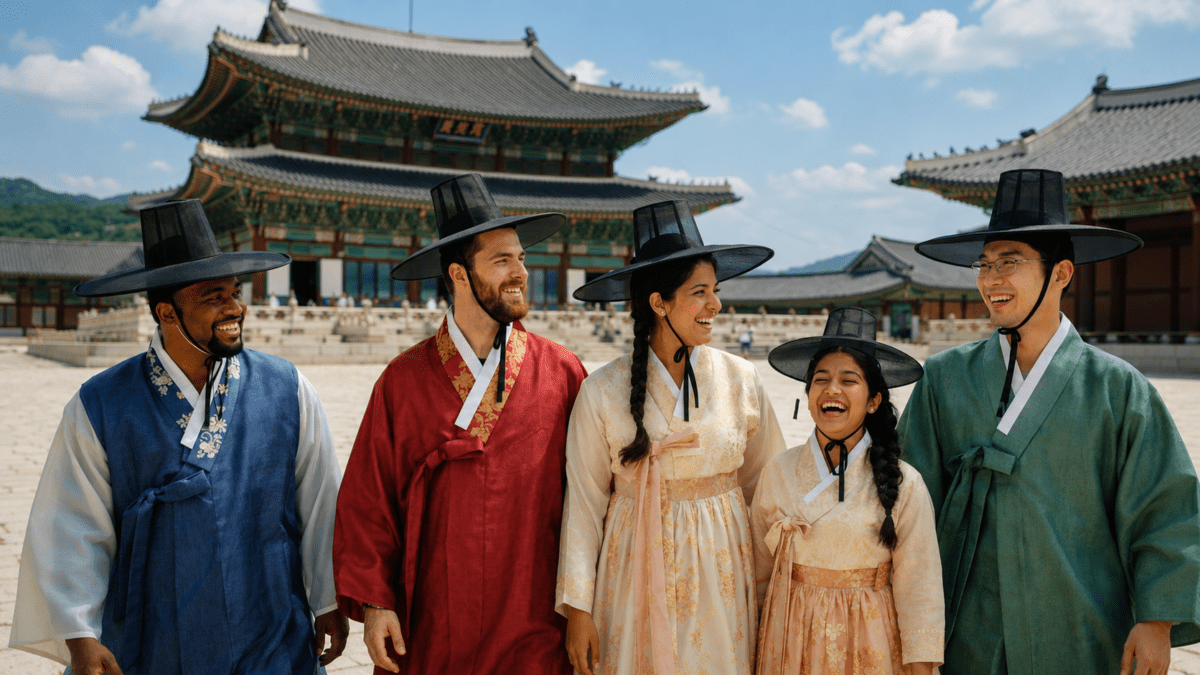
There is a place in Seoul where the gat is not a stage prop or a screen image.
Gyeongbokgung Palace offers free admission to visitors who arrive in hanbok (한복: han-bok, traditional Korean garment). Rental shops line the streets outside the gates, and the costume options include the full ensemble: jeogori (저고리: jeo-go-ri, upper garment), baji (바지: ba-ji, trousers), and for those who want it, the gat. Men and women both. No special occasion required. No cultural credentials demanded. Just the decision to put it on and walk through the gates.
On any given day, the palace grounds fill with people in hanbok moving between stone courtyards and wooden pavilions. Some are Korean, revisiting something they grew up seeing in dramas. Many are not — visitors from Japan, the United States, Europe, Southeast Asia, all wearing the same silhouette that once organized an entire social order. A French couple adjusts each other’s gat strings near the main gate. A group of friends from Tokyo photographs their reflections in a palace pond, the wide brims tilting toward each other. Someone from São Paulo stands very still in the middle of a courtyard, looking up at the roofline, one hand raised to steady the brim against the wind.
None of them know the Confucian geometry. None of them know what the height of the crown once signified, or what the material of the strings revealed about a man’s standing. They know only the weight of the brim, the shadow it casts, the particular feeling of carrying something above your head that changes how you hold yourself.
That feeling is not nothing. It is, in fact, the beginning of the question.
What Survives the Gap

The gatjjang workshops are mostly gone. The living transmission — master to apprentice, hand to hand, ten thousand repetitions before the first solo attempt — was broken in the early twentieth century and has not fully recovered. What exists now are a handful of craftsmen working to reconstruct from the outside in what was once passed from the inside out.
This is not the same thing. Everyone involved knows it is not the same thing.
But the image survived. And images carry more than decoration — they carry the outline of a logic, waiting for someone to ask what it means. Every time a viewer paused to look more carefully at the hat above an actor’s head, every time a fan held a replica and felt the unexpected weight of the brim, the outline was doing its work. Not transmitting the full knowledge — that is gone, or nearly — but holding the shape of it, keeping the question open.
There are things that survive a gap by becoming something slightly different on the other side. The gat that exists in global imagination today is not the gat of Joseon. It has been filtered through drama and concert stages and palace courtyards and the hands of people who never tied a topknot in their lives. Something has been lost in that filtering. Something has also, unexpectedly, been found — the same pattern surfacing in a different season, the way certain rhythms reassert themselves even after long interruption.
A symbol dismissed as dead weight for half a century is now the most recognizable silhouette in Korean visual culture worldwide. That arc does not resolve neatly into triumph or loss. It simply is — the shape of how things persist.
The wide brim. The translucent crown. The shadow falling across the upper face.
A performer steps onto a stage. A traveler pauses in a palace courtyard, one hand raised to the brim. Somewhere in the world, someone recognizes something they cannot name.
Some content in this post was created with AI assistance.