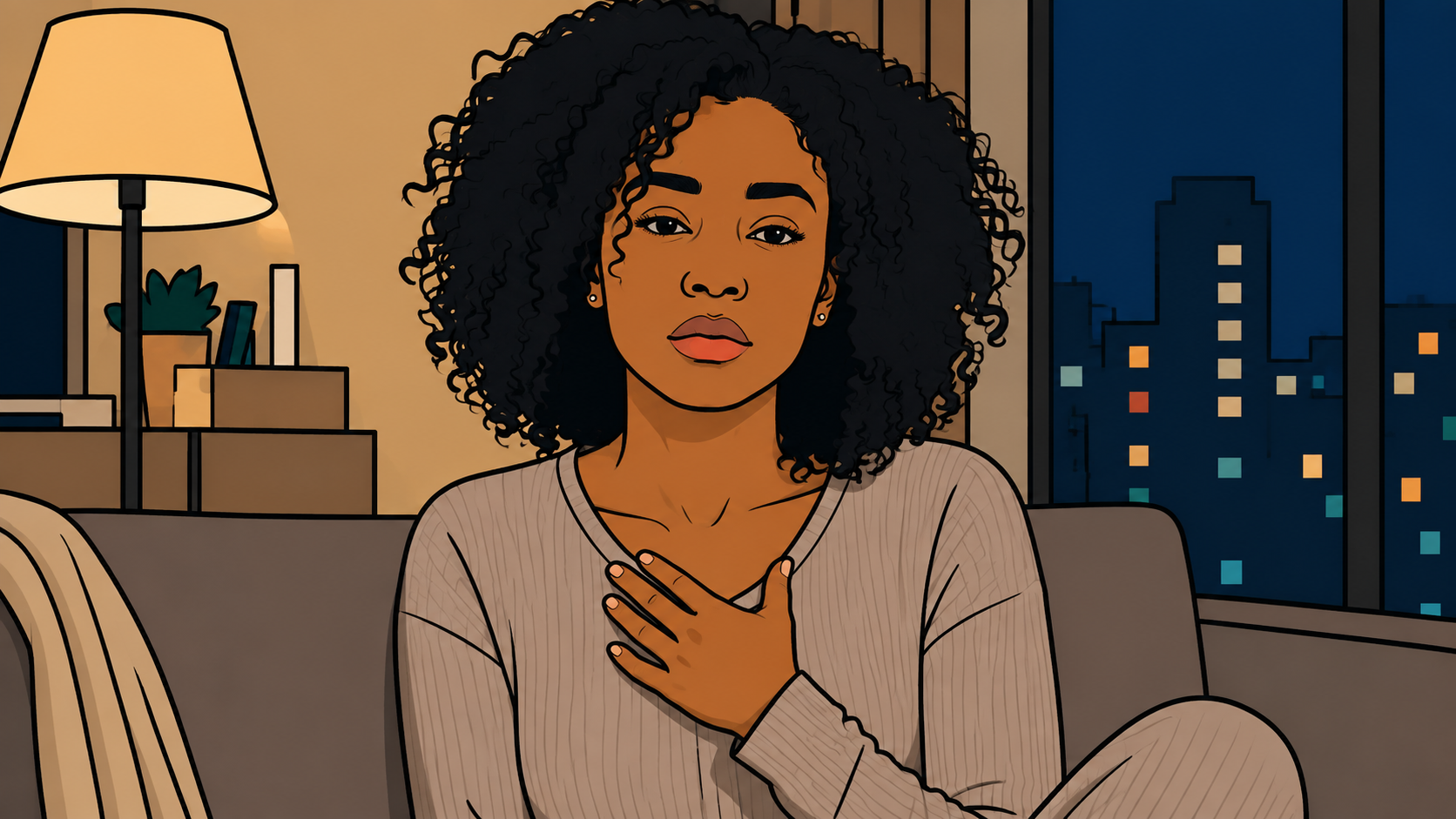

Why does rejection hurt so much that a three-word text can flatten an entire evening? Not sting. Not sadden. Hurt — in a way that feels like it’s happening in your chest, not your head.
It’s the feeling of a message that sits unanswered, a storm that moves through you before anything is confirmed. Underneath that storm is a question the body keeps trying to answer. Because the size of the pain never quite matches the size of the event, and there’s a reason for that gap. It isn’t drama. It’s older than you.
The Pain That Feels Physical

Notice where you feel it. A rejection doesn’t stay in the mind as a thought you can reason with. It drops into the stomach. It tightens the throat. It flushes the face. People describe being left on read the same way they describe getting the wind knocked out of them — as something that landed in the body.
Think of the last time it happened to you. A name you were waiting on went quiet. Maybe your hands went a little cold. Maybe you read the last message again, then again, hunting the words for a tone that wasn’t there. Maybe you couldn’t finish the meal in front of you. None of that is thinking. That’s the body responding to a threat it has already decided is real, before a single fact has come in.
That’s not a figure of speech. When researchers put people through social rejection and watched what lit up in the brain, the regions that fired were the same ones that handle physical pain. The brain, it turns out, doesn’t keep a clean line between a stubbed toe and a cold shoulder. It runs them through overlapping wiring.
So when you say a rejection hurt, you’re being accurate, not poetic. The ache is real. Your nervous system filed it under the same category as injury.
There’s an odd kind of relief in knowing this. If the pain were just a mood, you’d be right to wonder why you couldn’t talk yourself out of it. But you can’t reason your way out of a sprained ankle either. The wiring that carries the ache doesn’t take arguments as input. That’s why “just don’t let it get to you” has never once worked — you were never dealing with a thought. You were dealing with an alarm.
Why Does Rejection Hurt So Much
Here’s the part that reframes everything. Why does rejection hurt so much? Because the pain isn’t a malfunction. It’s a feature that worked so well your ancestors survived because of it.
For most of human history, being cut off from the group wasn’t a bad afternoon. It was a death sentence. Alone, you couldn’t gather enough, guard against enough, or last through a hard winter. The people who felt the sharp alarm of exclusion — who found it unbearable and scrambled to repair the bond — stayed inside the group and lived. The ones who shrugged it off drifted to the edge and didn’t.
So the alarm got built in deep. Rejection had to hurt enough to override everything else and pull you back toward belonging, immediately. A mild preference for company would not have done the job. It needed teeth.
Think about what that means. Over generations, sensitivity to exclusion may have carried an advantage: people strongly motivated to protect social bonds were more likely to stay connected to the groups they depended on. You are, quite literally, the result of a long line of people who could not stand to be left out. The sensitivity you’d like to switch off is the same one that kept your bloodline inside the circle.
You’re carrying that same wiring into a world of unanswered texts and left-on-read. The system can’t tell the difference between being exiled from the tribe and a friend being slow to reply. It only knows one thing: a bond might be at risk. And it sounds the same alarm it was built to sound ten thousand years ago — full volume, whole body, right now.
When Belonging Was Survival

This is why the reaction feels so out of proportion to the trigger. You’re not overreacting to the text. You’re reacting to what the text represents to a nervous system that still runs on ancient math: connection equals safety, disconnection equals danger.
For some people that alarm is set louder than for others. If early on the bonds around you were unreliable — love that came and went, approval you had to keep earning — the system learned to watch closely and react fast. It calibrated itself for a world where rejection was frequent and costly, and it never got the update saying the danger had passed.
So the alarm fires early and often. A pause becomes a threat. A short reply becomes a verdict. The body isn’t being irrational. It’s doing exactly what it was trained to do, in an environment that no longer matches the training.
That mismatch is the whole thing. The pain was accurate once. It’s just answering a question — am I about to be left behind to fend for myself? — that a slow text almost never actually poses.
You can see the same mismatch in smaller ways all day. A friend picks someone else to sit with and your whole nervous system registers a loss, as if a resource you needed to survive just walked away. A group message you weren’t added to lands like an exile order. The scale of the response gives it away — and it answers why does rejection hurt so much even now: nobody’s survival is on the line, but the alarm doesn’t know that. It runs the only calculation it has, and every dropped thread reads as the tribe closing ranks without you.
The Story You Tell After the Sting
The alarm is only the first half. The second half is what you do with it.
The body sends the raw signal — danger, a bond might be breaking. But the signal doesn’t come with an explanation attached, so the mind rushes in to supply one. And it almost never reaches for the neutral version. It doesn’t land on they’re probably just busy. It reaches for they’re pulling away, I did something wrong, this is the beginning of the end.
That’s the move worth catching. The hurt is automatic and ancient — you can’t argue your nervous system out of it, and you don’t need to. But the story you wrap around the hurt is not fixed. That’s the part with a little room in it.
The two get fused so fast they feel like one event. The drop in your stomach and the sentence they’re done with me seem to arrive together, as a single fact. But they’re two separate things — an old alarm, and a fresh interpretation — and only one of them is really about the present. Pulling them apart is most of the work.
The pain will still arrive; it’s built in. What you can slow down is the half-second where the body’s raw alarm gets handed a script that makes everything worse. When you feel the drop, you don’t have to believe the first story that explains it. You can let the alarm be what it is — an old system doing its old job — without letting it write the ending.
Because most of the time, the bond isn’t breaking. The tribe isn’t casting you out. It’s a slow reply, a tired face, a call with no subject line, a friend who ran out of battery at lunch. The alarm is real. The emergency usually isn’t.
The pain is one thing. How it shows up is another — the specific, often invisible ways this sensitivity leaks into an ordinary day, long before you’d ever call it rejection.
This post was planned and edited by a human, with AI assistance.