
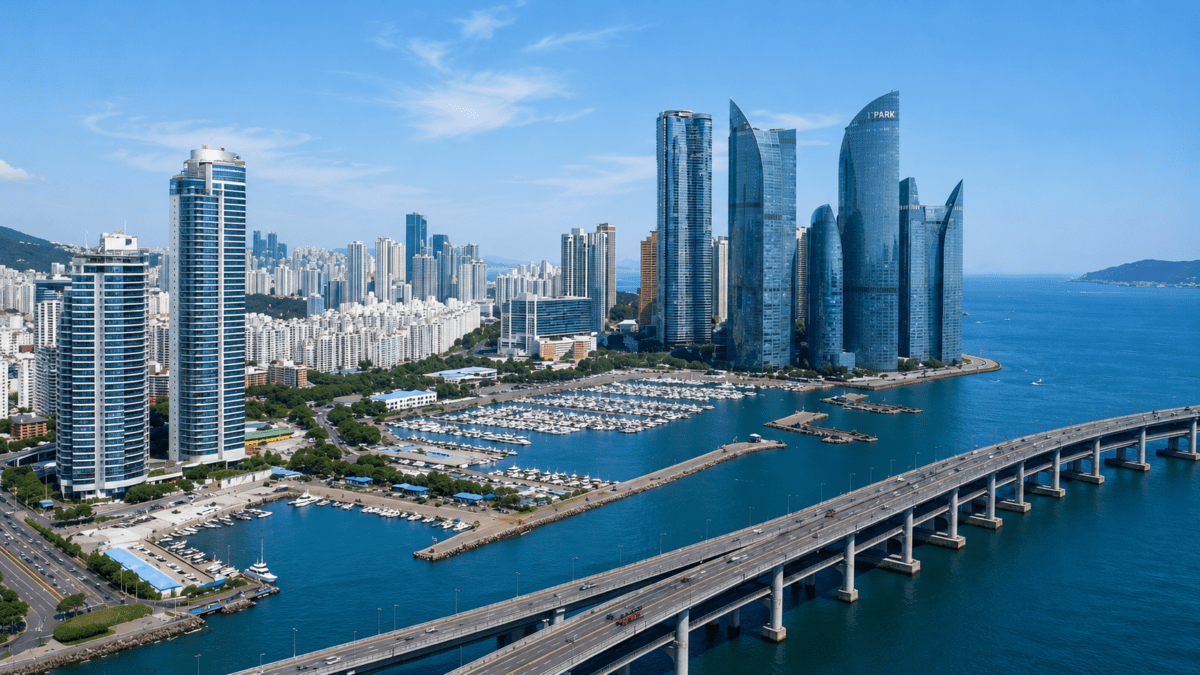
The Korean War ended in 1953. Busan didn’t stop moving.
During the war, the port city became the temporary capital — a place where refugees from every corner of the peninsula arrived with almost nothing. Food was scarce, ingredients were improvised, and survival required invention. Out of that pressure came a bowl that has never left the street.
Korean pork soup — dwaeji-gukbap (돼지국밥: dwae-ji guk-bap, Korean pork bone soup with rice) and its close companion sundae-gukbap (순대국밥: sun-dae guk-bap, Korean blood sausage soup with rice) — was not designed in a kitchen. It was improvised in a crisis, refined over decades, and is now the most widely eaten gukbap in the country. What began in scarcity became a staple. This wasn’t something designed. It felt more like something that remained. A shape formed out of repetition and pressure, until it no longer needed the pressure to continue.
What started in Busan ended up everywhere.
The Busan Bowl: Dwaeji-gukbap
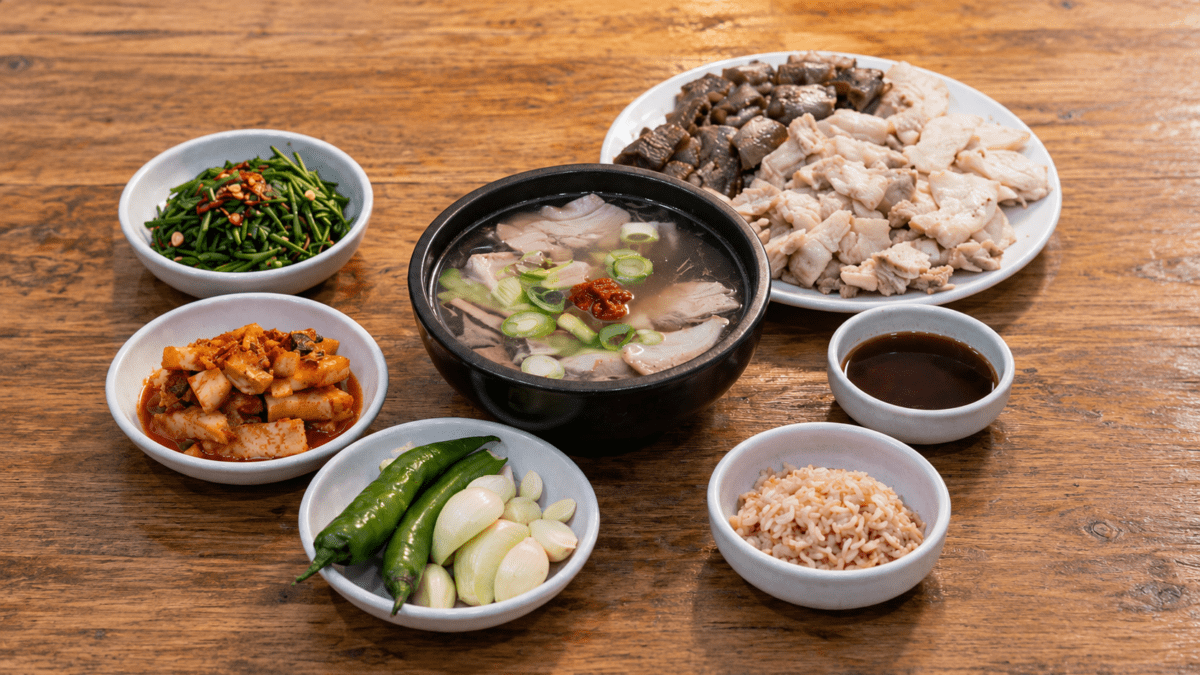
Beef was not an option in postwar Busan. Cattle were scarce and expensive. Pork was accessible — supported by military rations, easier to raise, available in cuts that others overlooked. Refugees and street vendors took pork bones, simmered them long, and produced a broth that was intense in a way seolleongtang never is. Not milky and quiet. Bold, direct, and unmistakably pork.
Dwaeji-gukbap is Busan’s bowl the way seolleongtang is Seoul’s. The broth is built from pork bones simmered for hours — sometimes all night — until it turns milky white, thick with collagen, carrying a depth that only long preparation produces. Sliced pork — usually brisket or shoulder — goes in already cooked. Rice follows. A generous handful of green onion on top, and the bowl arrives.
The seasoning comes after. In Busan, dwaeji-gukbap is served with a dish of salted shrimp, a small container of doenjang, and crushed garlic on the side. The customer builds the flavour themselves — a practice that gives each bowl a slightly different character depending on who is eating it.
This is Korean pork soup at its most direct. No subtlety, no restraint. The broth announces itself. The pork is generous. The whole bowl asks to be eaten quickly, because it is best when it is hottest, and it cools faster than seolleongtang does in its dolsot.
Busan built this bowl out of necessity. The city kept it out of loyalty. Today, entire streets in Busan are lined with dwaeji-gukbap restaurants, some of them running for three generations. Walk into any of them and the rhythm is the same — broth already going, pork already sliced, rice already warm. The server doesn’t ask how you want it. There is one way. It arrives, and it is enough. The bowl that kept people alive during a war is now the bowl they choose on an ordinary Tuesday. That continuity is not accidental. It is the whole point.
One More Thing in the Bowl: Sundae-gukbap
Sundae (순대: sun-dae) is Korea’s blood sausage — pork intestine stuffed with glass noodles, pork blood, and vegetables, then steamed until firm. It has been part of Korean food culture for centuries, appearing in records from the Joseon era. What changed after the war was how it was served.
Sundae-gukbap takes the same pork bone broth as dwaeji-gukbap and adds sundae to the bowl — along with pork head meat, offal, and whatever the kitchen has prepared that morning. The result is denser, more complex, and considerably more filling than the pork alone.
The flavour sundae adds is harder to describe than seonji. It doesn’t dissolve into the broth. It sits in it, contributing a richness that comes from the combination of meat, blood, and noodle — all in one casing, all releasing into the same bowl. Perilla powder and crushed garlic go in at the table. The broth darkens slightly. The bowl becomes something heavier and more complete.
Where dwaeji-gukbap is direct, sundae-gukbap is layered. Where the pork bowl is about the broth, the sundae bowl is about what’s in it. Both are Korean pork soup. They are not the same experience.
Outside Busan, sundae-gukbap became the more common version — partly because sundae was already widely available across the country, partly because the variety of ingredients made it feel generous in a way that appealed beyond the south. In Seoul and the capital region, ordering gukbap often means sundae-gukbap by default. The pork bone broth traveled north. The sundae went with it.
Korean Pork Soup: From the Port to Every Corner
Dwaeji-gukbap and sundae-gukbap are now everywhere. Not the way seolleongtang is everywhere — quietly, in small restaurants with simple signs. These bowls are loud about what they are. The storefronts are bright. The portions are large. The price is low. The queue, especially at lunch, is long.
What happened between Busan in the 1950s and Korea today is the same thing that happens to any food born from necessity — it became comfort. The bowl that refugees ate to survive became the bowl that office workers choose on a cold afternoon. The ingredient that nobody else wanted became the ingredient that defines an entire category.
In Busan, the transformation is visible on the street. What were once makeshift stalls became permanent restaurants. What were once survival portions became generous ones. The broth got better because the equipment got better, but the logic stayed the same — pork bones, water, heat, time. The bowl that crisis invented, the city refined. The city that refined it, the country adopted.
Korean pork soup is now the country’s most democratic meal. It crosses region, class, and generation without effort. A bowl costs less than most alternatives. It fills more than most alternatives. And it arrives faster than anything that requires the kitchen to start cooking after you order.
That last part — the speed — connects it back to everything that came before. The pork bones went on before dawn. The sundae was prepared the night before. The broth was ready long before the first customer arrived. Fast to serve, slow to make. The logic hasn’t changed since the first jumak opened its doors in Joseon Korea.
The Bowl That Crisis Built

Some foods carry the time they came from. Dwaeji-gukbap carries the port, the war, the improvisation of people who had very little and made something enduring from it. Sundae-gukbap carries the street — the market stalls, the late-night crowds, the smell of broth that has been going since before the sun came up, the generosity of a bowl that gives more than it costs and asks nothing in return.
K-saju reads cycles — the conditions that produced something, the season in which it arrived, and the reason it persists long after those conditions have changed. Not everything that survives a hard season does so by accident. Some things find their shape exactly because of the pressure, and keep it long after the pressure is gone. Dwaeji-gukbap arrived in the hardest season Korea experienced in the twentieth century. It survived because it was useful. It endured because it became something more than useful — it became familiar, then beloved, then indispensable.
The crisis passed. The bowl stayed. Some things that begin under pressure discover their own rhythm once the pressure lifts — and that rhythm, once found, doesn’t need the pressure to continue. The pork bones go on before the city wakes. The sundae is prepared before the first order comes in. The broth does its work in the dark, the same way it always has. By the time the doors open, the hardest part is already done.
From the Joseon jumak to the postwar streets of Busan, the logic was always the same. Prepare before anyone arrives. Start before anyone is hungry. The bowl that crisis built is the bowl that endures — not because it remembers the war, but because it never stopped being useful. The morning after — whatever morning that is — there is always a pot already on.
Content in this post was created with AI assistance.