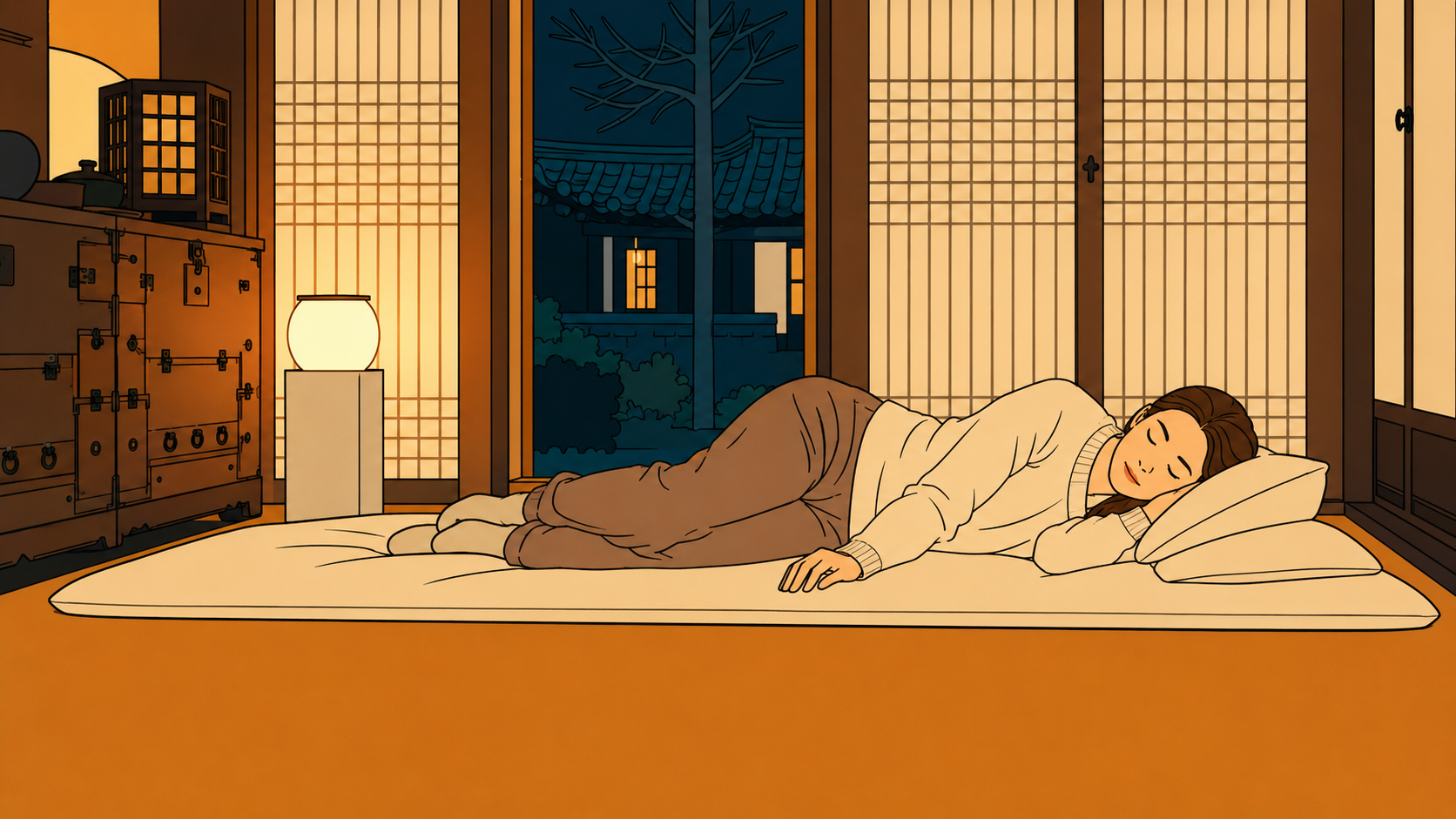
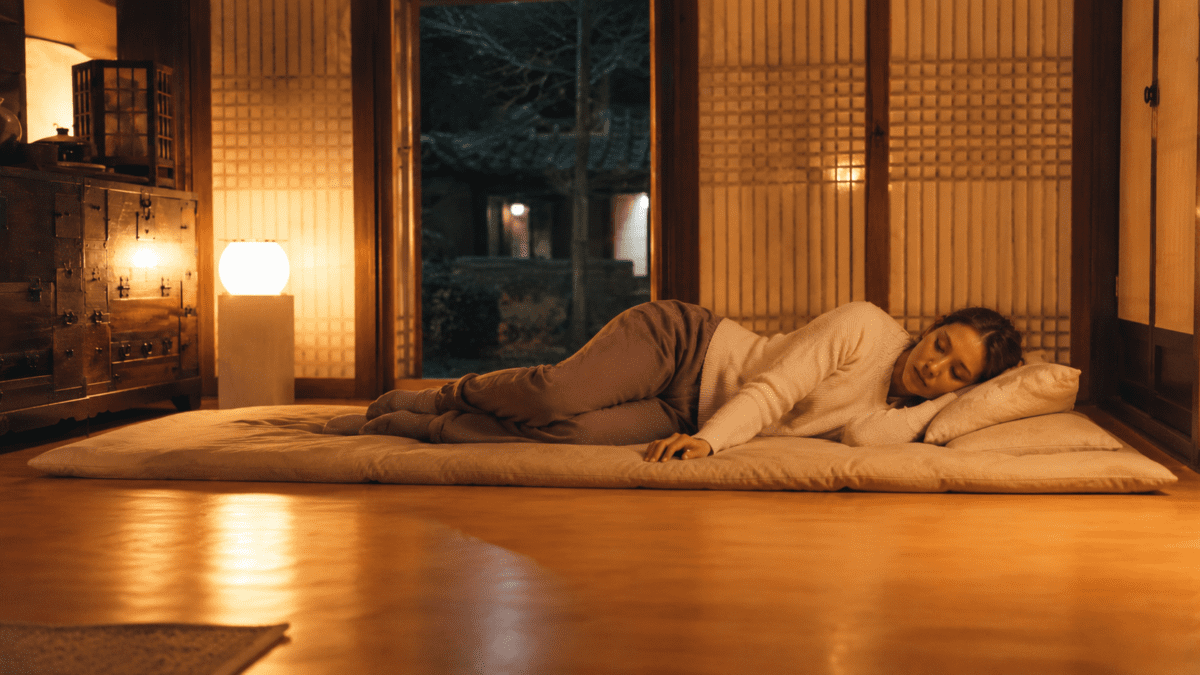
Korea gets cold. Not picturesque-snow-globe cold. Bitter, ground-cracking, your-breath-turns-to-fog-before-you-finish-the-sentence cold. Winters in Seoul regularly dip below minus ten, and in the northern inland regions, minus twenty is not unusual. For a peninsula this exposed, survival required something more than a fire in the corner.
What Korea built instead was ondol Korean floor heating (온돌: on-dol, warm stone) — a system that doesn’t fight the cold from above. It works from underneath. Heat travels through stone, rises through the floor, and holds. The room warms not by pushing heat into the air but by making the ground itself a source.
In the summer of 1950, United Nations troops landed on the Korean peninsula and assumed they understood the climate. By November, advancing north, they encountered something they had no equipment and no training for. At the Chosin Reservoir, temperatures dropped to minus thirty. More soldiers were lost to frostbite and hypothermia than to combat. The cold was the enemy that didn’t need a weapon.
This is not a small distinction. It changed everything: how Koreans sit, sleep, eat, age, and think about comfort.
The Stone Behind Korean Floor Heating
The structure has a name before ondol (온돌: on-dol, warm stone) did: gudeul (구들: gu-deul, baked stone). A fire is lit in the agungi (아궁이: a-gung-i), the furnace mouth built into the outer wall or kitchen. From there, hot smoke doesn’t rise — it travels horizontally through a maze of low stone channels called gorae (고래: go-rae, smoke channels), running directly beneath the floor. Flat stone slabs, the gudeuljang (구들장: gu-deul-jang, flat stone slabs), sit on top of those channels. Red clay seals the gaps. Oiled mulberry paper — hanji — covers the surface.
The smoke moves. The stone absorbs. And then, long after the fire dies, the floor stays warm.
This is not metaphor. A well-built gudeul system could hold heat for days. One documented room in a Hadong temple reportedly stayed warm for forty-five days after a single heating. The thermal mass of thick stone, properly designed, didn’t just transfer heat — it stored it.
Korean traditional medicine carries a principle that maps precisely onto this structure: du-han-jok-yeol (두한족열: du-han-jok-yeol) — head cool, feet warm. Heat should stay low for circulation to work properly. ondol is this principle built in stone. The person lying on the floor warms from the feet and back first, while the head stays in the cooler air above. Korea’s farmers didn’t design it that way deliberately. That’s just how the physics landed.
The West had something similar. Rome’s hypocaust system circulated warm air beneath bath house floors. But the hypocaust disappeared when the empire did. Korea kept building.
How a Fire in the Kitchen Heated the Bedroom
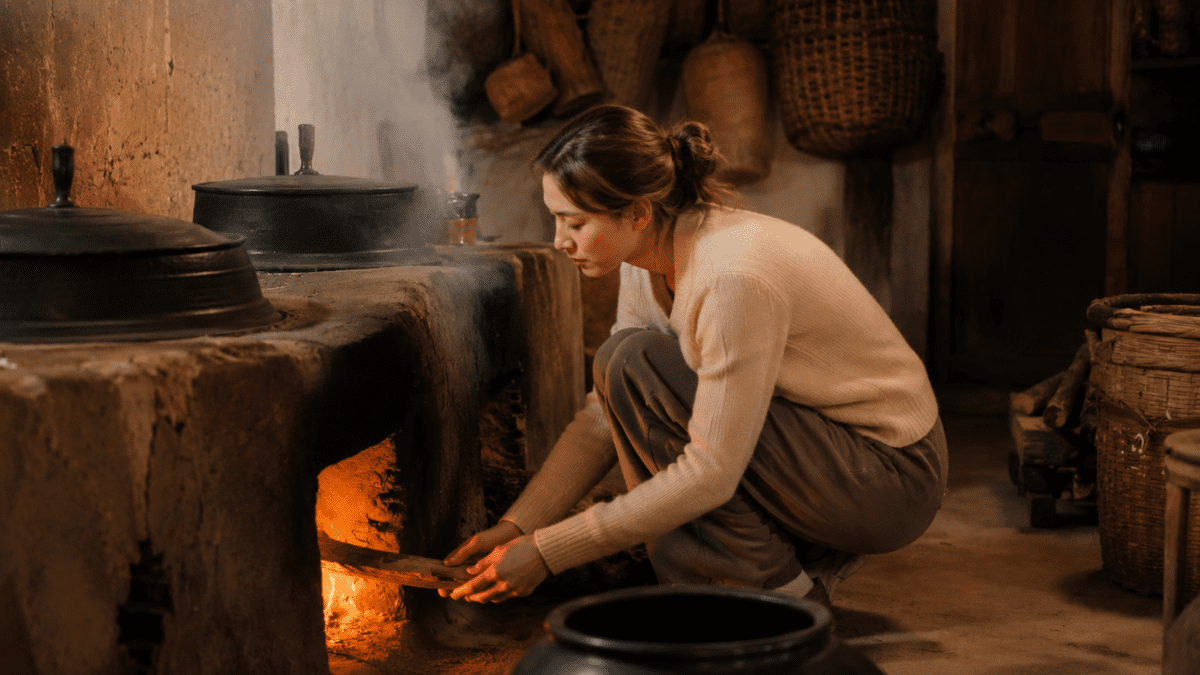
The most quietly efficient feature of ondol is that it produces nothing extra.
A traditional Korean kitchen, the bueok (부엌: bu-eok), sat lower than the living room — deliberately, by two or three feet. This elevation difference created the pressure differential that pushed smoke horizontally rather than straight up. When a cook lit the agungi to boil rice or simmer soup, the heat didn’t vanish through a chimney. It ran under the floor of the adjacent room, heated the stone, and only then escaped through a tall chimney at the far end.
One fire. Two purposes. The kitchen produced heat as a byproduct of cooking, and the house captured it entirely.
Modern thermodynamics has a term for this: cogeneration. Korea’s farmers had no such term. They had cold winters and limited wood, and they built accordingly. Fuel efficiency wasn’t a design goal — it was a survival constraint that became architecture.
There was a second byproduct, unplanned. Hot dry smoke traveling through the gorae beneath the entire floor made the space below uninhabitable — for rats, for insects, for the ants that work through a building’s wooden frame in winter. No one building an agungi was thinking about pest control. They wanted warmth. The rest followed.
The floor closest to the agungi was always warmest. In a traditional household, that spot was reserved. Elders sat there. Honored guests. The warmth of the floor was a form of language.
Who Had Ondol — and When
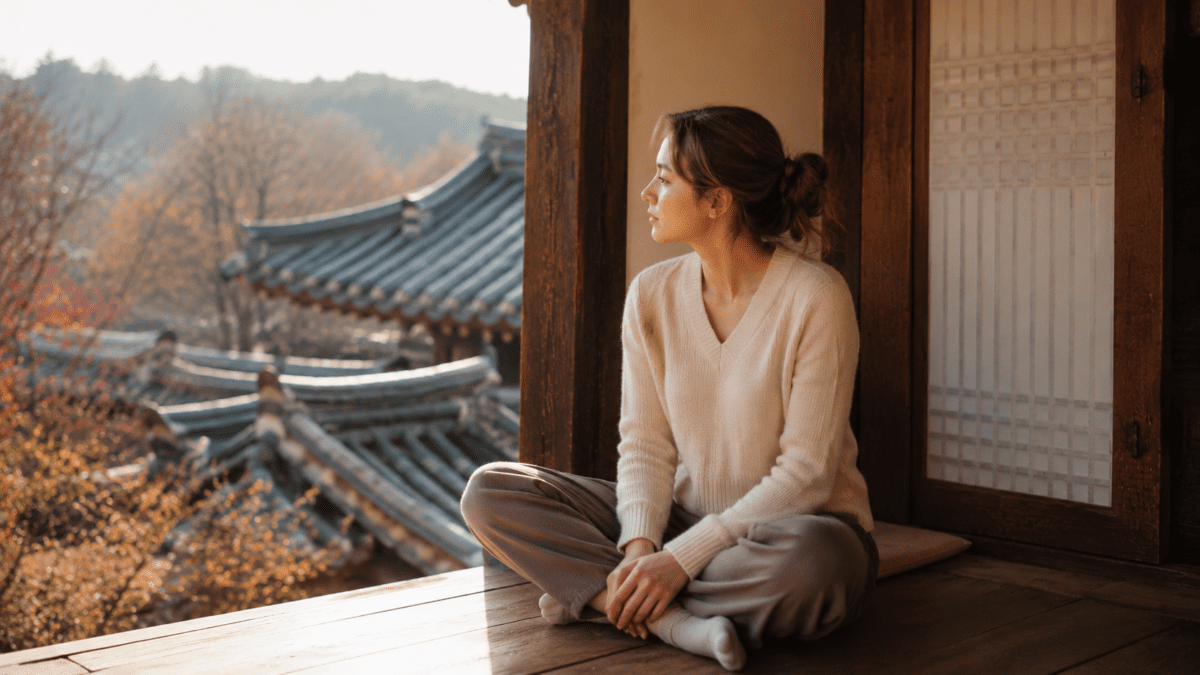
Ondol didn’t begin on the Korean peninsula. It began further north.
Around the fourth century BCE, the Okjeo (옥저: ok-jeo) people living along the Tumen River developed the first documented gudeul system. Farming through Manchurian winters demanded a solution that firewood alone couldn’t provide. What they built worked — and it spread. The technology moved south with them — into Gojoseon (고조선: go-jo-seon), Buyeo (부여: bu-yeo), and Goguryeo (고구려: go-gu-ryeo), the kingdoms that rose and fell across the peninsula’s early centuries, carried by the same people pushing through the same cold.
By the first century BCE, ondol had reached the southern coast of the peninsula. Archaeological evidence from Neukdo, a maritime trading hub near present-day Sacheonpo, confirms the system was already traveling with people along trade routes.
Goguryeo’s military expansion southward in the fifth century CE brought ondol into central Korea. Every fortress built along strategic ridgelines contained ondol — without exception. The heating system was as standard as the walls.
What followed was slow and uneven. Through the Goryeo period, ondol remained largely a feature of upper-class households and mountain temples. Here is the detail most histories skip: in early Joseon, ondol was considered a lower-class technology. Aristocrats used braziers. The Injo Sillok records a court official noting that even palace servants were living on ondol floors, suggesting the system was beneath the nobility.
That changed in the seventeenth century. A period of severe cold — the Little Ice Age — settled over the peninsula. Braziers were no longer sufficient. By the eighteenth century, court documents stopped distinguishing between rooms with and without ondol. The distinction had become irrelevant. Every room had it.
Three centuries of aristocratic resistance, ended by one cold winter.
The spread had a cost. Ondol consumed wood at a scale the peninsula couldn’t sustain. By the late nineteenth century, the mountains around Korean cities had been stripped bare. Joseon court records show repeated attempts to regulate logging — none of them successful. The forests were gone before the regulations caught up. That depletion set the stage for what came next.
The Floor That Shaped a Culture
When the floor is warmer than the air, the floor becomes where life happens.
Ondol created a culture organized at ground level. Meals on low tables. Sleep on mats rather than raised beds. Work, conversation, rest — all conducted sitting or lying on the same warm surface. Shoes were removed at the entrance not as ceremony but as obvious logic: the floor was clean, warm, and where you lived.
A single ondol room cycled through its functions across the day. Morning: sleeping space. Midday: study or workspace, the low table repurposed as a desk. Evening: dining room, the same table loaded with food. Night: bedroom again. No furniture to move. No heat to redirect. The room transformed because the people in it transformed, not the space.
Foreign visitors to Joseon left records of the experience. A Russian military officer noted the custom of offering the warmest spot — closest to the agungi — to honored guests, then stoking the fire higher as a gesture of hospitality. The British traveler Isabella Bird Bishop wrote of opening a door because the floor was unbearably hot, only to have the innkeeper rush over to close it, warning of tigers outside. Floor temperatures in ondol rooms regularly reached thirty-three to forty degrees Celsius. For visitors unaccustomed to heat rising from below, it was disorienting. For Koreans, it was simply winter.
In 1914, the American architect Frank Lloyd Wright encountered an ondol-heated room in Japan — a space a host had built specifically in the Korean style. Wright later wrote that the warmth felt like climate rather than heating. The experience informed his approach to radiant floor systems in his subsequent buildings. The influence was one of concept, not structure. But the concept was Korea’s.
Today, underfloor heating is standard in Germany, Austria, and Scandinavia. South Korean companies export the systems globally. The floor that kept a Joseon farmer alive through February is now a selling point in a Stockholm apartment.
The floor doesn’t announce itself. It simply holds what’s given to it — and releases it slowly, long after the fire is gone.
This post was planned and edited by a human, with AI assistance.