

In the winter of 1914, an American architect named Frank Lloyd Wright was invited to dinner at a client’s home in Japan. After the meal, he was led into a small room his host called “the Korean room.” The floor was warm. Not from a radiator, not from a fire in the corner — from below, evenly, without a visible source.
Wright is often associated with the spread of radiant floor heating in modern architecture, and some Korean and architectural sources connect this interest to his encounter with a “Korean room” in Japan. But the relationship is better presented as an influence often noted by later writers than as a fully documented single turning point.
He had experienced it once. Korea had been building it for two thousand years.
What Wright encountered that evening was ondol radiant floor heating — a system whose early forms developed in the northern regions of the Korean peninsula. Archaeological evidence traces its origins back at least to the early historic period, possibly earlier. Over time, it appeared in various forms across ancient Korean societies, becoming especially well developed in the north and later widely associated with Korean domestic architecture. It survived the Joseon dynasty’s class system and the Little Ice Age, and it outlasted the era of coal briquettes—and the carbon monoxide dangers they carried. In modern South Korea, ondol-style underfloor heating has become the dominant residential system, especially in apartments and most contemporary housing.
The floor that warmed a Joseon farmhouse is warming a Seoul apartment tonight.
And now it is warming apartments in Almaty, Berlin, and Stockholm too.
The Architect Who Recognized the Floor
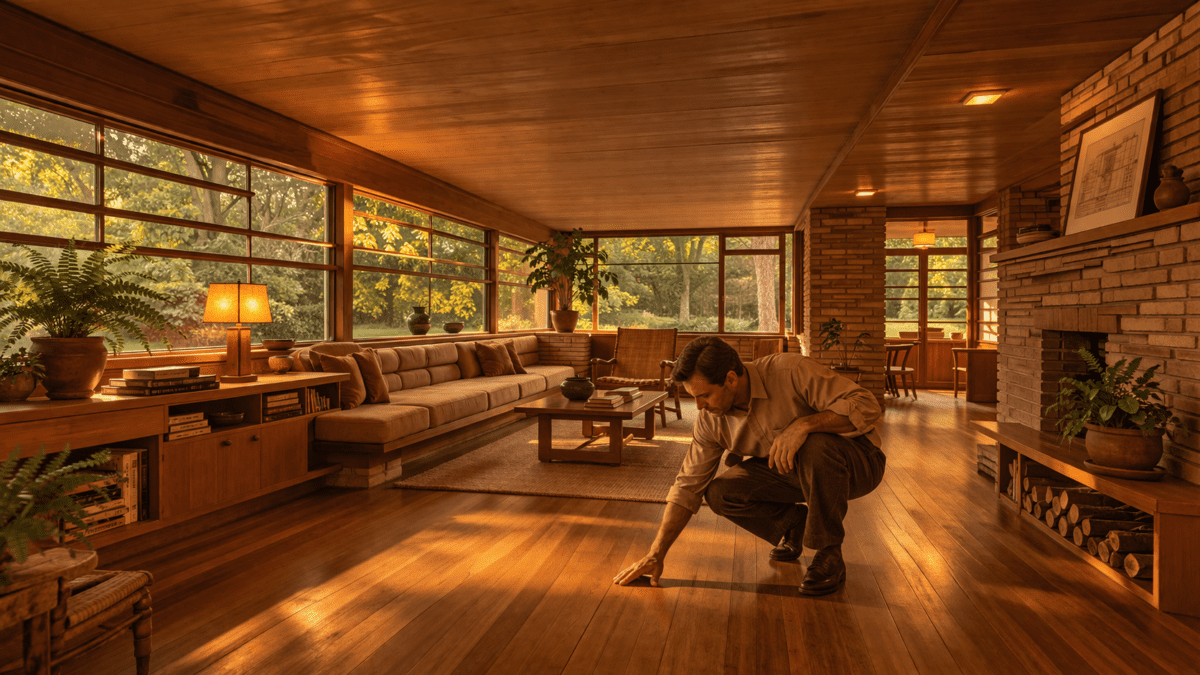
Wright’s encounter with ondol radiant floor heating was brief. The influence was not.
The principle he took from that evening in Japan was simple: heat the floor, not the air. When heat rises from below, the room warms evenly and efficiently. The body, closest to the floor, receives the warmth directly. The head stays in relatively cooler air above. The system requires no visible apparatus — no radiators along the wall, no vents in the ceiling, no forced air moving through the room. The warmth is simply there, coming from the surface you walk on.
Wright introduced radiant floor heating to American residential architecture in the 1930s. His Usonian houses — modest, affordable homes designed for middle-income families — used hot water pipes embedded in concrete slab floors. The system produced the same even, source-free warmth he had experienced in the Korean room. Clients who visited his completed buildings consistently remarked on the quality of the heat — how it felt different from anything they had encountered before.
The influence was one of concept rather than direct transfer. Wright did not replicate ondol’s stone channels and wood-fired agungi. He took the idea — heat the surface people live on — and adapted it to American materials and American construction. But the idea itself was Korean. It had been Korean for two millennia before Wright sat on that floor in Japan.
What Korea developed out of necessity — surviving Manchurian winters with limited fuel — Wright recognized as elegance. The two arrived at the same conclusion from opposite directions. Korea built it because it had to. Wright adopted it because nothing else came close.
The Logic That Traveled
Wright was not the first person outside Korea to recognize what ondol radiant floor heating offered. He was simply the most famous.
The principle had been traveling for much longer. Archaeological finds from areas beyond the Korean peninsula, including sites in Northeast Asia, show heating structures comparable to ondol or related underfloor systems. These similarities suggest regional exchange or parallel adaptation, but the exact route of transmission is still debated. Underfloor or heat-retaining floor systems also appeared in parts of Central Asia, and while they share useful similarities with ondol in thermal logic, they should not be described too quickly as identical or as direct copies. Heat the floor. Let it hold. Let it release slowly.
The twentieth century accelerated what centuries of migration had begun. Korean construction companies exported ondol-based apartment systems to Kazakhstan and China as part of regional development projects. Dongil Construction built ondol-equipped apartments in Almaty. SR Engineering built thousands of units in Shenyang and Shanghai. The technology moved with Korean economic expansion into markets that happened to share one thing with the Korean peninsula: cold winters and a need for efficient heating.
The logic traveled because the logic was sound. Radiant floor heating uses energy more efficiently than forced-air systems — heat delivered directly to the living space rather than cycling through ductwork and losing efficiency along the way. In a world increasingly conscious of energy consumption, a system that heats people rather than rooms carries obvious advantages.
Korea had been operating on this principle for two thousand years before it became an engineering insight.
The Country That Made It Standard
Other countries use radiant floor heating. No other country made it universal.
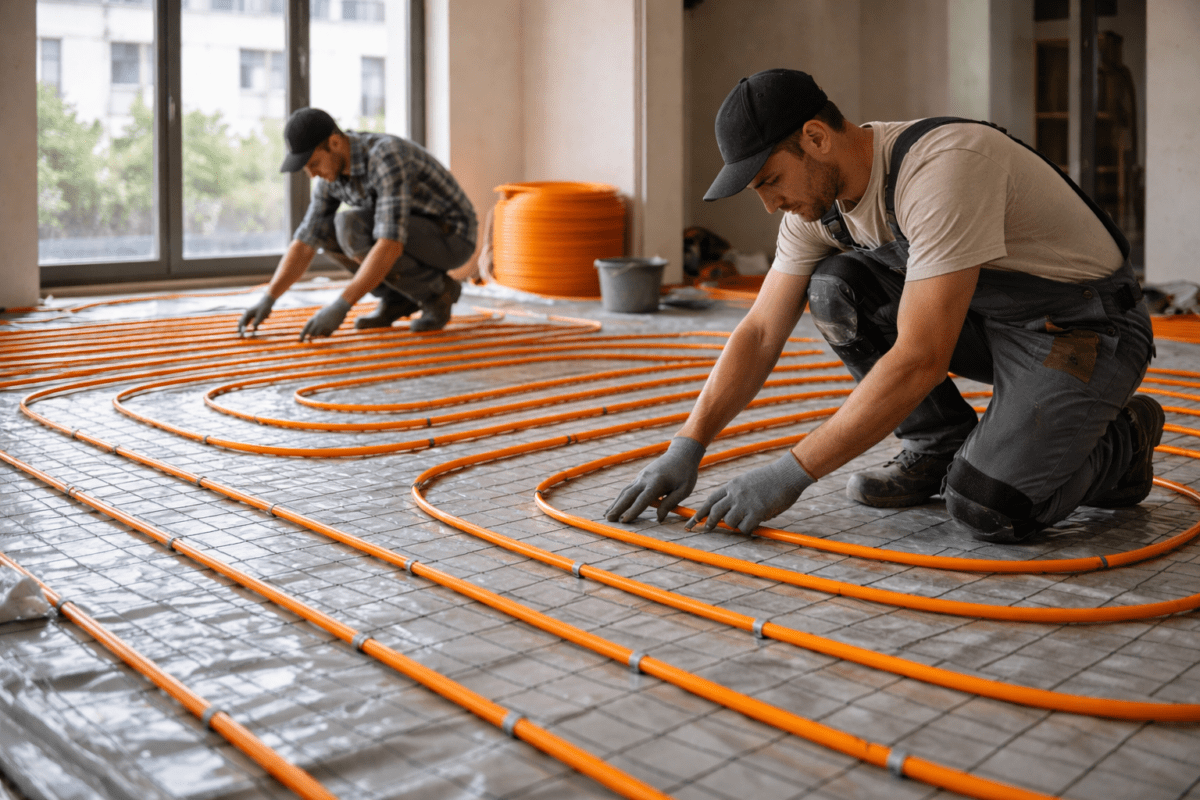
South Korea’s decision to standardize ondol radiant floor heating across its entire housing stock — apartments, single-family homes, new construction and retrofits, regardless of income level — produced something that exists nowhere else: a country where the warm floor is not a premium feature but a baseline expectation. You don’t pay extra for it. You don’t select it from an options list. It is simply there, in every home, because that is what Korean homes have.
The technology that enabled this at scale was the hot water boiler system — pipes embedded in concrete floors, connected to gas boilers, controlled by digital panels on the wall. Korean manufacturers developed and refined this infrastructure through the 1980s and 1990s as the country rebuilt its housing stock. Navien, founded in Korea, became one of the world’s leading manufacturers of condensing boiler systems. Its products now heat homes in the United States, Canada, and across Europe — the same ondol logic, packaged for global markets.
The Korean ondol industry exports not just equipment but standards. When architects and engineers in Germany, Austria, or Scandinavia specify underfloor heating for new construction, they are working within a technical framework that Korea had already normalized domestically. The details differ. The principle is the same one that can be traced back to early forms of ondol in the northern regions of the Korean peninsula.
There is a phrase in Korean architecture that captures what happened: 온돌은 문화다. Ondol is culture. The heating system and the way of living it produces are not separable. You cannot have the floor without having the life that organizes itself around it — the low tables, the sitting, the sleeping on mats, the shoes left at the door, the warmth that makes a t-shirt the right choice in January.
The world is importing the technology. The culture takes longer to travel.
The Floor the World Is Still Learning
In Germany, nearly half of newly built homes (as of 2023) now include underfloor heating. In the United States, radiant floor heating has moved from architectural novelty to standard specification in high-end construction and is expanding into the broader market. In the United Kingdom, the system that was once considered a curiosity is now specified in residential developments across the country.
One could read ondol alongside broader Korean ideas about balance, seasonality, and the management of space and warmth, but this is better framed as a cultural interpretation than as a direct historical or technical foundation: cycles of energy, the relationship between opposing forces, the logic of how things move through time and season. The floor that holds heat and releases it slowly is not separate from the culture that produced it. It is an expression of the same understanding — that warmth is not something you force into a space, but something you build the conditions for and then wait.
The world is learning the technology. It is learning it from a country that never stopped using it, that carried it through two millennia of political change and fuel transitions and housing revolutions, that lost its forests to it and then found a cleaner way to do the same thing.
In a new apartment in Oslo, a family adjusts a thermostat that controls pipes embedded in their floor. The floor is warm. They don’t think about where the warmth comes from.
In Seoul, no one ever did either.
The floor holds. It always has.