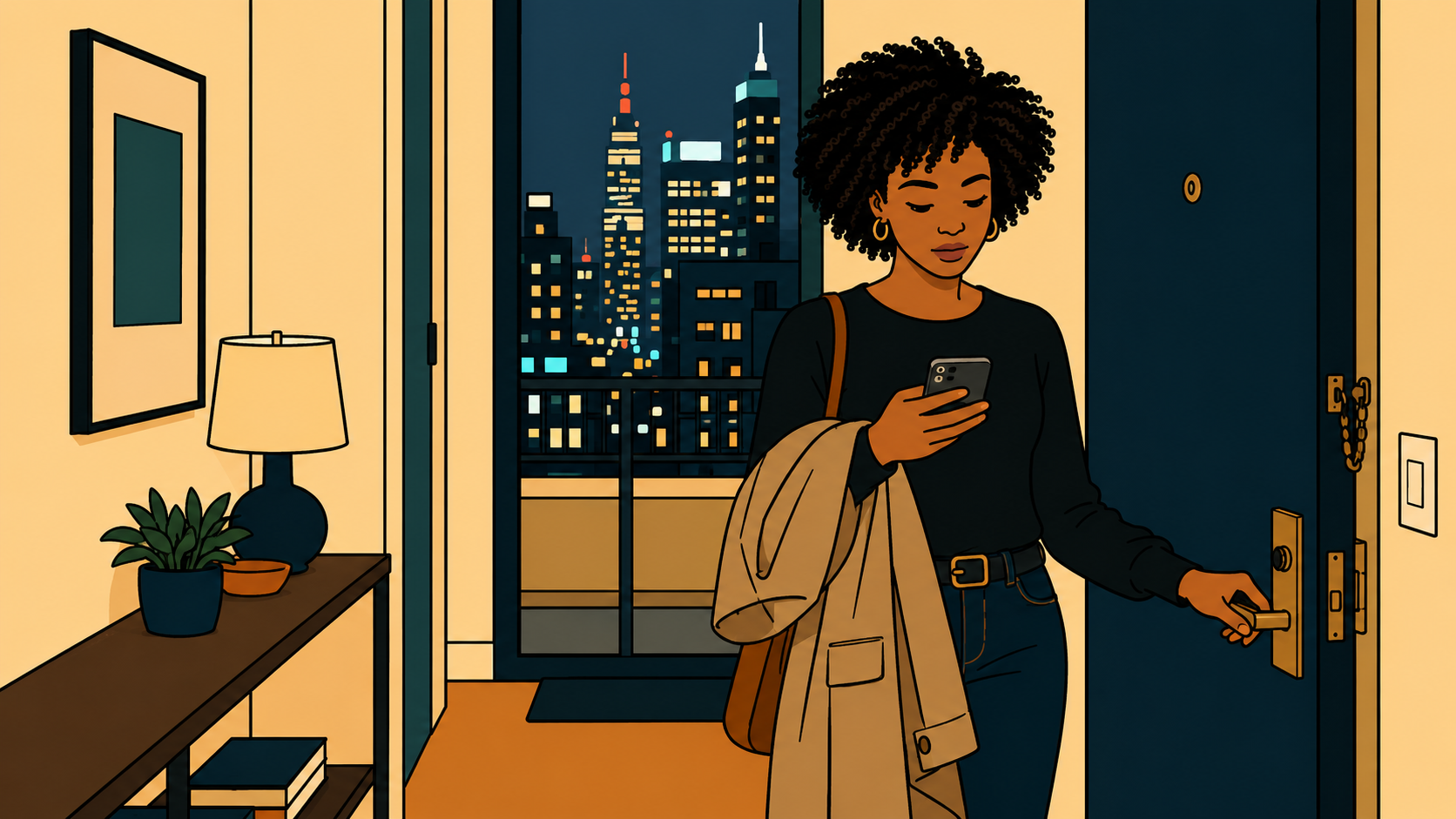

You closed the laptop. You left the building. By any reasonable measure, the day is over.
And yet, somewhere between the commute and the kitchen, the meeting from 3 PM is still running. Not loudly. Just there — a tab that didn’t close when everything else did.
Can’t stop thinking about work isn’t something that happens to people who can’t manage stress. It happens to people who are doing exactly what they were trained to do — stay on top of things, stay prepared, stay a step ahead. The system doesn’t know that the building is behind you now. It’s still running the same program it ran at 10 AM.
You check the time. Earlier than you thought, later than it feels. The body has clocked out. The mind never got the signal, and it keeps moving through the same loop it was running an hour ago, as if leaving were something that happened to someone else.
You’re home. The day is not.
The Door You Walked Through
There’s a specific moment when you cross the threshold — bag down, shoes off, the small rituals that are supposed to signal the shift. For some people, it works. The day files itself away and the evening begins.
For others, the door is just a door.
You walked through it. The day came with you. Not the whole day — just the parts that didn’t resolve, the conversations that ended before they were finished, the email you sent at 4:47 and haven’t stopped mentally editing since. The threshold did its job. Your nervous system didn’t get the memo.
This isn’t about discipline or the inability to relax. It’s about a system that was running at a certain frequency all day and hasn’t been given a reason to change registers. The door closed. The frequency didn’t.
The gap between those two things is where the evening goes. You’re physically in one place and operationally still in another, and the rituals — the shoes, the bag, the change of clothes — are doing their best against something that doesn’t respond to physical cues. The commute ended. The workday is negotiating its exit.
The Replay That Starts After Dinner
Dinner is done. The dishes are handled. There’s nothing left that requires your attention — and that’s exactly when it starts.
The meeting from this morning. The thing your manager said, and the thing you said back, and the thing you should have said instead. The slack message you read and didn’t respond to because the response needed to be worded carefully, and now it’s 9 PM and the window for a natural reply has closed and tomorrow you’ll have to decide whether to address it or let it quietly disappear.
Can’t stop thinking about work doesn’t feel like thinking. It feels like a background process — something running underneath whatever else you’re doing. You’re watching the show. You’re in the conversation. You’re physically present and mentally still at your desk, reviewing the transcript of a day that already happened, looking for the line where things could have gone differently.
The replay isn’t random. It targets the unresolved, the ambiguous, the moments that didn’t come with a clear outcome. Your brain isn’t torturing you. It’s doing what it’s built to do — processing incomplete information, looking for closure that didn’t arrive before you left the building.
The problem is that closure isn’t coming tonight either. The replay will run until it runs out of material, or until you fall asleep, or until tomorrow generates enough new material to push today’s to the back. Not because you resolved anything. Because something newer arrived.
Why You Can’t Stop Thinking About Work After Hours

There’s a reason the commute doesn’t end at the door, and it’s not personal weakness.
The kind of work most people do now doesn’t have clean edges. There’s no physical product that signals completion, no visible end point that tells the brain the task is done. Emails beget emails. Conversations are left mid-thread. Projects exist in states of ongoing partial completion. The brain, which evolved to track unfinished business because unfinished business used to matter for survival, keeps the files open. It doesn’t know the difference between an unresolved conversation with a predator and an unresolved conversation with your team lead.
The mental load after work isn’t a character flaw. It’s what happens when a system designed for finite tasks gets handed an inbox that never reaches zero.
And then there’s the other layer — the performance layer. Work isn’t just tasks. It’s a place where you’re observed, evaluated, compared. The brain tracks social data with particular vigilance. A comment that felt slightly off, a meeting where the room’s energy shifted, a response that arrived too quickly or not quickly enough — these register as social signals worth monitoring, even after the day is technically over. Especially after.
Work stress at home arrives wearing the clothes of rational concern. It feels like diligence. It feels like staying on top of things. It’s the same system running at the same frequency, unable to distinguish between the hour that requires it and the hour that doesn’t. There’s a structure to this kind of year — the way certain cycles make the off-switch harder to find — and the brain running hot in the evening is one of its most consistent symptoms.
The Specific Exhaustion of Being Half-Present

There’s a particular kind of tired that comes from being in two places at once.
Not fully at work, not fully home. Present enough to go through the motions of an evening — the dinner, the conversation, the small decisions — but operating at reduced capacity because a significant portion of your attention is still allocated elsewhere. You’re answering but not quite listening. You’re there but slightly behind glass.
The people around you might not notice. You’ve gotten practiced at the performance of presence. But you notice. The evening that was supposed to be yours passes in a state of partial occupation, and by the time you get to bed, you’re not rested — you’ve just relocated. The commute brought you home physically. The rest of you is still catching up.
This is the specific exhaustion that sleep doesn’t always fix. Can’t stop thinking about work isn’t the problem — it’s the symptom. The problem is a system that was never given a clear signal to stand down.
It’s not physical depletion. It’s the cost of sustained dual-location — the energy spent maintaining two open contexts simultaneously when the brain was built to run one at a time. You wake up already slightly behind. The evening didn’t recover you. It just held you until morning.
The Question the Evening Left Open
The day ended. The evening happened around you.
Tomorrow the inbox will reload. The unresolved threads will still be there, slightly older, waiting. The brain will pick up where it left off — because that’s what it does, because that’s what you’ve trained it to expect, because the boundary between work time and your time has been crossed so many times in both directions that it stopped functioning as a boundary.
The evenings accumulate. Each one a version of the same thing — present in body, distributed in attention, vaguely aware that something is being spent that isn’t being replenished. You keep showing up to them. You keep leaving them roughly the same way you arrived.
And somewhere in that accumulation, the evening stopped being yours in any meaningful sense. Not because anyone took it. Because the conditions that would have made it yours — a nervous system that clocked out when you did, a brain that filed the day away at the door — were never quite in place. The evening became the space where the workday finished processing. A continuation by another name.
At some point, the question isn’t how to stop thinking about work.
It’s what would have to change for the evening to actually belong to you.
This post was planned and edited by a human, with AI assistance.