A woman traveling solo to Korea sits in a booth no bigger than a closet. Three walls of padding, one window of scratched glass. She holds a microphone. The screen glows. She sings—loudly, badly, without apology. The song ends. She picks the next one. Outside this booth, it’s 11 PM on a Friday. Millions of people are out. None of them can hear her. None of them are watching. She’s completely alone.
This is normal in Seoul.
Not the booth itself. Noraebang (karaoke rooms) exist everywhere. What’s normal is the choice. She chose to be alone. She paid for it. She’s using her time exactly how she wants. Tomorrow night, she might go to a club with friends. Tonight, she’s here—singing off-key in a soundproof box—and it’s exactly what she needed.
Korean nightlife doesn’t just allow solitude. It celebrates it. The culture has built an entire infrastructure around the right to be alone.
The Private Room Where You Disappear
Noraebang booths line every street in Seoul. Small rooms, low ceilings, a couch, a screen, a microphone, a tambourine. You rent by the hour. Most people go in groups. But plenty go alone.
Walk past any noraebang at midnight. Look through the small windows. You’ll see solo singers. Some are men drinking soju between songs. Some are women who booked the room specifically to have two hours to themselves. The culture doesn’t question it. The staff doesn’t ask, “Where are your friends?” Nobody cares. You paid. You get the room.
What makes this different from karaoke in other countries isn’t the booth—it’s the assumption. In Western cities, going to karaoke alone reads as unusual, maybe sad. But for women on solo female travel to Korea, it reads as smart. You wanted time alone. You got it. You sang. No one heard. No one judged.
The booth itself is the point. Four walls that close out the world. A screen that faces only you. A microphone that doesn’t carry your voice beyond that room. You can be terrible. You can be loud. You can cry while singing a breakup song. You can laugh at yourself. The booth absorbs all of it. For two hours, you exist in a space that is completely, legally, culturally yours.
Walk out at 1 AM. You’ve been alone for two hours. The night is still young. The streets are still full. You step back into the crowd—but you’re not the same. You’ve had your time. You’ve been heard (by no one). You’ve been seen (by no one). And that was exactly what you needed.
This is what Korean nightlife does differently: it doesn’t force you to choose between being alone and being out.
The Runner No One Questions
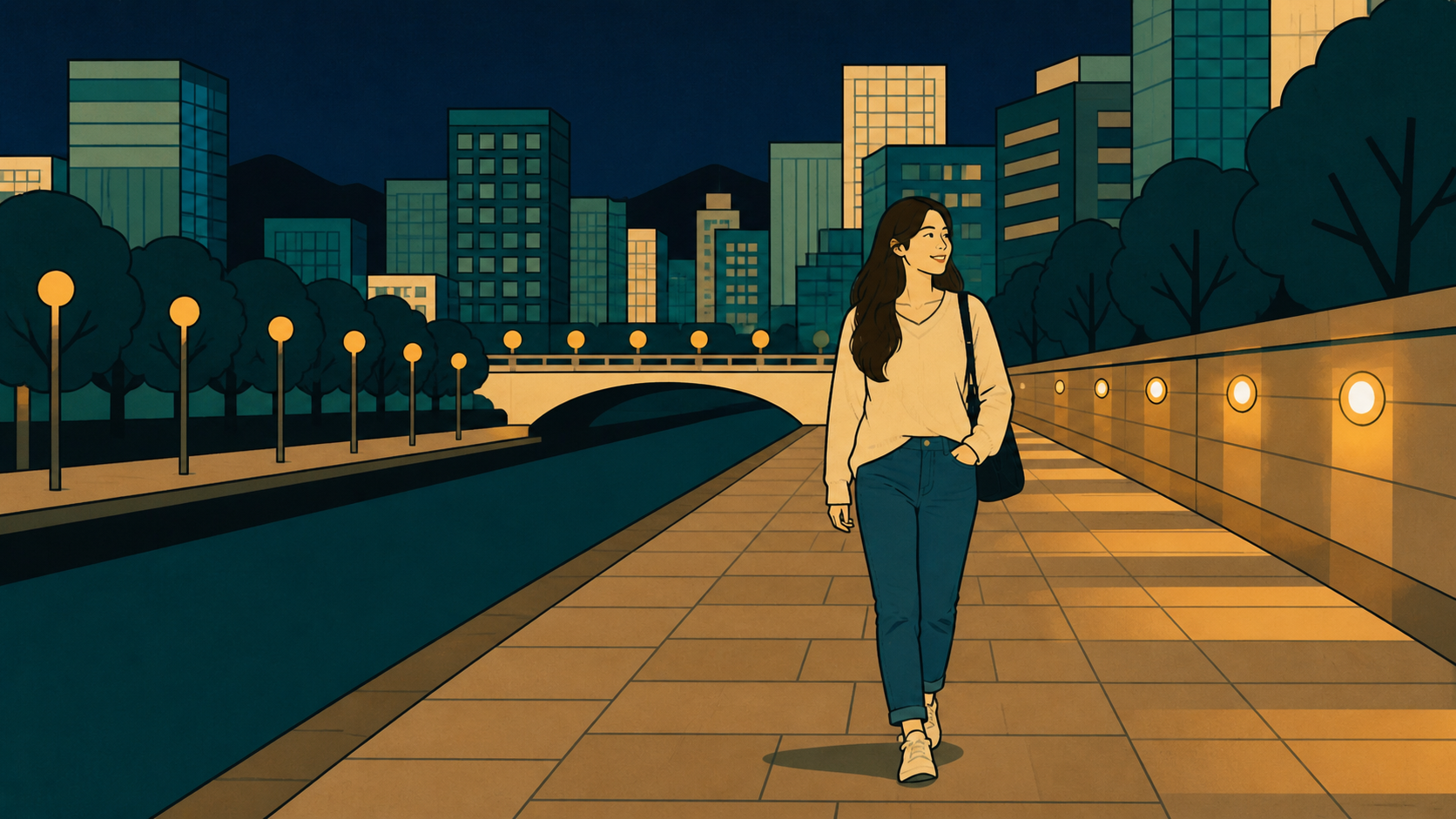
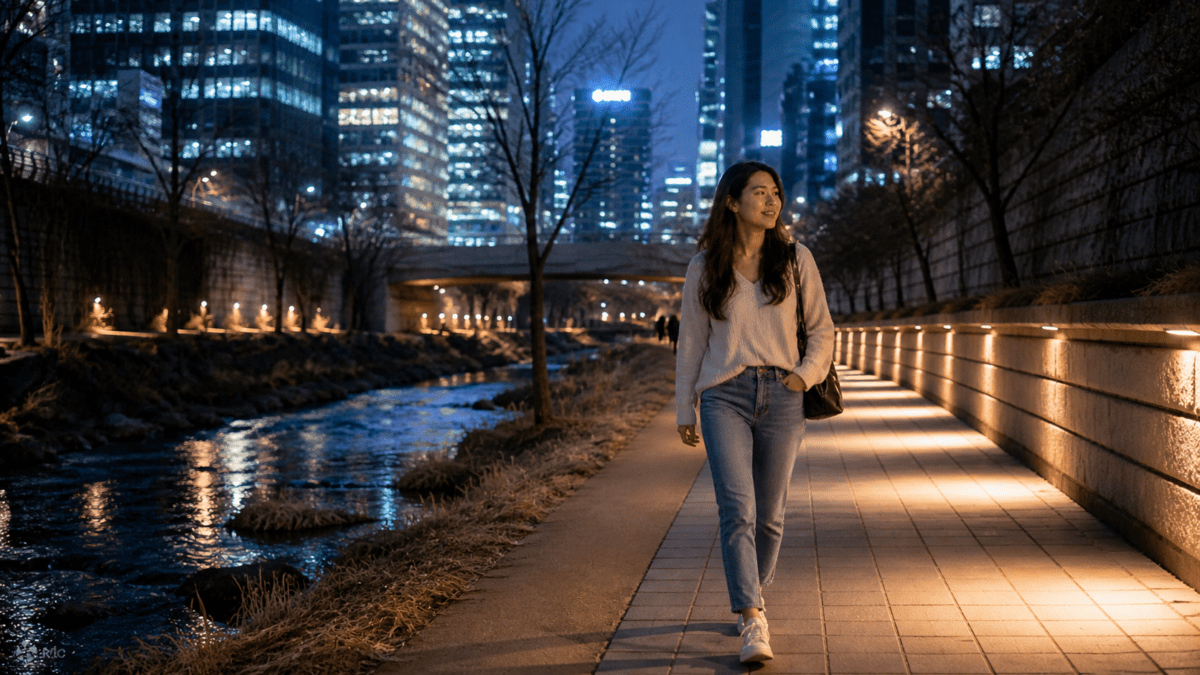
Han River Park at 2 AM. The path is lit. Street lamps every 20 meters. The water is visible. Trees rustle. A woman on solo female travel to Korea is jogging. Alone. Headphones in. Moving at her own pace.
In most Western cities, this would trigger concern—from strangers, from friends, from the jogger herself. A woman running alone at 2 AM. That reads as risk. That reads as either desperate or reckless.
In Seoul, she’s just running.
She chose nighttime because that’s when she has energy. Or quiet. Or freedom from the schedule that governs her day. She jogs at 2 AM the same way someone else jogs at 6 AM. The time is different. The safety structure is the same.
The Han River path has lighting. It has foot traffic—other runners, walkers, cyclists. It has police patrols, though you rarely see them. It has CCTV cameras, though their presence is subtle enough that you forget about them. But the most important thing is this: the culture doesn’t tell her she shouldn’t be there.
A woman running alone at night isn’t making a statement. She’s not “reclaiming the night” in a defiant sense. She’s just… running. Running when she wants. Running alone when that’s what she needs.
She passes other solo runners. Sometimes women. Sometimes men. Nobody nods. Nobody acknowledges the unusualness of the scene because there isn’t any. Solo movement through Seoul’s night is normal. Expected. Accepted.
The path curves. The lights continue. She keeps pace. In two hours, she’ll be home. She’ll have had her solitude. She’ll have moved her body. She’ll have existed in a space—outdoors, public, visible—completely alone.
This is what Western women find shocking: that being alone at night in a major city is safe enough that it stops feeling remarkable. Not thrilling. Not transgressive. Boring. She’s just a person on a path at 2 AM. Nothing more.
The Table That Asks Nothing
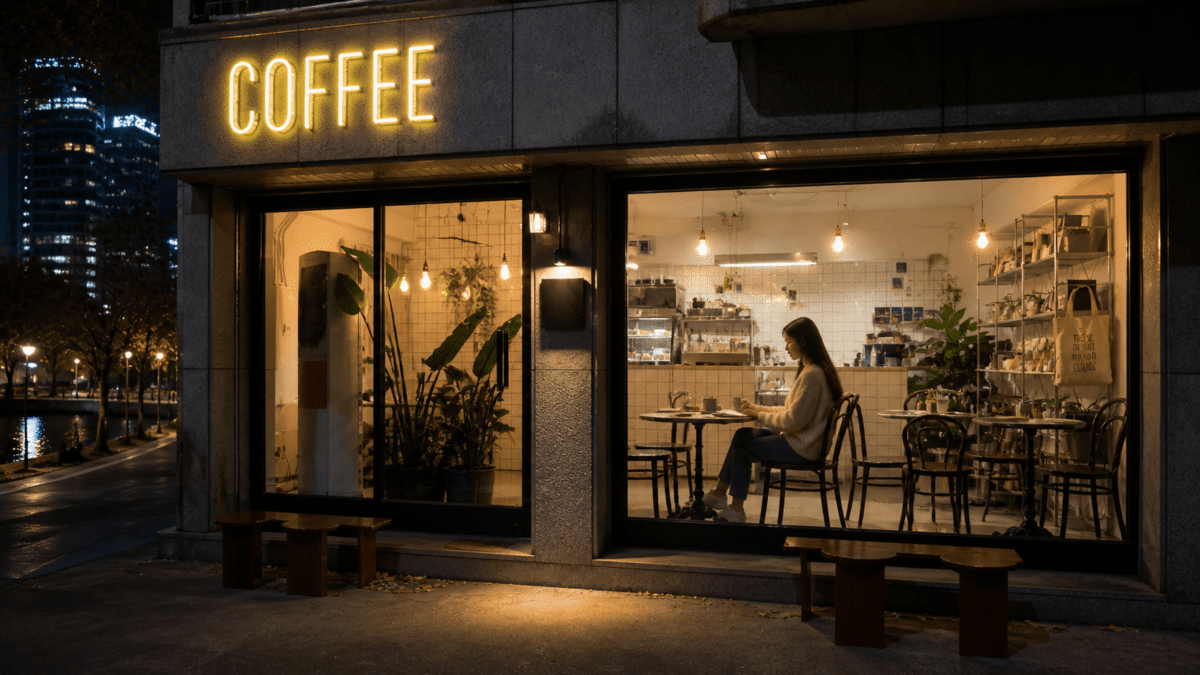
Convenience stores. 24-hour cafes. The tables at the edge of the window where you can sit alone without it reading as lonely.
A woman sits at a CU (convenience store chain) at 3 AM. She’s ordered a coffee. A pastry. She has a book. A laptop. Her phone. She’s been here for 90 minutes. The staff knows she’s not leaving soon. They don’t care. They refill her coffee without asking. They leave her alone.
Around her, others. A student cracking textbooks for an exam. A night-shift worker grabbing coffee before their shift. A couple sitting silently across from each other, phones in hand. An older man reading the newspaper. Nobody is performing connection. Nobody is pretending to be with someone when they’re alone. The space simply accepts solitude as one of many valid ways to exist in it.
In Western coffee shops, sitting alone for 90 minutes can feel like an imposition. Like you should buy more things. Tip more. Justify your presence. In Seoul’s 24-hour convenience stores, your presence is its own justification. You’re here. You’re spending money. That’s the transaction. Everything else—why you’re here, whether you’re waiting for someone, whether your solitude is by choice or circumstance—is irrelevant.
The table doesn’t ask. The staff doesn’t ask. Other patrons don’t ask. You sit. You exist. You take up space. It’s yours.
A woman working late sits with her laptop at 2 AM. She’s been there four hours. The staff has seen her progression: alert at 10 PM, tired at midnight, almost asleep at 2 AM. They don’t ask if she’s okay. They don’t suggest she go home. They simply accept that this is where she needs to be right now. Maybe her apartment is too quiet. Maybe she works better in public. Maybe she’s avoiding something. Maybe she’s just awake and hungry and this is the closest place. It doesn’t matter. The convenience store holds space for all of it.
Walk into any convenience store after midnight in Seoul. You’ll see tables full of solo people. Not together. Not performing connection. Just… existing. And the culture has created a space where that’s not only acceptable—it’s expected. Ordinary. Unremarkable.
The fluorescent lights don’t judge. The coffee costs the same whether you stay briefly or sit there all night. The staff moves around you like you’re a fixed object, a part of the furniture. And that’s the comfort: you’re not invisible (there are cameras, there are staff), but you’re also not being watched. You’re just a person, alone, in public, and that’s fine.
Alone Becomes a Permission
Here’s what Western women don’t understand about Korean nightlife: solitude isn’t treated as a problem to be solved. It’s not a phase. It’s not something you do until your friends are available. It’s a legitimate way to spend your night.
The difference shows in language. In English, if you’re alone at night, the framing is often protective: “Are you safe?” “Do you want company?” “Wouldn’t you be lonely?” The questions assume solitude is a condition that needs managing. In Korean culture, solitude at night is simply another choice—like choosing Gangnam over Hongdae, or beer over soju. It’s valid. It requires no justification.
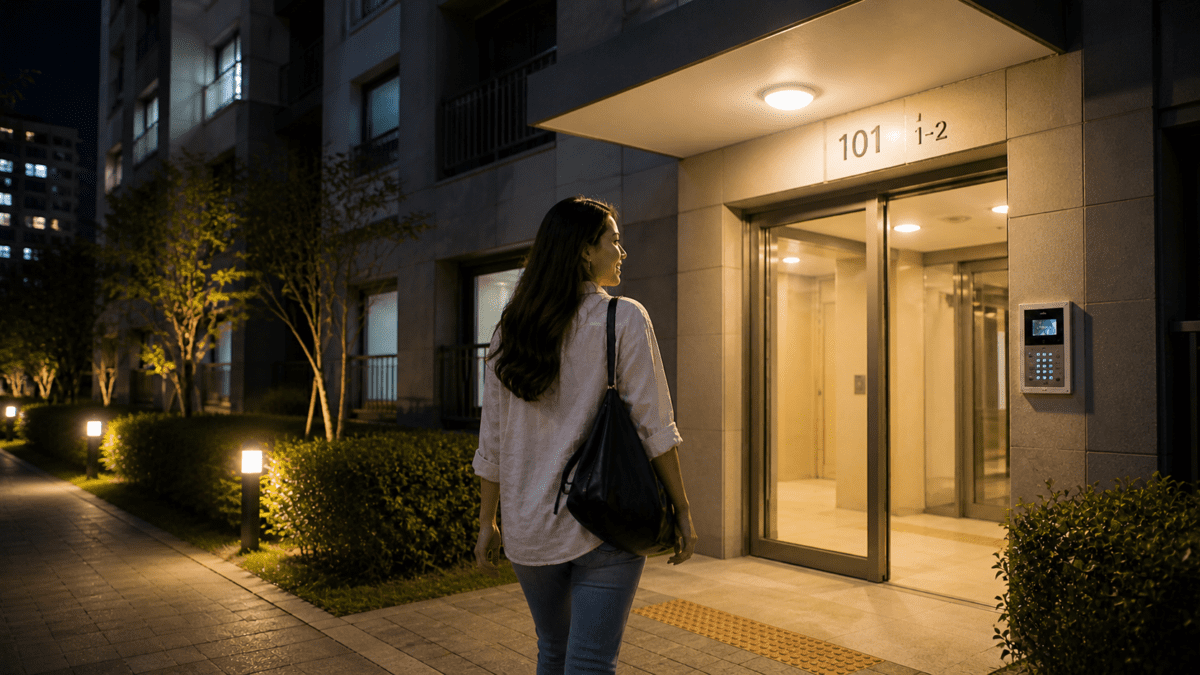
A woman takes the subway at 11 PM, gets off at her neighborhood, walks to a noraebang. She books a room. She sings for two hours. She walks to a convenience store. She sits for an hour. She walks home at 2 AM. She was alone the entire night. Nobody questioned her. Almost nobody questioned it. Nobody assumed something was wrong.
This is what changes everything: the permission. Not just the safety infrastructure (the lighting, the cameras, the police patrols). But the cultural permission. The absolute, unspoken agreement that a woman can choose solitude, that she can move through the night alone, and that this is a valid choice—not a risk she’s taking, not a defiance she’s performing, but simply what she wants to do.
Korean nightlife gives you the freedom to be with others. It also gives you the freedom to be with yourself. And it doesn’t treat one as superior to the other. Both are options. Both are normal. Both are yours to choose.
The woman jogging at 2 AM isn’t brave. The woman singing alone at midnight isn’t lonely. The woman working at a convenience store table isn’t waiting for something better. They’re all making a choice that the culture has validated by building infrastructure around it, by normalizing it, by asking no questions.
When you grow up in a culture that constantly asks, “Why are you alone?” or frames solitude as something to escape, this is revolutionary. When you move through a night where solitude is simply one of many valid options—not the second choice, but a first choice, made actively, protected structurally, and accepted culturally—everything shifts.
You stop seeing your own aloneness as a problem. You start seeing it as freedom.
This is why solo female travel to Korea matters to the women posting about it on TikTok. It’s not about the clubs or the street food or the neon lights. It’s about the permission. It’s about a city that says: You can be alone. You can be out. You can be both at the same time. And nobody will question it. Most people won’t question it. Nobody will try to fix it.
The night in Seoul doesn’t ask you to choose between solitude and safety, between being alone and being out, between your own company and the company of millions. It lets you have all of it—and it feels safe enough to be out alone at night.
What surprised you most about the freedom to be alone in Korean nightlife? Or if you haven’t experienced it yet—what would you want to do first?
Next: (Part 3) Korean Nightlife Doesn’t Ask You to Prove Anything
Night culture Korea doesn’t ask for credentials. Women and foreigners belong, and you can exist without productivity. Here’s what changes.
Content in this post was created with AI assistance.