

A canvas. Empty, mostly. White. Endless white. And then—a single dot. Blue, or red, or sometimes just a variation in the white itself. The dot sits there, alone, carrying something the entire painting couldn’t carry if it tried to fill every inch of space.
This is the Kim Whanki dot—his signature vision. This is what happens when a Korean artist leaves his country for Paris in 1956, travels through Europe, returns home briefly, competes on the international stage, and finally settles in America. What he discovered across continents was simple: emptiness is not absence. A single point of color could contain more meaning than a thousand carefully rendered objects.
Kim Whanki’s journey was long. What he found at the end of it was the weight of a single dot—and the silence that holds it.
Korea Left Behind, New York Ahead
(Wikimedia Commons, Public Domain / Edited)
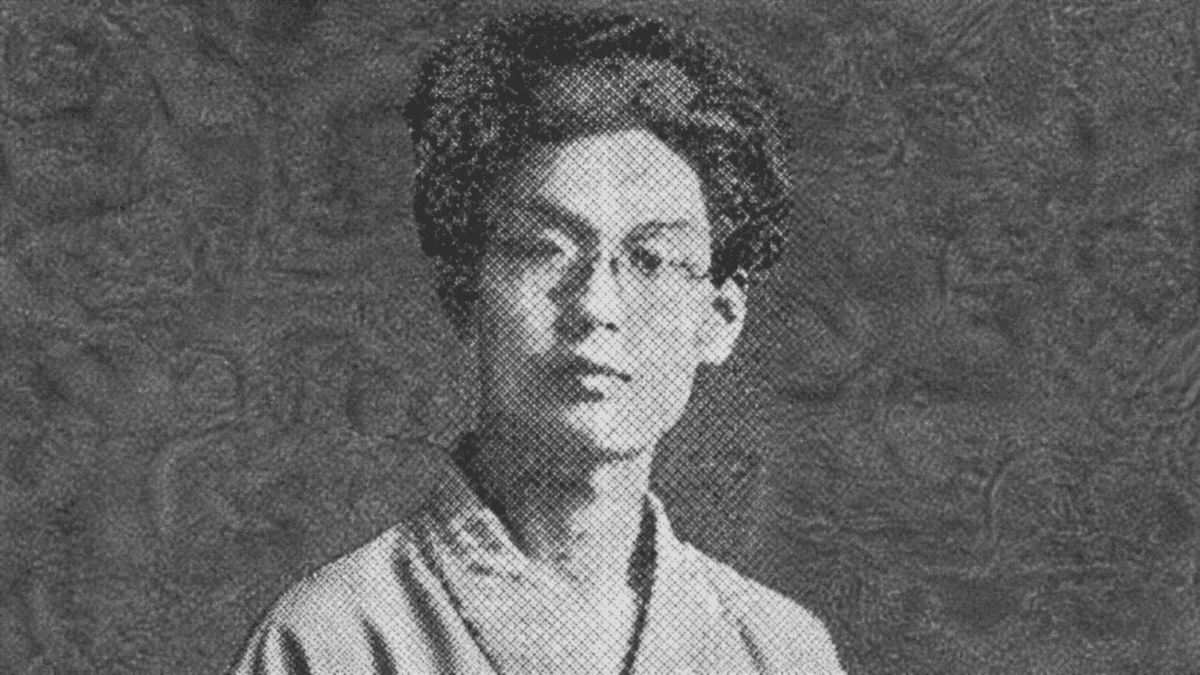
Kim Whanki was born in Korea in 1913. In 1936, he completed his studies at Nihon University’s Department of Fine Arts in Tokyo. His first solo exhibition followed in Tokyo in 1937. He returned to Korea and by 1946 had become a professor at Seoul National University’s College of Fine Arts, where he participated in the New Realism exhibitions and later served as a juror for numerous national art competitions.
By the early 1950s, Kim Whanki had achieved the kind of success that most artists spend their lives pursuing. In 1952, he became a professor at Hongik University. In 1954, he became a member of the National Academy of Arts. He was recognized. He was celebrated. He had a place in Korea’s art establishment.
But recognition in Korea’s postwar reconstruction era came with a price. Postwar Korean art institutions often favored styles and cultural priorities that were more immediately accessible and socially legible—art that could be understood immediately and that fit dominant cultural expectations of the period. Abstract painting, with its mystery and difficulty, did not easily fit the public language Korea seemed to need at the time. Kim Whanki increasingly felt drawn toward artistic directions that extended beyond the expectations of Korea’s postwar art environment.
So in 1956, at the age of forty-four, Kim Whanki left for Paris.
Leaving for Paris meant stepping away from the institutional position and recognition he had established in Korea. In Paris, he was unknown. He was simply a Korean painter with an unpronounceable name. But Paris in the late 1950s was not a place that demanded immediate legibility. In 1957, he held solo exhibitions in Paris, Nice, and Brussels. He painted. He explored. He was free.
In 1959, he returned to Korea briefly, but the pull of the international art world was stronger than the pull of home. He left again. In 1963, participating in the seventh São Paulo Biennial as Korea’s representative, he received an award of honor and gained broader international recognition. After that, he settled in America, continuing his work in the wider world.
The canvas in Paris, the recognition in São Paulo, the studio in America—these were the stages of his emergence. But they were also stages of his departure. Each step away from Korea was a step deeper into the language he was developing: the language of dots, of silence, of emptiness that speaks.
The Removal of Color, the Discovery of White
In Paris and the years that followed, as Kim Whanki moved between exhibitions and continents, something shifted in his painting. Something deeper was calling. He began to remove color. Not all of it—never all of it. But color became less insistent. Less about decoration, less about filling space and demanding attention.
What remained was white. Not the white of the blank canvas, but white as a presence. White as a deliberate choice. White as the dominant note in a composition where color became sparse, intentional, almost precious. The white was no longer a background. It had become the subject.
This wasn’t minimalism in the way the American minimalists understood it. Minimalism was about reduction for its own sake, about stripping away until only essential form remained. But for Kim Whanki, the reduction was philosophical, almost spiritual. It was about creating space for meaning rather than filling space with it. It was about understanding that less could be more—not as a slogan, but as a truth discovered through years of painting and living.
The white-dominant canvases he created in the 1960s feel almost overwhelming in their quietness. There’s a sound to them—not an actual sound, but a quality of silence so complete that your ears seem to ring in it. The paintings create a sense of stillness so complete that it feels almost physical. Standing in front of one, you feel the absence of noise as if it were a presence itself.
And in that white, dots. Sometimes dozens of them scattered across the canvas. Sometimes just a few, placed with the precision of a constellation. The Kim Whanki dot—whether blue, red, yellow, or green—sits against the infinite white field. The dots are like stars scattered across a sky so vast they seem impossibly distant from one another. The dots are like thoughts suspended in stillness.
The Kim Whanki Dot — A Whole Universe
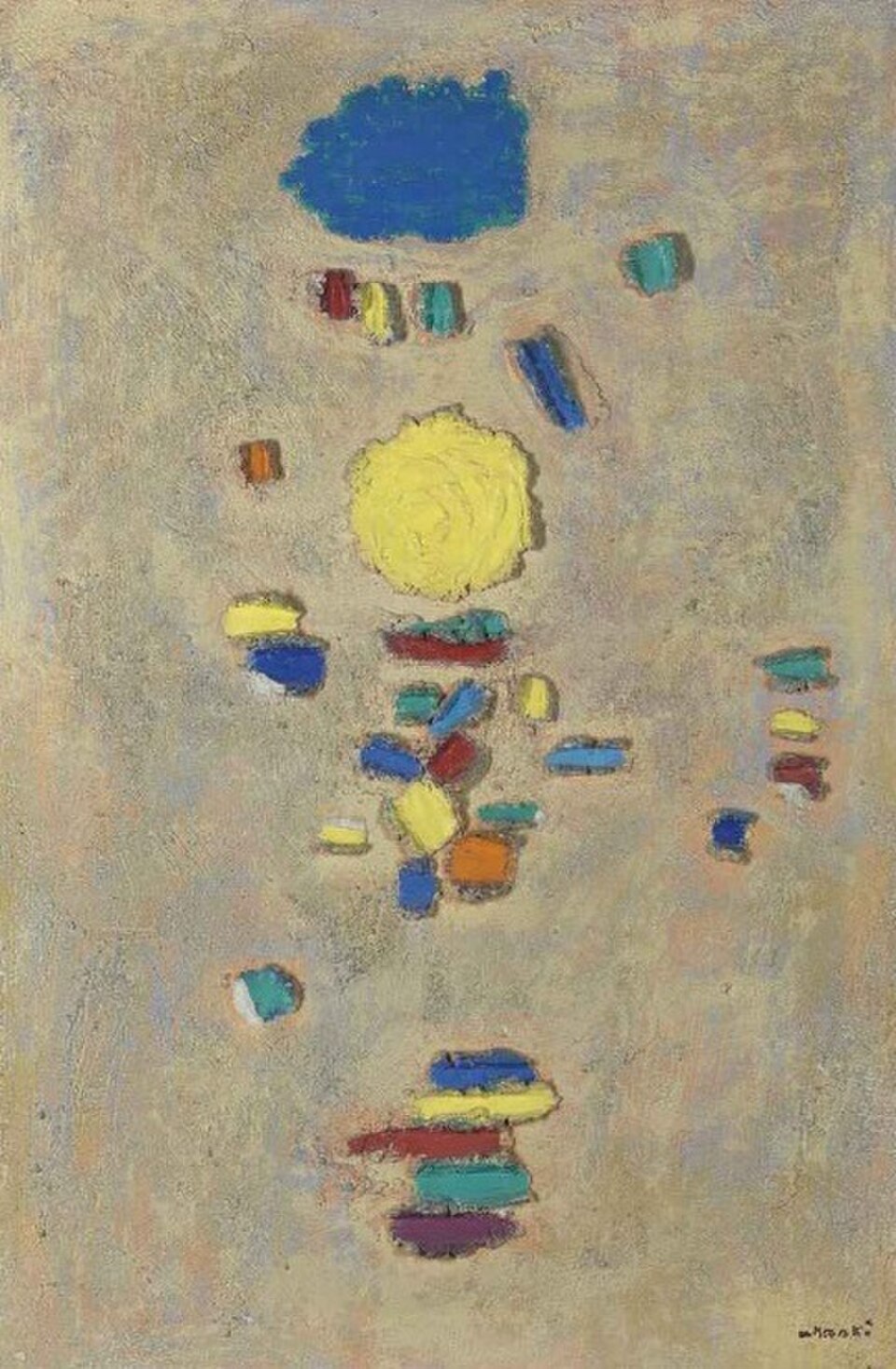
The dots became his language. This is the essential gesture of Kim Whanki’s late work: the understanding that a single point can speak for everything.
In Eastern philosophy—in Buddhism, in Taoism—there’s an understanding that the part contains the whole. That a single grain of sand can represent the infinite. That smallness and vastness are not opposites but aspects of the same reality.
Kim Whanki’s dots are this. Each one is complete. Each one carries weight. When you stand in front of a Kim Whanki canvas, you’re not looking at a small object placed on a large field. You’re looking at a universe expressing itself through the minimal means available.
The dot doesn’t need to be large to be significant. It doesn’t need to be complex to be meaningful. A blue dot on white silence is enough. It’s everything.
This felt radical beside many dominant currents on the international art stage. Many American painters were working at large scale, filling space, and demanding attention through intensity. Kim Whanki was painting the opposite: creating meaning through restraint, through emptiness, through the singular point that carries all the weight of human expression.
Museums began to acquire his work. Galleries invited him to exhibit. In 1963, when he participated in the São Paulo Biennial as Korea’s representative and won an award of honor, the world took notice. At last, Kim Whanki found the recognition he had sought. Not as a Korean artist making Korean art. But as an artist who had discovered something universal in the language of dots and white space.
The Philosophy of White Space
By the 1970s, Kim Whanki’s vision was fully formed. The white space was no longer a background. It was the art itself. The dots were almost incidental—or rather, they were everything because they existed in relation to the infinite white around them.
Kim Whanki’s work suggested a different approach to space, silence, and abstraction than many dominant Western movements of the period. The idea that emptiness could be as eloquent as fullness. That silence could speak as loudly as noise. That the space between things mattered more than the things themselves.
In Japanese aesthetics, there is a principle called ma—the space, the interval, the emptiness that gives form to what surrounds it. The white space in Kim Whanki’s paintings is ma. It’s not empty. It’s active. It’s alive. It’s the container that makes the Kim Whanki dot possible.
When you understand this, the paintings transform. They’re no longer sparse. They’re generous. They’re saying: “Here is everything you need. Here is white. Here is a dot. From these two elements, construct your own meaning. Complete the painting yourself.”
The viewer becomes a collaborator. The viewer fills the silence with their own thoughts, their own emotions, their own understanding of what a dot means, what white means, what the relationship between them expresses.
This is the quiet confidence of Kim Whanki’s art: he leaves space for the viewer to complete the meaning.
The white is not empty. The dot is not small. They exist only in relation to each other. Remove one and the other loses all meaning. This is the secret Kim Whanki understood: a complete universe requires both presence and absence, both visible and invisible. Neither can be diminished without diminishing the whole.
This post was planned and edited by a human, with AI assistance.