In late 2001, at the age of 23 (turning 24 by year’s end), Park Jae-sang stepped onto a stage wearing a necktie. His hands moved in a motion like he was rubbing his arms. Years later, Psy would describe the gesture as something accidental—a cramped arm, an unconscious movement in a club. The Psy dance hadn’t been designed. It had simply happened.
What makes a movement dangerous? Not the technical difficulty. Not the physical risk. The movement looked casual. That was what made television nervous. It moves through space as if space belonged to it. In the conservative broadcast culture carried over from the late 1990s, this kind of gesture was a problem.
The necktie around his neck. The arms rubbing. The posture twisted between awkwardness and intention. None of it fit. None of it asked permission first. And in a system built on control, that was everything.
The Psy Dance That Shocked Television
The debut song was “Bird.” The debut album was PSY From The Psycho World! But what people remembered wasn’t just the song—it was the Psy dance. It was unlike anything Korean broadcast networks had encountered before.
Broadcasters responded immediately. Youth-restriction controversies followed. The movement—that careless rubbing of his arm—looked different in the context of late-1990s Korean television. It wasn’t innocent. It wasn’t neutral.
In the conservative broadcast culture of that moment, intention mattered as much as movement itself. There was a clear line between what you should do and what you shouldn’t. Dance, too, was supposed to respect that boundary. Psy dance ignored it. More than that—it made the boundary itself into dance.
Censorship doesn’t announce itself. It works through quiet pressure. A network executive mentions that “the movement looks inappropriate.” A producer suggests “maybe we should adjust this part.” An editor removes footage without explanation. By the time you realize you’re being controlled, you’ve already internalized the control. The message is clear: this body is too much. This movement says too much.
What unsettled Korean television wasn’t technical skill. It was the attitude the dance carried. The difference between thinking “this should be fine” and deciding “this can’t happen” was thin. Psy crossed that thin line. And paradoxically, that’s what made him impossible to forget.
The Fool’s Philosophy
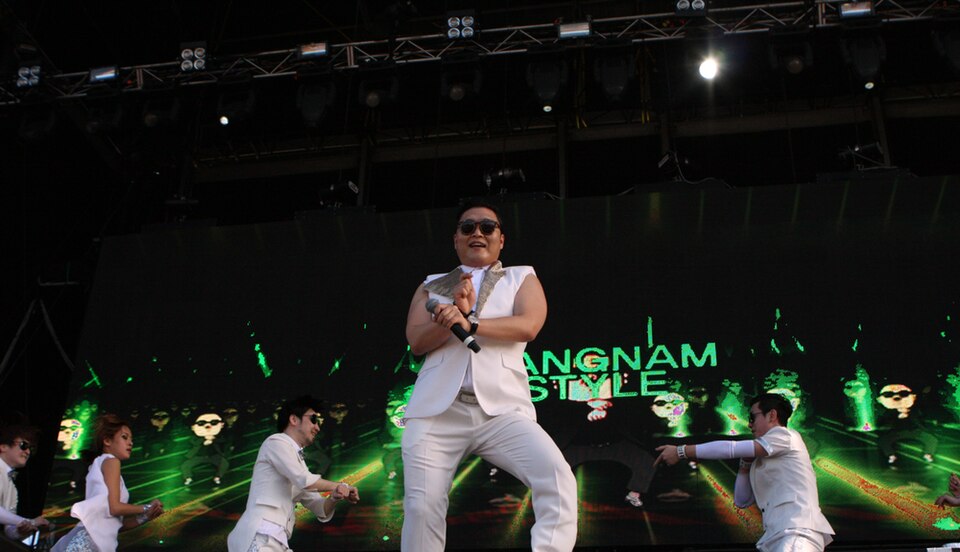
Here’s what matters: Psy was not a trained dancer.
He dropped out of Boston University. He studied at Berklee College of Music but drifted toward clubs, composition, movement. What remained was an obsession with moves that made people watch. Not beautiful. Not precise. Memorable.
The Psy dance didn’t need to be technically proficient. It needed one thing: to fill the room. To occupy the space. To say something through motion without asking first.
Most dancers spend years perfecting the craft. Perfect alignment. Perfect weight distribution. Perfect illusion of effortlessness through technical exactness. Psy did the opposite. A cramped arm in a club. An exaggerated posture. A face twisted into something between a smile and a grimace. These weren’t mistakes. They were design.
Late 1990s Korean music was already built on the idol system. Young singers trained in groups for years. They wore the same clothes, moved in the same formations, performed identical choreography with mechanical precision. Every gesture synchronized. Every step predetermined. Bodies became instruments of the system. Individual will was erased in pursuit of perfect unity. This was safety. This was control.
Against this backdrop, Psy dance looked like someone had switched off the rules themselves. You couldn’t predict where his hands would go. How his legs would unfold. What angle his face would twist into. The unpredictability wasn’t lack of skill—it was the point. It was design. It was refusal. A body that insisted on being itself, that refused to be small, that occupied space as if it had the right to be there.
Broadcast television preferred choreography that looked controlled. Psy looked impossible to predict. Psy dance looked like the body refusing to be small. And in a system built on control, that refusal was everything.
Military Service Twice
From roughly 2003 to 2012, Psy’s public career was interrupted. Six years when other artists performed, released albums, built audiences. For Psy, military service and legal controversy restricted his public performances. No possibility for Psy dance.
Military service flattens everything equally. The system doesn’t care what you were before you arrived. It doesn’t preserve individual identity. Individuals become the collective. Expression becomes obedience. Dance becomes marching. Psy was flattened too. Between the long legal battles and a second enlistment, a significant portion of his career unfolded in silence and invisibility.
This is what silence teaches you: that the world doesn’t stop. That other people continue living. That the culture you helped create moves forward without you. By the time you return, everything has changed. You’re the same person, but you’re arriving in a completely different moment.
The silence also teaches you what dance actually is, when you can’t do it. You realize it’s not movement. Movement is easy. Dance is something else—it’s a way of occupying space. A way of refusing invisibility. A way of saying “I exist and I will not be small.” Without that possibility, you learn what you were actually expressing. You learn what you took for granted.
Standing Again on Ground

2012. Psy returned. As someone who had waited.
More than a decade had passed. The censorship of the 1990s had transformed. The internet had arrived. YouTube existed. Smartphones existed. The walls had begun to disappear.
“Gangnam Style” was released in July 2012. It was the same man. The same obsession with movement that makes people watch. The same refusal of technical perfection in favor of memorability. But the world was ready in a way it had never been.
What determines everything is not the movement itself, but the moment in which the movement happens. Between 2003 and 2012, the world had been rebuilt. The broadcast networks that once controlled what a nation could see had lost their monopoly. Digital platforms operated by different rules. No single gatekeeper. No central authority. No way to control what spread. By 2012, online platforms such as YouTube had greatly reduced the influence traditional broadcasters once held over music distribution. The video was already everywhere. They could broadcast or not broadcast—it didn’t matter. The system had changed. The dance hadn’t.
What broadcast networks feared in 2001 was finally, in 2012, what the world needed. Not because Psy dance changed. Because the walls disappeared. Because the moment finally arrived.
He hadn’t forgotten how to dance. He’d learned, in those silent years, what that movement could actually do. Not when walls were watching. But when walls had disappeared. Not in the context of control. But in the context of freedom. He understood now what he’d always suspected: that the dance was waiting for this exact moment. That all those years—the military service, the legal battles, the invisibility—had been preparation. A conversation between the artist and history. Waiting for history to say yes.
The same dance looked completely different once the world around it changed. It had been waiting the whole time. Not in anger. Not in resentment. Just waiting. Patient. For the conditions to be right.
You stand in a crowd now. You watch the Psy dance on a screen. Your body recognizes it. Your legs want to move. Your arms want to rub in that same gesture. The movement that once made Korean television nervous now makes people in 190 countries move together, each person completing it in their own way. In military barracks and corporate offices and street corners and weddings and airports. The same dance. The same refusal. The same insistence that the body has the right to speak without asking permission first.
The same Psy dance once treated as a problem became a global phenomenon. Not because it was polished or perfected. Because it refused to be controlled. Because it waited for history to catch up. Because sometimes a revolution arrives not as anger, but as a movement you can’t resist repeating. A gesture that says: I exist. And I will not be small.
This post was planned and edited by a human, with AI assistance.