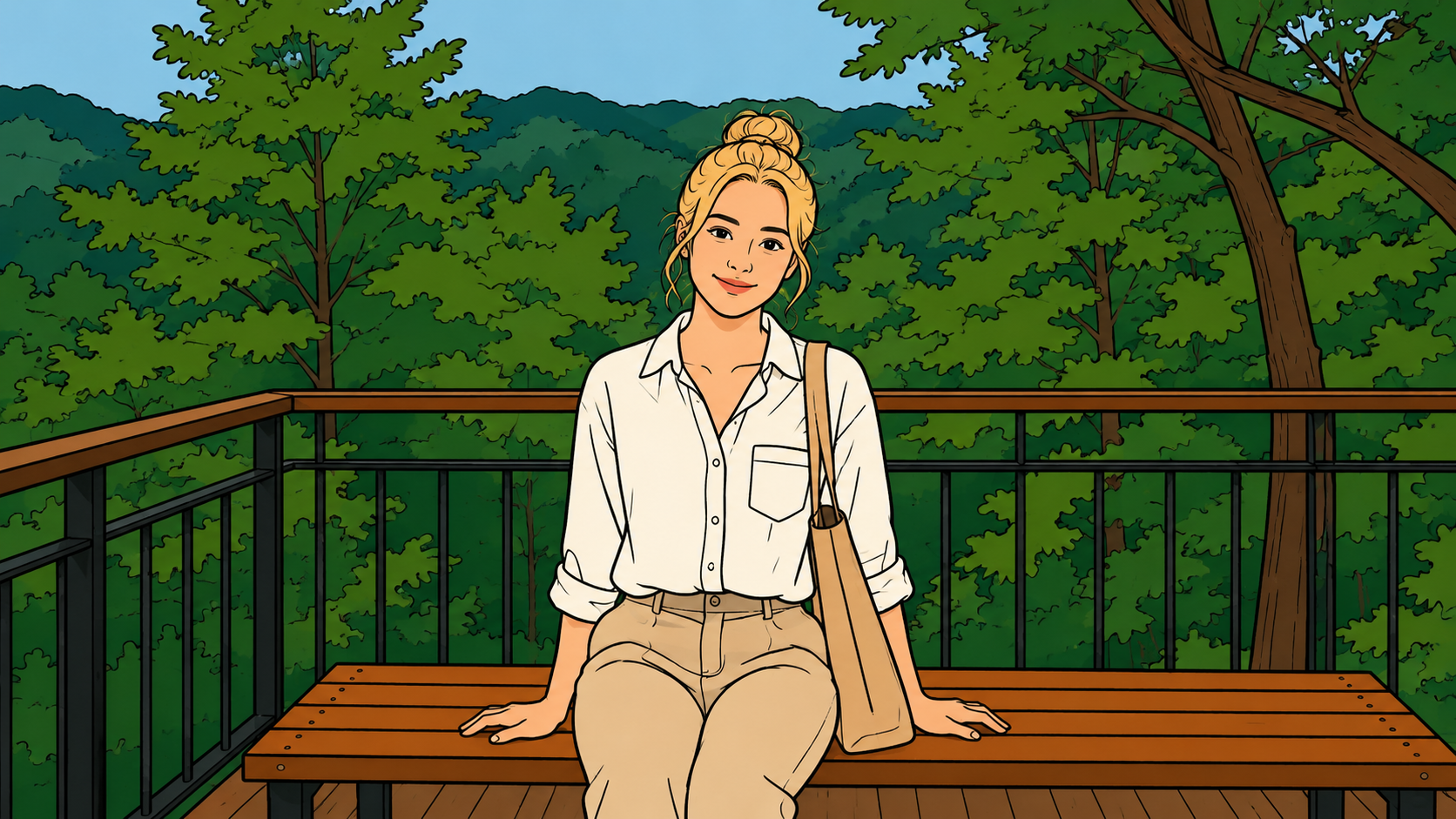

Seoul doesn’t reveal itself from the street.
At street level, the city is walls and intersections and the backs of buildings. You navigate it without seeing it. To actually see Seoul — the shape of it, the scale, the way it sits between mountains and river — you have to get above it. The Namsan observation deck is built into the trail itself — eight stops, eight different answers to the same question. None of them show you the same city.
The trail was built around this idea. The zigzag path, the long way around, the gradient that never exceeds 4.6 degrees — all of it exists so the trail arrives at each stop from the right direction, at the right height, with the right thing in front of you. The viewpoints aren’t placed where the construction was easiest. They’re placed where Seoul is most itself.
The Views That Don’t Show the City
The first thing the trail teaches you is that not every viewpoint faces outward.
Five minutes from the entrance, the path opens onto the Zelkova Deck — a platform built around an old zelkova tree. Not beside it. Around it. The trunk grows through the structure, and the branches extend over the platform on both sides. There are bench-beds here, flat enough to lie back on. You look up through the branches at a sky broken into irregular shapes by the canopy. To the left, gray buildings. To the right, more trees.
The view here is the tree itself. The underside of it. The way the branches divide and divide again, the light shifting through gaps when the wind moves. You’re looking up at something that has been here for decades, doing exactly what it has always done, while Seoul built itself around it.
Further along, the Adventure Bridge and the Wind Bridge cross a gap in the canopy through a stand of metasequoia — tall, narrow trees that grow in columns rather than spreading outward. The Adventure Bridge sways slightly underfoot. From it, you can see the Wind Bridge across the gap: a thin line of wood suspended between trees, and on it, people who look small against the height of the metasequoia.
The Wind Bridge earns its name. The trees channel whatever is moving through the air, and on the bridge you feel it directly — a pressure on one side of your face, the sound of it in the upper branches.
Neither stop shows you Seoul in the way a Namsan viewpoint is supposed to. What they show you instead is the forest from inside it, at the height where the trees are doing most of their work. That turns out to be its own kind of view — one that takes longer to describe because it doesn’t photograph well.
The Views That Show You the Shape of Things

Halfway through the trail, a set of stairs leads up from the main deck. They’re the only stairs on an otherwise stair-free path. At the top: a circular platform seven meters above the ground, 360 degrees, no obstruction.
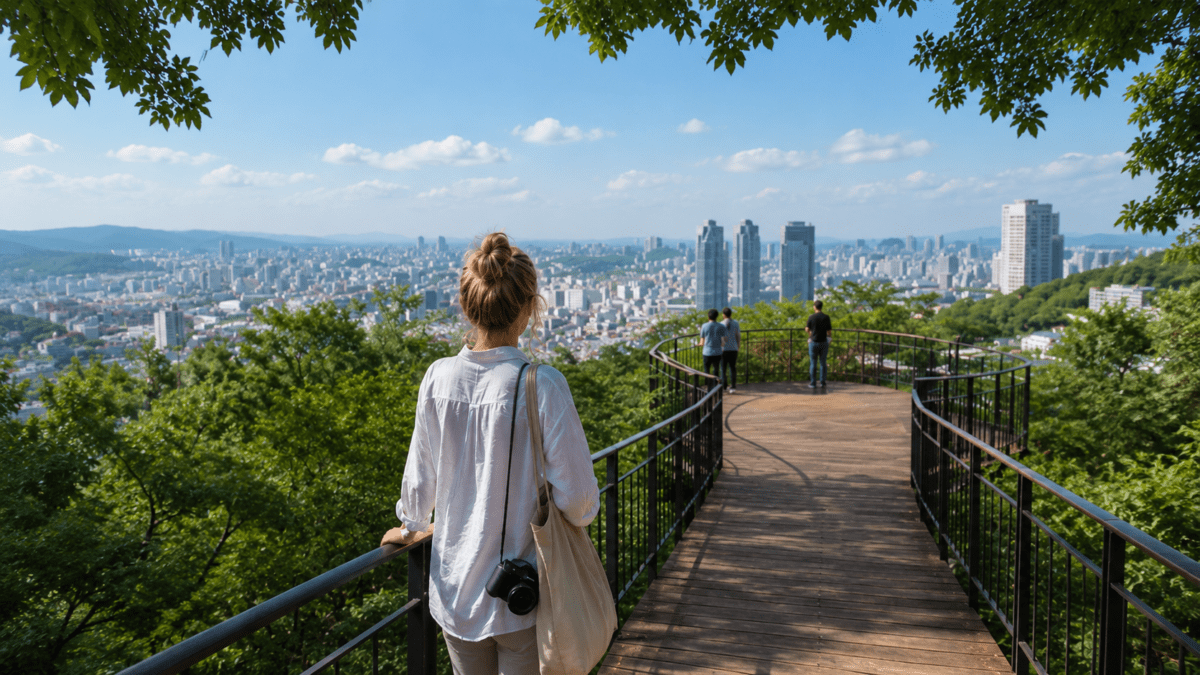
From the Pine Light Observatory, the relationship between forest and city inverts. Below you: treetops, the zigzag line of the deck through the green. Around you: Seoul in every direction. The Han River to the west. The ridge of Bugaksan to the north. Yongsan spreading outward in a grid that makes more sense from above than it ever does from inside it.
This is Seoul from the Namsan observation deck— not the street-level version you navigate, but the overhead version that shows how much of it is still mountain. From this height, the green is not a park surrounded by buildings. The buildings are surrounded by green. That reversal takes a moment to settle.
Twenty minutes into the trail, the canopy breaks again at the Sunset Deck. The platform extends outward with a pointed tip that angles slightly upward, and at the end the railing is glass. Beyond it: Yeouido, the Han River, the western half of Seoul. The glass has small droplet-shaped stickers spaced across it — there so birds don’t fly into the surface. Easy to miss. The kind of detail you notice once and can’t unnotice, after which the railing stops being infrastructure and becomes something more considered.
At sunset, the sky above Yeouido turns in sequence. Yellow first, then orange at the edges, then the shade the Korean word 노을 captures better than anything in English. The city below stays lit and indifferent. The lights coming on across Yongsan while the sky is still changing above Yeouido — that ten-minute overlap when the city is doing two things at once — is what this deck was positioned to catch.
This is the stop people set timers for.
The Views That Depend on When You Come
Two stops on the trail work differently depending on the season. Not better or worse in any absolute sense — just calibrated to a specific window that most visitors don’t plan around.
The Cherry Blossom Deck sits directly under the canopy of several mature cherry trees. In June it’s shaded and quiet — pleasant, not remarkable. The deck does its job. People pass through it, rest briefly, move on.
Come back in late March and the same deck becomes something else entirely. The petals fall onto the wooden planks and collect in the corners. Some land on your shoulders. The view isn’t of Seoul. It’s straight up — branches, flowers, sky in the gaps between them. Pink against blue, or pink against gray if the weather is overcast, which is its own version. Either way, the city disappears. For a few weeks every year, this stop has nothing to do with Seoul at all.
It’s the only stop on the trail that works decisively better in one specific window. The summer version is fine. The spring version is the reason people come back.
The pine rest area near the trail’s end is easy to walk past entirely. There’s no signage drawing attention to it, no glass railing, no dramatic drop. Just a cluster of old pines, benches underneath, and through the branches, Namsan Seoul Tower visible without effort — not framed dramatically, just present — another Namsan observation deck that works without trying.
The wood of the benches is warm in the afternoon. The pine needles catch the light differently depending on the hour — sharp in the morning, softer by four, nearly amber at dusk. Most people arrive somewhere in the middle and leave without knowing what they missed at either end. That’s fine. The pines don’t mind.
What Eight Versions Add Up To
Eight viewpoints. Eight different ways of seeing the same city.
Some face outward. Some face up. Some depend on the season, or the hour, or whether you thought to climb the one set of stairs on a stair-free trail. The zelkova deck looks up at a tree that predates most of the city around it. The Pine Light Observatory shows you Seoul’s actual footprint. The Sunset Deck catches the city mid-transition. The cherry blossom deck, in late March, shows you something that will be gone in two weeks.
Most people do the trail once, quickly, and leave satisfied. The trail doesn’t require more than that.
But the eight stops don’t exhaust themselves in a single visit. The Sunset Deck in June is not the Sunset Deck in October. The pine rest area at noon is not the pine rest area at four in the afternoon. The zelkova deck in summer, when the branches are full, is a different experience from the zelkova deck in late autumn, when the leaves are gone and the structure of the tree is visible without interruption.
The trail stays the same. What changes is everything around it — the light, the season, the hour, the city visible through the gaps in different configurations each time.
Standing on the trail, it’s easier to see what the timing layer most systems don’t read actually looks like.
That’s not a reason to come back. It’s just what’s true.
This post was planned and edited by a human, with AI assistance.