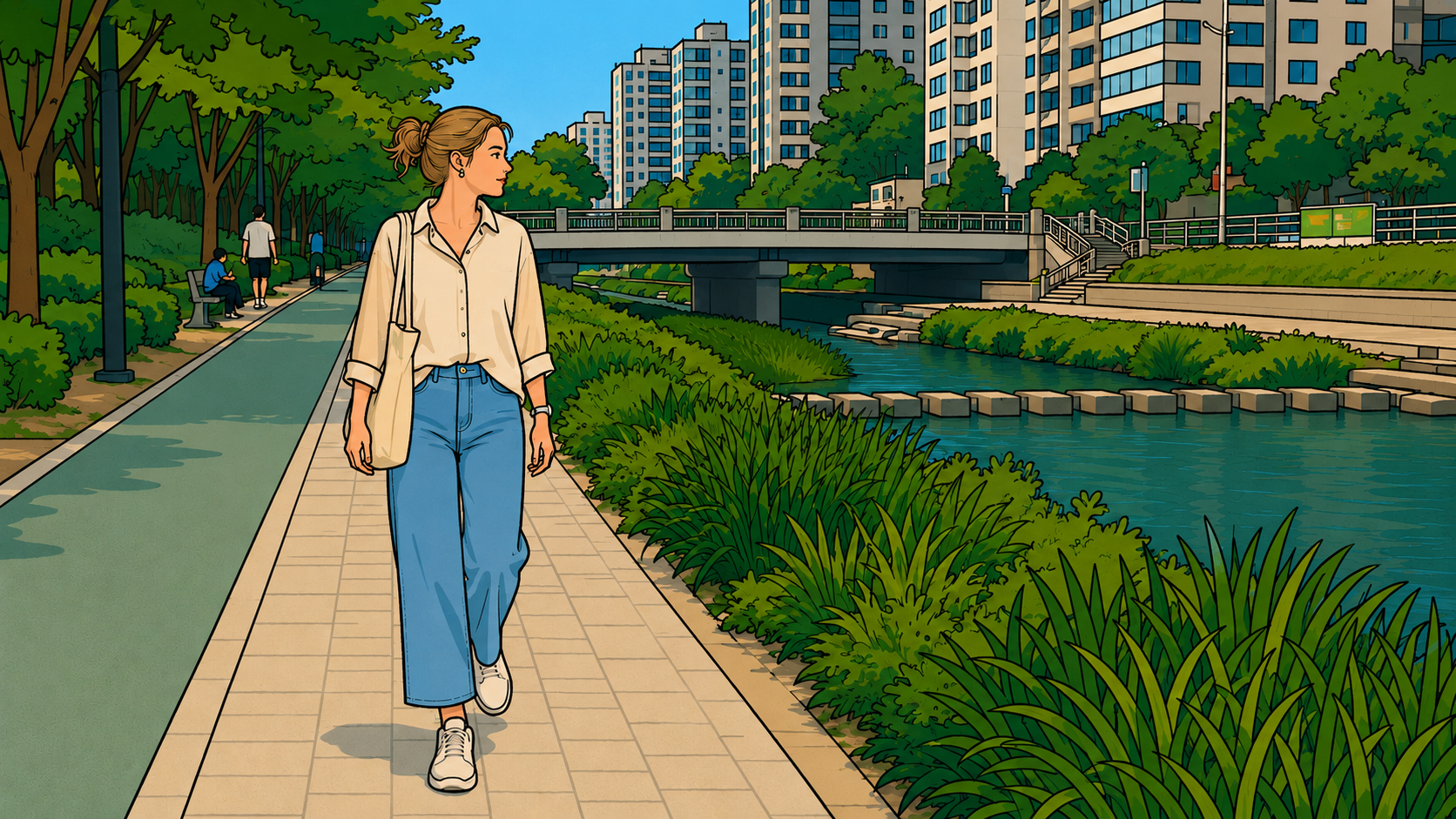
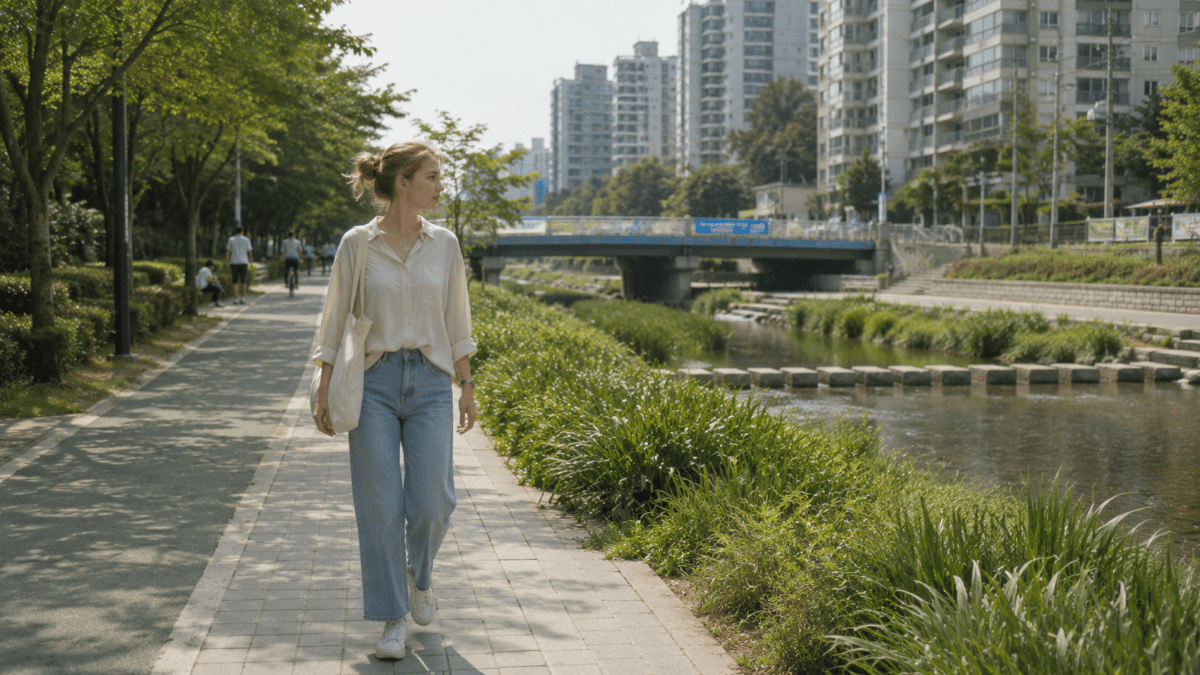
There is a particular hour in Korean neighborhoods when the streets fill without anyone planning it.
Dinner is finished. The dishes are done, or not done yet, but either way the door opens and someone steps outside. Not for exercise. Not to get somewhere. Just to walk. In the time it takes a cup of tea to cool, the sidewalks shift — couples, grandparents, people alone with their hands in their pockets, a dog pulling slightly ahead. Nobody announced this. It happens every evening the way the light changes: gradually, then all at once. This is walking in Korea at its most ordinary — and its most consistent.
It’s closer to punctuation — the pause at the end of the day before the next thing begins. It doesn’t require good weather, a destination, or a reason anyone else would recognize. It requires only that dinner is finished and the door is there.
Not Exercise — Just Walking
The distinction matters.
Exercise has targets. A distance to cover, a heart rate to hit, a number to log. It begins with intention and ends with completion. Korean evening walks don’t work like that. There’s no app running in the background. No route mapped in advance. No outcome expected. The walk starts when the door closes and ends when it feels right to turn back.
This isn’t laziness. It’s a different category entirely.
This kind of walking carries none of the effort implied by exercise. It’s closer to wandering with direction. The body moves, the mind loosens, and somewhere in between, the day gets processed without anyone deciding to process it. The difference between this and exercise is the difference between breathing and running wind sprints. One is something you do. The other is something you are.
Watch someone on an evening walk in a Korean neighborhood. They’re not pushing. They’re not tracking. They stop when something catches their eye — a new sign on a familiar shop, a cat on a wall, the particular way the light is hitting the building across the street. Then they keep going. Nobody checks the time. Nobody wonders if they’ve gone far enough.
The goal, if there is one, is simply to have gone.
This is a harder concept to export than it looks. In cultures where movement is justified by outcome, a walk without a destination can feel like a failed errand. Walking in Korea operates from a different premise: the walk is the point. The movement is the arrival.
Streets That Come Alive After Dark
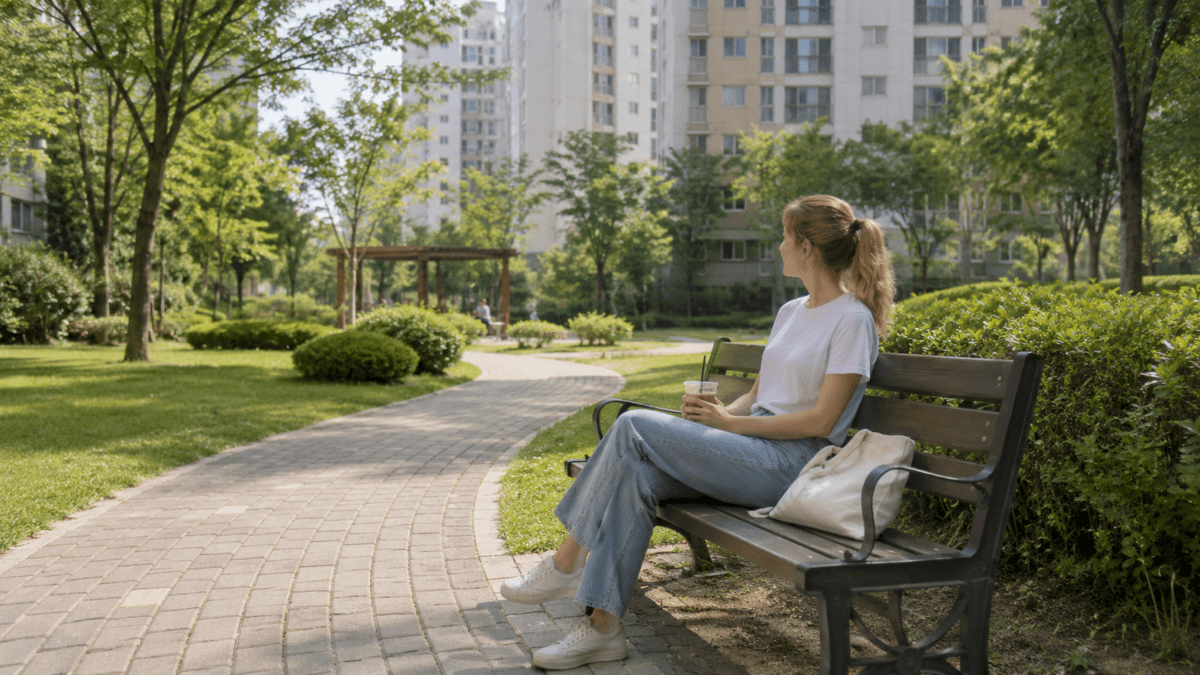
Korean residential neighborhoods are designed, accidentally or not, for exactly this kind of movement.
The blocks are scaled for walking. Convenience stores appear at intervals that feel timed for a thirsty person mid-route. Benches show up where you’d want them — near a small plaza, at the top of a gentle incline, beside the stretch of path that runs along a wall of old apartment buildings with their windows lit yellow. The infrastructure of the evening walk exists without ever being called that.
After dark, these streets change register. During the day they’re functional — people moving with purpose, delivery bikes threading through, the particular efficiency of a city that doesn’t like to wait. After eight, the same streets slow down. Voices carry differently. Someone is playing music from an open window two floors up. The smell of the evening meal still hangs in the air near the stairwells. A group of older men occupies a bench near the entrance of an apartment complex, the way they occupy it every evening, in the same configuration.
This is the version of the neighborhood that only walkers see. The one that exists in the hour between dinner and sleep, when the streets belong to no one in particular and everyone at once. It’s also, notably, a city where walking alone at night carries a different weight than it does in most places — something worth its own conversation. A tourist moving through the same block in the afternoon would see a different city entirely — faster, louder, less willing to be observed. The evening walk reveals the neighborhood at rest, doing what it actually does when performance isn’t required.
There is a specific quality to the light in Korean residential neighborhoods after eight. The convenience store fluorescence, the warmer glow from apartment windows, the occasional orange street lamp. None of it is dramatic. All of it is familiar. Walking through it feels less like being in a city and more like being inside something that has been lived in for a long time.
The Same Route, Never the Same Day
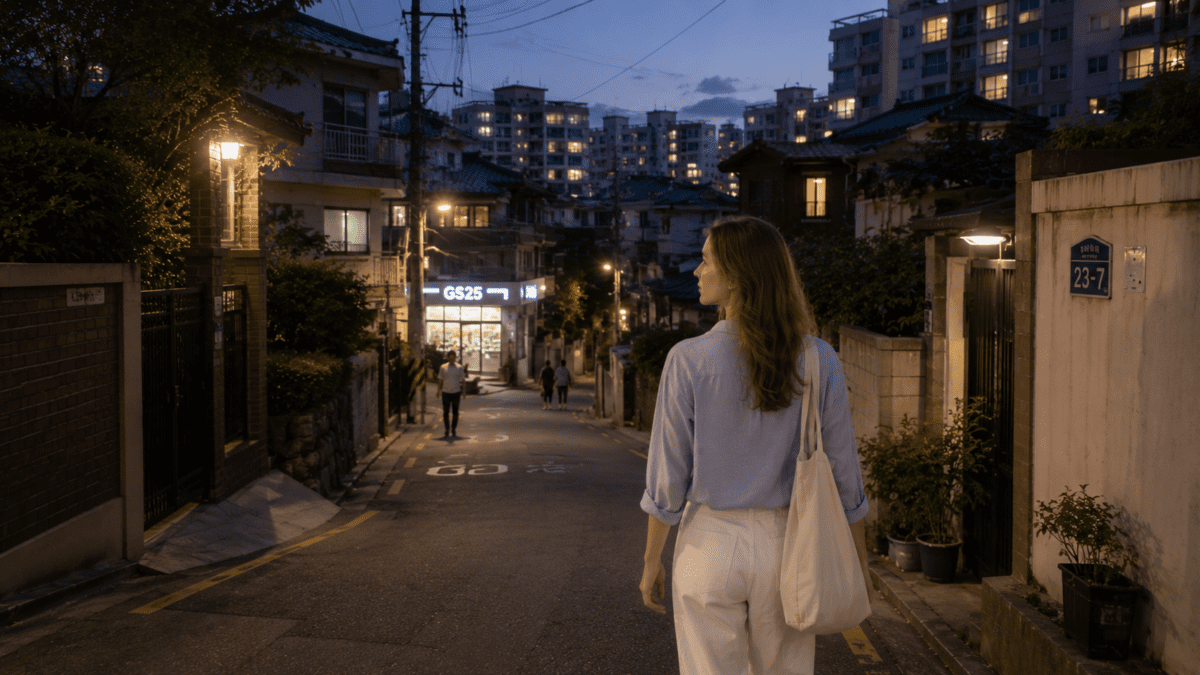
Most evening walkers in Korea have a route.
Not a fixed one — more like a preferred radius. The block around the apartment. The path that runs along the stream two streets over. The slight uphill section that opens onto a view of the neighborhood below. The route is known well enough that the body follows it without consulting the mind.
And yet it’s never the same walk twice.
The woman who sells fruit near the corner has rearranged her display. The zelkova tree at the end of the block has dropped enough leaves that the light through the branches is different tonight than it was last week. A family is sitting outside on folding chairs, three generations sharing something from a bag, a conversation happening in the particular overlapping way of families who have had this conversation many times before. The small changes accumulate — not noticed exactly, but registered. Filed somewhere.
This is what the repeated route does in Korean walking culture. It creates a baseline detailed enough that variations become visible. The walker isn’t looking for novelty. They’re looking at the same thing often enough to notice when it changes. That’s different. Novelty demands attention. Familiarity rewards it. The route becomes a kind of long-term observation project — not undertaken deliberately, but accumulated over months and years until the walker knows this particular stretch of city the way you know a face you’ve seen every day. Not by analyzing it. Just by having been there.
Regulars recognize each other without speaking. The woman who walks the small white dog at the same hour. The older man who always stops at the same bench for five minutes before continuing. They nod, or don’t. The acknowledgment is in the recognition itself — we are both here again, doing the same thing, in the same place. That’s enough.
How Repetition Resets the Mind
There is something specific that happens on a walk you’ve taken many times before.
The decisions run out quickly. The route is known. The body takes over. And in that handoff — from conscious navigation to muscle memory — something else gets space. The unfinished thought from the afternoon. The conversation that didn’t go the way it should have. The thing that needs deciding but keeps getting postponed.
None of this gets resolved on purpose. It just surfaces, floats, and settles differently by the time the walk ends. Not solved — rearranged. The problem is the same, but the walker’s relationship to it has shifted slightly. Enough to sleep. Enough to try again tomorrow.
Walking in Korea understands this without theorizing about it. The evening walk isn’t prescribed as a mental health practice. It isn’t sold as mindfulness. It’s just what people do after dinner, the way they’ve done it for as long as anyone can remember. The grandparent who takes the same loop around the apartment complex every evening isn’t optimizing for cognitive function. They’re doing what the evening calls for. The reset happens whether or not anyone is paying attention to the reset.
That might be why it works. The moment walking becomes a wellness practice — tracked, scheduled, optimized — something of its original logic gets lost. Korean walking culture works precisely because it makes no claims. The rest follows on its own.
Some things only become visible when the season is right — and so do some patterns. The evening walk is one of them. Most people think they’re walking the neighborhood. After enough evenings, the neighborhood has been quietly teaching them how to notice. It asks nothing except that they show up.
This post was planned and edited by a human, with AI assistance.