

The relationship growth a situationship gives you doesn’t arrive while you’re in it.
It arrives after. Sometimes weeks after. Sometimes in the middle of an ordinary Tuesday when something small — a text from a different person, a song in a café, a question someone asks you — lands differently than it would have before. And you realize you know something now that you didn’t know then. Not because someone told you. Because you lived it.
What situationships teach you isn’t always comfortable. Some of it is about the other person. Most of it is about you.
How Relationship Growth Changes the Way You Handle Ambiguity
Most people enter a situationship with a vague sense of what they want. Companionship. Connection. Something that feels like it’s going somewhere. The situationship provides some of those things and withholds others, and what you learn — slowly, through the gap between what was there and what was missing — is a more precise version of what you actually need.
She’d thought she was fine with something casual. That’s what she’d told herself at the beginning, and it wasn’t entirely untrue. But somewhere in the middle of the months she spent adjusting her expectations, softening her questions, learning to want less out loud than she wanted internally — she found the edge of what she could actually tolerate. Not through a dramatic realization. Through the quiet accumulation of knowing that this wasn’t quite it.
What situationships teach you about what you want is specific in a way that general self-reflection rarely achieves. You don’t learn it in the abstract. You learn it by wanting something that wasn’t there. By feeling the precise shape of the gap. By noticing, over and over, where the situation fell short of something you hadn’t fully named until it was absent.
The clearest picture of what you need tends to emerge not from getting it, but from living alongside its absence long enough to understand its exact dimensions.
She walked through Jeonju Hanok Village one afternoon, past the old tiled roofs and the narrow lanes she’d wanted to bring him to once, and thought about what the last several months had clarified. Not about him. About herself. About what kind of presence she needed from someone for this to feel like enough. The answer was more specific than she’d expected. Specific enough to be useful going forward.
What You Learned About How You Handle Ambiguity
Some of the deepest relationship growth comes from sustained contact with uncertainty — what you do inside that uncertainty reveals something real about your own patterns.
Some people discover they’re more comfortable with ambiguity than they thought. The not-knowing didn’t destabilize them the way they expected. They were able to hold the openness without needing to resolve it. That’s useful information.
Other people discover the opposite. They find that ambiguity activates something in them — a watchfulness, a low-level anxiety, a tendency to over-read signals — that costs more than they realized until they saw what it looked like over time.
She’d thought of herself as someone who was good with uncertainty. Flexible. Not someone who needed everything defined. The situationship taught her that this was partly true and partly a story she’d been telling herself. She was good with uncertainty in some areas. In this one, she’d been tracking everything carefully, adjusting constantly, working harder than she’d known to keep her equilibrium. That wasn’t ease with ambiguity. That was management of it. And management, sustained over months, is exhausting in a way that ease isn’t.
What situationships teach you about ambiguity is often less about your relationship to the other person and more about your relationship to not-knowing itself.
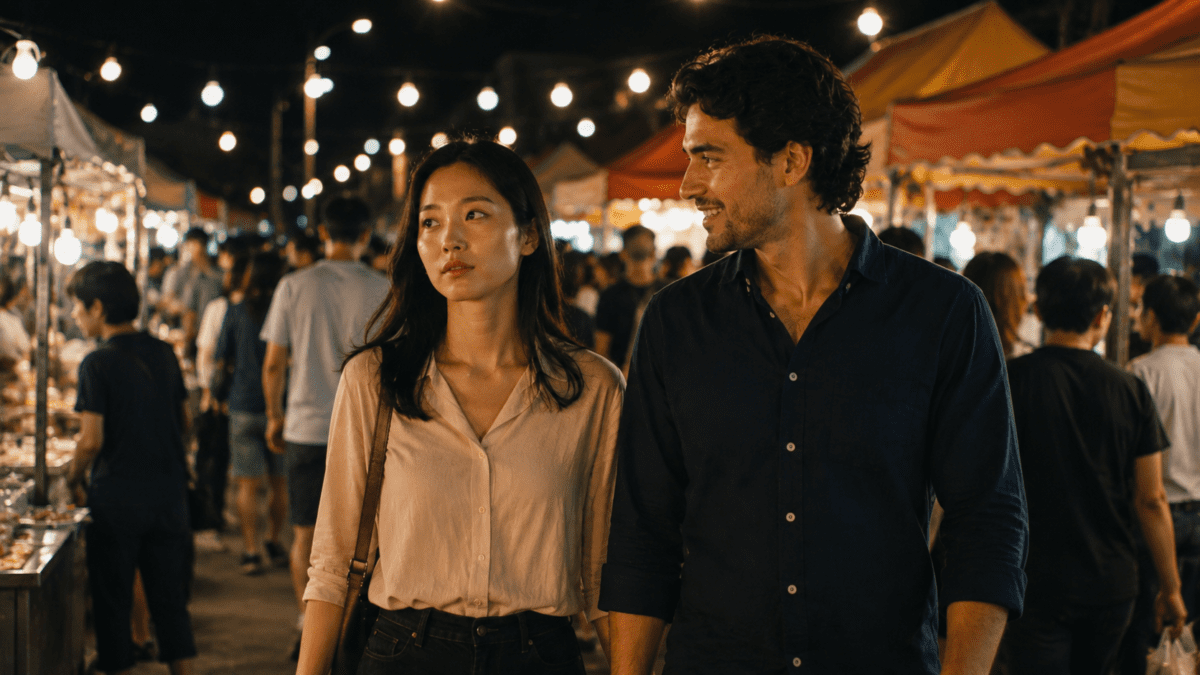
They’d wandered into Jeonju’s night market one evening, the kind of crowded summer night where everything feels slightly temporary. She’d spent most of it half-present — aware that she was enjoying herself and also aware of the background calculation that hadn’t quite switched off. She noticed that. Filed it away. It became part of what she knew about herself now.
What You Learned About Your Own Patterns

This is the part that takes the longest to see clearly — not what happened in the situationship, but what you brought into it.
The way you respond to ambiguity. The things that make you stay longer than you intended. The version of yourself that shows up when you care about something but aren’t sure if you’re allowed to show it. The adaptations you make so automatically that you don’t notice you’re making them until later, when you’re outside the situation and can see the shape of what you were doing.
What situationships teach you about your patterns is harder to see than what you want or how you handle uncertainty. But it tends to be the most durable piece of information.
She realized, slowly, that she had a particular way of making herself smaller in situations where she wasn’t sure she was welcome to take up her full space. It wasn’t something she’d chosen. It was something she’d developed, probably long before this situationship, that got activated here. The situationship hadn’t created the pattern. But it had given her a long, clear look at it.
She walked through a Jeonju side street in the early evening, past small restaurants with their doors open to the summer air, and thought about the version of herself that had been operating for the last several months. That version wasn’t wrong. It was doing its best inside a structure that didn’t quite fit. But knowing it was there — really knowing it, not just theoretically — changed something about how she would move forward.
What the Experience Was Worth
There’s a question that comes up after a situationship ends, sometimes asked by the person themselves, sometimes by people around them: was it worth it?
It’s a hard question to answer honestly, because it requires holding two things at the same time. The cost was real. The time, the emotional work, the recalibration, the quiet grief of an ending that didn’t announce itself — all of that was real and it wasn’t nothing.
And the learning was also real. What situationships teach you isn’t available any other way. You can’t read your way into knowing what you need, or how you actually handle sustained uncertainty, or what patterns you bring into situations where your feelings aren’t confirmed. You have to live it. The knowledge is inseparable from the experience that produced it.
The experience doesn’t have to have been worth it in terms of outcome to have been worth it in terms of what it taught you. Those are different calculations.
What you’re left with, after the grief settles and the after becomes ordinary, is real relationship growth — a more accurate map of yourself. Not a perfect map. But more accurate than the one you had before. That accuracy is something you get to keep, regardless of how the situation ended, regardless of what it was or wasn’t while it was happening.
That’s what situationships teach you. Not lessons you could have learned from a book. The specific, embodied, hard-won knowledge of what you’re actually like when you want something you’re not sure you’re allowed to want.
It doesn’t always feel like learning while it’s happening. Usually it feels like confusion, or adjustment, or just getting through the week. The learning is only visible in retrospect — which is part of why people underestimate what they got from the experience. Not because nothing happened. Because everything that happened was happening too close to see clearly at the time. Distance is what makes the shape of it visible. And by the time you have the distance, you already have the knowledge. You just didn’t know that’s what it was called.
This post was planned and edited by a human, with AI assistance.