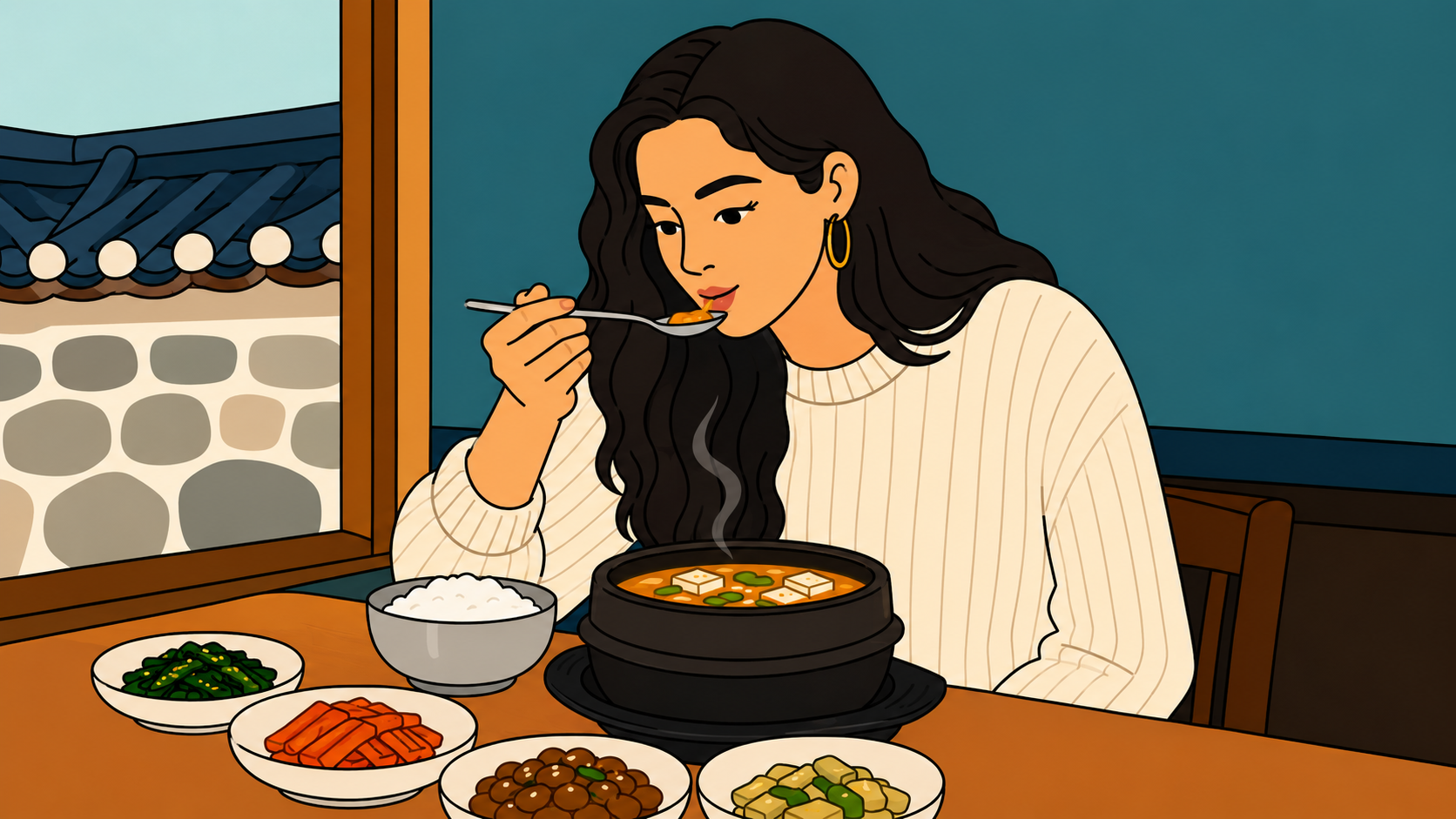
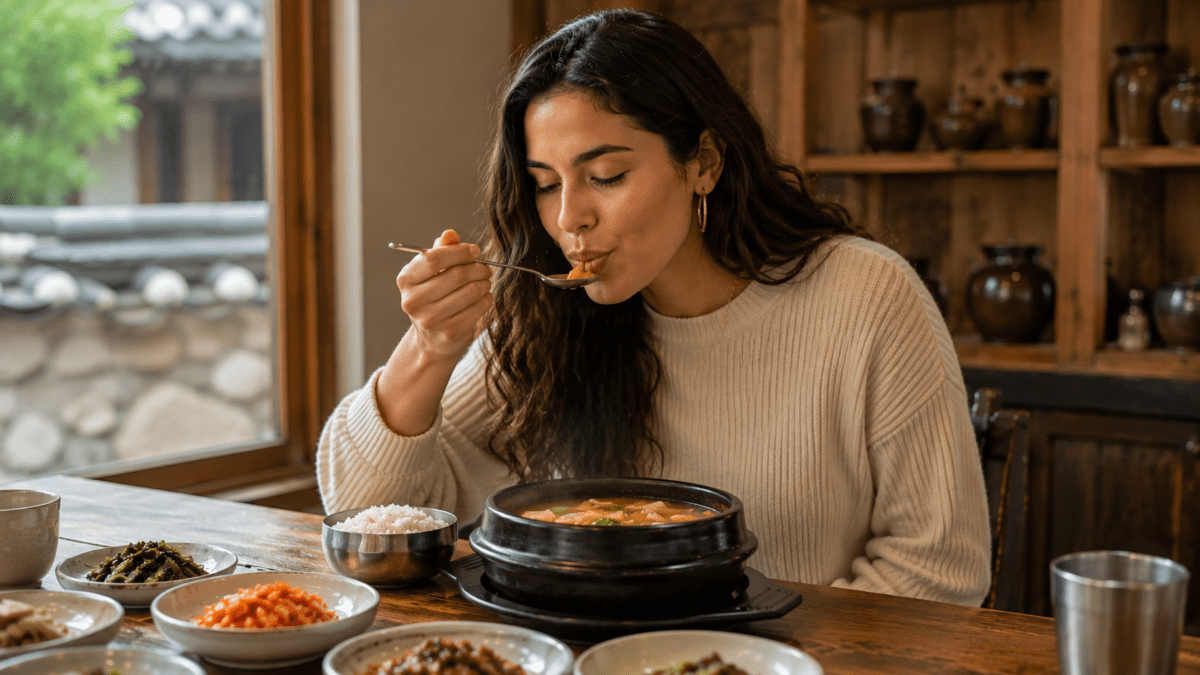
It comes from the backyard, not the kitchen.
Rows of brown earthenware jars sitting quietly under the sun. Lift the lid, and the scent is sharp, deep, and hard to pin down in a single word.
Some people wrinkle their noses.
Others lean in.
That smell is jang (장: jang) — the foundation of Korean jang fermentation, and the reason Korean food tastes like nothing else.
Not a Sauce — How Korean Jang Keeps Time
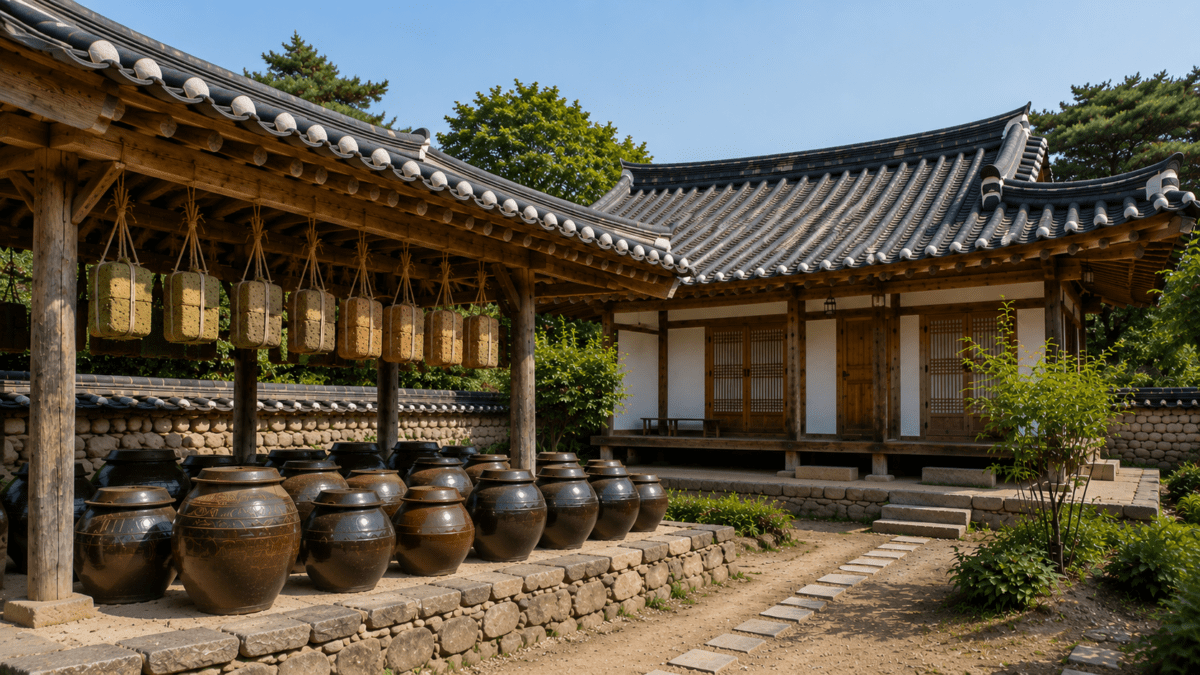
In Korea, jang is not just seasoning. It is time and memory, stored in clay.
People don’t say, “This food is well-seasoned.” They say, “This house has good jang.” It sounds like a compliment about cooking. It’s actually a compliment about patience — because good jang takes months, sometimes years, and there is no way to fake that.
Most condiments are made to be used quickly. You open a bottle, pour, and move on. Jang starts differently. Soybeans are boiled, shaped into dense blocks called meju (메주: me-ju, fermented soybean block — the mother of all jang), and hung to dry in the winter air for weeks. Then those blocks go into earthenware jars with salt water, exposed to sunlight, wind, rain, and cold — for months. Sometimes years.
Nobody controls this process the way you control a recipe. The weather does what it does. The microbes do what they do. You watch, wait, and adjust — but you don’t rush.
What comes out of those jars is not a single product. It splits: the liquid that rises becomes ganjang (간장: gan-jang, Korean soy sauce). The solid that stays becomes doenjang (된장: doen-jang, fermented soybean paste). Same origin. Two different lives. Both essential.
The Taste Nobody Can Name
Korean food is everywhere now. Bibimbap (비빔밥: bi-bim-bap, mixed rice bowl) bowls in London. Gochujang (고추장: go-chu-jang, fermented chili paste) mayo in Brooklyn delis. Tteokbokki (떡볶이: tteok-bok-ki, spicy rice cake) challenges on TikTok. The heat and the color arrived first, and they arrived loud.
But the thing that actually makes Korean food taste like Korean food — jang — stayed quiet.
When people outside Korea encounter the slower dishes — the soups, the stews, the long braises — there’s a reaction that repeats. Not “this is good” or “this is spicy.” More like: “I’ve never tasted this before. What is this?”
That reaction is about depth they have no reference for. Western cooking builds on butter, cream, stock, wine. Japanese food has dashi. Chinese cooking has its own fermented bases. Korean food builds on something most people outside Korea have never directly encountered: soybean fermented in clay, open to weather, for months or years.
That unfamiliar layer is jang.
Western sauces tend to show up. Hollandaise poured over eggs. Barbecue glaze brushed on ribs. You see the sauce. You taste the sauce. It announces itself. Jang disappears into the dish. It becomes part of the broth, the marinade, the base of the stew — so deeply woven in that pulling it out would be like pulling warmth from a room. You’d only notice it was gone.
Think about bulgogi (불고기: bul-go-gi, grilled marinated beef). Most people credit the sweetness, the pear, the char. But underneath — that quiet savory pull that stops you mid-bite — that’s ganjang. Take it out, and bulgogi goes flat. Sweet without anchor. Loud without weight.
Koreans have a word for what jang leaves behind: gamchil-mat (감칠맛: gam-chil-mat, the lingering savory depth that slow Korean fermentation creates). It doesn’t arrive fast. It builds. It asks you to stay at the table a little longer. And it only comes from things that have had real time.
Three Jars, One Source
Jang is not one thing. It is a family — and each member does something the others can’t.
Ganjang is the quiet one. Liquid, dark, precise. It seasons without changing color. It deepens without announcing itself. Korean cooks reach for ganjang when they want to adjust a dish without leaving a trace — the way a good editor works, invisible in the final result.
Doenjang is the one with history. Dense, complex, slightly rough around the edges. Drop a spoonful into a broth and the whole pot shifts. Doenjang-jjigae (된장찌개: doen-jang-jji-gae, soybean paste stew) isn’t subtle. It’s a statement: this house has been here a long time.
Gochujang arrived last — red pepper only reached Korea in the 16th century — but it became the face of Korean flavor to the outside world. Thick, fermented, sweet and sharp and hot in the same mouthful. Where ganjang and doenjang disappear into dishes, gochujang stays visible. It colors everything it touches. That visibility is part of why it traveled first. It photographs well. It announces itself. The other two work quietly for decades before anyone thinks to ask what they are — which is exactly what makes them harder to explain, and harder to replace.
Three jars. Three different relationships with time, heat, and restraint.
The Backyard Nobody Talks About
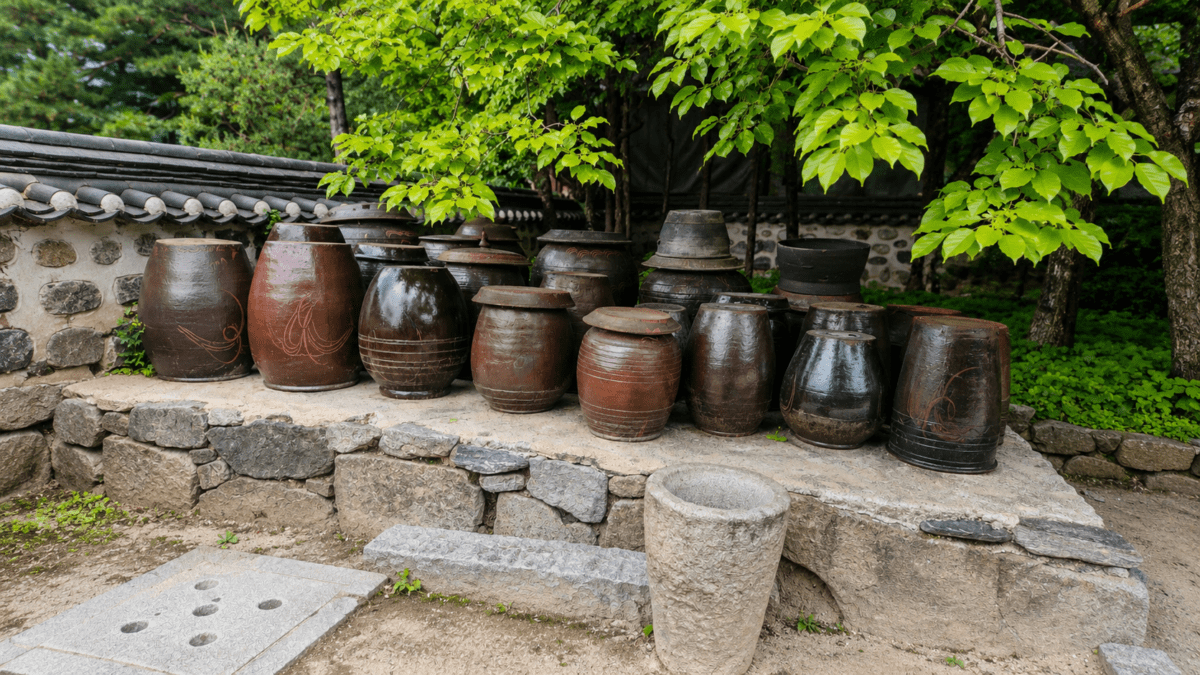
In Korean homes — at least the ones that still keep the old rhythm — there is a place called jangdokdae (장독대: jang-dok-dae, fermentation courtyard). Not the kitchen. The backyard.
The jars were placed with deliberate attention — not for decoration, but because placement shaped flavor. Which direction faced south. How the wind moved between the eaves and the wall. Whether the ground drained well after rain. A grandmother who kept jang understood her yard the way a winemaker understands a slope. The soil mattered. The shade mattered. The gap between jars mattered. Some yards had jars that had been sitting in the same spot for decades. Moving them wasn’t a practical problem. It was closer to an interruption — of something that had been quietly working for longer than anyone could track.
Korean grandmothers checked fermentation not with a thermometer, but with a pause and a smell. Lift the heavy stone lid. Lean in. Breathe. Let the smell tell you what the calendar can’t. Some lids stayed closed for another month. Some jars were ready earlier than expected. That knowing was not mysterious. It was accumulated. Years of the same jar, the same yard, the same weight of lid in their hands.
When jang turned out well, the household felt it in ways that were hard to isolate. Soups had body. Stews had grounding. There was a Korean phrase for this quality — son-mat (손맛: son-mat, the invisible mark a person’s care leaves on food). Not technique, exactly. Not a recipe followed correctly. More like presence — the accumulated attention of someone who checked the jar, adjusted nothing unnecessary, and let time do the rest.
But everything in the jangdokdae starts before the jars. It starts with meju.
Soybeans are boiled until soft, crushed while still steaming, then pressed into dense bricks roughly the size of a thick book. The bricks are tied with straw and hung from the ceiling, or set on a warm floor to dry. Air moves around them. Temperature shifts. And slowly, something starts to grow on the surface — mold.
For most people outside Korea, this is the moment that feels wrong. In Korea, this is the moment that feels right. It means the meju is alive — proteins breaking down into amino acids, flavor building itself from the inside out, becoming something no recipe could produce on a deadline.
After weeks of drying, the meju blocks go into the jars. Salt water is added. The lid goes on. And then the waiting begins — the real waiting, the kind that can’t be checked on or hurried. What comes out months later isn’t what went in. There’s a structure to this kind of waiting that Korean food has always understood — and the jar is only where it becomes visible.
What Stays After the Meal
Korean food doesn’t try to impress you on the first bite.
It stays with you after.
The depth people feel in Korean cooking — layered rather than loud — doesn’t come from spice or heat alone. It comes from accumulation. From jang sitting in a jar long enough to become something time alone can produce.
The jars in the backyard held this logic long before anyone thought to explain it. They were never trying to make a sauce. They were keeping time in clay — and waiting for someone who understood that the best flavors aren’t assembled. They’re earned.
Some content in this post was created with AI assistance.