

Leave the bamboo behind, drive a few minutes out of town, and the road changes. The open fields fall away on both sides and two rows of trees rise up to meet you — tall, impossibly straight, their tops leaning in until they touch overhead. Ahead, the road runs dead straight into a green tunnel that narrows to a single point somewhere far off, and doesn’t seem to end.
This is the Damyang metasequoia road, and the first thing it does is pull your eyes down its length toward that vanishing point, the way a long corridor always does, until you’re walking toward it without quite meaning to.
A Straight Line Into Shade
The trees are the kind you don’t see often — metasequoias, feathery and soft-needled, planted in ranks so even they look drawn with a ruler. They go up a long way before the branches start, bare reddish trunks rising in parallel lines, and then the green begins and closes over the road in a single unbroken arch.
Step in from the open and the change is immediate on the skin. Behind you the fields lie flat under high summer pressing down, the air shimmering over the asphalt, the sun with real weight to it. Under the trees that weight lifts. It isn’t cold the way the bamboo was cold — it’s a broader, softer shade, the heat taken down a few notches rather than shut out, warm air moving slow and green-tinted down the length of the tunnel.
And the road just goes. Straight, level, lined the whole way, the trees ticking past on either side in perfect rhythm as you walk. There’s no bend to hide what’s coming, no rise to crest. You can see almost the whole distance at once, the ranks of trunks stacking closer and closer together toward the far point until they merge into one green blur. It should feel monotonous. Instead it feels like something opening — a single clean line laid down through the middle of the summer, with room to walk it slowly.
The eye keeps reaching for an end and never finds one, and somewhere in the reaching the hurry goes out of you. There is nowhere to arrive. There is only the road, and the walking, and the green closing overhead.
Light and Shadow, Step by Step

Look down at the road and it’s covered in coins of light.
The canopy isn’t solid; it’s a mesh of needles, and the sun comes through it broken into thousands of small bright shapes scattered across the asphalt. They shift constantly. A breeze moves the high branches and the whole road ripples, the light-shapes sliding and flickering and reforming, so that the ground you’re walking on never holds still. Bright, dim, bright again — you pass through bands of it, warm on your shoulders where the light breaks through, cool a step later where the shade closes back over.
You feel it on your skin as much as see it: the quick alternation of sun and shade as you walk, warm-cool-warm-cool, a rhythm set by the spacing of the trees. It’s the tempo of the whole road, and after a while your steps fall into it without your asking them to. The eye keeps busy the entire time — there’s always something moving up ahead, a patch of brightness travelling down the tunnel toward you, a shadow crossing the road where a branch dips in the wind.
Overhead, when you tip your head back, the light is pure green again, filtered through the soft needles into the same watery color the bamboo made, but higher, airier, moving more. The metasequoias are looser than bamboo, and the whole ceiling of the road sways and breathes in a way the tight green walls of Juknokwon never did.
The Smell of Warm Bark and Cut Grass
Somewhere along the road you notice you’ve been breathing it in for a while.
It’s a warm smell, layered. The Damyang metasequoia road has a scent that changes as you walk it, and you catch it in pieces. Underneath is the trees themselves — the dry, faintly resinous scent of sun-warmed bark and needle, more noticeable in the heat, rising off the trunks where the light hits them. Over that drifts grass: someone has mowed the verges, and the cut-green smell hangs in the still air under the canopy, sharp and summery, the most ordinary smell there is and somehow the whole season in a single breath.
And threaded through both, faint, is the smell of the warm road itself — sun-baked asphalt where the light gets through, that particular dry mineral heat you only notice in summer. It shouldn’t belong with the green, but it does. Together they make the exact smell of a hot afternoon under trees, the kind that surfaces years later out of nowhere and puts you instantly back on a road like this one, walking nowhere in particular.
A bicycle passes, tires humming on the warm asphalt, and behind it a thread of moving air carries the grass smell stronger for a second before it settles again. The road holds its scents the way it holds its shade — loosely, warmly, without hurry. You stop noticing where the tree smell ends and the grass begins; by then they’ve become one thing, the single warm green breath of the road in July.
The Damyang Metasequoia Road Keeps Going
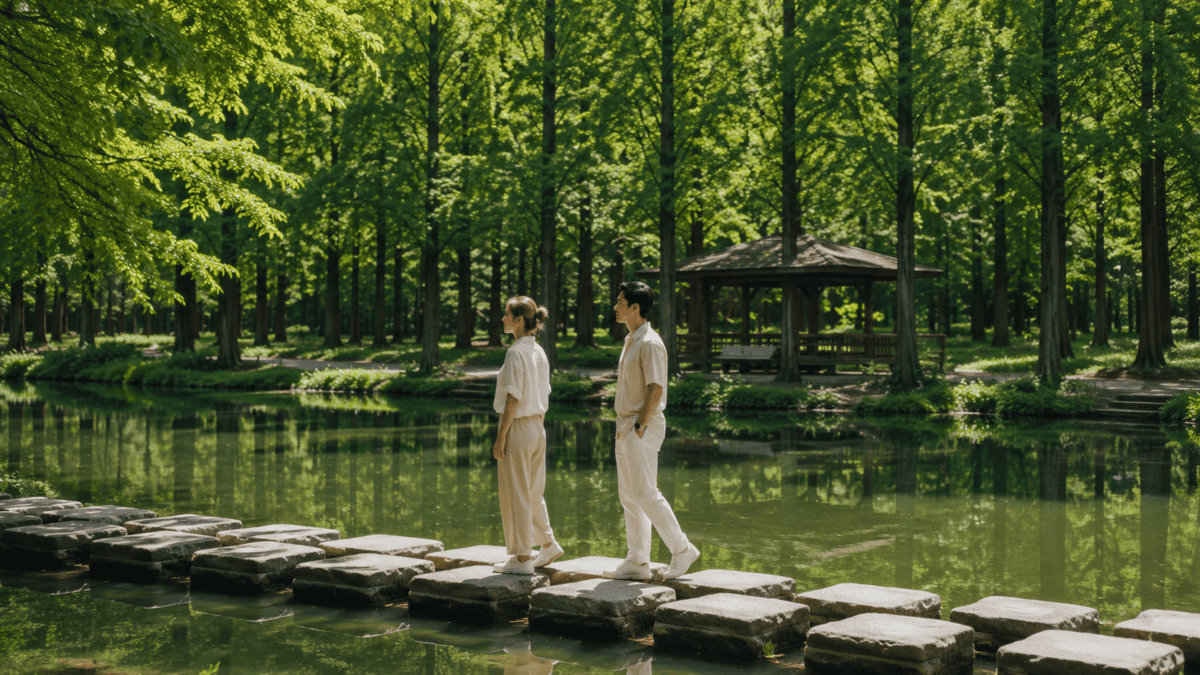
You walk, and the vanishing point never arrives.
That’s the strange pleasure of it. The far end of the tunnel stays exactly where it was, the trees still stacking toward a point you never reach, so that walking the Damyang metasequoia road feels less like getting somewhere than like being held in one long unbroken moment that simply keeps unrolling. Turn around and it’s the same in the other direction — the identical green tunnel running back the way you came, the same coins of light, the same soft arch closing overhead.
People slow here too, the way they did in the bamboo, but differently. In the forest the slowing came from enclosure, from being wrapped in green. Here it comes from the openness of the line ahead, from the fact that you can see so far and still have so far to go, and that none of it is urgent. Couples drift apart and back together. A child runs ahead and stops, waiting, small against the ranks of trunks. Someone stands still in the middle of the road just to look down it. No one is really going anywhere.
This is walking with nowhere to be, the kind that isn’t travel from one point to another but a thing done for its own sake — feet moving, eyes full, the road handing you the same green over and over and asking nothing back. You came to see the famous trees. What you end up doing is simply walking under them, which turns out to be the whole point.
You could walk for an hour and the road would keep giving you the same thing — light, shade, the warm green smell, the trees ticking past — and it would not once feel repeated. The road keeps its own time, slower than yours, indifferent to whether you hurry or linger.
It was here before the town filled in around it, planted by people who would never see it grown to this, and it will be here in autumn when the whole tunnel turns the color of rust, and bare in winter with the light coming straight down between the trunks, and green again next summer, warm and running straight into its own distance. You reach no end. You just turn, at some point, and walk back into the light, the warm green smell still on your clothes, the straight line of trees holding steady behind you long after you’ve left it.
This post was planned and edited by a human, with AI assistance.