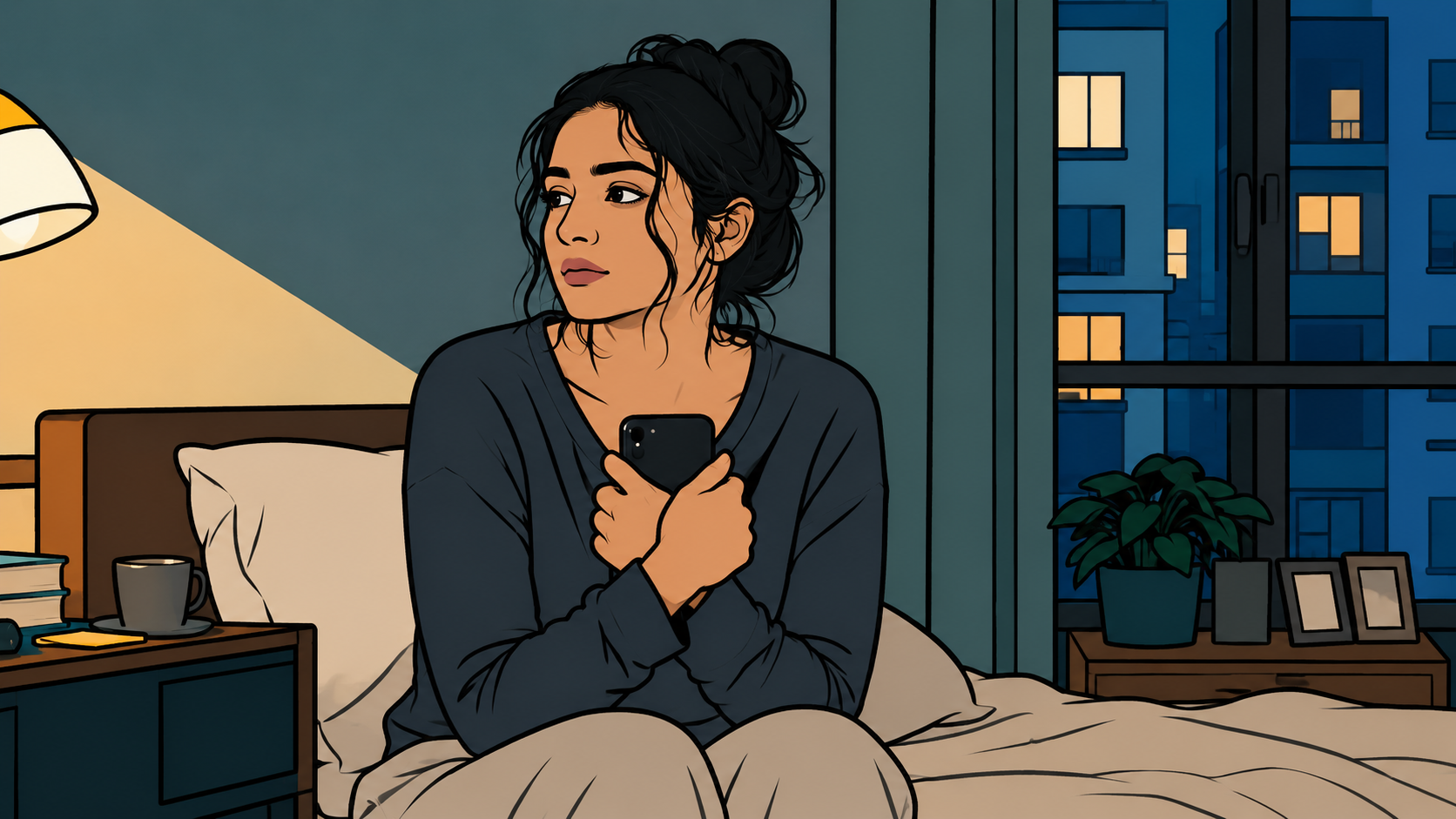

Rejection sensitive dysphoria doesn’t wait for an actual rejection. The message was three words. Can we talk? She read it once, turned the phone face-down, and didn’t touch it again for three hours.
In those three hours, she rewrote the whole friendship. She went back through their last conversation looking for the thing she’d done wrong. She drafted an apology for something she couldn’t name. By the time she finally flipped the phone over, she had already decided it was over.
The follow-up was sitting there: I found your earrings — want them back?
Nothing had happened. And yet something had. A storm had moved through her and passed before the second message even arrived. This is where the pattern lives — not in the rejection itself, but in the one your body stages before anyone has said no.
The Text That Sat Unanswered for Three Hours
Notice what actually happened in that story. One ambiguous message. No tone, no context, no confirmation of anything. On paper, a neutral event.
Another version of the same scene: a friend leaves you on read. You can see they opened it. An hour passes, then two. You go quiet, decide they’re annoyed with you, and start pulling back. The next day they mention their phone died at lunch. The whole afternoon you spent bracing for a fallout that never existed.
But it didn’t land as neutral. It landed as a verdict.
That’s the tell. For most people, an unclear text is a small open question — mildly annoying, quickly forgotten. For someone with this pattern, the same text opens a trapdoor. The mind fills the silence with the worst available answer, then treats that answer as fact. You don’t wait to find out if you’ve been rejected. You skip ahead and start grieving.
And here’s the part that makes it so hard to see from the inside: the reaction feels completely reasonable while it’s happening. It doesn’t feel like an overreaction. It feels like reading the room. You’d swear you were just being perceptive.
What Rejection Sensitive Dysphoria Actually Describes

Rejection sensitive dysphoria is the name for an intense, almost physical reaction to the perception of being rejected, criticized, or falling short — even when the rejection is small, imagined, or not there at all.
Two words in that definition matter most.
Perception. The trigger isn’t the event. It’s the read on the event. A pause before someone answers, a shorter reply than usual, a friend who seems a little off — none of these are rejection. But if you’re wired this way, they get processed as if they were. And once the read is made, you stop gathering evidence. The mind closes the case and moves straight to sentencing. You’re no longer waiting to learn what the pause meant — you already know, and now you’re just managing the fallout of a thing that was never confirmed.
Dysphoria. This isn’t ordinary disappointment. It’s a sharp, flooding kind of distress that arrives fast and takes over the whole body — a dropped stomach, a hot face, the sudden urge to fix it or flee. The size of the feeling has almost nothing to do with the size of what happened.
It’s worth saying plainly what this is not. It isn’t weakness, and it isn’t you being dramatic. It’s a nervous system that learned, somewhere along the way, to treat the possibility of rejection as an emergency — and to sound the alarm early, just in case.
There’s a strange logic to it. If you expect the no before it comes, it can’t blindside you. Bracing feels like protection. So the mind starts doing it constantly, running a background scan for the first sign of being unwanted. The problem is that a scanner set that sensitive finds threats everywhere — in a delayed reply, a changed tone, a face that’s tired for reasons that have nothing to do with you. The protection becomes the wound.
The Gap Between What Happened and What You Felt
If you want to spot this pattern in your own life, don’t look at your feelings. Look at the gap.
There’s what happened: a coworker didn’t say good morning. And there’s what you felt: certainty that you’ve done something wrong, that you’re being frozen out, that it’s only a matter of time. Line those two up side by side and the distance between them is enormous.
That distance is where the pattern becomes visible.
A normal reaction stays roughly the size of the event. A slightly cool hello earns a flicker of huh, wonder what that’s about, and then you move on. When the reaction is ten times bigger than the event, something else is running the show. You’re not responding to the coworker. You’re responding to every unanswered question you’ve ever collapsed into a no.
The same gap shows up everywhere once you see it. A partner says we should talk later and you spend the drive home rehearsing a breakup. A parent replies to your news with one flat word and you read a lifetime of disappointment into it. A manager schedules a quick call with no subject line and your stomach drops before you’ve even clicked accept. Different rooms, same trapdoor.
You weren’t reacting to what they did. You were reacting to what you were sure it meant.
Most people try to fix this by getting the facts straight — proving the rejection wasn’t real. But the facts were never the problem. By the time you’ve confirmed everything is fine, the alarm has already gone off, the day is already spent, and you’re already exhausted from a fight nobody else knew was happening.
And the relief never lasts. The reassurance quiets one moment, not the pattern. Tomorrow a new ambiguous signal arrives and the whole search starts over, because nothing about the underlying wiring has changed.
Why the Pattern Keeps Repeating

Here’s the loop that keeps it alive.
The feeling arrives so fast and so convincingly that it never registers as a reaction — it registers as information. And you act on it. You over-apologize. You go quiet and pull back first. You test the person to see if they’ll leave. Sometimes you leave before they can.
Then something predictable happens: the other person responds to your withdrawal. They get confused, or hurt, or distant — because you’ve changed, not because they had. And their reaction becomes your proof. See? I knew it. The very thing you feared, you helped build.
This is the cruel efficiency of the loop. It doesn’t just brace you for rejection — it manufactures the conditions for one, then points at the result as evidence it was right all along. You end up living inside a prediction that keeps coming true because you keep funding it.
That’s why rejection sensitive dysphoria can be so hard to outgrow with time alone. Left alone, it rehearses. Each cycle teaches you the same lesson a little deeper — that people leave, that the safest move is to see it coming — and the next ambiguous text lands harder than the last.
Which is also the opening. A pattern that repeats is a pattern you can learn to read. In the way K-Saju treats a recurring cycle — not as a flaw to erase but as a structure to recognize and time differently — the first real shift isn’t making the feeling smaller. It’s catching the half-second where a perception turns itself into a fact, and leaving that gap open a little longer before you fill it.
You don’t have to answer the Can we talk? with a whole grief. Sometimes it really is about the earrings.
That gap — between what happened and what you’re sure it means — is the whole thing. Underneath it sits an older question the body keeps trying to answer: why does rejection hurt so much in the first place that it can hijack a Tuesday afternoon over three unanswered words.
This post was planned and edited by a human, with AI assistance.