

The itinerary said Myeongdong. Skincare, maybe street food, the kind of afternoon that doesn’t need a plan. The optical shop wasn’t on the list. It was just there, between a cosmetics chain and a tteokbokki cart, lit up like every other storefront on the block.
She went in because her friend was already inside. That’s how glasses in Seoul usually happen — not with a plan.
The Unplanned Stop
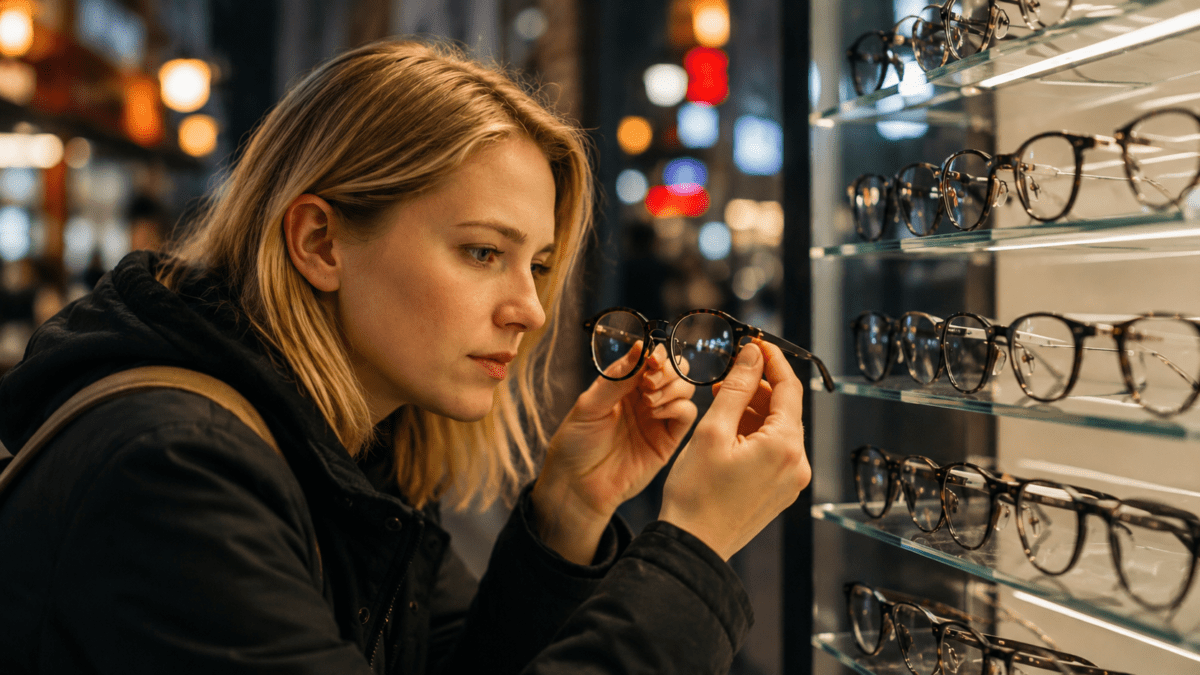
Travel has a way of making the ordinary visible. Things that locals pass without registering — the density of a particular street, the speed of a transaction, the way a shop is organized — land differently on someone who has never seen them before. The one-stop glasses shop is one of those things. Not a landmark, not a destination. Just a fact of Korean daily life that becomes, for a visitor, something worth stopping for.
The mechanics are the same as Part 1 described: exam on-site, lenses cut in the back, fitting at the counter, out the door in half an hour. But the experience of moving through those steps as a tourist carries a different texture. There’s no appointment to keep afterward. No work to get back to. The city is outside, and there’s nowhere else to be, which means the whole process unfolds as its own thing — not an errand squeezed between obligations, but an event with a beginning, a middle, and a before-and-after that happens in real time.
The before: squinting at a menu board across the street, the characters slightly soft at the edges.
The after: walking back out into Myeongdong and reading it clearly, the syllables snapping into focus one by one.
The street is the same street. The difference is entirely internal, and it happened fast enough that the city is still there to receive it.
What makes glasses in Seoul particular is that the shop didn’t require a plan. No appointment booked three days in advance. No prescription retrieved from a filing cabinet at home. The system is designed to absorb the walk-in, the spontaneous, the person who simply wandered past and decided to stop. That openness — a shop that can take you from blurry to clear with no prior coordination — is what turns an unplanned stop into something that stays.
What Gets Chosen
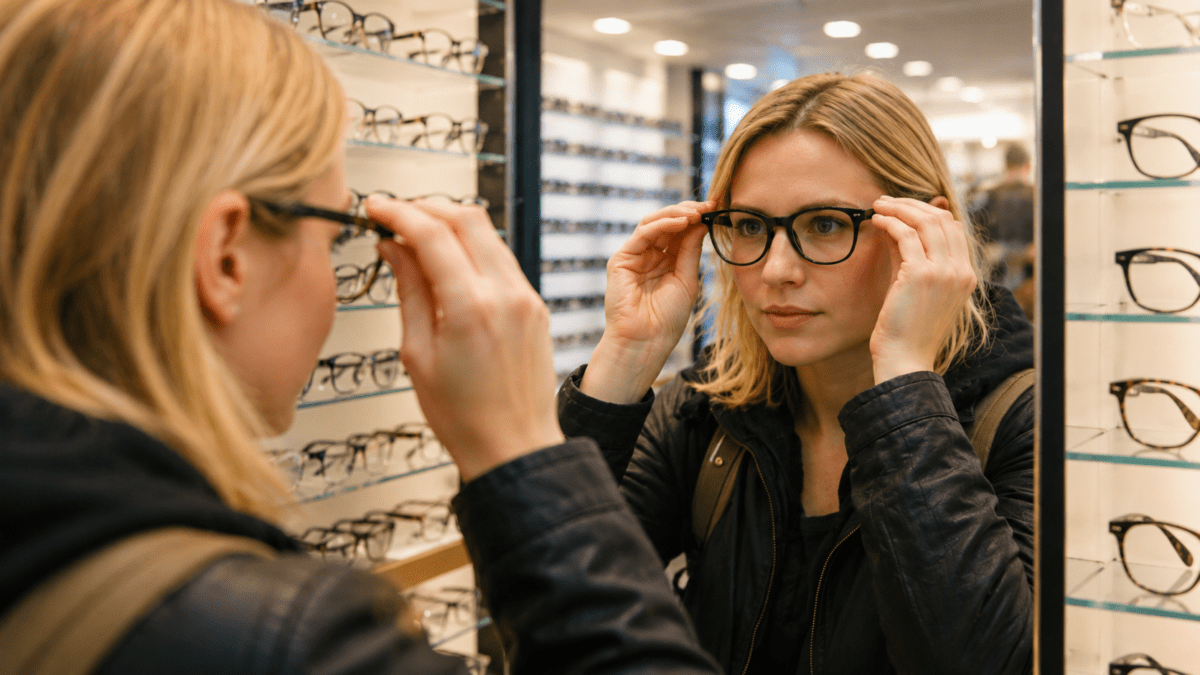
Inside the shop, the choice of frames takes longer than expected. Not because the selection is overwhelming — though it is — but because the decision feels different here. At home, replacing glasses is a considered purchase, something budgeted for and planned. In Seoul, the price point removes that weight. A complete pair for forty dollars doesn’t require the same deliberation as one for four hundred.
This changes the register of the choice. Instead of asking what do I need, the question becomes what do I want to try. Frames that would feel like a commitment at home become an experiment here. The oversized acetate that seemed too much. The slim wire that looked too minimal. The slight tint that was never quite justified at full price.
The display cases help. Korean optical shops arrange frames the way clothing stores arrange seasonal pieces — by mood as much as by shape, grouped in a way that makes the choice feel curatorial rather than medical. You’re not selecting a corrective device. You’re editing something. The optician watches without rushing, answers questions in whatever language arrives, and doesn’t steer. The decision belongs entirely to the person making it, which is rarer in a retail context than it sounds.
Several visitors describe the same pattern: they walked in intending to replace a practical pair, and left with something they wouldn’t have considered anywhere else. Not reckless — just lighter. The low price created a kind of permission that the usual cost structure doesn’t. One traveler from Australia put it simply: she’d wanted round frames for years but always talked herself out of them. In Seoul, the cost of being wrong was low enough that she stopped talking.
The optician adjusts the nose pads, checks the temple fit, asks a question in Korean and then immediately in English when the answer doesn’t come fast enough. The whole fitting takes under three minutes. There’s no upselling, no extended warranty pitch, no followup appointment scheduled. The transaction ends when it’s done, which is almost immediately, which is its own kind of relief.
The Story That Travels Home
Glasses bought in Korea have a particular afterlife. They go back to New York or Amsterdam or Melbourne in a carry-on, wrapped in the soft cloth the shop provided, and they enter a different context entirely. Worn on a Tuesday morning in an office or a café, they become a conversation starter in a way that a sheet mask or a bottle of toner never quite manages.
Where did you get those?
The answer takes longer than expected. Not just Korea — Seoul, Myeongdong, a shop between a cosmetics chain and a street food cart, one stop, forty dollars, the city looked different afterward. The story has texture because the experience had texture: a specific place, a specific speed, a before and after compressed into the same afternoon.
This is the particular quality of objects that carry memory. A pair of glasses worn every day becomes associated with the context in which it was chosen. The frames that came from Seoul carry, faintly, the afternoon they arrived in — the light in the shop, the noise of the street outside, the moment of stepping back out and reading the sign that had been soft-edged an hour before. None of that is visible to the person asking. But the wearer knows it’s there.
What travels home isn’t only the object. It’s the category of experience — the proof that something practical can also be surprising, that a city can look different in the space of an afternoon, that the gap between blurry and clear can close faster than expected and cost less than assumed. That proof gets retold. Online, in group chats, across tables. Get your glasses in Korea spreads the way useful information spreads: person to person, specific enough to act on, surprising enough to be worth passing along.
Why It Works as a Travel Experience
Not every practical errand translates into something worth remembering. Getting a haircut in a foreign city can be interesting or disastrous, rarely both. Having a prescription filled is usually just administrative. What makes glasses in Seoul different is the compression.
The speed collapses the experience into something small enough to hold. It starts and ends within the same hour, which means the before and after are close enough to feel like a single moment rather than a process. The low price removes the anxiety that usually surrounds optical purchases. The result is a transaction that feels unusually clean: you needed something, you got it, and the city looked better on the way out.
That cleanliness is rare in travel, where most experiences involve some version of waiting, confusion, or compromise. The glasses shop in Myeongdong asks for almost none of that. You walk in seeing one version of the street. You walk out seeing another.
There’s also something specific about the object itself. Glasses are worn on the face, every day, for years. A pair bought in Seoul doesn’t stay in Seoul — it comes home, enters daily life, sits on the nose through meetings and meals and ordinary Tuesday mornings. Every time it’s worn, the afternoon it came from is faintly present. Not loudly. Not in a way that interrupts anything. Just there, the way certain objects carry their origin without announcing it.
Korea understands something about timing that most places don’t articulate. Not everything should be fast — some things deepen with waiting, and rushing them costs something real. But some things have no reason to wait. The gap between blurry and clear is one of them. The moment the prescription is ready, the lenses can be cut. The moment the lenses are cut, the world sharpens. There is no argument for the two weeks. Korea looked at that gap and closed it.
In a country where when you act shapes what becomes possible, even an unplanned stop can arrive at exactly the right moment — sharper than expected, and gone before you thought to plan for it.
Content in this post was created with AI assistance.