

In Korea, glasses are never just about vision.
She doesn’t say anything when she walks in. She sets her bag down, pulls out the chair, opens her laptop. But something is different today. The frames are new — thin gold wire, sitting lower on the nose than the old ones. Her manager glances over once, then back to his screen.
The meeting starts. She speaks first.
How Korean Glasses Fashion Reads the Room
Glasses don’t wait for an introduction. Before a word is spoken, before a handshake or a name, the frame on someone’s face is already being processed — shape, color, weight, the way it sits. Square or round. Dark or transparent. Thick acetate or wire so fine it nearly disappears. Each combination lands differently, and in Korea, where appearance is read with particular attention, that landing matters.
This isn’t vanity. It’s a system. Korean culture places high value on visual legibility — the idea that how you present yourself signals who you are in a given context. A school uniform communicates belonging. A business card communicates rank. Glasses communicate something harder to name but just as real: the kind of person you are choosing to be today, in this room, in front of these people.
What makes glasses interesting is their flexibility. Unlike a suit or a uniform, they sit on the face — the most read part of a person. And unlike most accessories, they carry a functional justification that makes the choice feel less deliberate than it is. Nobody questions why you’re wearing glasses. That cover gives the frame room to work quietly, shaping impressions without announcing itself.
The Student’s Frame
In Korean glasses fashion, the student’s frame has its own history. Thick black plastic, slightly too large, pushed up the nose between study sessions. The shorthand was clear: glasses meant hours at a desk, stacks of textbooks, the particular exhaustion of preparation. In dramas like Sky Castle, the studious child in heavy frames isn’t a character detail — it’s a cultural signal, instantly legible to any Korean viewer.
That image hasn’t disappeared, but it’s been complicated. Students now choose frames the way they choose the rest of what they wear — with attention to what the choice communicates. Oversized clear frames suggest playfulness without sacrificing the studious read. Slim wire conveys a maturity that the thick plastic never could. Pastel colors soften the intensity. The diligence is still there, coded into the act of wearing glasses at all, but it now coexists with something the previous generation didn’t layer in: individuality.
The shift reflects a wider change in how Korean youth understand self-presentation. Conformity once meant safety. Now it reads as a lack of definition. The student who wears the same frames as everyone else isn’t blending in strategically — they’re failing to say anything. Glasses became one of the first places that negotiation happened, because they were already on the face, already functional, already there.
The Office Frame

Korean glasses work on a different logic in the office. Here, the goal isn’t self-expression — it’s legibility of a specific kind. The frames that work in an office are the ones that don’t distract. Slim wire. Neutral tones. Lenses that catch light without calling attention to themselves.
This is deliberate understatement. In Korean office culture, where hierarchy is visible and authority is maintained through consistency, glasses that announce themselves too loudly create friction. The manager in bold red frames is making a claim the office hasn’t agreed to. The analyst in near-invisible wire frames is signaling focus, composure, the willingness to let the work speak.
There’s a specific moment glasses earn their keep in professional settings. Someone adjusts their frames before speaking in a meeting — a small gesture, half a second, barely noticeable. But it functions like clearing a throat before a sentence that matters. The adjustment says: I am here, I am paying attention, what I’m about to say is considered. It’s the kind of nonverbal shorthand that accumulates over years of watching colleagues, bosses, and mentors do the same thing in the same rooms.
The reverse is also true. A new employee who walks in wearing frames too bold for the floor she’s joining isn’t making a fashion statement — she’s creating a question nobody asked. Not hostility, just a small misalignment, the kind that gets quietly noted and quietly corrected. Within a month, the frames have usually changed. The adjustment happens without discussion, because the feedback never came as words.
Glasses here are quiet armor. They cover the eyes that stayed open until two in the morning. They hold the face in a shape that reads as capable, even when the person behind them isn’t sure they are. The right frame cuts away what doesn’t belong — not loudly, but with the precision of something that knows exactly where the line is.
The Weekend Frame
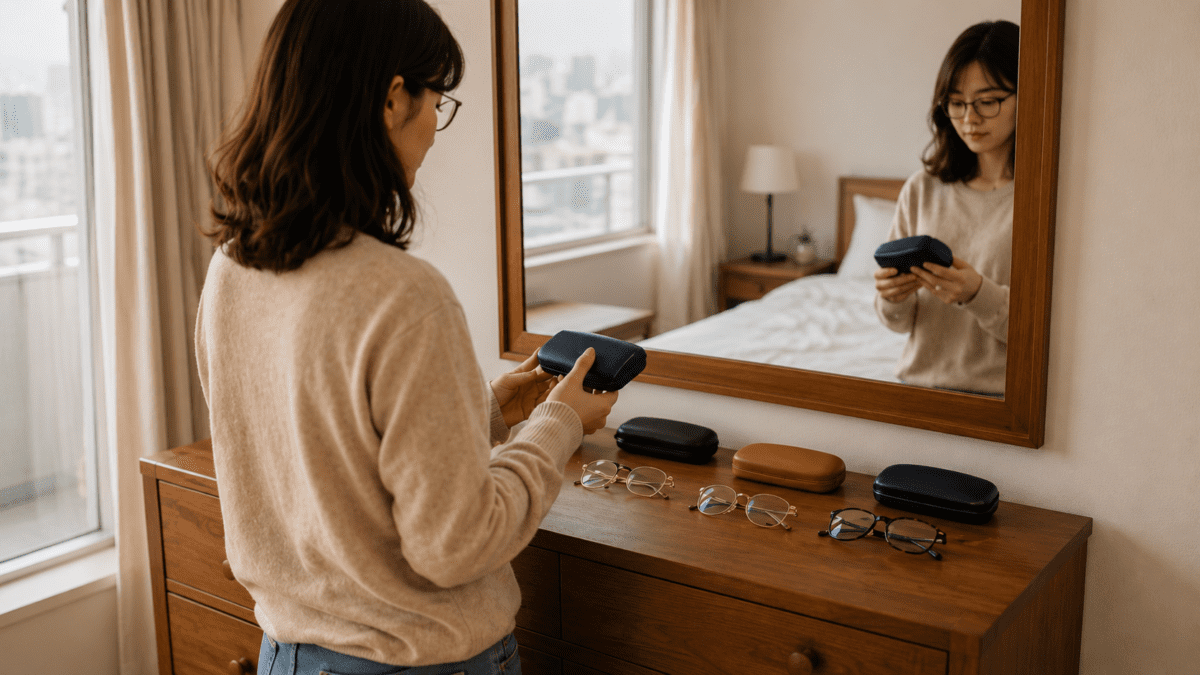
The office frames come off on Friday evening. Not immediately — there’s usually a moment somewhere between the elevator and the street where the adjustment happens, almost without thinking. The wire that held the face in a particular shape all week goes into a case. Something else comes out.
The weekend frame doesn’t have to do anything. It doesn’t signal focus or composure or readiness. It can be too big for the face, or a color that doesn’t match the coat, or the pair bought on impulse two years ago that never quite fit but keeps getting worn anyway. The logic that governed Monday through Friday is suspended. What replaces it is harder to name — not freedom exactly, but permission. The face gets to be less legible for a day or two.
This switch is so automatic in Korea that it rarely gets discussed. But the wardrobe makes it visible: the cases stacked on the dresser, each one for a different version of the week. The slim neutral pair for the office. The clear oversized frames for the café. The old scratched ones for the convenience store run at midnight. Each pair has its assignment, and each assignment has its room.
The airport is a version of the weekend frame taken public. K-pop idols moving through arrivals halls have made oversized frames one of the most recognizable accessories in the genre — not because glasses are required, but because they do something useful in that specific space. They soften the face without hiding it. They signal off-duty without fully stepping out of the frame. A pair of clear acetate or tinted wire at the airport reads as approachable in a way that sunglasses don’t — the eyes are still visible, the distance is controlled.
Fans track these Korean glasses choices the way they track everything else, and the optical shops in Myeongdong feel the effect within days. The weekend logic — permission to be less legible — turns out to be exactly what works in front of a camera, too.
What the weekend frame reveals is that the other choices were always choices. The office wire wasn’t just glasses — it was a decision about how to be read, made every morning before leaving the house. The weekend pair makes that visible by contrast. When the stakes are gone, what’s left is what was actually wanted all along.
One Object, Three Readings
The same pair cannot do all three jobs. The frame that signals diligence looks wrong in a café on Saturday. The near-invisible office wire disappears on a hiking trail. The oversized weekend pair reads as costume in a boardroom.
So the same person owns multiple pairs. Not because the vision changes — because the room does, and the face needs to move with it.
This is what makes Korean glasses fashion different from most other places. In many countries, glasses are a medical decision — one pair, chosen once, worn everywhere. In Korea, the question was never just about vision. It was always about which version of yourself was walking into which room. The frame is part of the answer. So is the case it came from, and the deliberate act of reaching for one over another before leaving the house.
The habit forms early and eventually stops feeling like a habit. The right frame for the right room becomes something simply known — the way you know which register to speak in before you’ve thought about it. What the frame communicates depends entirely on where it’s read. One object. Three rooms. Three different versions of the same face, each one exactly right for where it’s standing.
This post was planned and edited by a human, with AI assistance.