

The optometrist hands back the prescription slip. You fold it, put it in your bag, and think: a few weeks, maybe.
That’s not how it works here. Buying glasses in Korea means walking out with a finished pair before your coffee gets cold.
Sooner than expected, you’re back on the street. The neon sign across the road — the one that was smearing into orange blur — now has edges. Sharp ones. You can read it. You stop walking for a second, not because you need to, but because the detail is new enough to notice. The street hasn’t changed. You have.
Why Buying Glasses in Korea Works Differently
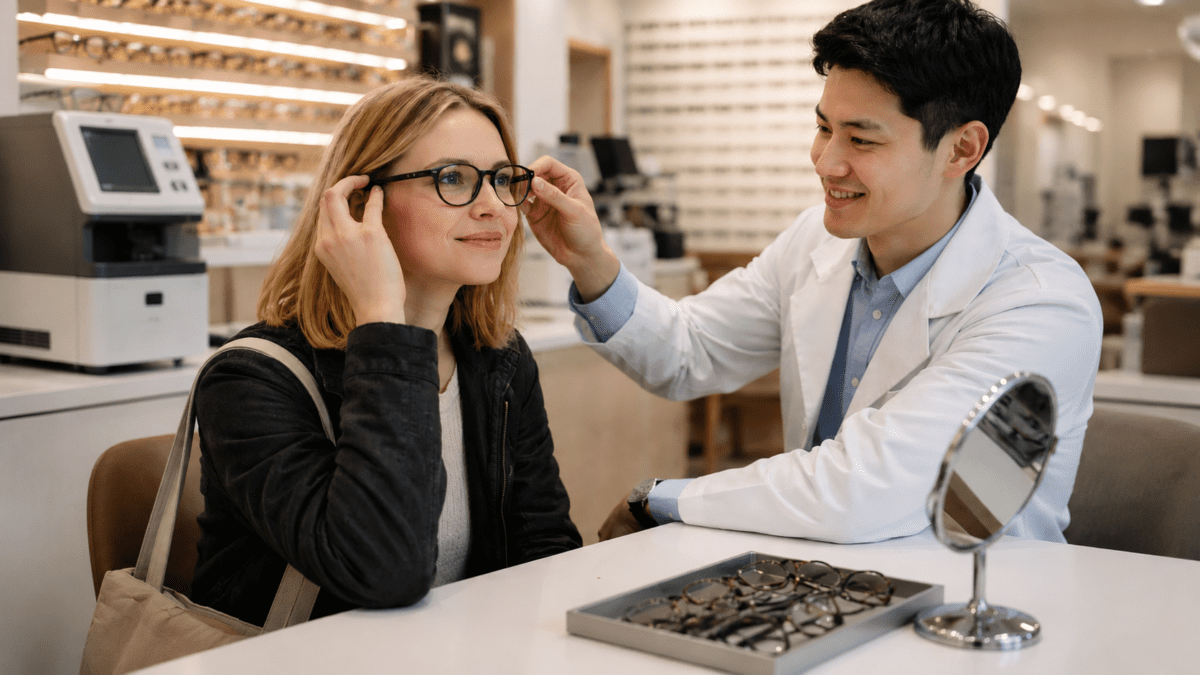
In much of the United States and Europe, getting glasses still runs as separate steps. Book the eye exam. Wait for the prescription. Order the lenses. Come back when they’re ready. Fast options exist — chains in Japan and some American stores finish a standard pair the same day — but they sit alongside a default that assumes a wait.
Korea collapses the entire chain into one room.
A licensed optometrist examines your eyes on-site. A lens-cutting machine runs in the back. Fitting happens at the counter. The whole operation — exam, cut, assemble, adjust — takes less time than you’d expect. There’s no waiting period because there’s no gap between steps. Everything that would normally be split across businesses, days, and callbacks happens in a single unbroken sequence.
The word that explains it is ppalli-ppalli (빨리빨리: ppal-li ppal-li, “hurry-hurry”) — the cultural reflex that treats unnecessary delay as a kind of failure. It shows up in subway punctuation, food delivery windows, and construction timelines. In Seoul, a subway train that arrives two minutes late is unusual. A food order that takes forty-five minutes feels slow. The expectation isn’t impatience — it’s a baseline assumption that if something can be done faster, it should be. Glasses are no different. If the technology exists to make them now, waiting until next week isn’t efficiency. It’s a choice nobody has agreed to make.
What Speed Does to the Experience
In most places, getting glasses is a transaction split across time. You leave the optometrist. You wait. You return. The new vision arrives as a pickup, something handed to you in a bag after the moment of needing it has already passed.
In Korea, the before and after happen in the same hour.
You sit down unable to read the small print on the display case. You stand up, adjust the frames, walk out. The transition is fast enough that you feel it as a single event — not a process spread across days, but a shift that happens while the city is still around you. The same street you squinted at thirty minutes ago is now legible. The same faces are now readable. Nothing was added. The blur was simply removed, and what was always there became visible.
For Koreans, this is ordinary. A student replaces a scratched lens on a Tuesday afternoon and is back in the library before dinner. A worker picks up a new pair during a lunch break, adjusts them at the counter, and returns to the office without the afternoon ever feeling interrupted. Buying glasses in Korea is so integrated into daily rhythm that it stops registering as remarkable — it’s simply what getting glasses means.
For visitors, the same experience lands differently. The version travelers tell tends to go like this. Squinting through the last week of a trip. A friend pulls you into a shop in Myeongdong. Frames chosen, measurements taken, a coffee from next door, and you are back outside before you finish it. The city looks different. Not because Seoul has changed, but because the same streets have acquired resolution you did not have before. You stand at the corner and read a sign three blocks away. Then you take a photo of it, not of anything in particular, just proof that the distance has collapsed.
That compression — blur to clarity inside thirty minutes — is what turns a practical errand into something people retell long after the trip is over.
The Price That Makes It Stranger
The speed would be remarkable on its own. The cost makes it harder to explain.
A complete pair — frames and standard lenses — typically runs between $40 and $80. High-index lenses or premium frames push the ceiling to around $200. The equivalent in the United States or most of Europe costs two to four times more, and usually arrives a week or two later.
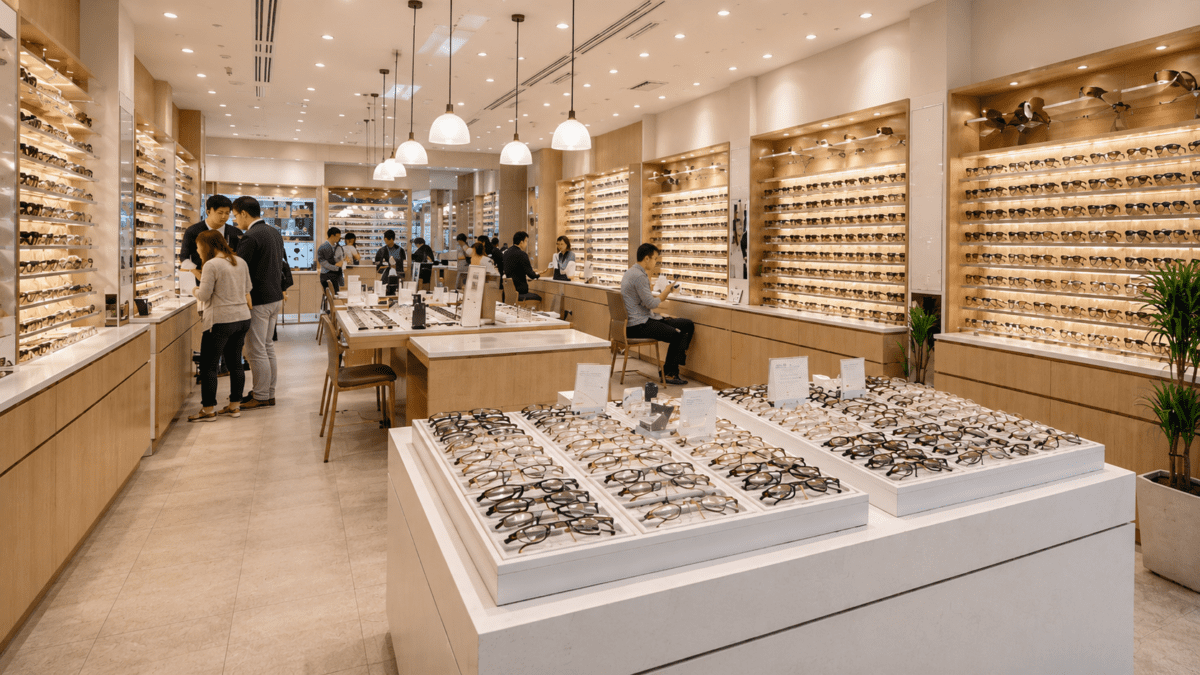
This isn’t a budget-market phenomenon. The optical shops along Myeongdong and Gangnam carry design frames, international brands, and precision lens options. Walking into one, it’s easy to spend twenty minutes just moving along the display cases — wire frames so thin they disappear on the face, oversized acetate shapes in colors that read as fashion rather than function, minimalist rectangles that could belong in an architecture magazine. The selection doesn’t feel like a medical supply shop. It feels like a carefully edited store where the product happens to correct your vision.
The price difference isn’t explained by cutting corners. It’s explained by a market dense enough to run on volume and competition, and a system efficient enough to eliminate the steps that cost money elsewhere. No middleman between the optometrist and the lab. No separate retail markup. No two-week holding cost passed to the customer. The savings come from compression — the same compression that makes the timeline a single visit instead of two weeks.
The combination — half the price, a fraction of the time — is what turns buying glasses in Korea from a chore into a story worth telling. Online forums, travel blogs, group chats: get your glasses in Korea has become a specific category of travel advice, passed between friends the way restaurant recommendations used to be. People plan around it now. Some bring their prescription from home. Others schedule the eye exam into the first day of the trip, so the new pair is ready before the real exploring begins. It’s the same efficiency that drew Korea’s tourism authority to highlight optical shops as a travel experience.
What the Wait Means Elsewhere
Speed is only legible against slowness. The thirty-minute window only feels significant because two weeks exists as the reference point.
But that reference point is worth examining. The wait in other countries isn’t primarily technical — it’s structural. Separate businesses, separate steps, separate appointments. The eye exam happens at one location. The prescription goes to another. The lenses are ordered from a third. Each handoff adds time, and the time adds up not because any single step is slow, but because the gaps between steps are treated as inevitable. They aren’t. Korea decided they weren’t.
What Korea built instead is a system where the question when can I have them? has a genuinely different answer — not because of better technology, but because of a different assumption about what waiting is for. If the wait serves no function, it shouldn’t exist. That logic, applied consistently across industries, is what produces subway trains that run on the minute, deliveries that arrive the same evening, and glasses that are ready before your coffee gets cold.
There’s a particular rhythm to this. Not everything in Korea moves fast — fermented foods take months, relationships take years, certain decisions take a lifetime. The speed is selective. It lands where waiting adds nothing, and steps back where waiting is the process itself. Glasses fall cleanly on one side of that line. The lenses don’t improve with age. The prescription doesn’t deepen with patience. There is no version of this where waiting makes the outcome better. So the wait was removed.
Someone is adjusting new frames right now on a street in Seoul, blinking at a sign they can finally read, somewhere between a pause and a shrug. In a country where the moment you act shapes what becomes possible, the way glasses are made here isn’t a selling point. It’s a design decision. One that most of the world hasn’t made yet.
Content in this post was created with AI assistance.