
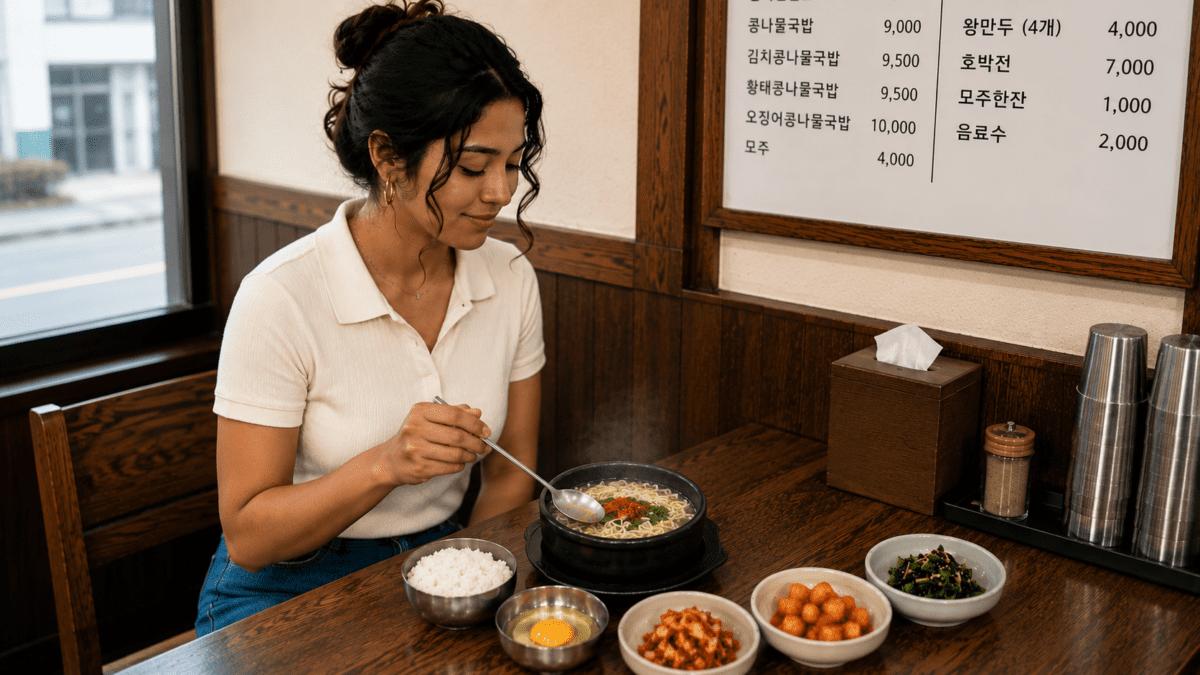
Some bowls are not about hunger. They are about reset. The kind of morning when the night before lasted too long, or the body needs something quiet and restoring before the day begins. Not every morning calls for the density of seolleongtang or the weight of soegogi-gukbap. Sometimes what the body needs is lighter, more specific, closer to the ground.
Korea has a Korean hangover soup for this — not one bowl, but three. Each from a different region. Each built from what that land had nearby. Bean sprouts from the plains of Jeonju. Dried pollock from the mountains of Gangwon. Freshwater snails from the rivers of Chungcheong. All arriving hot, fast, and without asking what happened the night before.
The Jeonju Bowl: Kongnamul-gukbap
Jeonju is famous for bibimbap. But the bowl the locals reach for in the early morning is not bibimbap. It is kongnamul-gukbap (콩나물국밥: kong-na-mul guk-bap, Korean bean sprout soup with rice) — rice in a light anchovy or beef broth, bean sprouts still crisp from the cold, a raw egg cracked on top just before serving.
The egg is the detail that matters. It goes in raw and cooks slowly in the heat of the broth. By the time the spoon reaches it, it has set just enough — soft, barely there, adding richness without weight.
Bean sprouts have been used in Korean kitchens for centuries. Their asparagine content was understood long before the word existed — they clear the head, settle the stomach, refresh what the night before disrupted. In Jeonju, this knowledge became a bowl. Cheap enough for anyone, fast enough for the early crowd, light enough to eat before the body has fully decided to be awake.
The morning markets around Jeonju still run kongnamul-gukbap stalls before dawn. The stalls are simple — a large pot, a ladle, a stack of bowls. No menu to read. No decision to make. Workers arriving from overnight shifts, students before exams, anyone who needs to start again without ceremony. They sit on low plastic stools, eat in silence or in noise, and leave before the rest of the city has opened its eyes. The bowl is ready before they are. That has always been the point.
Her mind was still somewhere in yesterday. The bowl wasn’t. It was already there, at a point she hadn’t reached yet.
This is Korea’s Korean hangover soup in its most delicate form — not spiced, not heavy, just clean and restoring. The bean sprout doesn’t force anything. It waits in the broth until the moment is right, then does exactly what it came to do. The kind of bowl that doesn’t fix what happened. It simply makes the next thing possible.
The Gangwon Bowl: Hwangtae-gukbap
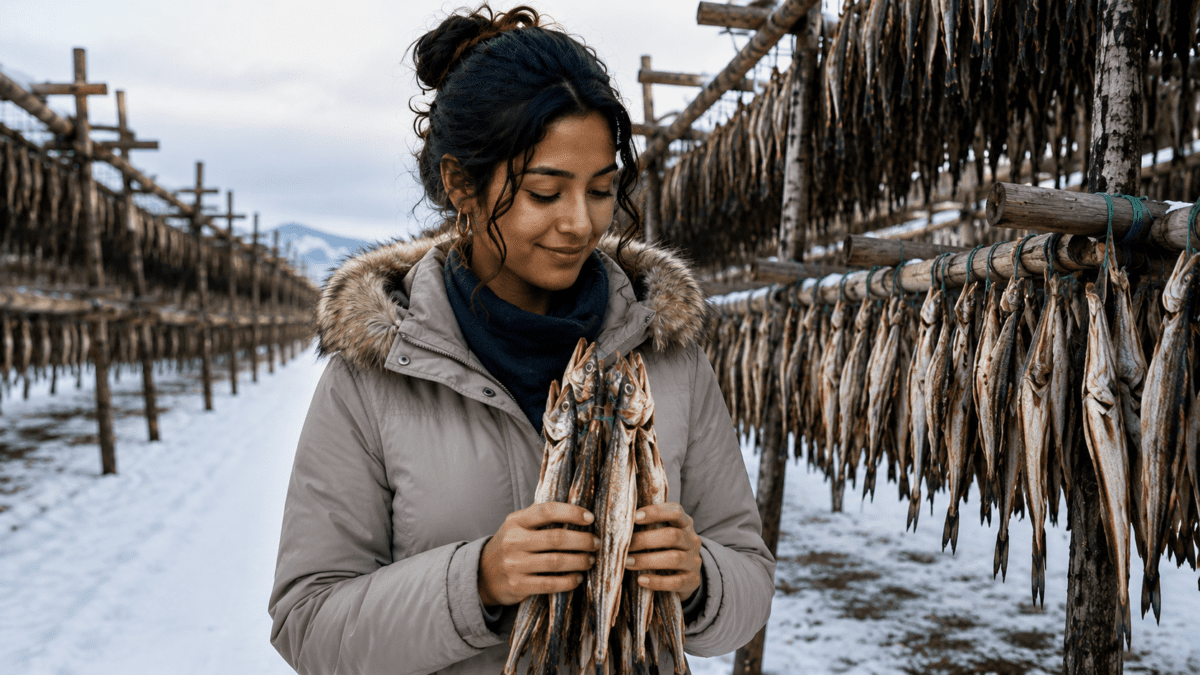
Gangwon-do is mountain country. The winters are long and cold, and the East Sea is close. Out of those conditions came hwangtae (황태: hwang-tae) — pollock hung outdoors through freezing nights and thawing days, repeatedly frozen and dried until the flesh turns golden, fibrous, and deeply concentrated.
The process takes weeks. What comes out is not simply dried fish. It is fish that has been through something — contracted and expanded by cold and warmth until the flavour has nowhere left to go but inward. When it goes into the broth, it releases that concentration slowly, producing a soup that is clean on the surface and complex underneath.
Hwangtae-gukbap (황태국밥: hwang-tae guk-bap, Korean dried pollock soup with rice) has long been understood as restorative. The broth is pale and clear, nothing like the milky density of seolleongtang. It is light in colour but not in effect. A bowl in the morning after a difficult night, and the body recognises it as exactly what was needed.
Garlic, radish, and green onion go in with the fish. The seasoning is quiet — just enough to support what the hwangtae is already doing. Rice sits in the broth, already softened. No fanfare. No drama. Just the slow work of mountain weather translated into a bowl that arrives fast and restores slowly.
In Gangwon, this is ordinary. Drive through the mountain towns in winter and the hwangtae racks are everywhere — thousands of fish hanging in rows, golden against the grey sky, swaying slightly in the cold wind. Each one is in the middle of its transformation. Freezing at night, thawing by day, losing moisture and gaining concentration. By the time it reaches the kitchen, it carries the memory of the mountain winter inside it.
The extraordinary part is that something requiring weeks of preparation can reach a table in minutes. The patience happened months ago, in cold mountain air, in the slow rhythm of freezing and thawing. The bowl is simply the delivery. What takes the longest to make arrives the fastest at the table — that is the logic Korea understood long before anyone named it efficiency.
The Chungcheong Bowl: Olgaengi-gukbap
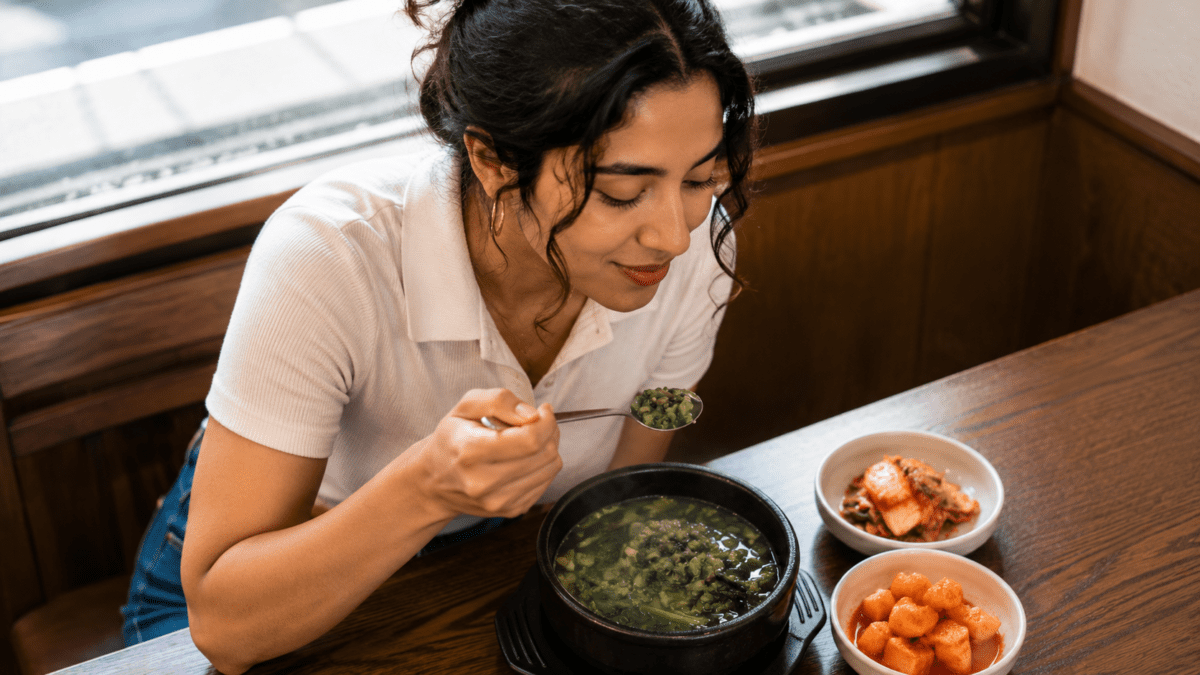
Chungcheong sits between mountains and rivers. The Geum River runs through it, and from those rivers came olgaengi (올갱이: ol-gaeng-i) — small freshwater snails, gathered by hand from stream beds, valued for their cooling and detoxifying properties.
Olgaengi-gukbap (올갱이국밥: ol-gaeng-i guk-bap, Korean freshwater snail soup with rice) is the least known of the three reset bowls outside its home region. Inside Chungcheong, it needs no explanation. The broth is clear and slightly herbal, the snails small enough to eat whole, the overall effect somewhere between light and grounding — not filling in the heavy sense, but steadying.
It was eaten by farmers before fieldwork, by market traders before the stalls opened, by anyone who needed something honest and uncomplicated before a long day. The olgaengi were gathered from shallow stream beds — small, dark, pulled from the river by hand or with simple tools. Cleaned, simmered, added to broth with doenjang and green onion. Nothing complicated. The river provided the ingredient. The kitchen provided the rest. What arrived in the bowl was a distillation of the landscape — cool water, soft earth, the quiet patience of things that live close to the ground.
What makes olgaengi-gukbap distinct from the other two reset bowls is its geography. Kongnamul-gukbap comes from fertile plains and market culture. Hwangtae-gukbap comes from mountain cold and coastal proximity. Olgaengi-gukbap comes from river life — a different kind of patience, a different kind of depth.
Outside Chungcheong, it remains a regional specialty. Visitors seek it out as part of the local experience, surprised by the lightness of the broth and the small, firm texture of the snails. It doesn’t travel the way kongnamul-gukbap or hwangtae-gukbap have. It stays close to its river. That may be exactly why it still tastes like somewhere specific.
All three bowls share the same logic: something that takes time to source or prepare, served fast, eaten quickly, and felt for the rest of the day. The region changes. The principle doesn’t.
Three Regions, One Idea
Kongnamul-gukbap, hwangtae-gukbap, olgaengi-gukbap. Bean sprout, dried pollock, freshwater snail. Jeonju, Gangwon, Chungcheong. Three entirely different ingredients, three different landscapes, three different histories.
And yet the bowl is the same idea. Light enough to eat when the body isn’t ready for anything heavy. Fast enough to serve before the morning has started. Restorative without being dramatic about it.
What each region understood was that the ingredient didn’t need to be expensive or rare. It needed to be available, honest, and ready to do its work quickly. Bean sprouts from the fields outside Jeonju. Pollock from the East Sea, dried by Gangwon winters. Snails from the rivers that run through Chungcheong. Each one a local answer to a universal morning.
Korea’s Korean hangover soup is not a single recipe. It is a category — a practical understanding that certain mornings require a specific kind of food, and that food should be ready before you are. Each region answered that understanding with what it had. Each answer is still on the menu.
What they share is not the ingredient or the region. It is the timing. The bowl that arrives before the body has decided to be awake. The broth that does its work without being asked. Some things only work when they’re not rushed — the ingredient took weeks or months, the bowl takes minutes, and the reset takes the rest of the morning. That is the rhythm. The morning that becomes manageable one spoonful at a time.
The bowl doesn’t ask what happened the night before. It doesn’t need to. Somewhere before dawn, the pot went on. The stall opened. The broth was ready long before the first customer arrived. It simply does what it has always done — arrives hot, and gets on with it.
This post was planned and edited by a human, with AI assistance.