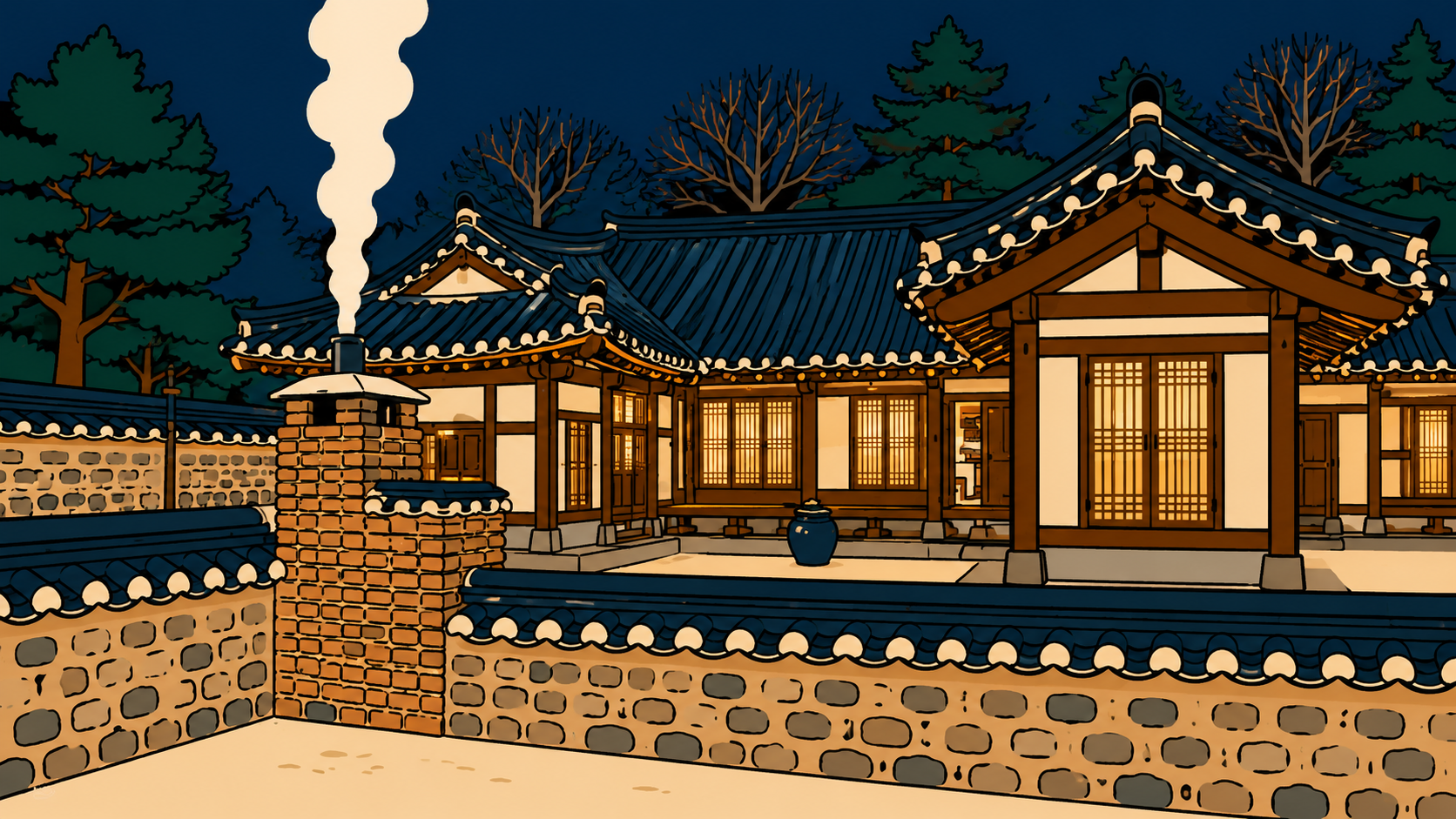
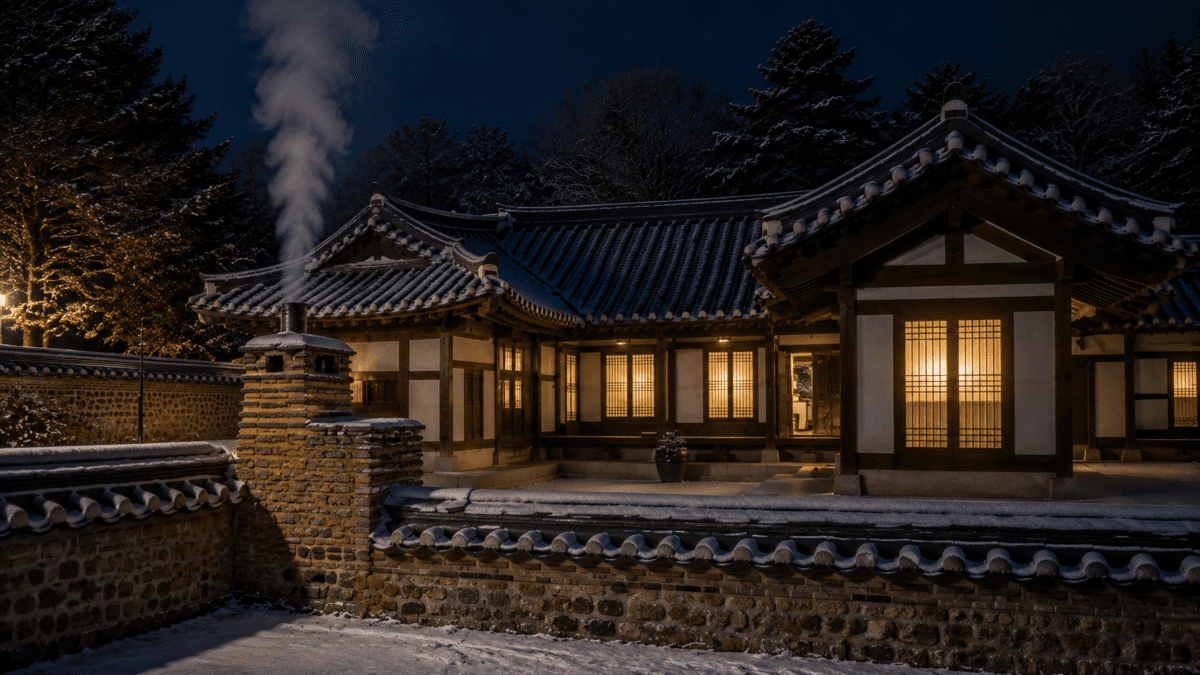
Korean winter culture begins with a simple fact: Korea does not have a gentle winter.
The Siberian high-pressure system moves in from the northwest sometime in November and doesn’t leave until March. What it brings is not the soft, photogenic cold of a European Christmas market. It is dry, cutting, and persistent.
In Seoul, January average temperatures sit around minus two degrees Celsius, but cold snaps regularly push that down to minus twelve or minus fifteen, occasionally lower. The wind chill makes it worse. In inland regions like Gangwon-do, temperatures can drop even further during these periods, and in the northern areas of the peninsula, lower still.
Korea sits at roughly the same latitude as northern Spain and southern France, yet winter conditions diverge sharply. In Madrid, January averages around eight degrees above zero. In Seoul, it remains below freezing for much of the season.
The cold also has a rhythm. Koreans call it sam-han sa-on (삼한사온: sam-han-sa-on) — three days cold, four days mild, a cycle that repeats through winter as pressure systems alternate. The winter doesn’t settle into a single sustained temperature. It oscillates, and Koreans have organized their lives around the oscillation.
Korea has always known this. The entire architecture of Korean indoor culture is a response to it — not an adaptation, but a deliberate decision. The cold stops at the door. Inside is another country.
What Korean Winter Actually Feels Like
The numbers are one thing. The body is another.
Minus twelve in Seoul feels different from minus twelve in, say, Stockholm. The Siberian wind that drives Korean winter is dry and relentless — it doesn’t settle, it cuts. The cold arrives without warning, peaks, retreats, and returns.
The coldest days in Korea are not quietly cold. They are aggressively cold. Exposed skin registers it within seconds. The air carries no moisture to soften the edge. On days when the wind comes directly off the continent, the streets of Seoul empty out. People move between heated interiors — subway stations, buildings, shops — minimizing the time spent outside to what is functionally necessary.
And yet Korea functions. Schools open. Offices fill. Markets operate. The country runs through its winters not by making the cold more tolerable outside, but by making inside so warm that the cold becomes irrelevant.
For centuries, Korean records documented sam-han sa-on — not as folklore, but as meteorology. Three days cold, four days mild. The pattern doesn’t shorten the winter. But it gives cold a rhythm that the body learns to move within.
During the three cold days, movement slows. Plans contract. During the four mild days, the city exhales—errands happen, markets fill, the streets come back. The body doesn’t fight the cold; it dances with the oscillation. This is the knowledge that built the ondol.
This is why the floor exists.
Dressed for Two Climates at Once
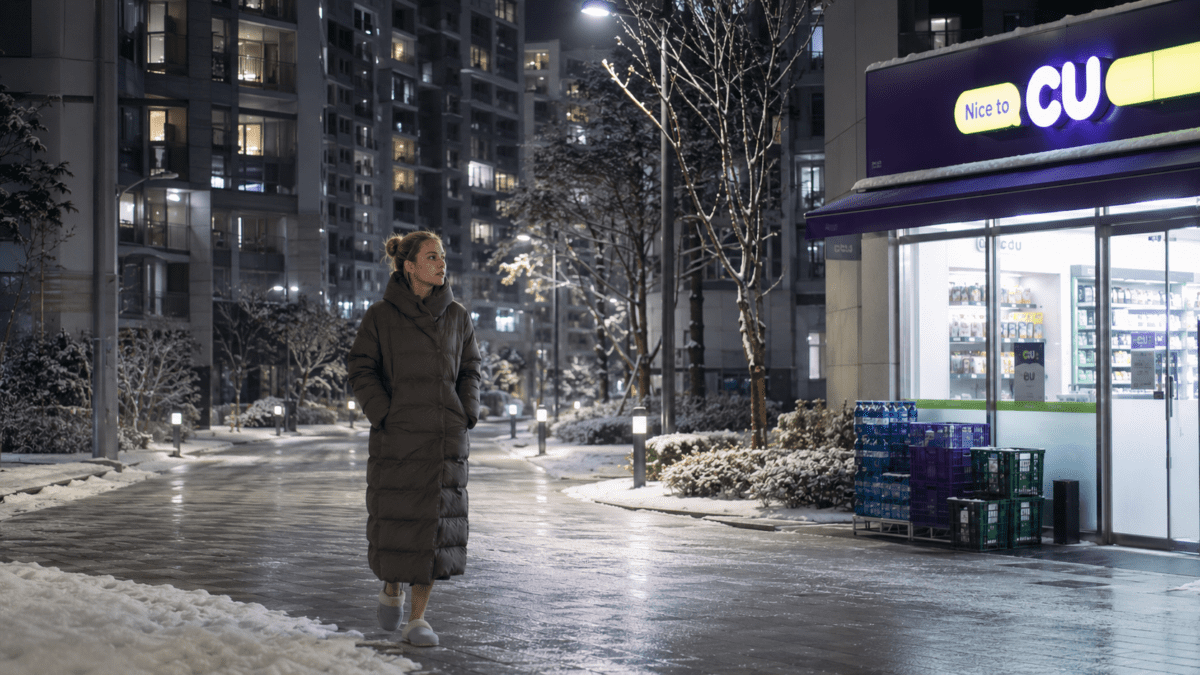
A foreigner watching a Korean street in January notices something that doesn’t quite add up.
The person coming out of the apartment building is wearing a heavy down coat — the long kind, padded to the ankle, the kind that signals serious cold. But underneath: a t-shirt. Bare legs. No socks. The slippers on their feet are the soft rubber kind meant for indoor use. They step out in a padded coat, slippers still on, walk to the convenience store, pick up a drink, and return within minutes.
This is not poverty. It is not indifference to the cold. It is the visual result of a house that is warm.
In a Western home, the interior temperature in winter is a managed compromise — cool enough that you wear layers inside, warm enough that you don’t freeze. The indoor and outdoor temperatures exist on a continuum. Getting dressed for a quick errand means adding something to what you’re already wearing.
In a Korean home with ondol, the interior is genuinely warm. Floor warm. The kind of warm where a heavy sweater becomes uncomfortable within minutes of sitting down. The body adjusts to that temperature and stays there. Going outside briefly means the coat goes on over whatever you’re wearing — the t-shirt, the shorts, the bare feet in slippers. The coat handles the outside. The inside handles itself.
To a Korean, this requires no explanation. To someone whose home is heated to sixteen degrees by a radiator that cycles on and off, the sight of bare legs under a padded coat in minus ten weather looks like a mistake. It isn’t. It’s what happens when the inside is warm enough that you never really have to prepare for the outside — just protect yourself from it, briefly, and come back.
The Floor as Winter Strategy
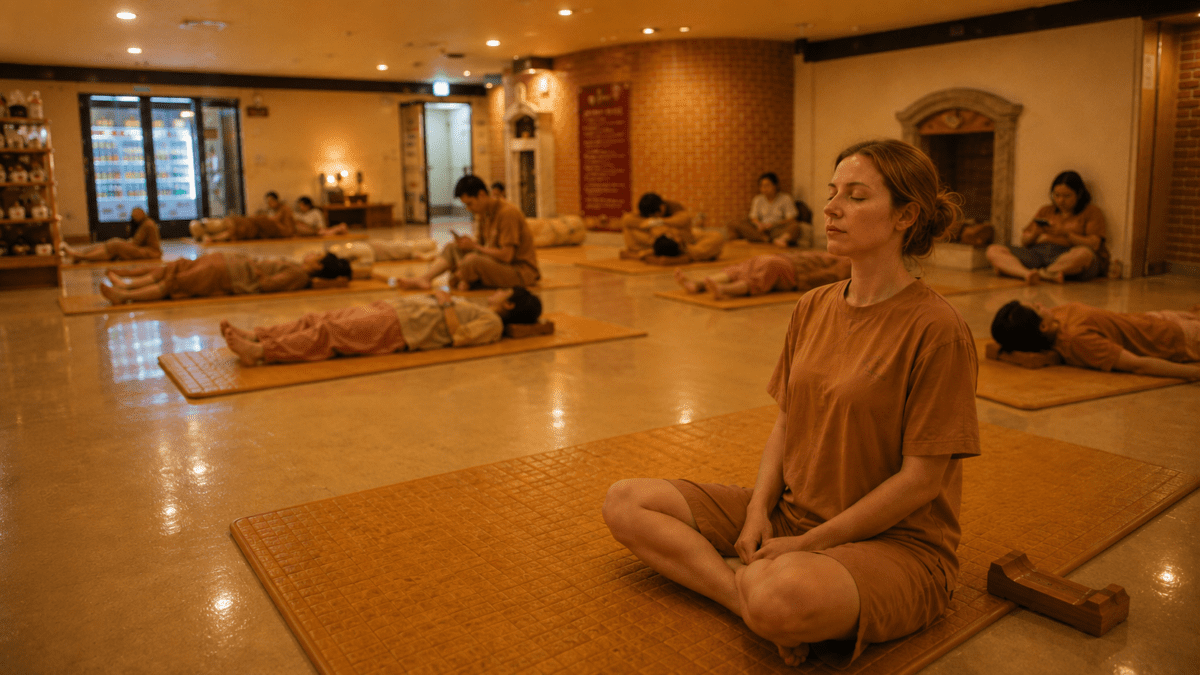
In a culture built on ondol, Korean winter culture organizes itself around the floor. The floor is not where you walk. It is where you live.
Winter in a Korean home organizes itself around the floor’s warmth. Meals happen at low tables, seated on the floor, because that is where the heat is most present. Sleep happens on mats laid directly on the surface, not on raised beds that would sit in the cooler air above. Children do homework on the floor. Families watch television from the floor. Guests are seated on the floor and offered the warmest spot as a gesture of hospitality — the same logic that placed elders at the aratmok in a Joseon farmhouse.
The floor is also where Korean winter leisure happens. Jjimjilbang (찜질방: jjim-jil-bang, heated public bathhouse) extends the ondol principle into a communal space — large heated stone floors where people lie flat, read, sleep, and spend hours doing nothing in particular except being warm. The experience is specifically Korean: not the performative cold-plunge culture of Scandinavia, not the social ritual of a Japanese onsen, but the particular pleasure of lying on a warm floor with no obligation to be anywhere or do anything until the cold outside becomes someone else’s problem.
Korea’s answer to winter is not to endure it. It is to make the inside warm enough that enduring it becomes unnecessary. That requires infrastructure — ondol, gas lines, insulated apartments — but it also requires a cultural agreement: the cold belongs outside, and inside is organized accordingly. Visit Korea describes the winter season as the perfect time to enjoy hot springs, ondol culture, and warm soup — three things that share the same logic. Warmth generated below, rising up, held as long as possible.
A grandmother lies flat on the jjimjilbang floor, towel folded under her head. She isn’t sleeping. She isn’t doing anything. The floor is doing the work, and she has nowhere else she needs to be.
The Country That Decided Winter Stops at the Door
Walk into a Korean apartment in January. The entrance is a step down — the threshold between outside and inside. Shoes come off here. The temperature changes immediately. The floor under your feet, even near the entrance, is warm.
This is the moment Korean winter culture makes itself felt. Not in the coat hanging by the door, or the slippers waiting on the step, but in that immediate physical shift — from a cold that has been aggressively present for the entire walk here, to a warmth that is simply there, coming from below, requiring nothing from you.
The ondol floor doesn’t announce itself. It doesn’t blow warm air. It doesn’t make a sound. It simply holds a temperature that makes the room livable, and has been doing so continuously since the last time someone adjusted the boiler panel on the wall.
Outside, Seoul in January is a serious proposition. Inside, a child is doing homework in a t-shirt. A family is eating on the floor. Someone is lying flat after dinner, doing nothing, warm from below.
Korea didn’t solve winter. It decided where winter ends.
The door closes. The floor holds.
This post was planned and edited by a human, with AI assistance.