Walk into any Korean restaurant and garlic is already there. In the marinade, in the kimchi, pressed into the sauce before the pan even heats up. It’s so embedded in the flavor profile that most people don’t register it as a choice. It’s just Korean food. Ask a home cook to leave it out and they’ll look at you like you’ve asked them to cook without heat.
Which is exactly why Korean temple food stops you cold the first time you taste it.
The garlic is gone. So is the green onion, the chive, the wild garlic, the asafoetida. Five ingredients — called o-sin-chae (오신채: o-sin-chae, five pungent roots) — removed entirely. Not reduced. Not substituted. Gone.
And the food is still deep.
What Gets Removed First
The five are: garlic (마늘: ma-neul), green onion (파: pa), chive (부추: bu-chu), wild garlic (달래: dal-lae), asafoetida (아위: a-wi).
In secular Korean cooking, these five carry most of the savory base. They go in early, they go in often, and they define what “Korean” tastes like to most palates outside Korea. Remove them and most cooks would tell you the dish is broken.
Buddhist monks remove them not for health reasons. The reasoning is older than that. Pungent alliums were observed to heat the body and agitate the mind — incompatible with the stillness required for meditation. Eaten cooked, they were said to arouse desire. Eaten raw, anger. Either way, they pull the mind toward the body and away from practice.
The distinction mattered enough to be recorded in detail. Cooked, the five were said to increase sexual desire — pulling attention toward the body at the moment practice required it to move inward. Raw, they produced anger — a different kind of heat, but equally disruptive. The monks weren’t avoiding flavor. They were managing the conditions that made stillness possible. A kitchen rule became a philosophical position: what you put in your body determines what your mind can do next.
The removal is a precision cut. Not an absence of flavor. A refusal to use the shortcut.
What’s left has to work harder. And it does.
What Korean Temple Food Uses Instead
Without the five, the kitchen turns to what remains: dried shiitake mushrooms (표고버섯: pyo-go-beo-seot), kelp (다시마: da-si-ma), perilla seed (들깨: deul-kkae), fermented soybean paste (된장: dwen-jang), and soy sauce aged inside the temple walls.
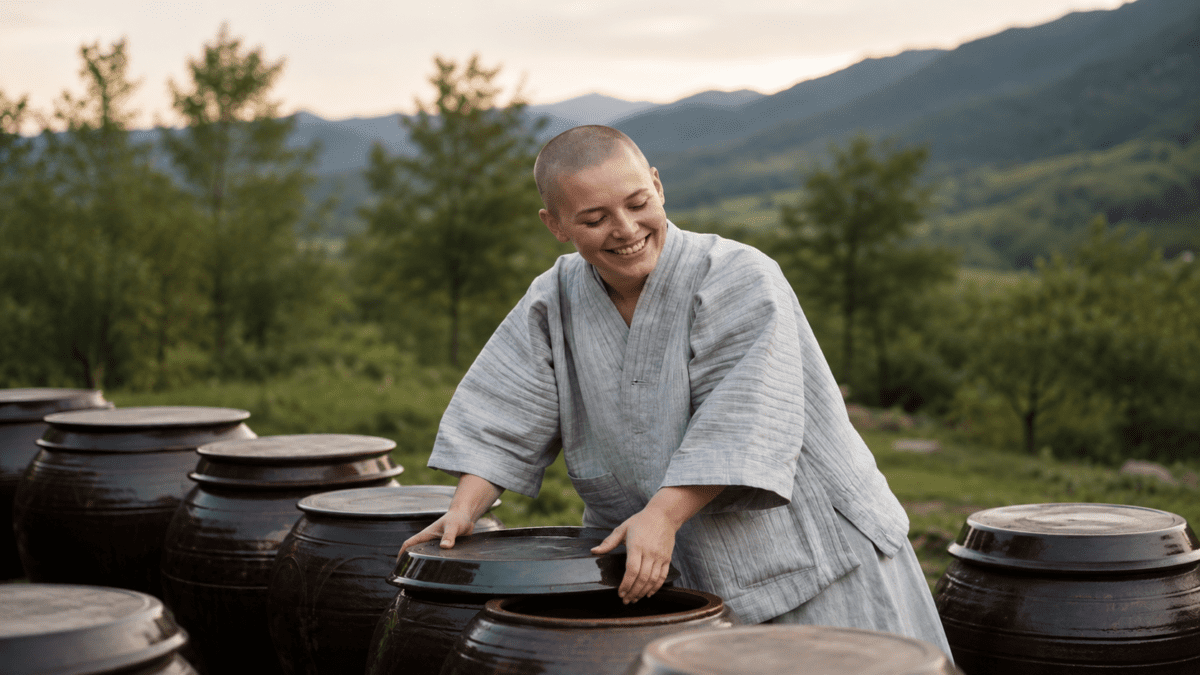
That last part matters. Temple doenjang and ganjang (간장: gan-jang, soy sauce) are not bought. They are made on-site, in onggi (옹기: ong-gi, earthenware crocks) that sit on the jangdokdae (장독대: jang-dok-dae, fermentation terrace) behind the kitchen. The soybeans are grown locally, boiled, pressed into meju (메주: me-ju, fermented soybean block), and left to dry through winter. By the time the paste reaches the pot, it has been working for months. Sometimes years.
This is the seasoning. Not a packet. Not a shortcut. Time itself.
The broth built from shiitake and kelp takes longer than a garlic-based stock. The heat has to stay low. The simmer has to hold. There’s no pungency to mask what isn’t developed yet, so the cook waits until it’s actually there.
A bowl of temple doenjang-guk arrives looking almost plain. No visible aromatics floating at the surface. The color is quiet. One spoonful tells a different story. The depth comes from the bottom up, not from the first hit. It doesn’t announce itself. It arrives.
That’s the structural difference. Secular Korean cooking announces itself immediately. Korean temple food makes you wait for it. The limitation is the method. The method is the flavor.
The Bowl and What Goes In It

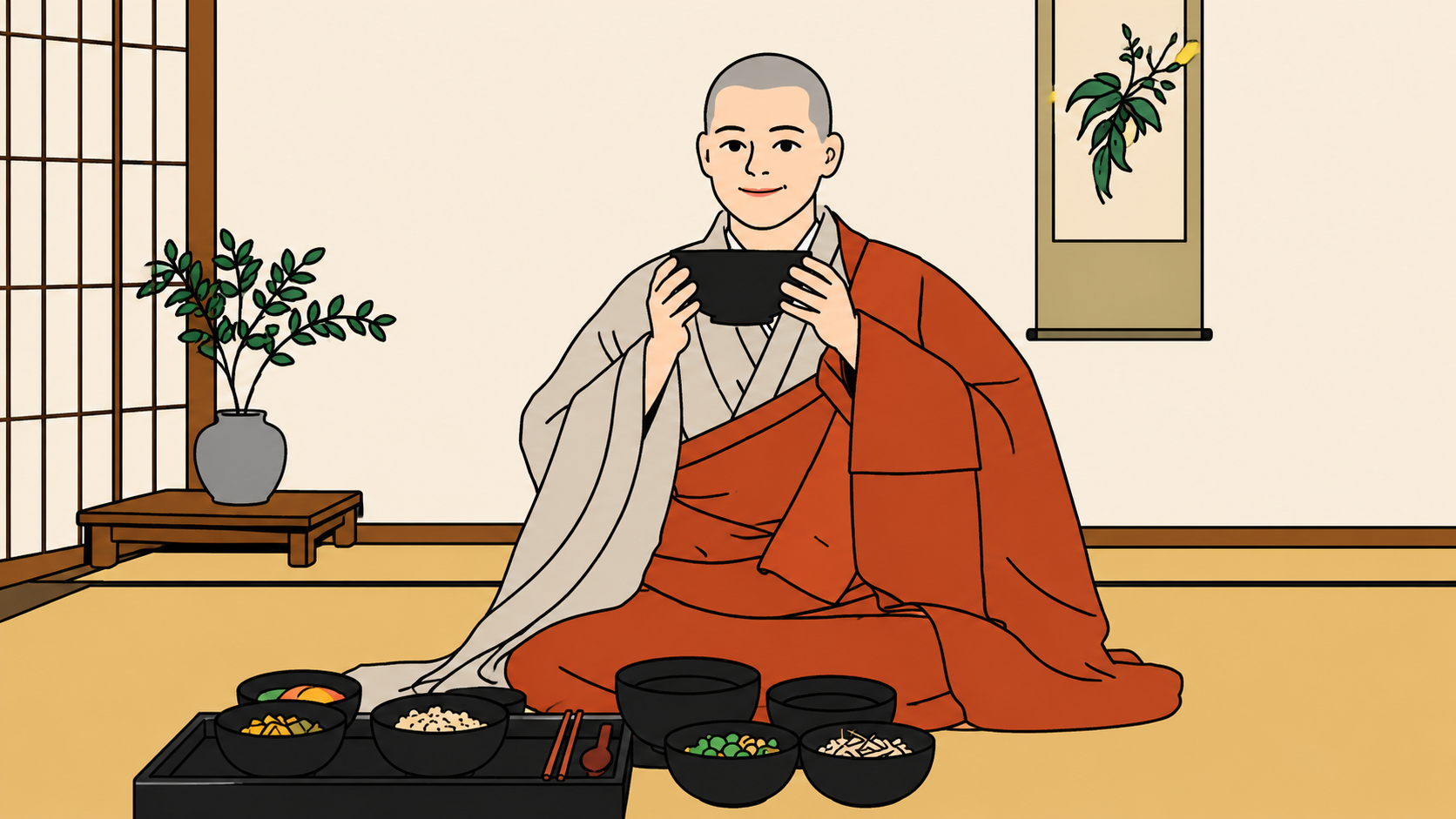
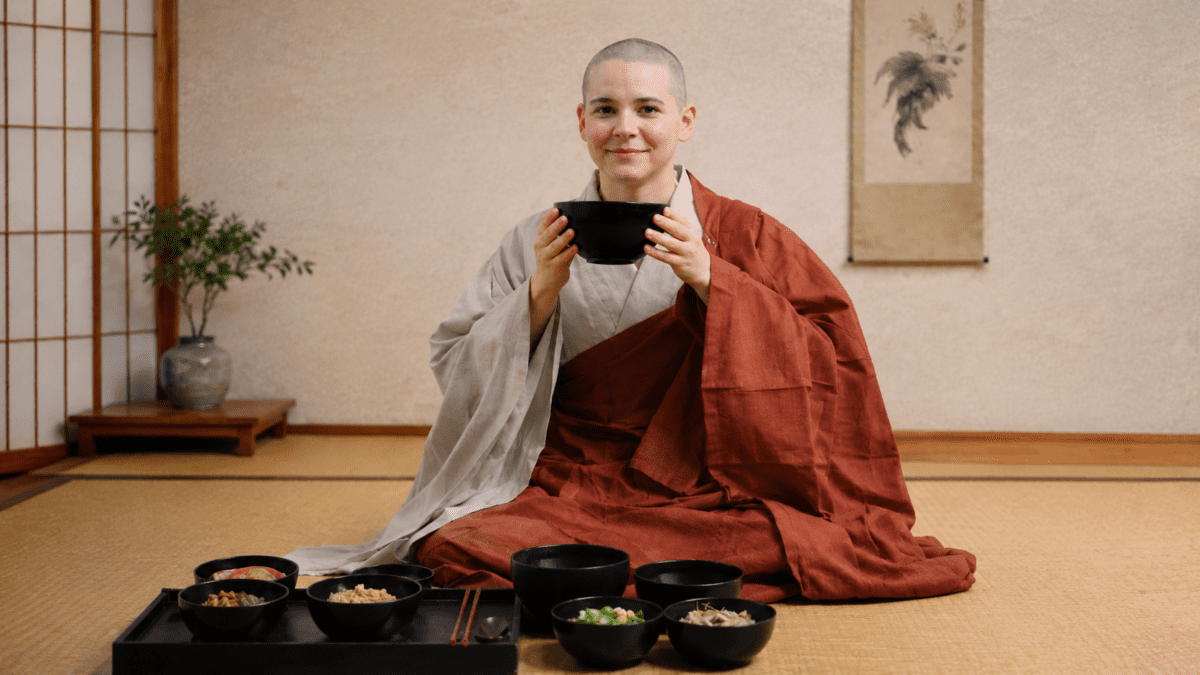
Korean temple food structures its daily meal around four bowls. Baru-gongyang (발우공양: ba-ru-gong-yang, ritual communal eating) — the largest holds rice, brown or mixed grain, unpolished to keep the nutrients intact. The second holds soup: doenjang-guk with radish and mushroom, or miyeok-guk (미역국: mi-yeok-guk, seaweed soup) made without oil or jeotgal (젓갈: jeot-gal) — the fermented seafood paste that works like fish sauce in most Korean kimchi. Two smaller bowls hold the side dishes.
What goes into those smaller bowls rotates by season. Spring brings du-reup (두릅: du-reup, fatsia shoots), chui-namul (취나물: chui-na-mul, aster scaber), and ssuk (쑥: ssuk, mugwort) — the first things to push through cold ground. Summer shifts to hobak-ip (호박잎: ho-bak-ip, pumpkin leaves), gaji (가지: ga-ji, eggplant), and oi (오이: o-i, cucumber). Autumn fills the bowls with mushrooms, doraji (도라지: do-ra-ji, bellflower root), and gosari (고사리: go-sa-ri, bracken fern). Winter returns to muk-namul (묵나물: muk-na-mul, dried and reconstituted greens) — the same vegetables that came in at their peak, preserved and brought back.
The same chui-namul appears three times across the year: blanched and dressed with soy sauce and perilla oil in spring, dried through summer, then rehydrated and stir-fried in winter. The ingredient doesn’t change. The form does. This is not resourcefulness. It’s a different relationship with food — one where nothing is discarded because nothing was treated as disposable to begin with.
Hobak (호박: ho-bak, Korean squash/pumpkin) follows the same pattern. In summer it arrives thinly sliced and stir-fried, or steamed and dressed soft. Later it is dried — the slices laid out in the mountain air until the moisture is gone and the flavor concentrates. In winter it comes back to the pan, denser now, the sweetness pulled tight. The same vegetable, three textures, three months apart.
Gon-deure (곤드레: gon-deu-re, Cirsium setidens) follows the same logic. Boiled and folded into rice in early summer, it becomes gon-deure-bap (곤드레밥: gon-deu-re-bap) — the grain carrying the herb’s faint bitterness through every bite. Dried later in the season, it comes back in winter as a namul (나물: na-mul, seasoned vegetable dish), quieter now, the green edge softened into something rounder.
The kimchi on the side contains no garlic and no jeotgal. It ferments on temple-made ganjang and time alone. The result is baek-kimchi (백김치: baek-gim-chi, white kimchi) — pale, clean, faintly sour. Next to the seasoned greens and the dark broth, it reads almost delicate.
Nothing in the bowl is there because it was convenient. Every element arrived through a decision — when to harvest, how to prepare, what to preserve, what to let go.
How the Meal Ends
Korean temple food doesn’t end when the chopsticks go down.
Before the first spoonful, the community recites o-gwan-ge (오관게: o-gwan-ge, five contemplations) — a chant that names where the food came from, how much labor it carried, and whether the one eating has done enough to deserve it. It is not grace. It is an accounting. The meal begins with the question already asked.
The bowls themselves carry the count. Four of them — one for rice, one for soup, two for side dishes — mirror the four phases that structure everything in Korean philosophical thought: initiation, stabilization, restructuring, expression. A meal is not just sustenance. It is a complete cycle, eaten in sequence, closed without remainder.
During eating, there is no conversation. Portions are taken only as needed. The rule is not moderation as virtue. It is precision as practice.
After eating, warm sungnyung (숭늉: sung-nyung, scorched rice water) is poured into each bowl. The diner uses that liquid to clean the bowl — tilting it, swirling it, drinking what remains. Every grain of rice. Every trace of broth. The bowl goes back clean enough to be stored without washing.
Nothing is left behind. Not because the rules say so, but because the philosophy doesn’t recognize waste as a category. At Bongjeongsa (봉정사: bong-jeong-sa), home to one of Korea’s oldest surviving wooden buildings, this sequence has repeated across centuries. The ingredients change with the season. The bowl, the water, the silence at the end — those stay.
The spoon goes down. The bowl comes up. The water goes around once.
What gets left out has a logic that runs deeper than flavor — the same logic that decides what belongs and what doesn’t, in a kitchen and everywhere else.
Content in this post was created with AI assistance.