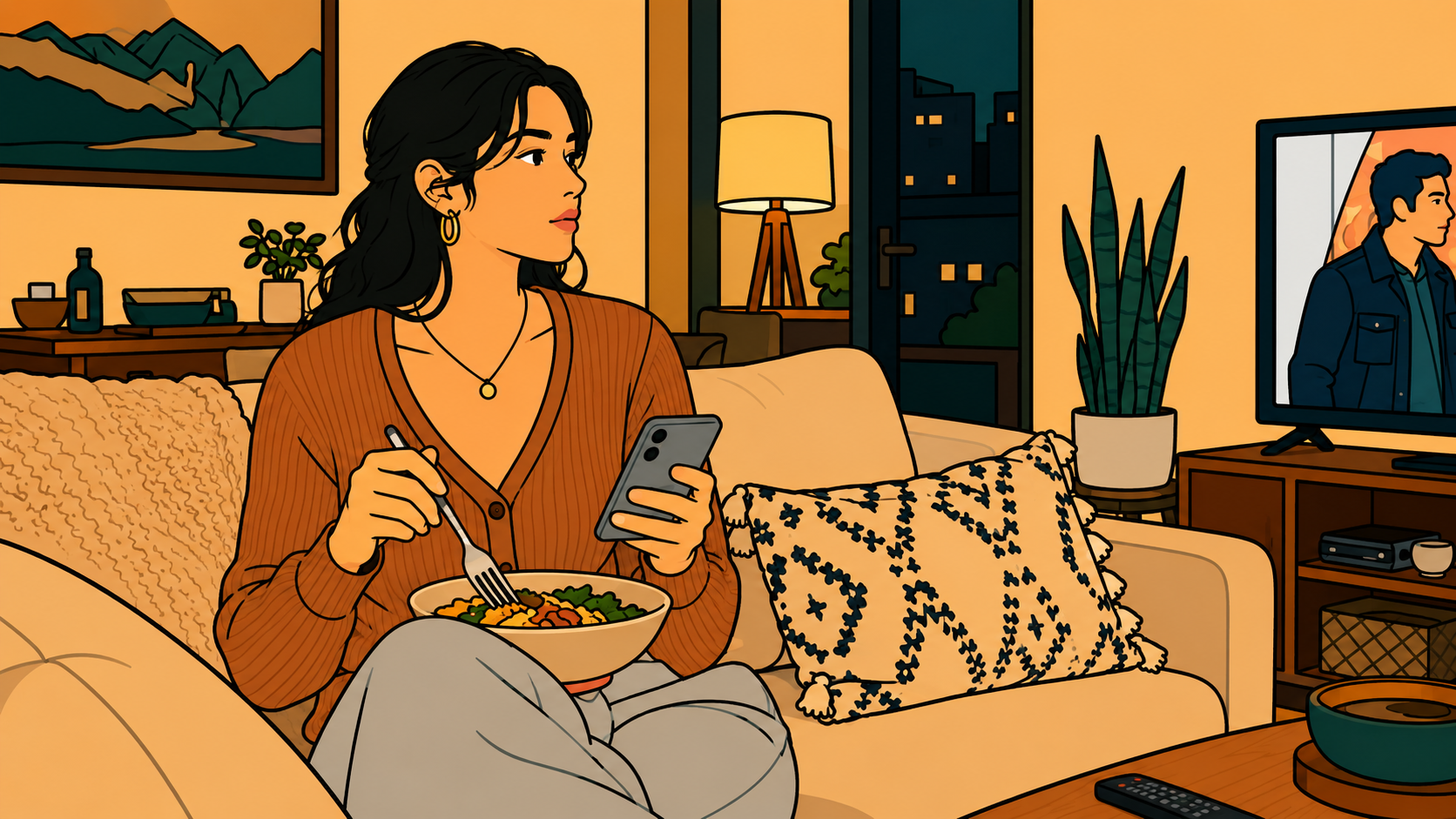

The week ended. You know it ended. You were there when it happened — the last email sent, the laptop closed, the commute home that was supposed to mark the transition.
And yet something is still running. Not loudly. Not in a way you could point to if someone asked. Just a low, steady hum underneath everything else — the week still occupying space that was supposed to be yours by now.
Letting go of work stress sounds simple. The difficulty isn’t in the instruction. It’s in what the holding is actually doing for you.
This isn’t about failing to relax. It’s about why part of you won’t let go.
The Grip You Don’t Remember Tightening
Nobody decides to hold on.
You check the email because it seemed responsible. You run through the meeting in your head because you want to be prepared. You keep the work tab open because closing it feels premature. The weekend arrives and the grip is already there — settled in, familiar, running quietly underneath whatever else you’re doing.
The shoulders that won’t fully drop. The thought that surfaces during dinner without being invited. The phone you pick up without deciding to. You put it down. You pick it up again. Not because anything changed — just because the hand moved before the decision did.
The grip looks like diligence from the inside. It looks like caring about your work, which you do. You’re not holding on by accident. You’re holding on because it feels like preparation, control, and proof that you care. And there’s no single moment when it crossed from one to the other — from caring into holding, from readiness into something that runs even when there’s nothing left to be ready for. It just kept going. The way a light stays on in a room after everyone has left, not because anyone decided to leave it on, but because no one came back to turn it off.
By the time you have enough quiet to feel one from the other, the weekend is almost over.
There’s a version of the weekend that used to exist before this. Saturday mornings that belonged to Saturday. Sundays that didn’t start tilting toward Monday until late, if at all. The grip wasn’t always there — or it was lighter, easier to put down between one thing and the next.
Somewhere in the accumulation of weeks, it settled in. Not as a decision. Just as the shape the week leaves behind when it finally ends. Letting go of work stress becomes harder the longer the grip has been the default.
Why Letting Go of Work Stress Feels Like Risk

You’re watching something. Eating something. Having a conversation that has nothing to do with work. And yet part of you is still scanning — maintaining the connection, keeping the signal alive, making sure the line doesn’t go completely quiet.
The inbox might fill. The situation might shift. Something might require your attention. If you’re still holding the thread, you’ll know. The moment you let go, you’re no longer monitoring. And not monitoring, for a nervous system trained on responsiveness, registers as exposure.
Sunday evening has a specific version of this. The show is on. The food is good. The conversation is real. And underneath all of it, a quiet calculation running — how many hours until Monday, what still needs to happen, what got left unresolved on Friday that will be waiting. Not loud enough to interrupt anything. Just present. The way background noise becomes noticeable only when it stops.
If work is where your value is most legible — where you know what you’re doing, where feedback arrives, where your competence is visible — then staying connected to it is staying connected to the version of yourself that makes sense. Putting the thread down, even briefly, means temporarily losing that signal. The version of you that exists outside of it is quieter. Less defined. Harder to locate in the dark.
The Thing You’ve Been Holding It For
A genuinely absorbing weekend afternoon. The kind where two hours pass and you haven’t checked your phone once.
And then it returns — the low-level awareness that time is passing, that Monday is closer than it was, that you’ve been off the signal for too long. Not dramatic. Just a quiet reclaiming. The thread tightens. The grip resumes. The week reasserts itself before it’s technically started.
You’re on the couch. The show is still running. Nothing changed in the room. But something shifted inside it — a slight reorientation, the way a compass needle moves when something magnetic gets close. The evening that was yours a moment ago has a different quality now. Still technically the weekend. Already something else.
The holding is preparation. If you’ve already worried about Monday, Monday can’t surprise you. If you’ve already rehearsed the difficult conversation, it has less power when it arrives. The stress isn’t residue from the week. It’s being carried forward deliberately, as a form of readiness.
There’s also loyalty in it. The work stress you carry into the weekend is partly evidence that you take the work seriously — that you’re not the kind of person who drops things. The holding is commitment, in its own way. The weekend doesn’t know the difference. Neither does the grip.
The Pattern That Was Always Underneath
The holding didn’t start this week.
The evening you stayed at the desk longer than necessary. The Sunday that tilted toward Monday before you noticed. The version of yourself that used to exist in the spaces between work — quieter, less calculated — that started showing up less often without any single moment you could point to.
The week has been reaching into those spaces for a long time. And the grip has been meeting that reach — holding the thread so nothing slips, staying ready so nothing catches you off guard.
There’s a specific texture to the spaces that are left. Not empty — just narrower. The evening that used to have room for something unplanned. The Sunday that used to belong to itself before it started belonging to Monday. The version of the weekend that existed before the week learned to arrive early.
What would it feel like to hold it differently? Not drop it. Just loosely enough that the evening could be an evening again. Loosely enough that the version of you that existed before the job could find enough room to surface, briefly, in the margins.
You’ve felt that version. In unexpected moments, when nothing was being asked of you long enough for the grip to ease on its own. That’s the closest letting go of work stress actually gets — not a decision, just a moment when the conditions were finally right.
The Moment Before You Put It Down

It doesn’t happen all at once.
There’s a moment — brief, often unannounced — when the grip loosens slightly. Not because you decided to let go, but because something else became more present. A conversation that pulled your full attention. A meal that required it. A moment of quiet that arrived unexpectedly and stayed long enough to matter.
In that moment, the work is still there. The inbox didn’t disappear. Monday is still coming. But for a few minutes, the thread went slack — not dropped, just no longer taut — and something else came through.
You’ve had those moments. They arrive without warning, in the margins of the week, when the conditions are right and nothing is being asked of you for long enough that the grip relaxes on its own. They don’t last long. But they’re long enough to remember what the evening used to feel like before the week learned to arrive early.
In that moment—when the thread goes slack just long enough—the evening that was yours belongs to itself again.
Not for the whole night. Just long enough to feel the difference.
This post was planned and edited by a human, with AI assistance.