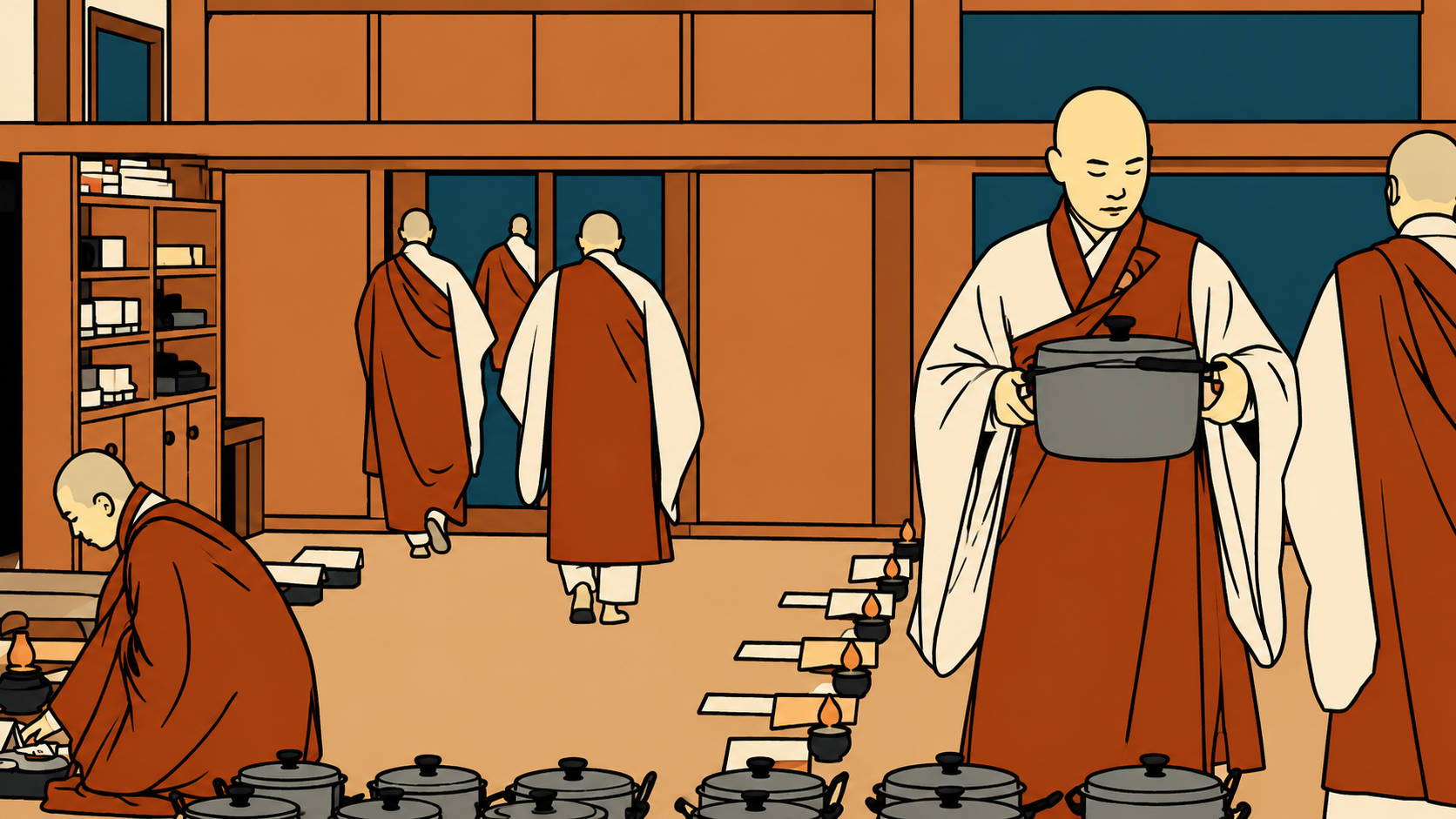
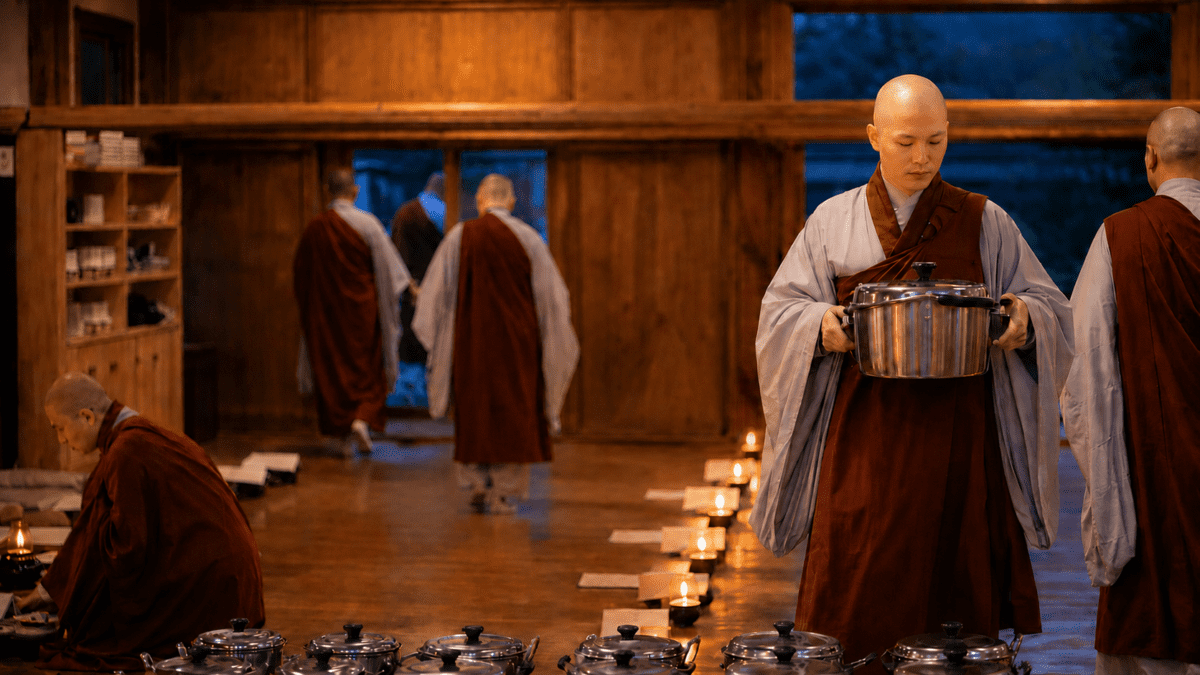
The monks are already up. They have been up since 3:30, when the first bell rang across the courtyard. By 4 AM, the morning chanting is done and the kitchen is moving.
Most people who visit a temple arrive after breakfast. They see the result — the bowls, the soup, the arranged namul. They don’t see the hour that made it. That hour is the temple kitchen experience.
It runs without an audience and without applause, the same sequence repeated regardless of who shows up to eat. No one schedules it around visitors. No one slows down because someone is watching. By the time a guest sits down to breakfast, the work that made it possible is already finished, already cleaned up, already forgotten by the room.
The Temple Kitchen Experience Before Dawn
The gong-yang-gan (공양간: gong-yang-gan, temple kitchen) at Bongjeongsa faces east. In the hour before dawn, the only light comes from the stove. One monk has already started the stock — the kelp went into cold water before the chanting began, which means it has been steeping for close to an hour by the time the kitchen fills.
There is no conversation. The sounds are specific: water beginning to move in a pot, the soft knock of a wooden spoon against ceramic, the particular sound a knife makes on a wooden board when the cook is not in a hurry.
The rice went in earlier. Temple rice — brown or mixed grain — takes longer than white rice, and the timing has to account for everything else that needs to be ready at the same moment. The cook who started the rice did not check a clock. The rhythm is internal, built from years of the same sequence in the same space.
Outside, the courtyard is still dark. The stone lantern that stands between the main hall and the kitchen casts a pale circle on the ground. A second monk crosses it on the way to the storage room, where the muk-namul (묵나물: muk-na-mul, dried and reconstituted greens) soaked overnight in cold water, pulling the moisture back in after months of drying on the mountain. She lifts the bowl, presses the water out with both hands, and carries it back to the cutting board without turning on a light. She knows the distance.
What Gets Prepared and in What Order
The stock comes first, always. While it steeps and then simmers, the namul preparation begins.
Vegetables that were blanched the night before get dressed now — gosari (고사리: go-sa-ri, bracken fern) with doenjang and perilla oil, sigeumchi (시금치: si-geum-chi, spinach) with ganjang and sesame, doraji (도라지: do-ra-ji, bellflower root) with a lighter hand. Each bowl is dressed separately. The flavors are not mixed until they reach the individual baru at the table.
The muk-namul goes into the pan next. Chui-namul (취나물: chui-na-mul, aster scaber) that was harvested in spring, dried through summer, and soaked last night gets stir-fried now with a small amount of ganjang and perilla oil. The green edge it had in spring is gone. What remains is quieter, more concentrated, the flavor pulled inward by months of drying and then slowly released by the heat. It takes four minutes. The cook does not leave the pan.
Dubu-jorim (두부조림: du-bu-jo-rim, braised tofu) goes on a separate burner. The tofu was pressed overnight — a board weighted on top to extract as much moisture as possible, so that when it hits the pan it browns instead of steams. Ganjang and dashima stock go in after the first side sets. The heat drops. The tofu braises for twelve minutes, absorbing the brine into each piece. No garlic. No green onion. The pan is watched the entire time because the ganjang will burn if the heat isn’t managed correctly, and there is no way to fix braised tofu that has gone bitter.
Jangajji comes out of its jar. The lotus root (연근: yeon-geun) that went in three weeks ago gets sliced to the right thickness — thin enough to carry the brine, thick enough to hold its texture at the table. Two or three pieces per bowl. No more. The jar goes back.
The doenjang-guk comes together last, after the stock has been strained and every side dish is ready. The paste goes in, then the radish or the mallow or whatever the season brought in yesterday. The soup is tasted once. Adjusted once. It does not get tasted again.
By 5:30, everything is ready. The bowls are laid out. The rice is resting. The soup is holding at temperature. The kitchen goes quiet again.
The Silence That Runs the Kitchen

The temple kitchen experience runs on a different principle than any professional kitchen. A secular kitchen before service is loud — tickets, timers, the controlled chaos of multiple dishes moving toward a simultaneous moment. The temple kitchen operates on a different principle.
The silence is not the absence of communication. It is the communication. When one cook reaches for the ganjang, the other has already moved. When the soup needs to be stirred, someone is already there. The coordination happens without language because the sequence has been internalized to the point where language would only slow it down.
This is what happens when a kitchen runs the same sequence every day for years. The decisions disappear. What remains is the action, clean and without hesitation.
In the temple kitchen, ulyeok (울력: ul-lyeok, communal temple labor) means the work is not preparation for something else. It is the practice itself. The chopping, the stirring, the timing — these are meditation carried out with utensils instead of stillness. The quality of attention brought to the stock is the same quality brought to the breath in the meditation hall. A bowl made from that attention carries something a bowl made without it does not.
What the Bowls Carry to the Table

At 6 AM, the bamboo clapper sounds three times. The community assembles in the dining hall, each monk carrying their baru bundle — four bowls nested inside the largest, wrapped in cloth, tied at the top. The bundles are unwrapped in sequence. The food arrives in order: water first, then rice, then soup, then the side dishes, passed from hand to hand down the row.
There is no conversation during the meal. The pace is set by the group — eating too fast or too slow pulls against the collective rhythm. Before the first spoonful, the community recites o-gwan-ge (오관게: o-gwan-ge, five contemplations) — not a blessing but an accounting, naming the labor behind the food and asking whether the one eating has earned it.
When the eating is done, sungnyung (숭늉: sung-nyung, scorched rice water) goes into each bowl. The diner wipes the bowl clean with the last piece of kimchi, then rinses it with the warm water, drinking what remains. The bowl goes back into the bundle spotless.
The cook who made the soup does not watch it being eaten. The kitchen is already being cleaned. The stock pot is rinsed. The cutting board is wiped. The jangajji jar is back on the shelf. By the time the last baru is tied back into its bundle, the kitchen is ready for the next sequence.
Nothing about the 4 AM kitchen is dramatic. The movements are small, the sounds are quiet, and the light, when it finally comes through the east-facing window, falls on a space that has already done its work. What the bowls carry to the table is not just food. It is the record of two hours of attention, applied without interruption, in the dark, before anyone arrived to watch.
There’s a stillness to this kind of kitchen that runs deeper than quiet — the same stillness that shapes every decision about what to keep and what to let go.
Content in this post was created with AI assistance.