
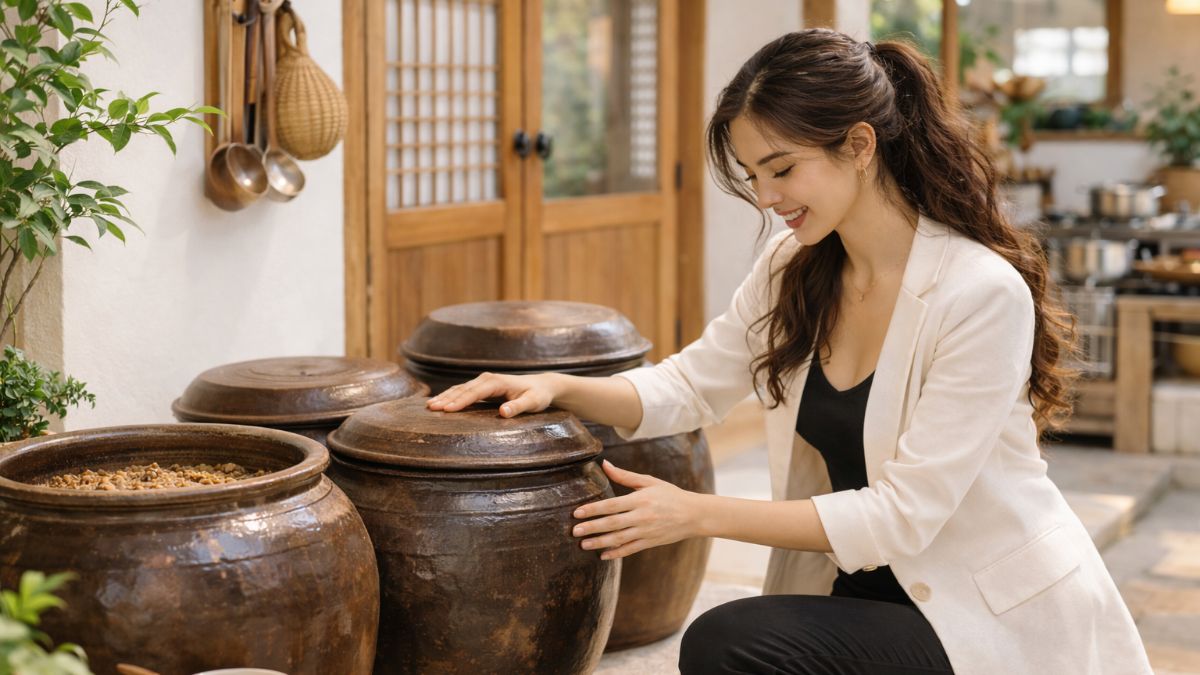
Most Korean kitchens keep garlic on the counter. A head or two, always within reach. It goes into almost everything — the marinade, the stir-fry, the soup base, pressed in before the pan heats up.
Korean Buddhist food removes it entirely. Which means the three jars on the temple shelf — doenjang, ganjang, gochujang — have to do everything garlic used to do, and more.
They do.
What Doenjang Does Without Garlic
In a secular Korean kitchen, doenjang and garlic work together. The paste provides depth, the garlic provides sharpness. Remove the garlic and most cooks would say something is missing.
Temple cooks disagree.
Korean Buddhist food builds its flavor architecture from fermentation alone — and the paste that results is more complex than garlic ever was.
Temple doenjang (된장: dwen-jang, fermented soybean paste) is made on-site, fermented longer than commercial versions, and carries a complexity that mass-produced paste cannot replicate. By the time it reaches the pot, it has been developing for months. The sharpness that garlic would have provided is already there, built into the fermentation itself.
Into doenjang-guk (된장국: dwen-jang-guk, soybean paste soup) goes whatever the season allows — radish in autumn, mallow in summer, mugwort in spring. The paste dissolves into the shiitake-kelp stock and the soup becomes layered and specific. No garlic was needed. The paste carried the weight alone.
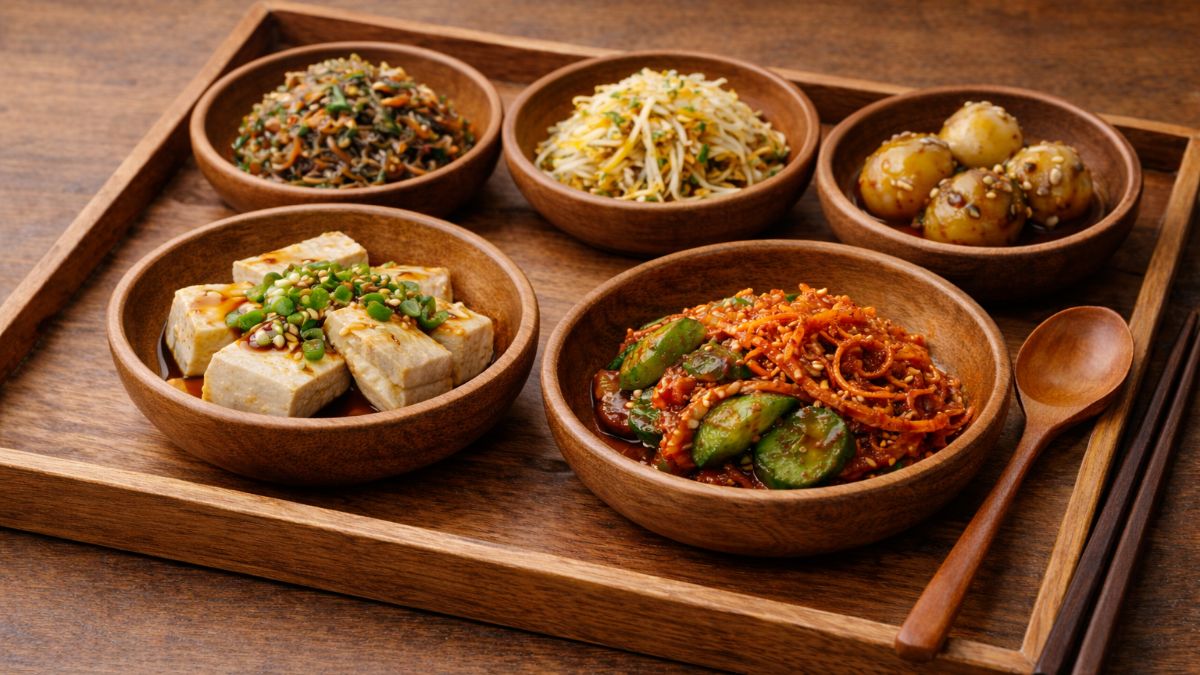
The same doenjang appears in namul (나물: na-mul, seasoned vegetable dishes). Blanched gosari (고사리: go-sa-ri, bracken fern) gets dressed with a small amount of paste, perilla oil, and sesame — earthy and round, the vegetable staying in front, the paste holding everything together behind it. Chui-namul (취나물: chui-na-mul, aster scaber) takes the same treatment, the slight bitterness of the green meeting the fermented depth of the paste and arriving somewhere neither ingredient could reach alone. Doraji (도라지: do-ra-ji, bellflower root), blanched and squeezed dry, goes into a lighter doenjang dressing — the paste used sparingly here, just enough to round the root’s sharpness without burying it.
Auk-doenjang-guk (아욱된장국: a-uk-dwen-jang-guk, mallow soybean paste soup) is the version that appears most often in summer. The mallow leaves go in late — just before the heat is turned off — and cook for less than a minute. They arrive at the bowl still slightly green, their texture sitting between soft and silky, the doenjang broth holding them without overwhelming the leaf’s own mild sweetness. It is one of the quieter soups in the temple kitchen, and one of the most difficult to get right. The paste has to be measured carefully. Too much and the mallow disappears. Too little and the broth reads thin. The margin is narrow, and there is no garlic to fill the gap.
Dubu-jorim (두부조림: du-bu-jo-rim, braised tofu) uses doenjang as its primary seasoning — the tofu cut thick, braised slowly in a mixture of paste, ganjang, and dashima stock until the fermented flavor penetrates each piece. No garlic. The depth comes entirely from fermentation, concentrated by heat into something that coats the tofu and stays long after the bowl is empty.
What Ganjang Does Instead
Ganjang (간장: gan-jang, soy sauce) is the liquid that comes from the same fermentation as doenjang. Where the paste is thick and earthy, ganjang is precise and clean. It goes where the paste cannot — into the clear broth, into the thin marinade, into the jar.
Temple ganjang is aged longer than commercial soy sauce. The color runs darker, the flavor sits rounder, and the salt integrates differently — less sharp at the front, more present at the finish. A few drops into a clear vegetable broth shifts the entire register without announcing itself.
Beoseot-bokkeum (버섯볶음: beo-seot-bok-keum, stir-fried mushrooms) goes into the pan with ganjang and perilla oil. Shiitake, oyster mushroom, pine mushroom — whichever arrived that week. No garlic, no green onion. The mushroom’s own glutamates amplify the soy sauce the same way they amplified the broth. The result is concentrated and specific, the flavor shifting depending on which mushroom came in from the mountain.
Ganjang also goes into jangajji (장아찌: jang-a-jji, soy-pickled vegetables). Lotus root (연근: yeon-geun) is sliced thin and submerged in diluted ganjang with a small amount of vinegar. Burdock (우엉: u-eong) goes in whole or cut into long strips, the fibrous root slowly absorbing the brine over weeks. Wild mountain pepper (산초: san-cho) goes in last — its numbing heat needing the longest time to settle into something usable at the table.
The transformation is not dramatic. A week in, the vegetables still taste mostly of themselves. Two weeks in, the ganjang has begun to pull moisture out and push salt in. By the third or fourth week, the lotus root has turned from crisp and neutral to something chewy, faintly sweet, and deeply savory. It arrives at the table in small portions — two or three pieces beside the rice — and the flavor it carries is months old.
The jangajji jar sits on the same shelf as the doenjang crock, in the same light, at the same temperature. The temple kitchen does not separate cooking from fermenting. Both are the same process running at different speeds.
What Temple Gochujang Does Differently
Gochujang (고추장: go-chu-jang, fermented chili paste) is the jar most people outside Korea think they already know. The commercial version — in supermarkets globally — is sharp, sweet, and immediate. It contains garlic. Most versions contain sugar. It is designed to be used in large amounts.
Temple gochujang contains neither garlic nor added sugar.
Made from fermented soybeans, red pepper powder, and glutinous rice, temple gochujang relies entirely on fermentation for its complexity. The process takes months. The glutinous rice is cooked and cooled before the red pepper powder and fermented soybean powder are folded in. Salt is added by weight, not by taste.
The jar is sealed and set in sunlight — the same stone terrace where the doenjang and ganjang sit — and left. The sweetness that develops comes from the rice as it breaks down slowly over weeks. It is nothing like the sugar in the commercial version. It arrives later, quieter, and sits at the back of the palate rather than the front.
The heat from the red pepper integrates at the same pace, becoming part of the paste’s overall character rather than its dominant note. By the time the jar is opened, the paste has become something unified — no single ingredient legible on its own, everything present at once.
It appears in bibimbap (비빔밥: bi-bim-bap, mixed rice) at the temple table — a single spoonful stirred through seasonal namul and rice, binding everything without overwhelming any single ingredient. It appears in namul dressings where a bitter green needs something to balance against. In ssuk-muchim (쑥무침: ssuk-mu-chim, seasoned mugwort), a small amount of temple gochujang cuts through the herb’s intensity and holds the dish together. In gosari-namul dressed with paste instead of soy sauce, the heat adds a dimension the soy version doesn’t reach.
Without garlic, the paste has nowhere to hide. Every note in the fermentation is readable. The cook has to know the paste well enough to use it correctly — the right amount for the right green at the right moment — because there is no garlic to smooth over what isn’t working.
What Korean Buddhist Food Builds Without Garlic
The three jars are not interchangeable. Each does something the others cannot. Doenjang carries weight and rounds the bitter edges of greens. Ganjang carries precision and lifts the flavor of anything it touches without changing its character. Gochujang carries heat and binds ingredients that would otherwise pull apart.
Together, they season an entire meal without a single allium. The vegetables stay themselves. The broth stays clear. The rice stays neutral. And the jangajji — sitting in its ganjang brine since spring, tended by no one, opened when the time is right — contributes something no fresh ingredient could: the specific flavor of time passing inside a sealed jar, at a specific temperature, in a specific place.
That is what the shelf knows. Not a recipe. A condition. The three jars were not designed to replace garlic. They were built from entirely different premises — fermentation as the primary flavor source, time as the primary ingredient, restraint as the primary technique. A cook trained on garlic learns to add. A temple cook learns to wait.
The meal that results from the three jars is not a meal without something. It is a meal built on a different logic — one where the absence of alliums is not a gap to be filled but a space that allows everything else to become more itself. The gosari stays earthy. The tofu stays clean. The mushroom stays specific. And somewhere in the background, the jars keep working, the next batch already underway, the shelf never quite empty.
What changes when the three jars replace garlic is not just the flavor. It is the pace of the kitchen. Garlic is immediate — it goes in, it hits, it’s done. Fermented paste is cumulative. Each addition builds on what came before. The cook who opens the doenjang crock in November is working with decisions made the previous winter, adjustments made in spring, conditions set by the mountain and the water and the particular quality of that year’s soybeans. The jar is not just a container. It is a record.
This post was planned and edited by a human, with AI assistance.