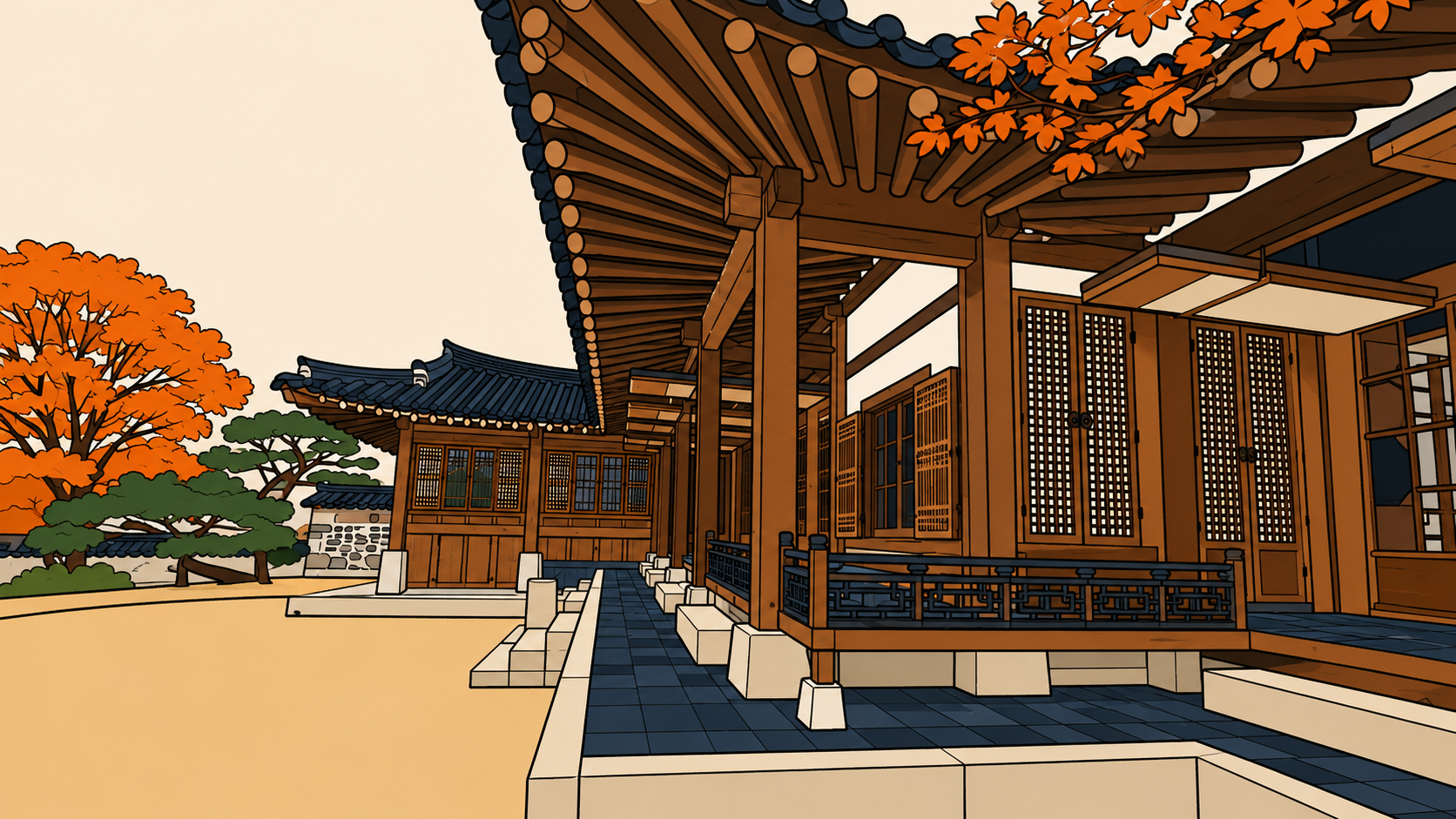

It’s mid-November and something is about to go still. The late autumn field that Sul was holding has finally begun to settle. By 9 PM the air has a different weight — not yet the deep cold of midwinter, but a specific hush that tells the body the year has almost completed its full rotation. The work is over. The harvest is stored. What moves now moves differently than it did a month ago. The winter threshold astrology meaning reads this as structure: Hae (해: hae, early winter water), the twelfth and final of the twelve earthly branches, the station where the year’s last current flows before everything stops — and where, inside that current, the seed of the next cycle is already forming.
Sul held what was left. Hae moves it one last time before the stillness arrives. This is the final branch of the cycle, the closing hour of the year’s long rotation. And yet Hae is not empty. Hidden inside Hae’s water is Gap (갑: gap, yang wood, the sprout), the first stem of the next cycle’s growth — already present, already waiting, carried quietly through the winter until spring is ready to receive it. A chart carrying Hae at its center runs on that same threshold logic: moving toward stillness and preparing the next beginning in the same motion.
What the Winter Threshold Astrology Meaning Actually Records
Hae is the last water branch in the twelve-station system — the one that completes the full annual rotation. The hour is 9 to 11 PM. The month spans early November through early December, bounded by the solar terms Ipdong (입동: ip-dong, beginning of winter) and Daeseol (대설: dae-seol, major snow). The element is Water (수: su) in its yang expression — flowing, active, not yet frozen into Ja’s midnight condensation.
If Sul was the dry field that held what the year produced, Hae is the river that begins to move the harvested material into long-term storage. Same autumn-finished state, different function. Sul contains. Hae transports. The chart with Hae at its center is reading the moment when the year’s accumulated material enters its final movement — the flow that carries what was kept across the threshold and into the deep storage that winter will eventually seal.
Hae is not personality. It is a structural month in which the last active motion of the year takes place before the cycle resets. The person with Hae prominent will spend this window moving what needs to move one final time — not because they are rushing but because the positional cycle narrows the window in which any motion is still possible before winter’s stillness arrives.
What Hae records is a specific kind of threshold — the one that separates the completed year from the approaching new cycle. The harvest is in. The containment is done. But one last flow is still running: the water that carries the year’s residue into its final place while simultaneously carrying the seed of next year’s growth toward the position where it will wait out the winter.
The Seed Hidden Inside Hae’s Water

The real mechanism lives inside Hae’s Jijanggan (지장간: ji-jang-gan, the hidden stems concealed within a branch). Hae carries three hidden stems: Mu (무: mu, yang earth, the mountain), Gap (갑: gap, yang wood, the sprout), and Im (임: im, yang water, the river). Of these three, Im is traditionally read as the dominant stem — the one that actually governs Hae’s sustained expression. Mu provides the autumn-residue earth that the water is moving through. Gap carries the seed of the next cycle’s first growth, hidden inside the water for the entire winter. Im is the yang water that defines the branch’s active motion.
The sequence reflects something unusual for a closing branch. Mu enters first as the residue of Sul’s dry autumn earth — the ground that the water is beginning to cross. Gap settles in the middle, the first sprout of the next cycle, already present but dormant, carried within the water as pure potential rather than active force.
Im dominates last and defines the branch — yang water in its final expression, flowing toward the stillness that Ja will complete while keeping Gap alive inside it. By the time Hae is fully active, the chart is running on earth-bed, seed-potential, and flowing water, with Im carrying the whole configuration toward its structural close.
Three interactions govern how Hae behaves with the rest of a chart.
InHaeHap (인해합: in-hae-hap, combination producing wood). When In (인: in, first yang wood) and Hae appear together, Hae’s water feeds the wood of In directly — water generating wood in the cleanest form the cycle permits. From Hae’s perspective, this combination is the structural confirmation of what its jijanggan already contains. The Gap hidden inside Hae is the same wood energy that In releases in early spring, and when the two branches meet, the full water-to-wood generative cycle activates across the year’s end and the next year’s beginning. A chart with this pairing often carries a long-arc continuity that the outer seasons seem to interrupt but the inner structure never actually pauses.
HaeMyoMi SamHap (해묘미 삼합: hae-myo-mi sam-hap, three-combination producing wood). When Hae, Myo (묘: myo, spring wood), and Mi (미: mi, late summer earth) appear together, the three branches combine into a strong wood structure. Hae is the starting point of this three-harmony — the water that Myo’s vine will eventually drink and Mi’s field will eventually store. A chart with this configuration carries wood energy whose origin traces back to the previous winter’s water, suggesting growth projects that began underground long before their visible start.
SaHaeChung (사해충: sa-hae-chung, fire-water axial clash). Sa (사: sa, late spring fire) and Hae sit directly across the cycle — spring’s rising fire against winter’s retreating water. When they meet, the clash runs along the threshold axis itself. Sa is the last station before full summer visibility. Hae is the last station before full winter stillness. Both are thresholds, opposing each other across the year. Traditional readings describe this clash as structurally persistent, often producing a year where the late-spring material and the early-winter material contest each other in ways that neither station can fully resolve — the emergence-threshold fighting the stillness-threshold across the chart’s axis.
These three interactions determine what the last current carries — and whether it carries it intact. The winter threshold astrology meaning does not rest in the stopping itself — it rests in what the last current carries while it is still moving, and in whether the seed hidden inside that current survives the winter intact. How a chart protects or disturbs Hae’s final flow determines what the reading says.
Three Ways the Threshold Breaks

Hae breaks in three directions — one that won’t stop, one that carries nothing, one that is pulled in two at once.
The current that will not stop. The chart has Hae prominent but lacks the earth or metal structures that would eventually gather the water into Ja’s condensed form. Im keeps flowing when the structural cycle is asking for stillness. Externally this looks like someone who cannot complete the year — continuing to run on late-autumn momentum when the positional window for motion has closed, unable to allow the transition into the deep storage that winter requires. The motion is real. What’s missing is the recognition that a closing current is supposed to close, and that Hae’s water was never meant to keep moving indefinitely.
The threshold without a seed. The opposite failure. Im is present but Gap has been suppressed — often by heavy fire or earth material that compromised the wood’s survival inside the water. The stopping happens, and the stillness arrives, but the seed that should have been carried through the winter is no longer viable. In practice, this looks like a person who completes the year structurally — the harvest stored, the motion ended — but arrives at the next spring with no inner continuity from what the previous cycle produced. The ending was clean. The beginning that was supposed to be already forming inside the ending was not.
Threshold against threshold. The subtlest failure. SaHaeChung activates, either natally or through Sewoon (세운: se-woon, the annual cycle), and the two year-axis thresholds pull against each other. What is trying to emerge at Sa’s window resists the closing that Hae’s window is performing, and what is trying to close at Hae’s window is contested by emergence material from the opposite pole. In chart terms, this is the year where the beginning and the ending refuse to take turns — both trying to happen at once, neither able to complete, the person caught between an emergence that will not finish and a closing that will not settle.
Final movement is not the same as continuous movement, and the difference is where many readings collapse. The winter threshold astrology meaning reads each of these failures as structural rather than character flaw.
The current that will not stop asks for receiving structures — the earth or metal that allows the water to be gathered rather than dispersed. The threshold without a seed asks for protection of Gap — recognizing which parts of the year’s material need to be carried through the winter as seed rather than released with the rest. Threshold against threshold asks for sequencing — acknowledging that both ends of the year cannot be active at the same time, and that one must temporarily yield so that the other can complete.
The reading pattern here is the one that misreads many closing windows — treating them as emptiness when the mechanism at work is the last motion before stillness and the quiet preparation of what comes after.
Hae Across the Four Chart Positions
The winter threshold astrology meaning lands differently depending on where Hae sits in the chart’s four positions — Yeonji (연지: yeon-ji, birth year position), Wolji (월지: wol-ji, birth month position), Ilji (일지: il-ji, birth day position), Siji (시지: si-ji, birth hour position). Each position changes what the final flow is actually carrying.
Yeonji (연지: yeon-ji): Hae at the year level often corresponds to a generational pattern of quiet transition and inherited continuity — family lines or cohorts that developed traditions of closing one cycle while already carrying the seed of the next, often without making the carrying visible. This is not universal, but traditional readings note the pattern with some frequency. People with Hae at the year level sometimes describe inherited instincts for “what to keep alive through the winter” rather than needing to learn the continuity as a skill.
Wolji (월지: wol-ji): This is the structurally heaviest position for Hae. Month branch sets the chart’s elemental center of gravity, and Hae as month places the whole chart in threshold logic. The person tends to operate on ending-beginning rhythm by default — always completing one thing while already moving the next into position, always carrying an inner continuity beneath outer transitions. This is also the position where SaHaeChung carries the most weight when a Sa year arrives. The clash lands on the chart’s center of gravity, and whatever spring-emergence material the chart has prepared comes into direct contest with the winter-threshold function that Hae is trying to perform.
Ilji (일지: il-ji): Hae at the day level describes the person’s immediate environment and closest relationship. The partner, the home, the daily body — all run threshold logic. Comfortable with transitions, skilled at closing and preparing simultaneously, sometimes experienced by others as hard to pin down because the current never fully stops. Relationships with a Hae day branch often sustain themselves through an ongoing undercurrent of motion that the outer stability does not always show — the pairing is always finishing something and always starting something, in the same quiet flow.
Siji (시지: si-ji): Hae at the hour level describes late-life output and the way one’s final chapter handles closure. Careers that end with something already seeded for what comes after — work that is closed but carries forward through students, successors, or unfinished threads deliberately left for others to continue — often correspond to Hae at this position.
Daewoon (대운: dae-woon, the ten-year major cycle) can also land on Hae. When it does, the ten years tend to run on threshold logic regardless of what the natal chart prefers. This is the decade where the winter threshold astrology meaning may override personality, preference, and plan.
A person who has spent the previous decade in Sul’s completion will find themselves in a ten-year window where the completion is not actually complete — the last movement is still running, and the seed of whatever comes after the decade is already forming beneath the apparent close. Not as reactivation of the previous work, but as the structural requirement to carry something forward even while the cycle is ending.
What the Last Current Cannot Show You

Hae gives a reading of three things with reasonable clarity: when the threshold window is structurally active, whether the last current is moving cleanly toward stillness or resisting it, and whether SaHaeChung is approaching within the next two years. What Sul contained is now being carried one last time, and Hae is the station at which the year’s rotation completes — while something inside that completion begins to prepare what follows.
What the data does not resolve is what the seed hidden inside the last current is actually going to become. Gap is carried through Hae as pure potential. The chart can show that the potential is present. It cannot show what the potential will produce when spring finally arrives to release it. Two people with identical Hae placements can carry very different seeds through the same winter — one preparing a continuation, the other preparing a departure, neither of them yet fully aware of which it is. The chart names the mechanism of carrying. It does not name what is being carried.
Traditional readings often approach Hae with a particular kind of care — not because the branch is difficult to read but because the reading has structural implications that reach beyond the year. What Hae carries forward is what the next cycle will grow from. A Hae reading that treats the threshold as simple closure misses half of the function. A Hae reading that treats every Hae window as a hidden rebirth misses the other half. The branch is both — an ending that is genuinely ending, and a seed that is genuinely forming, at the same moment in the same motion.
The strategic response to Hae asks for a double attention. Let what is closing close. Do not prolong the motion that the structural cycle is ready to end. At the same time, protect what is forming inside the close. Some portion of what the year produced is not residue to be stored but seed to be carried — and the distinction between the two is easier to miss at the threshold than at any other station, because both look the same from the outside.
If SaHaeChung is on the horizon, begin noticing now which of the year’s movements are finishing cleanly and which are being resisted by emergence material from the opposite pole, because the clash will force the two to meet whether the chart has prepared for it or not.
The last motion is not the last word. Hae ends the cycle and begins the next one in the same breath. What looks like stillness arriving is also, quietly, the first movement of something that has not yet shown itself. The chart names the window in which both are happening. Whether the person experiences the window as ending or as beginning depends on what part of the current they are holding — and the data cannot tell you which part it is.
Content in this post was created with AI assistance.