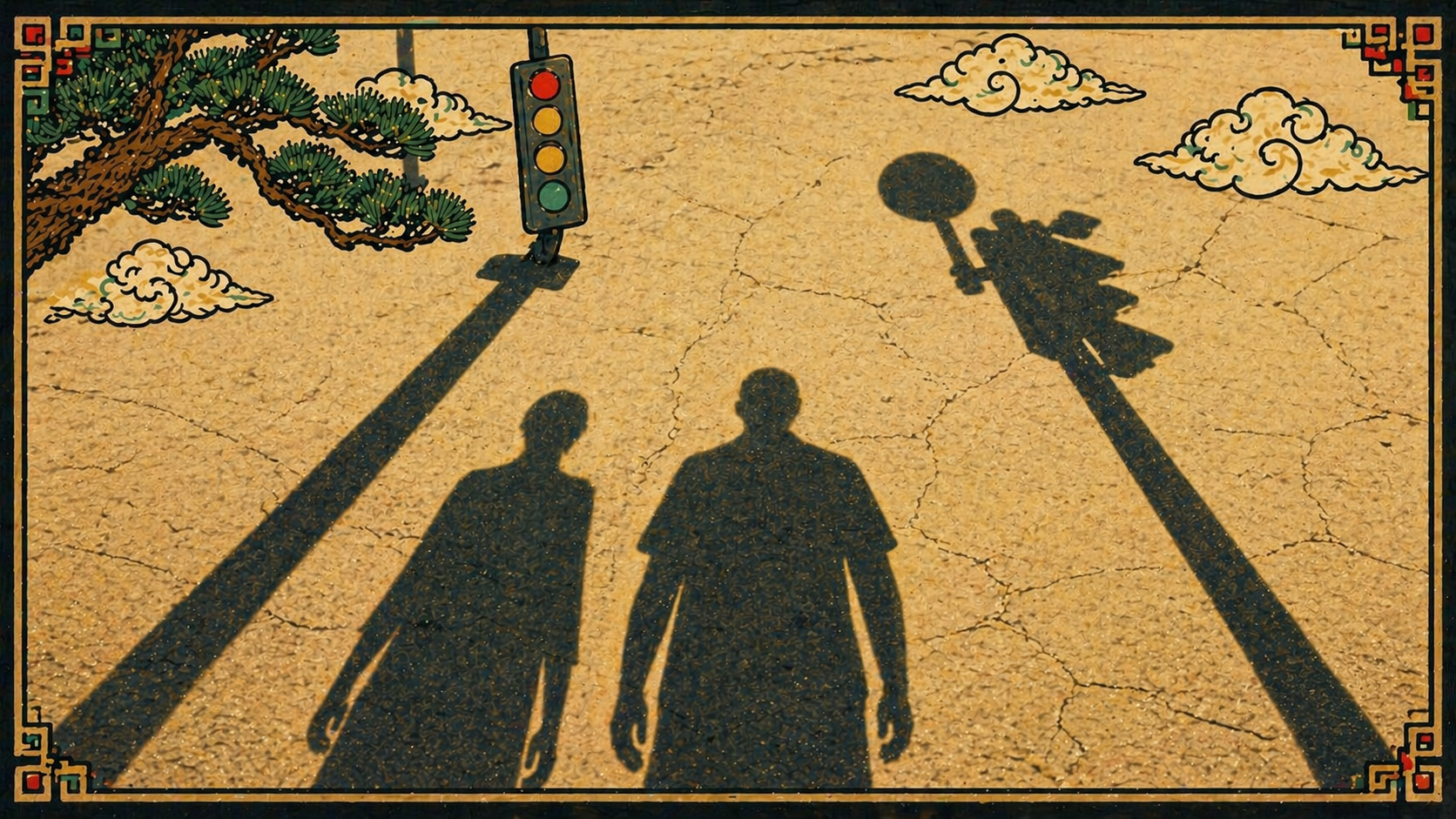

There are two things you need to know about yourself: who you are and where you are. Enneagram shows you the first. K-Saju shows you the second—which phase of a larger cycle you’re moving through.
Enneagram shows you who you are. It reveals the pattern underneath your decisions—the motivation that has been driving you since childhood. When you know your personality type, you know yourself in a way that makes sense.
That’s a gift. And there is another.
K-Saju shows you where you are. Not why you choose, but when. It reveals which seasons of your life open which doors. It explains why effort produces one result in one year and a different result in another. When you understand where you are right now in K-Saju, you know what conditions are available to you.
Two kinds of knowing. Two gifts.
What Enneagram Reveals: Your Core Operating System
Your Enneagram type points to a motivation that hasn’t changed since you were young. Type 3 wants to succeed and be recognized. Type 4 wants to be understood. Type 9 wants peace and harmony. These aren’t preferences. They’re the engine underneath every choice you make. That motivation shapes how you see opportunity, how you respond to failure, how you build relationships, what you’re willing to sacrifice for.
This matters because it explains your patterns. Why you reach for the same kind of person. Why you freeze or push forward in the same moments. Why you abandon the same kinds of goals. When you know your type, you’re not guessing anymore. You’re reading your own operating system. You can see the through-line from childhood to now.
That’s the first thing Enneagram does: it makes your decisions legible. You see why you chose what you chose. And once you see that, you can work with it. You can stop blaming circumstance and start looking at what you actually want underneath. You can recognize when your type is serving you and when it’s trapping you. You know which patterns have kept you safe and which ones have kept you stuck.
The second thing: Enneagram gives you a language for yourself. Not a diagnosis. A mirror. Before you knew your type, you might have called yourself indecisive or people-pleasing or ambitious. After, you don’t just have a word—you have a structure. You understand the decision, not just the label. You can explain to yourself and others why you do what you do.
The third thing: knowing your type means you can anticipate yourself. You learn which environments activate which parts of you. You learn your own rhythm. You learn what you reach for when you’re stressed, what you become when you’re safe. This isn’t destiny. It’s pattern recognition. And pattern recognition is a tool.
What K-Saju Reveals: Your Changing Environment

K-Saju shows you something else. It doesn’t ask who you are. It asks where you are. Specifically, which phase of a larger cycle you’re moving through. In K-Saju, this is called the Daewoon (대운: dae-woon)—a ten-year period that shapes what doors open and close in your life. The cycle isn’t about your personality changing. It’s about the conditions available to you shifting.
This matters because it adds another layer of context to what effort already helps explain. Even with the same underlying patterns, your results can shift depending on the Daewoon you’re in. The effort that produced results at 28 produces nothing at 38. Not because you’ve gotten worse. Because the environment has changed. K-Saju lets you see that distinction. It tells you which seasons favor your moves and which ones don’t.
That’s the first thing K-Saju does: it makes your circumstances legible. You stop assuming your repeated failures are personal failures. You can ask: Is this about me, or is this about timing? You can recognize when you’re trying to plant in winter and call it what it is—sometimes influenced by timing as well as personal factors.
The second thing: K-Saju gives you a language for the seasons of your life. Without it, you might call yourself lazy or stuck or cursed. With it, you have a structure. You understand that some years are for building, some years are for waiting, some years are for moving. You can name what’s happening without shame.
The third thing: knowing your current phase means you can stop fighting the conditions you’re in. You learn when to push and when to consolidate. You learn which of your strengths are activated right now and which ones are dormant. You learn to work with the season instead of against it. This can be understood as part of a broader strategy.
When Who You Are Meets Where You Are

Here’s the distinction that changes everything. Enneagram answers one question about you. K-Saju answers another. They’re not competing answers. They’re answers to different questions.
Enneagram tells you who you are. Your core motivation. Your operating system. The way you process information, handle stress, seek connection. This doesn’t change. A Type 5 at 25 and a Type 5 at 55 still want to understand. Still withdraw to think. Still fear incompetence. The pattern is consistent across decades.
K-Saju tells you where you are. Your current season. The doors that are open to you right now. The conditions you’re actually working within. This changes every ten years. A Type 5 in a building Daewoon (대운) operates in an environment that asks them to consolidate, to make things practical, to create structure. A Type 5 in a moving Daewoon operates in an environment that asks them to adapt, to discover, to explore. Same person. Different landscape.
When you know who you are and where you are simultaneously, the picture becomes three-dimensional. You’re not just a Type 3 trying to achieve. You’re a Type 3 in a season that either amplifies or dampens that drive. You’re not just someone who fails at relationships. You’re someone failing at relationships during a phase that makes intimacy difficult—or easy. You’re not just ambitious. You’re ambitious in a moment when ambition either builds or burns.
The question changes from “Why am I like this?” to “What does this look like in this particular moment?” That shift—from identity to context—can be one place where strategy becomes clearer. That’s when your understanding becomes useful. That’s when you start to work with both yourself and your conditions in a more balanced way.
The Full Picture
Enneagram shows you who you are. It reveals your Type. Your core motivation. The pattern that drives your choices. When you know this, you understand why you reach for certain things and away from others. Why Type 3 pursues achievement and recognition. Why Type 9 protects harmony and belonging. Why Type 5 hungers for understanding and competence. You see yourself clearly. You see the through-line from childhood to now. That’s valuable.
K-Saju shows you where you are. It reveals your phase. Your current season. The conditions you’re actually working with right now. When you know this, you understand which doors are open and which are closed. What this particular decade demands of you. What you can realistically build in this cycle. You see your actual circumstance clearly. That’s valuable too.
What changes when you know both?
You stop arguing with yourself. Your Type 3 ambition—you know it’s there. You also know whether this season supports it or not. Your Type 9’s need for peace—it’s real. You also know whether this phase allows it or demands something else. There’s no confusion anymore about which is which.
Your repeated patterns make sense. Not just because of who you are. Also because of where you are. Your blocked goals aren’t just about effort. They’re also about timing. You can see both dimensions at once.
Your next choice becomes clearer. Not because one system is better than the other. Not because one fixes the other. Simply because you have information from both dimensions now. You know yourself. You know your season. You see your nature. You see your environment. You understand both. From there, you can actually choose what to do next.
That’s what changes.
Next: (Part 2) Strength and Timing: When Effort Lands Differently
Strength and timing aren’t the same thing. Discover why the same effort produces completely different results in different cycles.
Some content in this post was created with AI assistance.