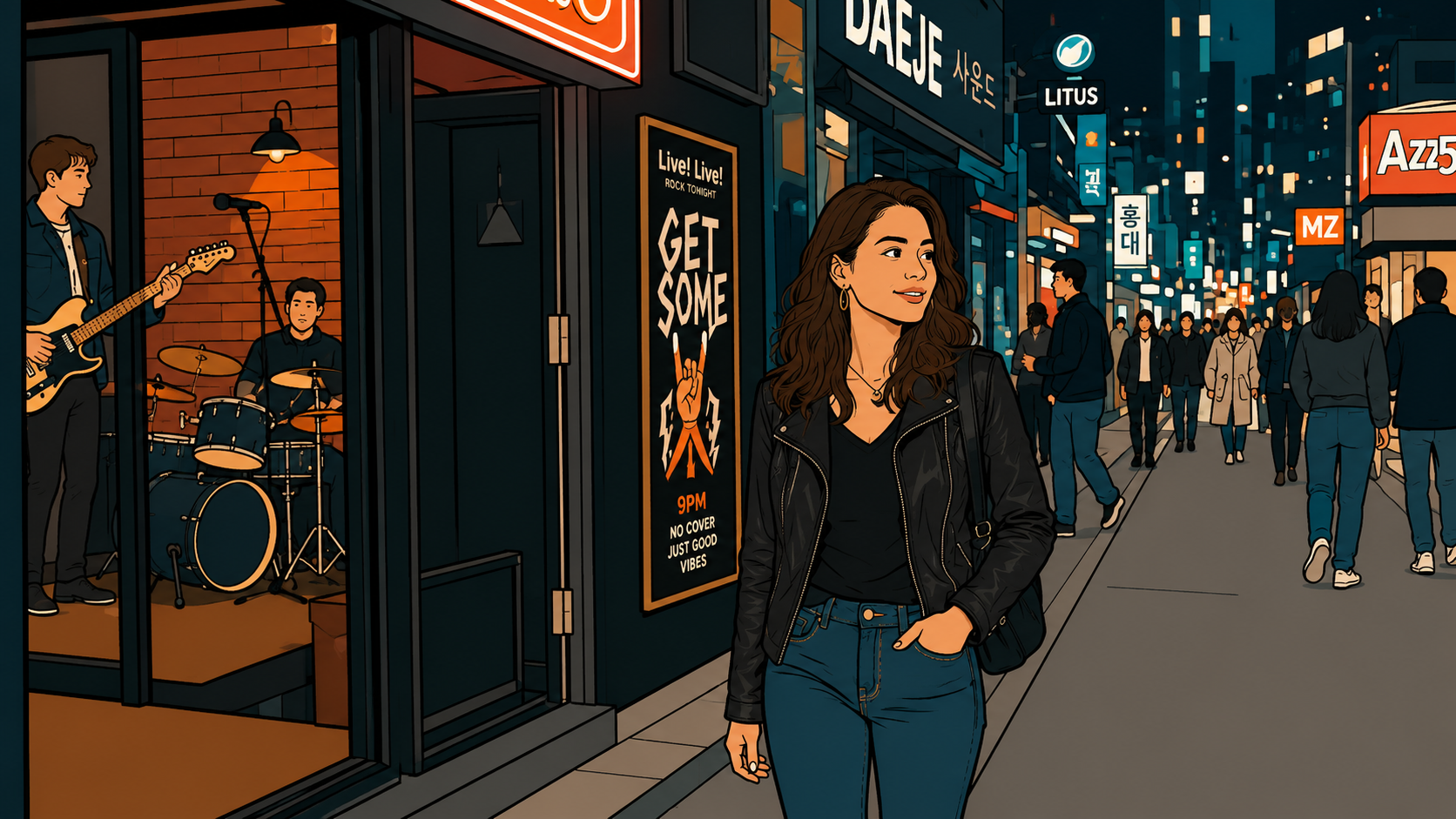

Gangnam at 6 PM. The office towers release their workers. Black suits, tired faces, fast pace. Everyone knows their place. The hierarchy is visible. The pecking order is established. Your job title determines how people treat you. Your income determines your status. Your credentials determine your access. The daytime city runs on proof.
Gangnam at midnight. Same streets, different rules.
A CEO sits next to a night-shift worker at a pojangmacha. Neither knows what the other does. Neither asks. The CEO isn’t trying to network. The worker isn’t trying to impress. They’re just two people, eating ramyeon, existing in the same space. At night, credentials don’t matter.
This is what night culture Korea actually is: permission to stop proving.
The Night Doesn’t Care About Your Resume

In daytime Korea, everything is credentials. Your job title arrives before you do. It determines the conversation. It sets the tone. It establishes the hierarchy.
What do you do? This question arrives early and often. It’s not casual. It’s the first real question. Your answer determines how people treat you. It shapes opportunities. It defines your worth.
The night asks a different question: What do you want to do?
Walk into a club at 1 AM in Hongdae (홍대: hong-dae, Hongik University area). Nobody’s checking your resume. A woman who runs a company dances next to a woman who works retail. A man with a prestigious job stands in line for beer next to a man without a job. The club doesn’t care. The music doesn’t care. The night doesn’t care.
This is different from “hierarchy doesn’t exist”—it does. It exists everywhere in Korea. But night culture has made a choice to not activate it. The night has rules, and the first rule is: your daytime credentials don’t matter here.
In many Western cities, status still follows people into nightlife spaces. Exclusive nightlife spaces often signal status through price, dress code, or access. Your credentials determine your access, even when the sun goes down.
In Seoul, the night opens to anyone. Not because everyone is equal—they’re not. But because night culture Korea has decided that the markers of daytime status are irrelevant in darkness. You don’t need to be anyone to belong at night. You just need to show up.
A woman with a powerful job and a woman with no job sit at the same noraebang booth. For two hours, they’re equal. The booth doesn’t know their resumes. The microphone doesn’t care about their status. The song is the song. The night is the night.
This is what daytime Korea doesn’t offer. Daytime demands proof. Nighttime offers rest from proof.
Everything You Want Is Here
Night culture Korea isn’t monolithic. It’s not just one thing. It’s multiple versions of night, and you get to choose which one you want.
Hongdae at midnight is a street of permission. Clubs with open garage doors spill live music onto the pavement. A woman stands outside, listening to a band she’s never heard of. The entry fee is cheap. She can stay one song or stay until 4 AM. The street smells like soju, street food, and the sweat of young people. Young artists set up their own sound systems on corners. The energy is: come as you are, stay as long as you want, leave whenever. Nobody’s performing a version of themselves for someone else. Everybody’s just existing.
Gangnam at 10 PM is controlled nightlife. Clubs with clear hierarchies and dress codes. People moving fast between venues with intention. The streets are bright, commercial, choreographed. It’s nightlife with a structure: arrive at this bar, go to that club, end up somewhere exclusive. It’s planned.
Konkuk (건대: kon-dae, Konkuk University area) at 1 AM is student energy. The streets are packed. Bars and clubs are cheap. The music is loud. Everyone is young. The pace is fast. Nobody’s trying to be impressive. Nobody’s pretending. The feeling is: this is your time, this is your space, nobody’s gatekeeping. Walk down the street and you’re part of something alive.
Itaewon (이태원: i-tae-won, international district) at midnight is international chaos. Foreigners and Koreans mix without separation. Clubs with different music on each floor—K-pop, hip-hop, reggae, house, techno. Women alone, women in groups, men, foreigners, all moving through the same space. Nobody’s checking credentials. Nobody’s asking if you belong. The energy feels open, relaxed, and easy to enter.
Pojangmacha serve hot food and soju to strangers who became friends over ramyeon. Coffee shops stay open all night for people who need quiet. Spas and saunas run 24 hours—women alone, soaking in hot water, existing outside of time.
You want to run at 2 AM? Run. You want to sing badly in a booth? Sing. You want to sit in a coffee shop until 3 AM with a laptop? Sit. You want to eat ramyeon with strangers? Eat. You want to dance until your feet hurt? Dance. You want to sit in silence? Sit. You want to read? Read.
Night culture Korea says yes to all of it.
You Belong Here, Just As You Are

A foreign woman walks into a pojangmacha alone at 2 AM. She doesn’t speak Korean fluently. She’s not trying to fit in. She just sits down. The ajumma (older woman) running the tent serves her without asking questions. She orders ramyeon. She eats. Other people come and go. Some are foreigners. Some are Korean. Nobody questions why she’s here. Nobody assumes she’s lost or waiting for someone. She’s just a person at a pojangmacha at 2 AM, and that’s completely fine.
A woman walks down Hongdae at 1 AM alone. She’s not dressed for a club. She’s just walking, listening to live music spilling from venues, watching the street come alive. Nobody looks at her strangely. Nobody asks what she’s doing or where she’s going. She’s allowed to exist on this street at this hour, moving at her own pace, for her own reasons.
A group of foreigners—mixed ages, mixed languages, different nationalities—sits at a table on Konkuk Street. The bar owner doesn’t check their credentials. She doesn’t ask if they can “handle” Korean culture. She serves them. They belong.
This is the feeling that women return to again and again when they talk about night culture Korea: absolute acceptance of your presence without explanation.
In daytime Seoul, being foreign is noteworthy. You stand out. People notice. People help (the culture is helpful), but they notice. Your foreignness is visible. Your difference is remarked upon.
At night, you’re just a person. Your nationality becomes secondary. Your foreignness becomes irrelevant. You’re not a tourist. You’re not an outsider. You’re just someone at a bar, a street, a cafe, existing in the same space as everyone else.
The night has decided that night culture Korea belongs to anyone who shows up. Not because of diversity initiatives—Korea doesn’t market itself that way. But because night culture operates under a completely different set of rules than daytime culture. The day requires credentials. The day requires proof. The day requires you to be someone.
The night just lets you be.
This Is What Changes Everything
Daytime Korea is about proof. What’s your job? What’s your income? What’s your education? What’s your family background? These credentials determine your value. They determine your access. They determine how you move through the world.
Night culture Korea is about presence. You exist. You showed up. That’s enough.
This is what changes everything. Not the neon. Not the food. Not the convenience. But the permission. The absolute cultural agreement that you can exist without justification. You don’t have to prove anything. You don’t have to be anyone. You just have to show up, and the night will receive you.
In Western cities, even at night, the daytime rules follow you. You need money to have fun. You need the right clothes to enter certain places. You need credentials to belong. The hierarchy of daytime doesn’t sleep—it just changes venues.
In Seoul, night culture Korea has made a different choice. The night operates on different principles. The night says: your title doesn’t matter. Your income doesn’t matter. Your status doesn’t matter. What matters is that you’re here. What matters is that you exist.
A woman who owns a business sits at the same pojangmacha as a woman who works nights at a convenience store. A CEO sits next to a student. The translator and the nurse and the person without a job all occupy the same space. Nobody’s keeping score. Nobody’s checking resumes. Everyone’s night is equally valid.
This is why women keep posting about night culture Korea on TikTok. Not because it’s exotic. Not because it’s different. But because it offers something most other cities don’t: the permission to exist without output. To have a night that produces nothing measurable and still be completely fine. To move through a city after dark without proving anything to anyone.
Night culture Korea doesn’t ask: Who are you? It asks: Where are you right now? And then it says: That’s fine. Stay as long as you want. Do what you want. Be however you want. The night will receive you.
This is what changes everything. The permission. The freedom from proof.
Is night culture Korea safer than many people expect? Usually, yes. Is it welcoming to outsiders? Yes. Is it expensive? No. Is it real? Absolutely.
But what matters most isn’t the infrastructure or the statistics. What matters is this: you can exist in Seoul at night without proving anything. Without justifying your presence. Without explaining yourself. The night just lets you be.
What would you do if no one was watching? If there was nothing to prove? If you just got to exist exactly as you are? That’s what night culture Korea offers.
This post was planned and edited by a human, with AI assistance.