
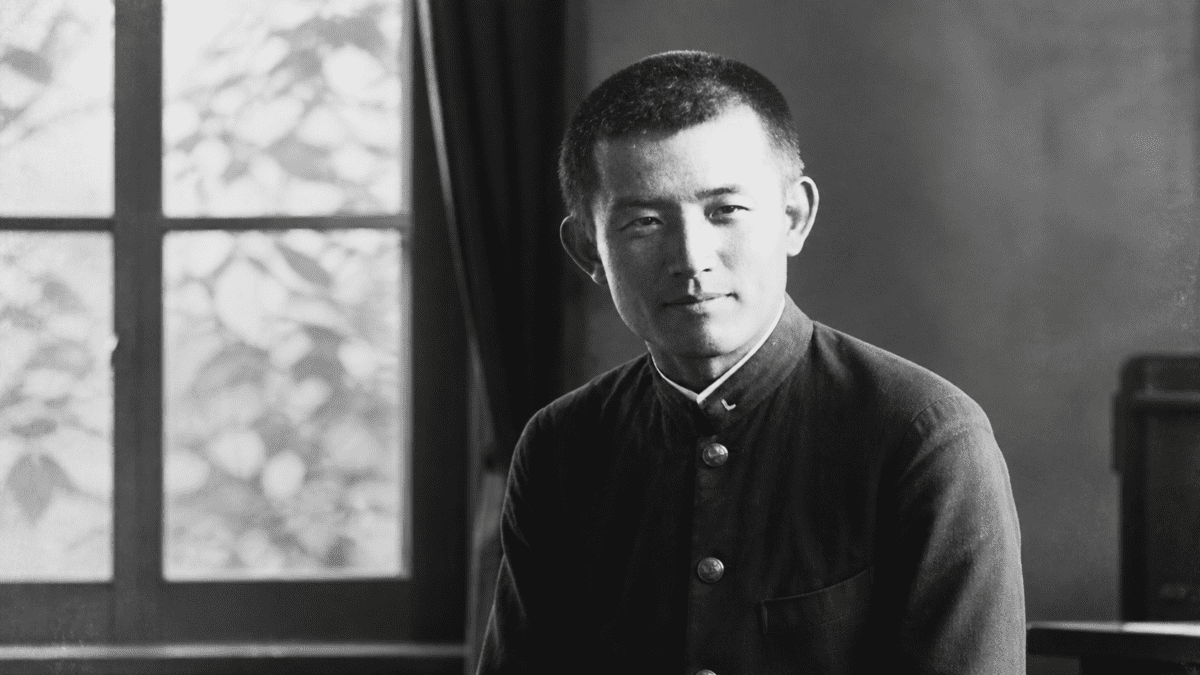
(Edited public domain image)
Yun Dong-ju (윤동주, 1917–1945) carried a notebook everywhere. In it, he wrote in Korean—a language increasingly suppressed under Japanese colonial rule. His poems, Foreword (서시: seo-si) and Counting the Stars at Night (별 헤는 밤: byeol-he-neun-bam), would outlive the occupation.
Yet during his lifetime, his life was not meant to be remembered. It was meant to disappear.
Born in Myeongdong: A Village Built on Resistance
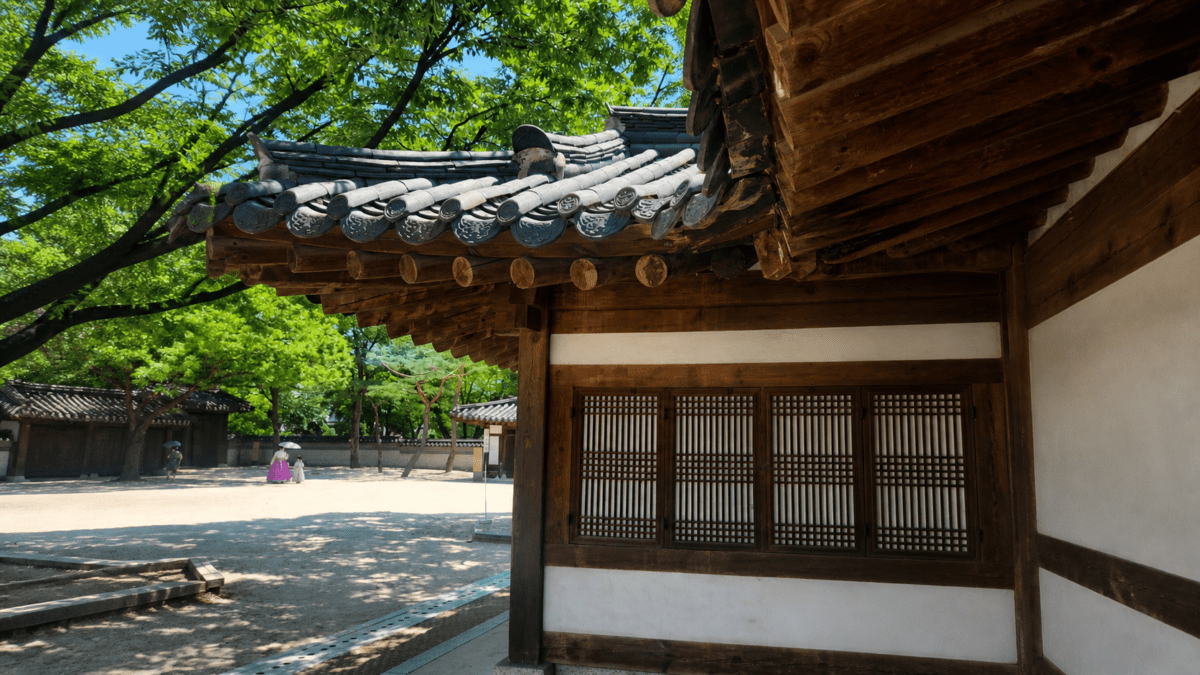
Yun was born December 30, 1917, in Myeongdong, a Korean settlement in Jiandao, Manchuria. The name itself meant “the place that illuminates the east.” The village was not accidental. It was constructed as an act of preservation.
In 1899, Korean settlers from Hamgyong Province—approximately 140 families facing famine and displacement—migrated east under the leadership of Kim Yak-yeon, Kim Ha-gyu, and Moon Byung-gyu. Yun’s grandfather, Yun Ha-hyeon, joined them. Within a generation, Myeongdong had become the largest Korean community in the region. By 1918, it was a place where Korean consciousness could still breathe.
Kim Yak-yeon, Yun’s uncle, was not merely a merchant or farmer. He was an intellectual and activist. He had studied Mencius’s political philosophy and initially envisioned Myeongdong as a utopian village based on Confucian principles. But when he recognized the necessity of modern education, he founded Myeongdong School. When he saw the power of Christian faith, he converted to Presbyterianism and became a minister. In 1918, he signed the Declaration of Independence in Jilin. In 1919, he drafted the Jiandao Declaration of Independence and led the March 13 Uprising. For this, he was arrested and imprisoned for two years.
This was the intellectual lineage into which Yun was born. Independence was not taught as politics. It was lived as daily practice.
Myeongdong School, run by Kim Yak-yeon and supported by the Presbyterian Church, became a beacon. From 1908 until its destruction by Japanese troops in 1920—and its permanent closure in 1925—the school educated approximately 1,200 students. Many would become leaders of the Korean resistance. Yun’s father, Yun Young-seok, taught there. His grandfather served as an elder in the church. The boy grew up surrounded by men and women who had chosen conscience over compliance.
Displacement and Continuity: From Myeongdong to Seoul
After Japanese forces destroyed Myeongdong School in 1920 and forced its permanent closure in 1925, Yun was eight years old. The family relocated to Yongjeong. He attended Eunjin Middle School. In 1935, at fourteen, he transferred to Sungshil Middle School in Pyongyang.
In October 1935, he published his first poem, Reverie (공상: gong-sang), in the school paper Sungshil Hwalcheon. It marked his formal entry into the literary world.
But Sungshil itself was a battleground. In December 1935, students refused to participate in Shinto worship. In January 1936, the principal—George S. McCune, an American missionary—definitively refused to conduct Shinto worship ceremonies. He was dismissed. The school closed.
Yun and his friend Mun Ik-hwan, whom he had known since childhood in Myeongdong, transferred together to Gwangmyeong Middle School in Yongjeong. At Gwangmyeong, Yun met Jung Byung-wook, who would become his closest literary companion.
He graduated in February 1938 and entered Yonhui College in Seoul two months later. The decision had not been automatic. His father wanted him to study medicine. His grandfather intervened. The family agreed: Yun would study literature.
Yonhui College: The Education of Consciousness

At Yonhui College, Yun lived in Pinson Hall, a dormitory for Korean students. He was not known for outward ambition or political charisma. What distinguished him was depth. According to his classmate Mun Ik-hwan, who studied theology, Yun understood the existential philosophy of Søren Kierkegaard more deeply than many graduate students. He studied Korean and English alongside French and Chinese, and his linguistics professor, Choe Hyun-bae, awarded him a perfect score in Korean language.
At night, Yun reportedly sat quietly in the dormitory copying poems by hand long after other students had gone to sleep. While many argued loudly about politics, he spoke little and listened carefully.
But Yonhui was also becoming a place of growing surveillance. By 1939, Japanese authorities had intensified their monitoring of Korean students. That year, Yun published work in the student section of the Chosun Ilbo and in the literary magazine Youth (소년: so-nyeon). He received his first payment for writing. Soon afterward, police began keeping records on him.
Yun left Pinson Hall and moved between rented rooms in Bukahyeon-dong and Nusangdong with Jung Byung-wook, a younger student who would become his closest literary companion. They lived modestly, sharing cramped spaces, avoiding attention, and devoting themselves almost entirely to writing.
In late 1941, as graduation approached, Yun and Jung gathered nineteen poems into a manuscript titled Sky, Wind, Star, and Poem (하늘과 바람과 별과 시: haneul-gwa-baram-gwa-byeol-gwa-si). But Lee Yang-ha, a professor of English literature, warned him not to publish it. The atmosphere had become too dangerous. Instead, Yun entrusted the manuscript to Jung and prepared to leave for Japan to continue his studies.
The Name That Was Not His: Hiranuma
In March 1942, Yun crossed to Japan. He enrolled at Rikkyō University in Tokyo, studying English literature. Six months later, he transferred to Doshisha University in Kyoto—the university attended by Jeong Ji-yong, the poet he most admired.
But the transfer required documentation. And documentation required a Japanese name. In early 1942, shortly before his departure, Yun’s family had registered the family name as “Hiranuma”. This was not his choice. It was a condition of travel. Yet the erasure devastated him.
Days before submitting the name-change form, Yun wrote the poem Confessional (참회록: cham-hoe-rok). In it, he documented the precise texture of forced transformation—the shame of wearing a name that was not his, the necessity of the choice, the impossibility of accepting it.
“Let me condense my confession into a single line: / what joy was I hoping for, living these twenty-four years and one month?” he wrote. The severity was the point. Under occupation, there was no clear line between compromise and survival.
Kyoto: The Marked Student
At Doshisha, Yun was one of many Korean students. But he was marked. The Japanese police files listed him as bulryeong seonin—a disloyal Korean. The category itself treated political consciousness as suspicion.
What they observed: a Korean student who read deeply in existentialist philosophy. A student who maintained quiet friendships with other Korean students. A student who, in his dormitory room, continued to write poetry in a language the empire had declared obsolete.
In 1943, Yun prepared to return to Korea for a visit home. On July 14, before boarding the train at Kyoto Station, he was arrested. The charge: violation of the Peace Preservation Law—Article 5, which specifically targeted those seeking to alter the imperial system or to propagate communist or nationalist ideology.
He was not alone. His cousin Song Mong-gyu, who had been involved in similar study circles, was arrested simultaneously. Both were transferred to the Kyoto District Court.
The Judgment
On March 31, 1944, the court issued its judgment. Two years of imprisonment for each. The document stated:
“Yun Dong-ju was educated from childhood in a nationalist school. He was deeply influenced, ideologically and culturally. Through the influence of friends, he developed strong ethnic consciousness. He harbored deep resentment regarding the discrimination between Japan and Korea. He engaged in reckless activity seeking to realize Korean independence.”
The charge was not sabotage or violence. It was the persistence of Korean identity under imperial rule. The court had understood precisely what the Japanese empire could not tolerate: a mind that remained Korean even when the empire demanded it become Japanese.
Yun was transferred to Fukuoka Prison.
He was twenty-six years old. Korea’s liberation was less than two years away. He would not see it. But what survived that prison cell was not the body. It was the notebooks—thirty-one poems written in a language the empire tried to erase—that would survive. Three years after his death, they would become part of how postwar Korea remembered loss, conscience, and survival under occupation.
Content in this post was created with AI assistance.