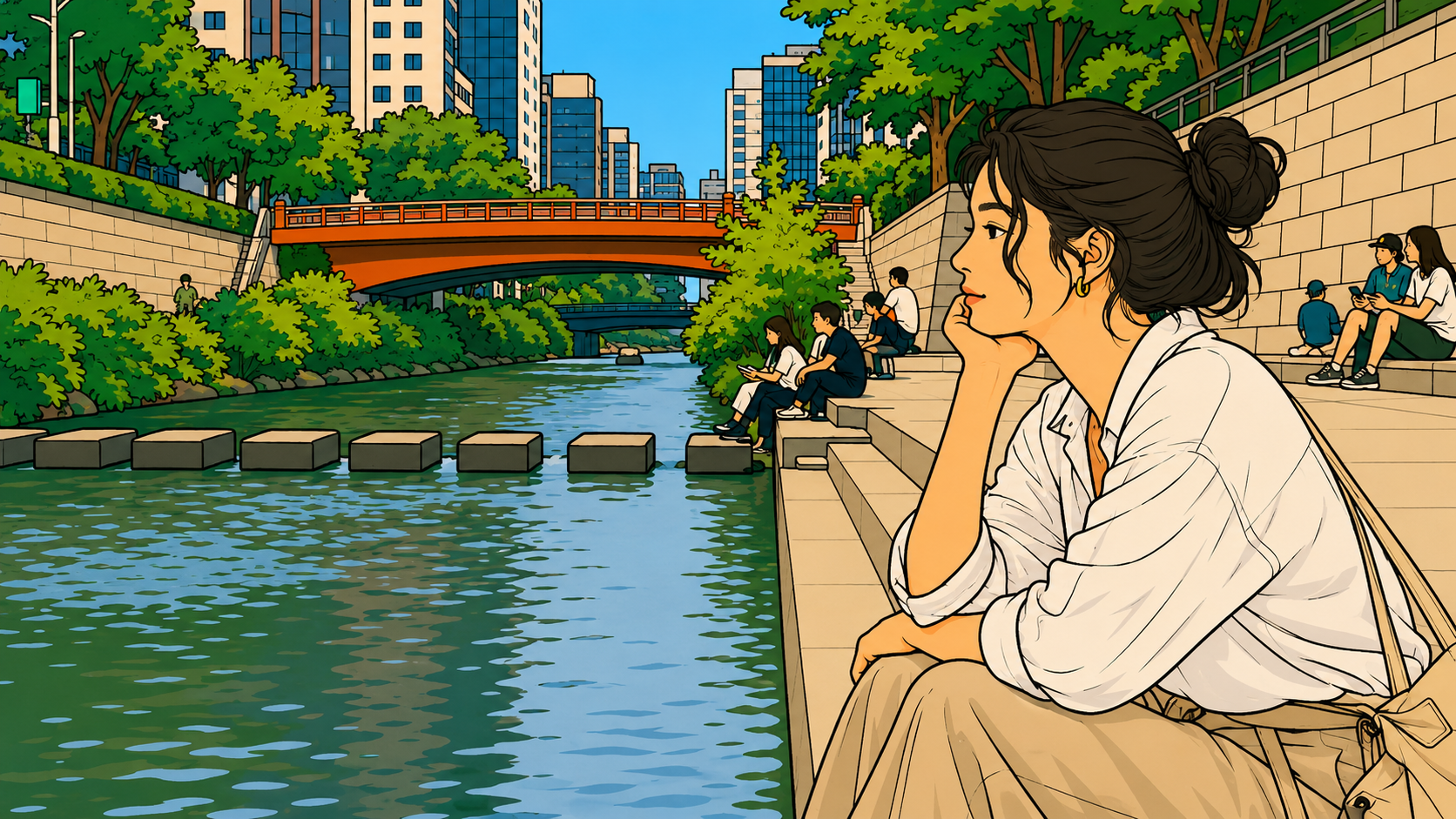
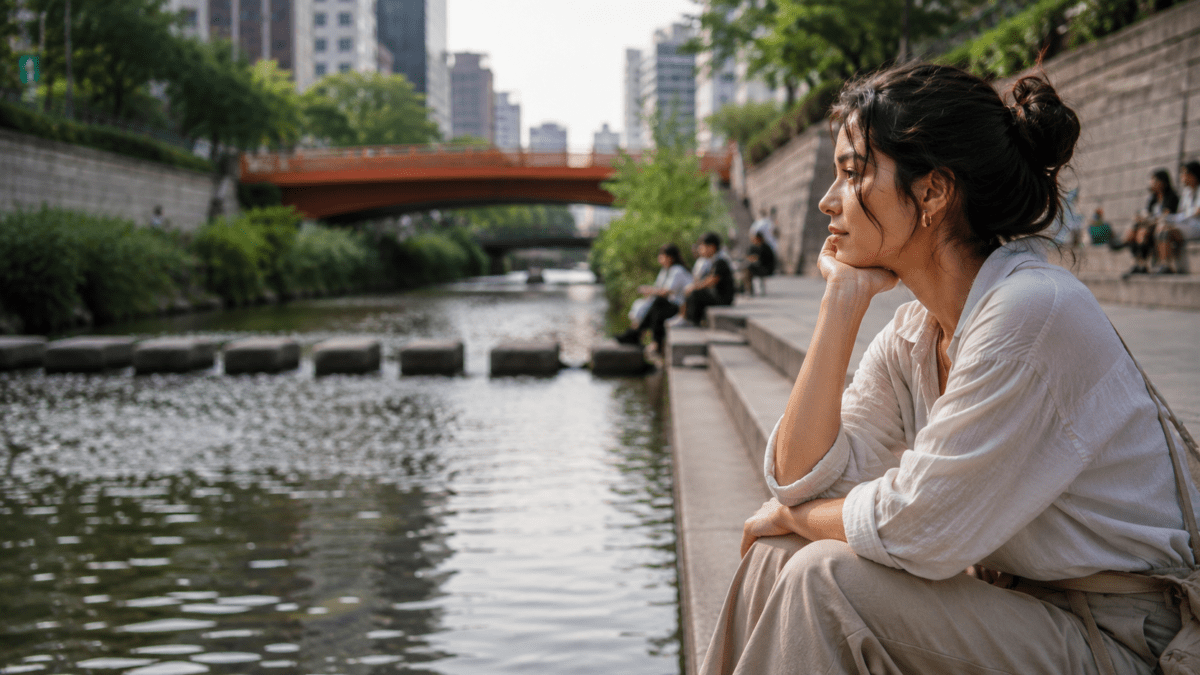
The little egret is standing in twelve centimeters of water, completely still. Behind it, a bus crosses the bridge. Horns, acceleration, the specific percussion of a city in motion. The egret doesn’t move. It has found something in the water and is waiting for it to move first.
Cheonggyecheon runs for 8.12 kilometers through the center of one of the densest cities on earth. Every day, about 120,000 cubic meters of water are supplied to keep the stream flowing at the upstream plaza to flow east. The egret standing there doesn’t know any of this. Neither do the herons working the shallows downstream, or the ducks that have claimed the sandbars, or the small fish moving through water that originated twelve kilometers away.
This is Seoul’s most engineered piece of nature. It is also where you can watch a cormorant three meters away without it looking up.
The stream sits below street level—not dramatically, not underground, but low enough that the city above becomes a different frequency. You descend a short flight of steps and the traffic noise changes. Still present, but above rather than around. The water is audible. In a city where ambient sound is constant and omnidirectional, the stream offers something rare: a direction the noise comes from.
What the Stream Actually Is
In 1958, the city buried it. In 2005, the city opened it again. Forty thousand cubic meters of treated water, pumped daily from a river twelve kilometers away, released at the plaza upstream. The water flows east because a pump is running somewhere, maintained by a crew nobody sees.
Cheonggyecheon is real water. It is not, strictly speaking, a river. It has no source it reaches by gravity. It doesn’t rain in the mountains and fill it—it runs because infrastructure decided it should.
Below the visible channel floor, another current moves east: the city’s drainage, different composition, different origin. Two layers, two flows, occupying the same space. The people on the path walk above both without knowing the lower one exists. The egret stands in the upper layer, hunting fish that live in water someone else chose to move here.
What’s visible from the path is this: the water is moving, light is catching the surface, and something is alive in it. The heron doesn’t care about the engineering. The heron only cares that there is food.
What Moved In Anyway
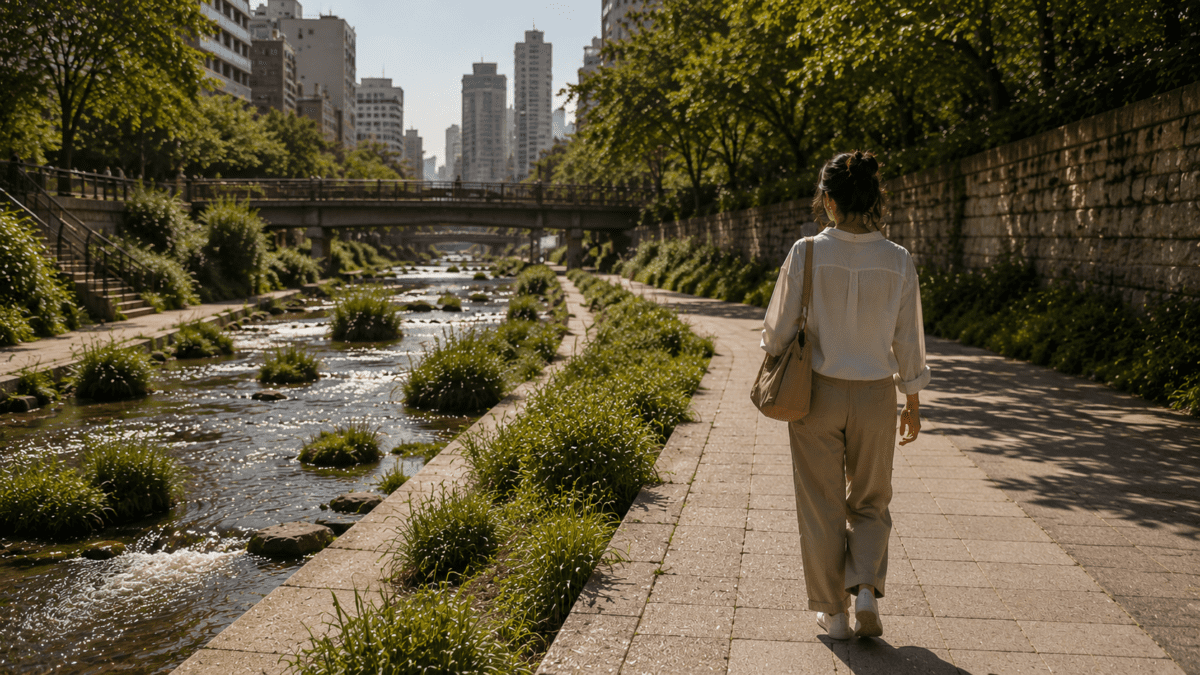
The birds arrived. Herons, egrets, night herons, ducks, cormorants. They came because there was water and the water held fish. The fish came because the water was clean enough to sustain them. Below the surface, small species moved upstream—species that only survive in water without toxins. Along Cheonggyecheon, what had been a drainage corridor became a hunting ground. What had been silent became a place where you could hear splashing, the small chaos of a fish fleeing, the precision of a strike.
The sandbars are the detail nobody designed for. The straight artificial channel began accumulating sediment at specific points where the flow slows. The sandbars bent what was built as a straight line into something with curves. Plants established themselves. The ducks found elevated ground useful. Nests appeared. Within the geometry of the straight line, life began drawing its own curves—the reeds bending with current, the willows reaching over water, the sediment building islands where birds could rest without seeing the city.
Year by year, the density increased. The egrets that had stayed near the lower reaches moved upstream, following the fish, following the improved conditions. The cormorant, technically a winter visitor, decided to stay year-round when the fishing proved reliable. The birds are still moving upward, following what they need, adapting the space to themselves. Fish populations stabilized, then grew. The ducks nested where they’d never nested before. The herons expanded their territory upstream, claiming sections of the channel that had been bare months earlier.
The channel is becoming something the engineers didn’t plan for. Not because of redesign—because of adaptation. The willows growing thicker, the sandbars redirecting the current, the birds claiming territory, the small fish moving upstream, the sediment softening the concrete edges. Most changes happen below attention first—the sediment shifts, the reeds thicken, and one morning a heron is standing where there was nothing months earlier. By the time you notice it, nature has already decided: this can sustain life. This can become home.
The Specific Experience of Watching
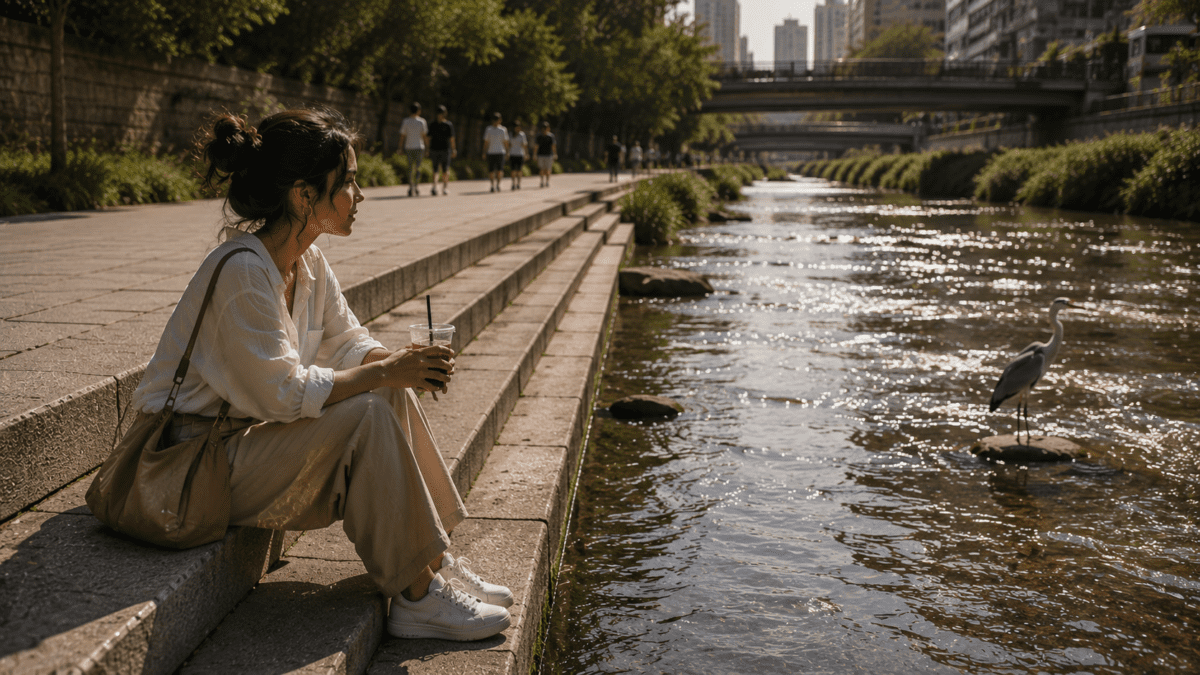
The birdwatchers arrive early—early enough that the path is mostly empty and the light comes from the east, catching the water at an angle that changes how it looks. Early enough to hear the water itself, not just the city above. Early enough to smell the particular damp of Cheonggyecheon where life is thick—not the chemical smell of treated water, but the green smell underneath, the earth-smell that appears when plants begin taking hold.
They carry binoculars but often don’t use them. The birds are close. The channel is narrow enough, the path close enough to the water, that distance becomes almost irrelevant. A person standing on the path and an egret standing in the shallows are separated by less space than two people at adjacent cafe tables. Close enough to see the precision of the egret’s eye. Close enough to notice the water move when the fish moves beneath it. Close enough to see the slight ripple when a heron’s weight shifts, the millisecond of adjustment before the strike.
The birdwatchers and the office workers on their lunch breaks use the same path. The tourists with cameras stop without understanding what they’re photographing. The @birdsseoul account documents these moments—a kingfisher nobody mentioned but which was there, a heron they weren’t looking for. Visitors come specifically for the cormorant. They leave having also photographed what the account shows them they missed.
The egret acknowledges none of them. It is hunting. The city is present but not relevant. The tourists are visual noise in the periphery. What matters is the shallows, the slight movement beneath the surface, the precision of waiting and striking. The egret’s focus is absolute. The water, the fish, the moment between breath and movement.
What It’s Becoming
The birds moving upstream is what ecologists track. In previous years, the larger wading birds stayed in the lower reaches where the habitat was older, more established. This year they’ve been observed significantly further upstream, following the fish that followed the water conditions that followed the sediment that followed the sandbars that nobody planned for. It is a slow chain of consequences, each link invisible until the next one appears.
The channel was designed as a straight line. Straight lines don’t exist in nature for long. The current bent them, the sediment redirected the flow, the plants took root on raised ground, the birds found what they needed. What restructuring looks like when it isn’t forced—that’s what Cheonggyecheon has been doing for twenty years, one sandbar at a time.
When it opened, engineers worried it would fail. A concrete aquarium, critics said. Engineered nature, artificial life, a landscape prop rather than a functioning system. Twenty years later, the critique has become more complicated. The stream is still artificial in its mechanics—the pump, the treatment, the release schedule. It is becoming something else in its behavior: adaptive, generative, responsive to what it holds.
The little egret standing in twelve centimeters of pumped water is not performing ecology for the people on the path. It is hunting because conditions allow hunting. It stays because the fishing is reliable. It will return tomorrow for the same reason. Between the engineering and the adaptation, between the artificial and the living, the distinction has become less useful than simpler questions: Is there food here? Is there shelter? Is it safe? The egret is answering yes to all three. That is all that matters.
This post was planned and edited by a human, with AI assistance.