
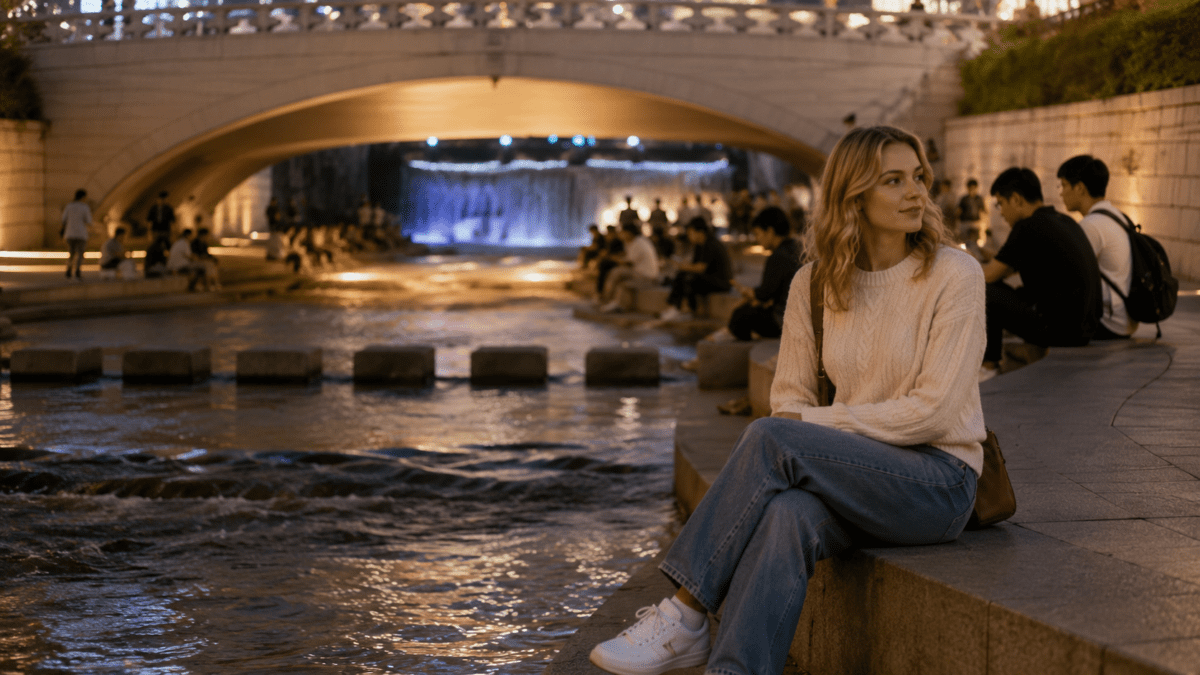
The thirty steps down take longer than you’d expect. Not because of the distance but because of the shift. At street level, Seoul moves in layers—the underground subway, the ground-floor shops, the elevated expressway, the distant mountains. Everything exists in parallel, rarely intersecting. But the moment you begin the descent into Cheonggyecheon Seoul, the city’s simultaneity collapses into a single current: the water, the path, the direction you’re walking.
By the third step, your pace has already changed. It’s not a decision. The path is narrower, the slope is slight, and something in the air changes—moisture, acoustics, the particular quality of light reflected off water. The city above continues at its regular speed: commuters, motorcycles, the percussion of commerce. But you have entered a different tempo. The people on the path beside Cheonggyecheon Seoul move like they’ve accidentally discovered a mode of travel that doesn’t require urgency.
This is what the city designed without intending to design it. A place where slowness became the default.
The City Above
The street level above Cheonggyecheon Seoul operates under different rules. Eight lanes of traffic cross the bridges. The sidewalks are crowded during rush hours. Storefronts compete for attention. The pace is the pace of everywhere else in Seoul—efficient, forward-moving, structured around arrival rather than transit. A person on the street above is moving toward something. A destination, a deadline, a transaction.
Thirty steps down, those destinations still exist, but they’ve become less relevant. The architecture of urgency begins to dissolve. The path is too narrow for the kind of movement that characterizes the city above. You cannot walk here the way you walk on a street—in straight lines, with purpose, checking your phone. The path curves with the water. Your feet adjust to the slight slope. Your attention, whether you intend it or not, settles on what’s immediately present: the water, the vegetation, the angle of light.
The city above doesn’t disappear. You can still hear it—the bridge traffic, the distant sirens, the hum of the city operating at full capacity. But it becomes background. Literally background: thirty steps above your head, happening in a different air. The two Seouls exist in the same geography but not the same experience. On the street, you are part of Seoul’s central nervous system. On the path beside Cheonggyecheon Seoul, you are in Seoul’s rest state.
Who Stops Here and Why
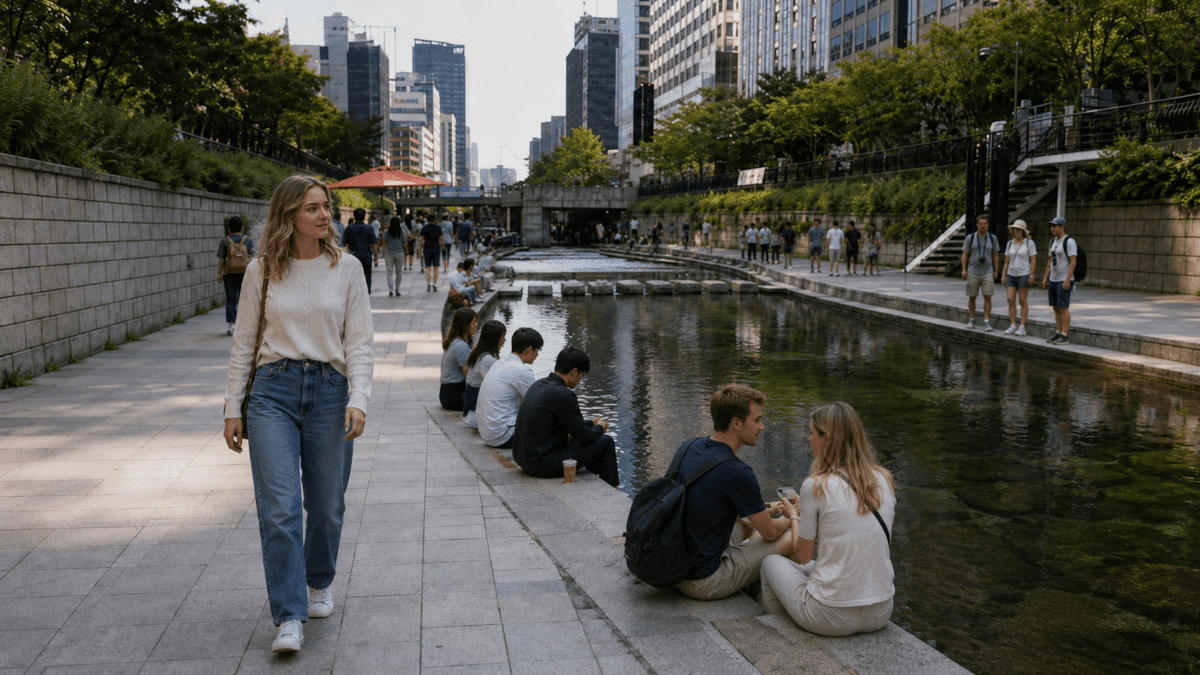
The birdwatchers come with intention. They’ve researched where the herons congregate at what time of day. They know the seasons, the breeding patterns, the precise spots where the cormorant has claimed territory. Their stopping is directed, purposeful. They are on Cheonggyecheon Seoul for a specific reason and will leave when that reason has been satisfied.
The office workers come on lunch breaks. They descend the thirty steps because it’s closer than the park, because the water offers something the office doesn’t, because thirty minutes beside moving water and green vegetation feels like a different day than thirty minutes at their desks. They sit on the benches. Some eat. Some stare at the water without looking at their phones. They don’t stay long—the time is bounded by work schedules—but the time they spend on Cheonggyecheon Seoul is time they have chosen to be somewhere else, doing something other than what was scheduled.
The couples come in the evening. The path provides something a street doesn’t: privacy within the city. You can be close to someone, walking slowly, without the city’s usual surveillance. The water offers a script—something to look at together, something to remark on, something that fills the silence if the silence needs filling. Along Cheonggyecheon Seoul, people move differently with each other. Faster walkers slow down. Awkward couples find a rhythm.
The tourists often come for reasons they’re not quite sure about. A friend recommended it, or a guidebook mentioned it, or they wandered down from the street above and found themselves in a place that doesn’t look like the rest of Seoul. They take photographs. They walk further than they intended. The water in the photographs will be a surprise later—cleaner, more reflective, more peaceful than they remembered noticing it in the moment. The experience of Cheonggyecheon Seoul is often better in memory than in the actual walking, which is a kind of success for a place designed to be functional.
The regulars come because they live nearby and the path is a route. The students come because there’s nowhere else to walk. The elderly come because the pace is manageable. Everyone arrives with a different reason and leaves with the same observation: time moved differently here.
The Rhythm of the Hours
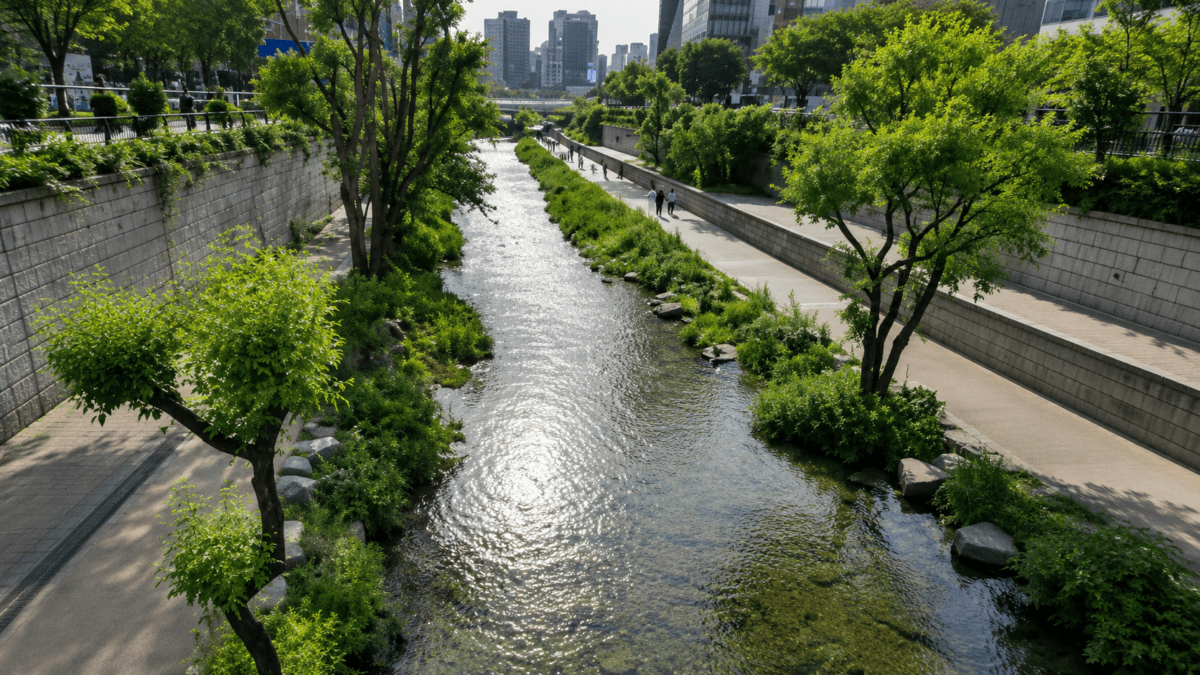
Cheonggyecheon Seoul changes with the time of day. Early morning—before the office workers descend, before the tourists emerge—the path belongs almost entirely to the birds and the people who came specifically to see them. The water is audible. The path is quiet. There is nothing performing here; everything simply is.
By mid-morning, the pace has increased slightly. More walkers, more families with children, more people whose purpose is simply to be outside. The birds have retreated slightly upstream or downstream, away from the noise. The water is still visible, still audible beneath the voices, but it has become a setting rather than the primary experience.
At noon, Cheonggyecheon Seoul reaches a kind of saturation. The benches are full. The path is crowded enough that you have to be aware of others, to make small adjustments to your pace and direction. The experience becomes social. You are no longer alone with the stream; you are part of a temporary community of people who have all made the same decision to descend the thirty steps. The birds are gone entirely now. The water is barely visible between the people. And yet, something persists—a coolness in the air, a sense that you are still in a different place, even if that place has become temporarily crowded.
By evening, the rhythm shifts again. The office workers leave. The crowds thin. The light changes—coming now from the west, catching the water differently, making it look like it’s in motion in a new direction. The evening walkers move slowly, deliberately, often alone or in pairs. The path reopens. The birds return in smaller numbers. The water becomes the primary experience again, as described in ArchDaily’s analysis of the restoration.
At night, Cheonggyecheon Seoul transforms into something else entirely—lit artificially, quieter, a place where couples walk and insomniacs think, where the city’s usual pace has no meaning. Few people are here, and those who are move as though they’re in a private space, which they almost are.
The Particular Slowness
There is a specific kind of slowness that happens on the path beside Cheonggyecheon Seoul. It is not idleness. The birdwatchers move slowly while remaining focused. The office workers move slowly while thinking about what they’ll do when they return to their desks. The couples move slowly while tracking the emotional temperature of their companionship. Nothing here is without purpose; the purpose is simply different from the purpose that structures the city above.
In Seoul, slowness is often read as inefficiency—time not spent productively is time wasted. But the people on the path beside Cheonggyecheon Seoul are not wasting time. They are changing the terms of what time is for. A person walking slowly beside water, observing the light, noticing the birds, is not unproductive. They are engaged in the specific productivity of being present, which the city above has no category for.
The path itself enforces this slowness. You cannot move quickly along Cheonggyecheon Seoul without it feeling artificial. The width of the path, the curves, the irregular surface, all of these discourage hurry. They encourage attention. A person who enters this space already walking slowly will continue walking slowly. A person who enters moving quickly will, within a few minutes, find themselves walking slowly. The space has a quiet insistence about pace.
This post was planned and edited by a human, with AI assistance.