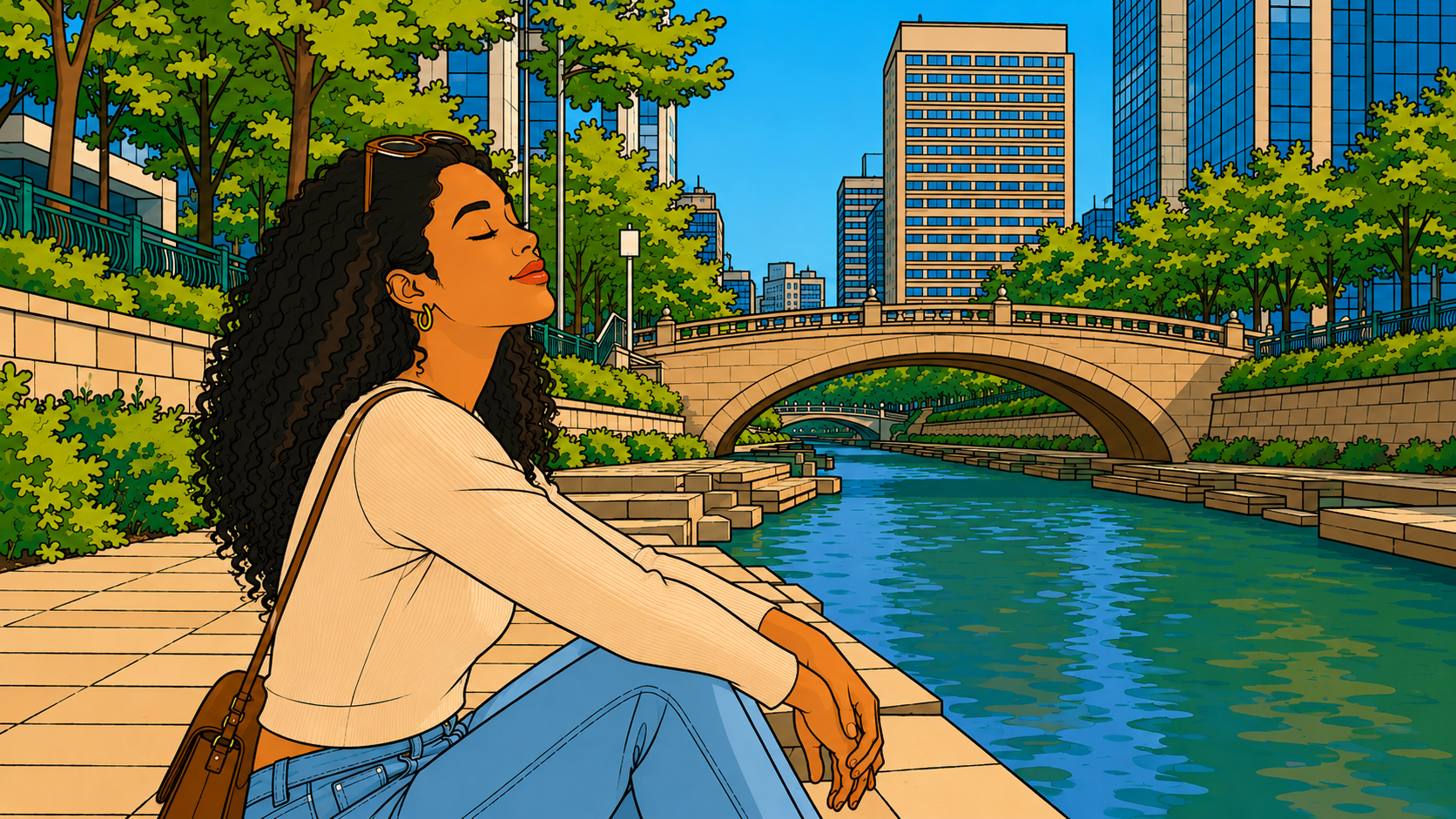
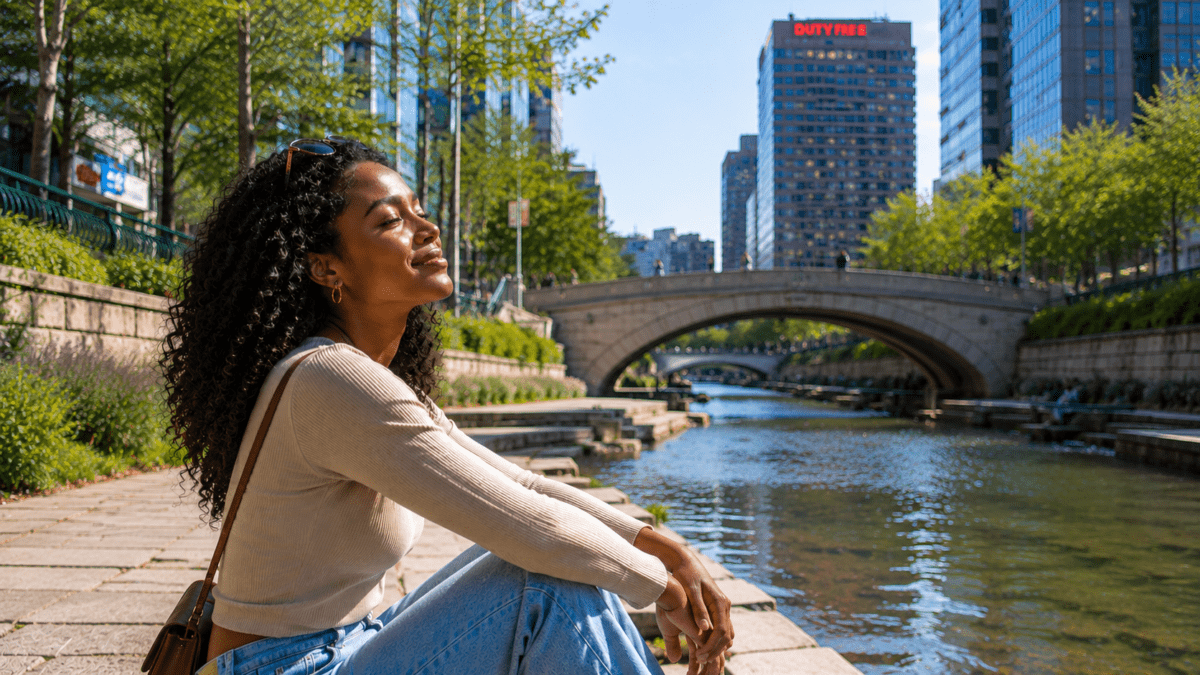
Thirty steps separate two kinds of time. Above, the city moves in the rhythm of contemporary Seoul. Below, the stream carries multiple pasts simultaneously—the water that flows through Cheonggyecheon ecology now is not one thing but three: treated Han River water from Jamsil, groundwater from beneath the subway, and the city’s own sewage moving invisibly below the surface. None of this water chose to be here. All of it arrived because Seoul made choices: first to bury what was there, then, fifty years later, to undertake Seoul stream restoration—not as environmental recovery alone, but as an act of remembering what the city had forgotten.
What runs freely becomes infrastructure. Infrastructure becomes invisible, and invisibility becomes erasure. This is the pattern that all rivers follow once a city claims them. And then, if a city is lucky or wise or simply desperate enough, erasure becomes the condition for return. Seoul experienced this entire cycle in less than a century. The question now is what comes next—and whether the city can hold what has emerged without repeating the mistake of trying to control it.
Before the Burial — What Seoul Had

There was a time when Cheonggyecheon was simply a stream. Not remarkable. Not engineered. Not a destination. It was what happened when rain fell in the mountains north of the city and moved downward through gravity alone. The stream had been moving this way for centuries—long enough that it had organized Seoul’s life around itself.
When the Joseon government began managing the stream in the early fifteenth century, the goal was not to replace it. The goal was to live with it. The channel was widened. The banks were reinforced with stone. Bridges were built. Flood controls were improved. Generation after generation, the work continued. The stream was measured, dredged, repaired, and adjusted whenever the city demanded more from it. People changed the stream, but they did not try to erase it.
Over time, the relationship became more sophisticated. Water that once followed only the logic of rainfall and gravity increasingly followed human planning as well. The channel became more predictable. The floods became easier to manage. The city learned how to guide the water without completely removing it from view.
But every improvement carried a trade-off. The curves that slowed the current became straighter lines. The stream became easier to control and slightly less like a stream. What had once moved according to its own rhythm increasingly moved according to the needs of the city. The water remained visible. The relationship remained visible. But the balance had begun to shift.
For more than five centuries, this was the arrangement. Seoul lived with Cheonggyecheon—not as untouched nature, but as nature managed. Managed carefully. Managed with stone. Managed with intention. Yet still a stream. Still water moving through the center of the city under gravity, following the logic of slope and flow.
That arrangement lasted until 1958.
The Fifty-Year Silence — What Seoul Buried

In the 1950s, just after the Korean War, Cheonggyecheon became something else entirely: the most representative slum district in Seoul. The war had displaced hundreds of thousands of people. They had nowhere to go except down—to the banks of the stream, where they built temporary shelters that became permanent. The stream that had organized Seoul for five centuries became a problem to be solved.
The Seoul stream restoration that would come fifty years later would be framed as environmental. But the first action—the covering—was framed as urban development. In 1958, the city began to bury what it could not control. From May 1958 to December 1961, the section from Gwang Bridge to Cheonggyecheon 6-ga was covered with concrete. From 1965 to 1967, the next section fell. From 1970 to 1977, the final section disappeared. The stream didn’t disappear. It went underground. Infrastructure became invisible became erased.
Above the concrete came the Cheonggyecheon Elevated Highway. This was the second covering—the visible one. The highway that would carry millions of people across what had been a stream for centuries. The stream became the secret that Seoul kept from itself. Children born after 1958 had no memory of it. Adults forgot it. The city that had organized itself around flowing water for five hundred years reorganized itself around moving vehicles.
But the water kept moving. Below the highway, below the concrete, the Han River’s water still flowed when Seoul sent it downward. The stream was still there. It was just no longer acknowledged. This fifty-year silence was not restructuring—it was denial. The Gam (감) in Korean philosophy marks a period of necessary reorganization, of breaking down in order to rebuild. But what happened to Cheonggyecheon was not necessary. It was a choice. The choice to forget.
By the 1990s, the consequences of that forgetting had become unavoidable. The Cheonggyecheon Elevated Highway was aging. The concrete was failing. The structure that Seoul had built to hide the stream became dangerous. The city that had buried a river had to acknowledge what it had buried. And in 2002, a new mayor—Lee Myung-bak—made a promise: he would open it again.
The Seoul stream restoration began officially on July 1, 2003, when the first section of the elevated highway came down. The work took less than three years. By September 30, 2005, the project was complete: 5.84 kilometers of stream uncovered, 386.7 billion won spent, the concrete removed, the highway gone, the stream returned to visibility. The restoration was fast—too fast, some would later say. Fragments of the original stone embankments from Yeongjo’s time were left in storage. The Suphyo, the water gauge, was moved to a park. The ancient bridges were not rebuilt as they had been. But the water returned. The stream was opened.
The Reunion — What Moved Back In
What emerged when Seoul opened Cheonggyecheon ecology was not what the engineers expected. They had planned for a restored park—cleaned water, controlled flow, a place for citizens to walk. What actually emerged was more complicated. The water itself came from three sources: the Han River near Jamsil, groundwater from beneath the city, and the city’s own sewage moving invisibly in a lower channel beneath the visible stream. This is the truth of Cheonggyecheon: it is not one stream but three, layered vertically, each carrying a different Seoul.
And then the living things arrived. The birds came first—the egrets and herons that Part 1 documented. The fish followed. In the first years after opening, 98 species of aquatic organisms lived in the stream. Twenty years later, that number had grown to 626. The species that arrived are precise indicators of what has happened: Korean shiners that require clean water, species of dragonfly that appear only in specific conditions, the presence of which means the water has reached a level of purity that nobody predicted would be possible in the middle of Seoul.
Part 1 documented this reunion in its immediacy: the egret standing in water, the fish moving upstream, the sandbars accumulating where the current slows. Part 2 documented what the reunion meant for people: the slowness, the contrast, the path below the city. But the reunion itself carried something darker. The infrastructure that brought the stream back—the pumps at Jamsil, the treatment plants, the controlled release of 40,000 cubic meters of water daily—requires constant maintenance. The electricity bill alone averages 800 million won per year. The stream does not pay for itself. It must be subsidized by a city that had learned to live without it.
And the stream that returned carries traces of what had been buried. Yeongjo’s stone embankments from 1773, discovered during excavation, were not reinstalled. The original bridges were not reconstructed in their original forms. The Suphyo was moved to Changdeokgung Palace. This is the paradox that the reunion contains: Cheonggyecheon ecology exists because of Seoul stream restoration, but it exists in a form that erases the history of how humans and water once lived together. What returned is real. What was lost in the returning is also real.
The Cycle Continues — What Comes Next

Twenty years after Seoul stream restoration, Cheonggyecheon has become a global destination. Japanese officials from Nagoya came to study the project. Harvard University published a book about it, made it required reading for architecture students. The Los Angeles Department of Water and Power sent teams to Seoul to learn how to recover their own concrete rivers. The stream has become visible globally, in photographs, in case studies, in the international language of environmental recovery.
But this global visibility creates a new problem. The tourists keep arriving. The path fills at midday. The birds move further upstream to escape the crowds. The office workers who discovered slowness beside the water twenty years ago now encounter crowds. The structure that the city built to hide the stream has been replaced by the structure of global attention. Cheonggyecheon has moved from invisible to seen to famous, and each transition has changed what the stream can be.
The same pattern appears in rivers as it does in people. What was there before 1958 was one kind of flow—natural, difficult to predict, requiring constant human management. What was there from 1958 to 2005 was rupture. What has been there since 2005 is the third phase: adaptation. The birds adapt to the crowds. The fish adapt to the artificial water supply. The city adapts to the contradiction of maintaining a “natural” stream through constant artificial intervention.
And the cycle continues. Seoul has committed to a long-term vision that extends to 2050. Tributaries may return to the stream. Historical structures may be restored. The relationship between Seoul and its water may become more visible again. The stream that exists today is not the final version any more than the buried stream was the final version before it.
But if history is any guide, every restoration creates its own form of forgetting. The infrastructure that sustains the stream today may one day be hidden from view. New conditions will require new understanding. This is not failure. It is the pattern that time imposes on all things: what is visible becomes invisible, what is forgotten becomes important again, and what is revealed never remains unchanged for long.
The question is not whether Cheonggyecheon will survive. The question is what it will become. The birds will move where the conditions permit. The people will seek what they need. The water will carry what Seoul sends downward. And the cycle will continue, as it always has, following the logic of opening and closing that all rivers impose on the cities they pass through.
This post was planned and edited by a human, with AI assistance.