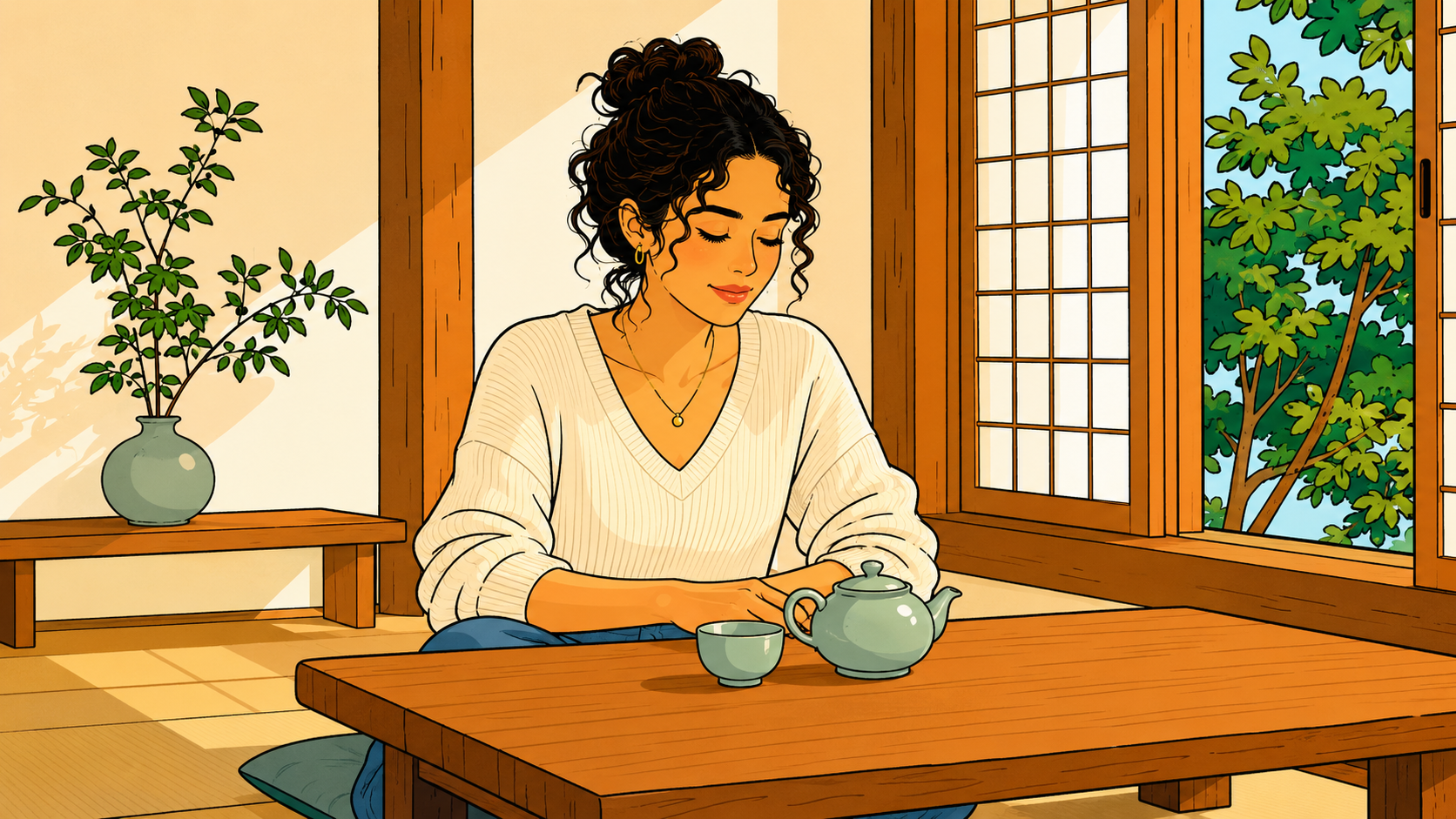
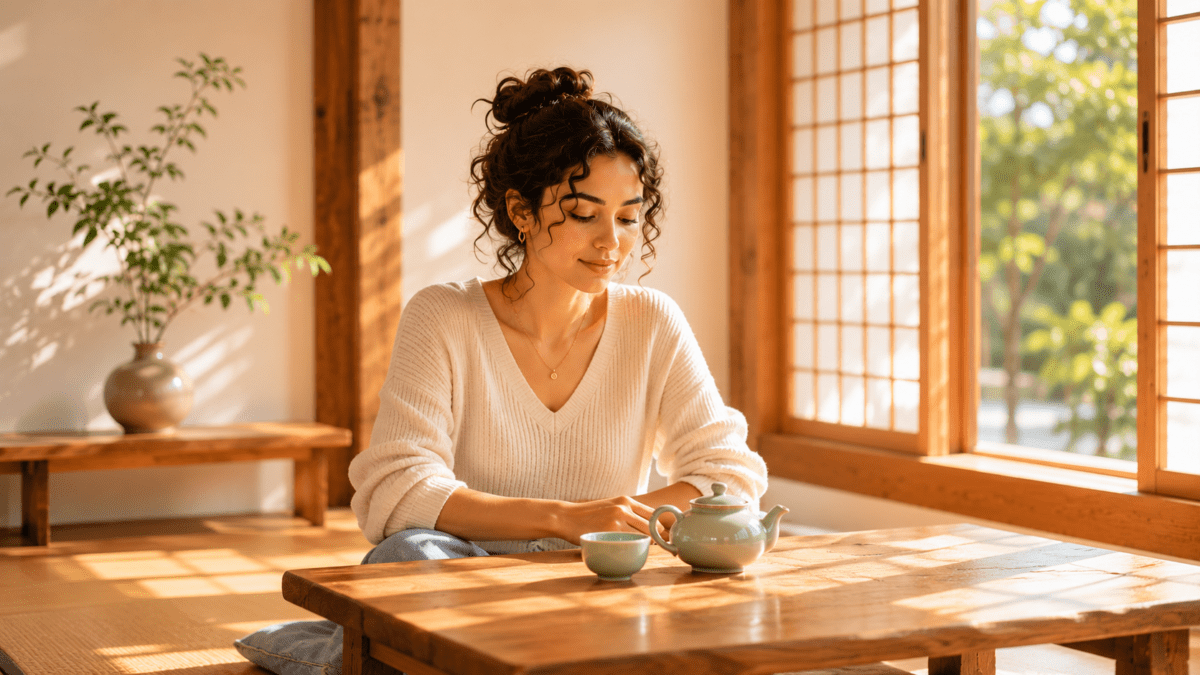
She didn’t come for the tea.
She came because her apartment had been too loud for three weeks — not with noise, but with decisions. What to say to her manager. Whether to renew the lease. A message she had drafted and deleted nine times. She walked into the tea house on a Thursday afternoon with nothing resolved and ordered the first thing on the menu she could pronounce.
The tea arrived in a small clay pot. She poured it wrong the first time, too fast, too full. The second pour was slower. By the third cup she had stopped thinking about the message.
She still hadn’t sent it when she left. But something had shifted — not the problem, but the speed at which she was carrying it.
The Korean tea experience doesn’t promise resolution. It changes the conditions under which you think.
The Korean Tea Experience Behind the Drink
Most people who discover Korean tea do so by accident, often through a Korean tea house they weren’t planning to visit. A friend’s recommendation, a tea house near a place they were already going, a slow afternoon with nowhere specific to be. They sit down expecting a drink and leave having had a Korean tea experience that’s harder to name.
What they experienced wasn’t ceremony in the formal sense. There was no instruction, no prescribed sequence of movements, no teacher explaining significance. There was just a room with low furniture, a cup that required two hands, and water that had been cooled to the right temperature before it touched the leaves.
The experience is structured without announcing its structure.
This is the part that surprises people who come expecting ritual. Korean tea culture doesn’t present itself as a practice. There are no robes, no scrolls on the wall with translated aphorisms, no staff who explain what you’re supposed to be feeling. You sit. You pour. You wait. The structure is in the objects and the pace, not in the presentation.
What that structure does is remove the conditions that usually prevent a person from slowing down. The low table means you can’t perch at the edge of your seat. The small cup means you finish quickly and pour again, which keeps the hands occupied without demanding attention. The waiting — for the water to cool, for the tea to steep — introduces intervals that have no task assigned to them.
Most environments are engineered to fill every interval. The tea house is engineered to leave them empty.
Attention as an Ingredient in the Cup

There’s a concept in Korean timing philosophy that treats attention not as a personality trait but as a directional force — something that moves, accumulates, and depletes depending on what conditions it encounters. The ten heavenly stems each describe a different way energy moves through a person: some push outward without pause, some gather before releasing, some move by finding angles rather than applying force.
What the Korean tea experience creates, without naming it this way, is a temporary condition where that directional force can settle.
The cup requires a particular kind of attention — not focused, not effortful, not productive. You’re not solving anything while you pour. You’re not processing, optimizing, or deciding. You’re tracking something small: the color of the water as the tea steeps, the weight of the cup, the temperature change between the first and second pour.
This is attention used as an ingredient, not a tool.
The person who sat with three cups and stopped drafting the message in her head wasn’t suppressing the problem. Her attention had simply found somewhere else to be for long enough that the grip loosened. The message she eventually sent, two days later, was shorter and calmer than the nine drafts she’d deleted.
She didn’t attribute this to tea. Most people don’t.
What Gets Slower When You Sit With Tea
There’s a particular quality to the inward-moving, accumulating direction in Korean timing philosophy — one that is almost impossible to access through effort. You can’t force yourself into that state by deciding to slow down. The harder you try, the more the attempt itself becomes another form of output. What actually creates the conditions for inward movement is a shift in environment: something that removes the external pull toward productivity and replaces it with a pace that doesn’t require defense.
The inward and outward forces that govern timing aren’t activated by will — they respond to conditions. The tea house creates those conditions without announcing it.
What slows down is the scanning. Most people in most environments are running a continuous background process — checking for threats, opportunities, social cues, unfinished tasks. This process is so habitual it becomes invisible. You don’t notice it until it pauses.
The pause happens, when it happens, somewhere around the second cup. The hands are occupied. The room is quiet in a specific way — not silent, but unhurried. The next pour is maybe four minutes away. There is, briefly, nothing to scan for.
What people describe as “calming” is actually the temporary suspension of a process they didn’t know was running.
The tea didn’t do this. The environment did. That’s what the Korean tea experience is, at its core — not the drink, but the conditions the drink creates. Attention restoration research describes exactly this mechanism: the environment does the work, not the will.
The Cup as a Pause Inside the Day

Korean timing philosophy’s approach to time is layered — the decade cycle sets the conditions, the year cycle moves through them, the month and day add texture. But within all of that, there are smaller intervals that function as reset points: moments where the dominant direction of a person’s energy encounters a brief counterweight.
A cup of tea is too small to appear on any timing map. It won’t shift a decade cycle. It won’t correct a structural misalignment. But it can create, within a single afternoon, a few minutes of genuine interval — time that isn’t moving toward anything, isn’t adding to the accumulated output of the day, isn’t being used.
This is what the Korean tea experience is actually offering.
Not aesthetic experience, though it has that. Not cultural education, though it carries that. Not health benefits, though those exist. It’s offering a pause that has been designed, through centuries of refinement, to feel like nothing is happening — because the most useful thing about a pause is that it doesn’t announce itself as one.
The woman who came in with nine unsent drafts and left with nothing resolved had, in the interval between the first pour and the last, given her attention somewhere neutral to be. That’s all. It’s not transformation. It’s not insight. It’s the small structural fact that some problems look different when you stop carrying them for forty minutes.
She came back the following Thursday.
And the Thursday after that. Not because she’d decided to make it a habit, not because she’d read anything about tea culture or slow living or the benefits of mindful pauses. She came back because the experience had done something she hadn’t asked it to do and couldn’t quite replicate anywhere else.
The apartment was still loud with decisions. The manager situation had resolved itself in the way these things eventually do. The lease got renewed. But the Thursday afternoons had become, without announcement, the part of the week that belonged to nobody and nothing — not to productivity, not to resolution, not to the version of herself that was always halfway to the next task.
The Korean tea experience doesn’t scale. You can’t compress it or optimize it or carry it into the rest of the week as a technique. It exists only in the interval itself — in the low table, the cooling water, the cup that requires both hands.
She didn’t know why, exactly. The tea was fine. The room was quiet. There was nowhere she needed to be for a little while.
That was enough.
This post was planned and edited by a human, with AI assistance.