
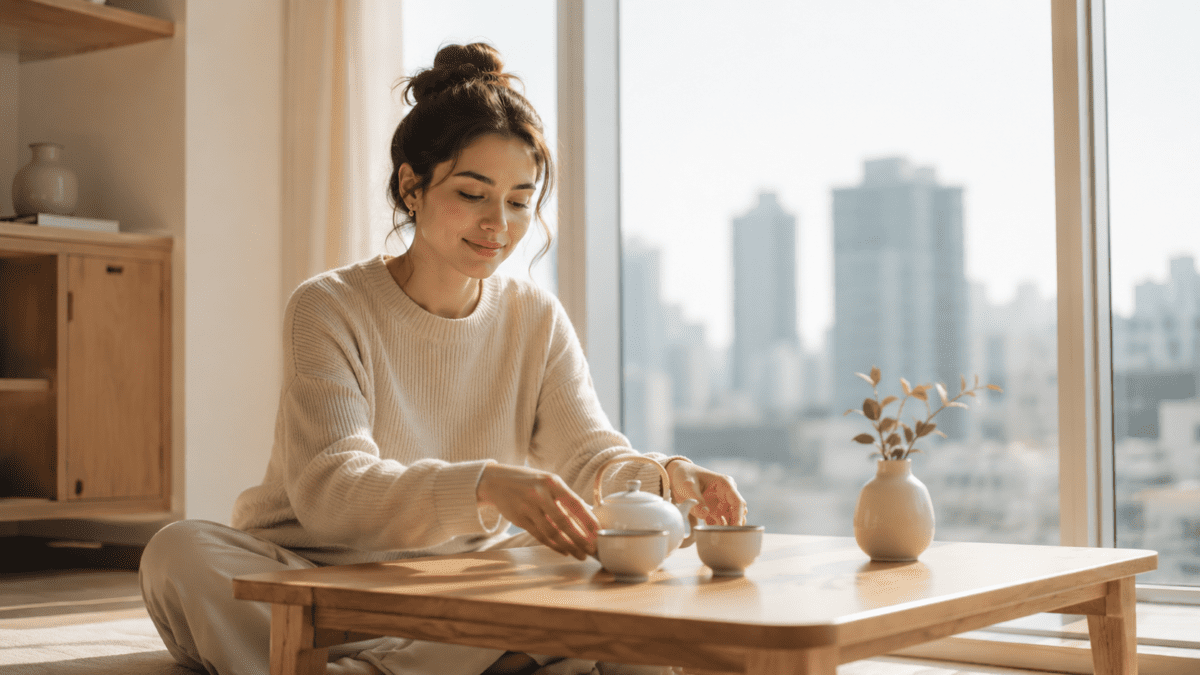
Mindful living often begins this way. Nobody calls it a ritual, and yet small daily rituals have quietly returned to Korean life over the last decade.
That’s the first thing to understand about the way tea has returned to Korean daily life. It doesn’t arrive with a name or a framework. There’s no decision made, no practice adopted, no philosophy consulted. A person buys a small teapot at a market because it catches their eye. They start making tea in the morning because the coffee was giving them headaches. They find themselves doing it the same way, at the same time, every day — and at some point they notice that the day feels different on the mornings they don’t.
The ritual existed before they had a word for it. The word comes later, if it comes at all.
How Mindful Living Begins With the Habit Nobody Calls a Ritual
There’s a working definition of ritual that most people carry: something formal, deliberate, inherited. A ceremony with steps. Something that belongs to religion or tradition or special occasions — not to a Tuesday morning before work.
This definition excludes most of what actually functions as ritual in daily life — and this is where mindful living quietly begins, through small rituals repeated every day.
The woman who fills her kettle before she opens her laptop. The man who arranges the cups before anyone else is awake. The student who makes tea at the same point every afternoon, not because she planned to but because the body started expecting it. None of them would use the word ritual. But what they’re doing has all the structural properties of one: repetition, sequence, a specific quality of attention, a felt difference when it’s absent.
What distinguishes these small acts from mere habit is that they carry weight beyond their function. Making tea produces tea, yes. But that’s not why the person feels off when they skip it. They feel off because they skipped the interval — the few minutes of unhurried, sequential action that organized the transition from one part of the day to another.
The tea is the vehicle. The interval is the point.
Darye (다례: da-rye, tea rite) — the Korean tradition of tea ceremony — has always understood this. The formal practice is elaborate, its movements precise and deliberate. But the principle beneath it is simple: the act of preparing and sharing tea creates a container for attention, a structured pause that marks time differently from the time around it. What’s returned to Korean daily life isn’t darye itself. It’s the same principle, stripped of formality, operating quietly inside ordinary mornings.
Small Actions That Organize the Day

There’s a particular problem with unstructured time that most productivity advice misses entirely.
The problem isn’t that people don’t know what to do. It’s that without transition points — small, repeated actions that mark the boundary between one mode and another — the day becomes a continuous smear. Work bleeds into rest. Morning bleeds into afternoon. The nervous system, given no signal that something has ended and something else has begun, stays perpetually half-activated, unable to fully commit to either.
Small rituals solve this not through their content but through their structure. The action itself matters less than the fact that it’s repeated, sequential, and bounded. It has a beginning and an end. It takes approximately the same amount of time each day. It requires a specific quality of presence — not intense focus, but the quiet attention of someone doing something familiar with care.
Making tea does all of this. The sequence is fixed: water, wait, pour, steep, pour again. The duration is consistent. The hands are occupied in a way that doesn’t demand mental engagement but doesn’t allow complete absence either. You’re present without being productive, which is exactly the condition that marks a genuine transition.
The day organized around small rituals isn’t more disciplined. It’s more legible — to the body, if not always to the mind.
A man who started making tea every morning during a period of working from home described the shift this way: he hadn’t changed his hours or his workload. But the ten minutes of tea preparation had become, without planning, the line between being at home and being at work. The same apartment, the same desk — but the tea had created a threshold that the physical space couldn’t provide.
The threshold was real. The ritual made it.
This is the quiet function that slow rituals Korea has been rediscovering — not through grand cultural revival, but through ordinary people making ordinary adjustments to ordinary mornings. The teapot on the counter. The same cup, the same sequence, the same unhurried ten minutes before the day begins to demand things. Small enough to dismiss. Consistent enough to matter.
Why Repetition Produces Stability
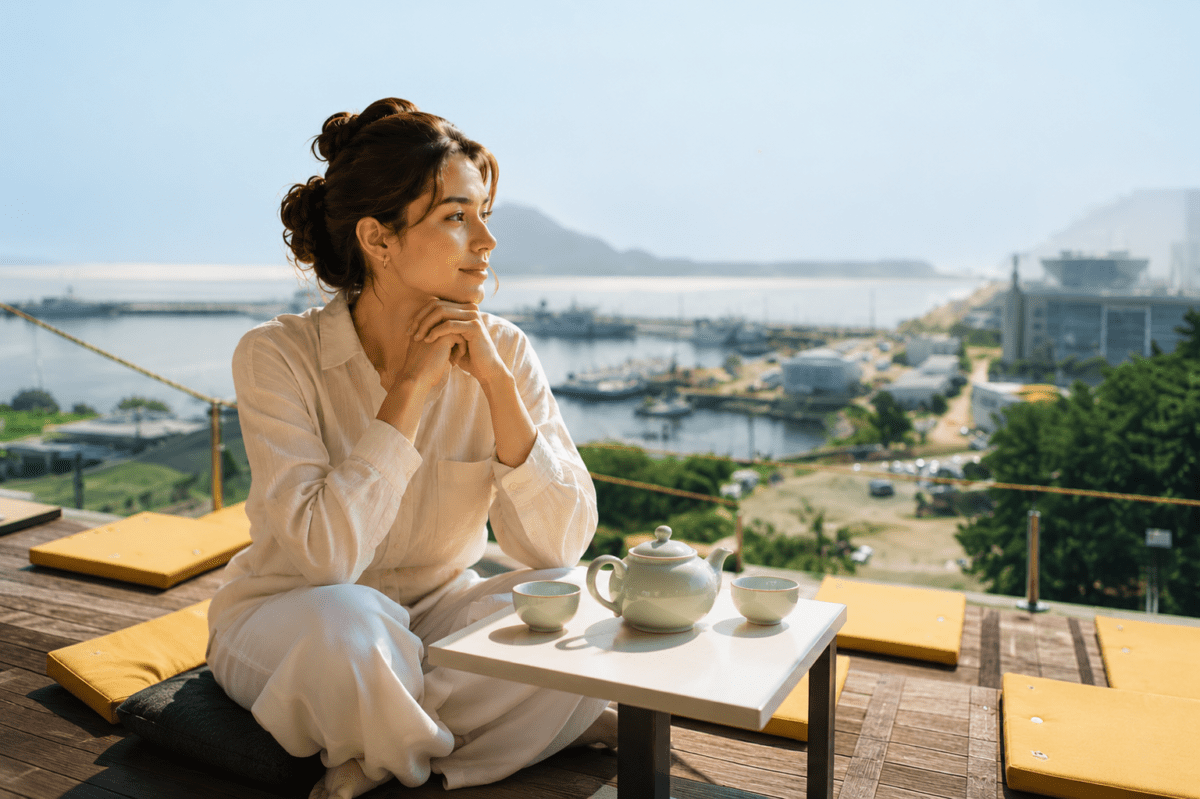
Repetition has a bad reputation in cultures that prize novelty. But the slow rituals Korea has been returning to aren’t built on novelty — they’re built on the opposite. Doing the same thing the same way every day reads as rigidity, lack of imagination, failure to evolve. The self-improvement framework that dominates much of contemporary life treats repetition as a means to an end — you repeat until you’ve optimized, then you change.
But repetition has a function that optimization misses. It produces predictability, and predictability produces a specific kind of calm that novelty cannot replicate.
In Korean timing philosophy, the cycle returns. Daily, monthly, yearly, and across decades, experience moves through repeating structures that make change visible. The cycle returns not because nothing has changed, but because the structure that makes change legible is itself stable. Without the repeating structure, the changes have nothing to be changes against.
Small daily rituals work the same way. The tea made the same way every morning isn’t evidence of a life that isn’t moving. It’s the stable point against which the movement of everything else becomes visible. The day that goes wrong feels wrong against the background of the ritual that went right. The day that goes unexpectedly well is felt as deviation from a norm — which means there was a norm, which means there was something reliable to deviate from.
This is what repetition actually produces: not stagnation, but a reference point. And reference points, it turns out, are what make a life feel navigable rather than just continuous.
What People Are Actually Seeking
The return of tea to Korean daily life — part of a wider shift toward mindful living has been quietly rebuilding — is often described as a reaction to speed. People are burned out, overstimulated, exhausted by the pace of contemporary life, and they’re reaching for something slower.
For many people, the appeal isn’t simply Korean tea culture. It’s the return of a Korean tea ritual simple enough to fit into ordinary life.
This is true, but it’s incomplete.
What people are seeking isn’t slowness for its own sake. Slowness without structure is just empty time, and empty time produces its own anxiety. What they’re seeking is the specific experience of an interval that belongs to them — time that isn’t claimed by productivity, responsiveness, or output, but that isn’t formless either.
The small tea ritual provides this with unusual precision. It’s slow, but it’s structured. It’s unhurried, but it has a sequence. It asks for presence without demanding performance. And because it’s repeated, it accumulates — each instance reinforcing the last, building a small but genuine architecture of predictability inside days that otherwise offer very little of it.
The people who find themselves making tea at the same time every day, in the same way, with the same cups — they’re not performing wellness. They’re not optimizing their mornings. They found something that made the day feel different, and they kept doing it.
That’s all a ritual ever is. Something that worked, repeated until it became structure.
The kettle clicks off. The cup waits on the table. Morning arrives the way it always does. Yet the day feels slightly easier to enter than it did yesterday.
This post was planned and edited by a human, with AI assistance.