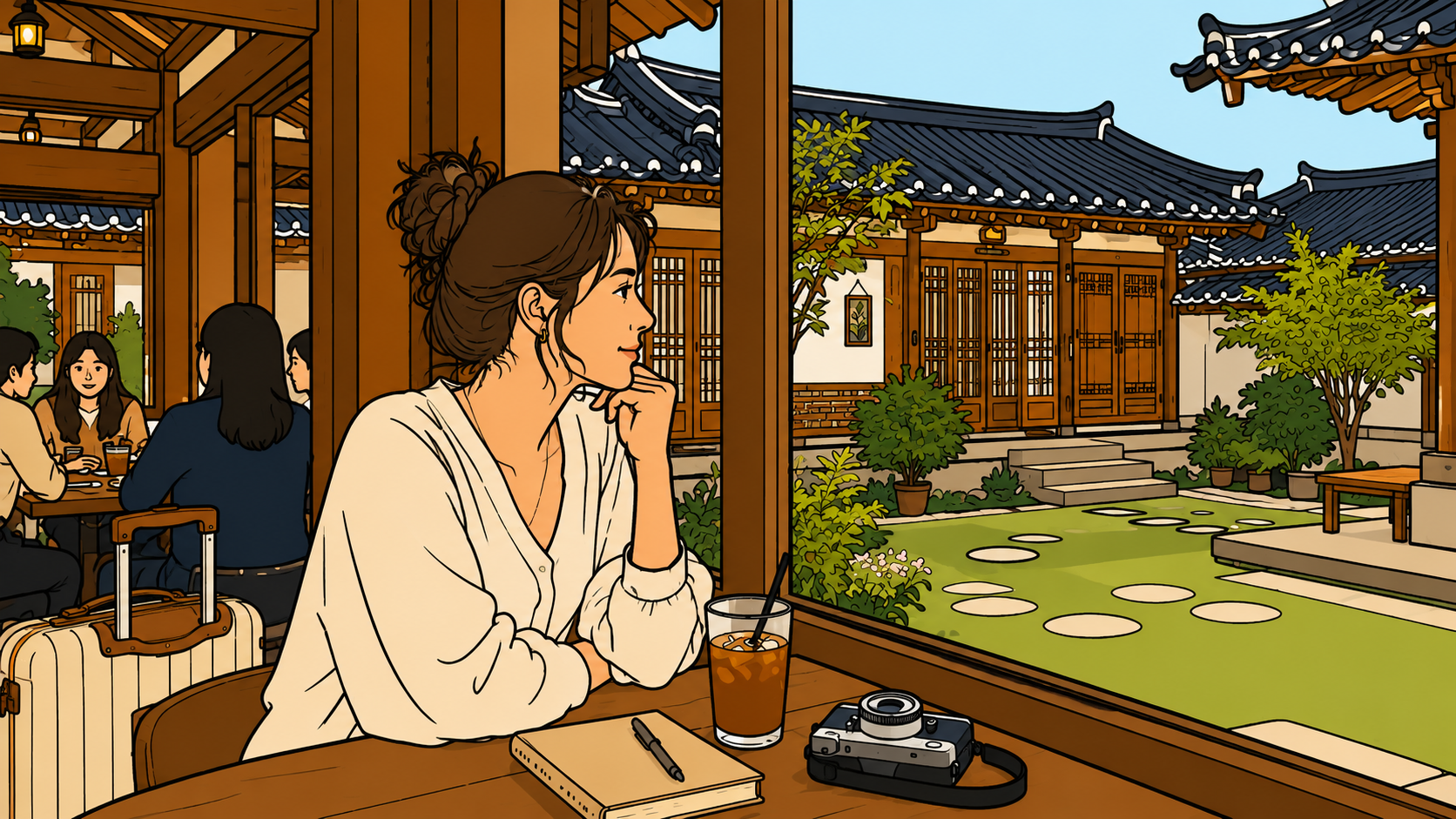

Three minutes after leaving Incheon Airport, she was already sitting in a café.
Not because she needed coffee. She needed somewhere to sit. Somewhere that wasn’t the airport, wasn’t the hotel lobby, wasn’t the street. She pulled up a map, walked three minutes, and pushed open a glass door. A barista nodded. Nobody asked how long she was staying — that’s Korean café culture.
She stayed four hours.
That moment — the nod, the seat, the four hours — is the thing most visitors to Korea can’t quite explain when they get home. They remember the coffee was good. They remember Korean café culture felt different from anything back home. They don’t always know why.
The Drink Is Just the Ticket
Walk into most cafés in the world and the transaction is straightforward: you pay for a drink, you drink it, you leave. The drink is the product. The seat is where you consume the product.
In Korea, the drink is the entry fee.
What you’re actually purchasing is harder to name. Time, maybe. Or the right to occupy a space without explaining yourself. The cup of Americano sitting on the table isn’t the point — it’s the object that makes everything else acceptable. You ordered something. That’s enough.
This distinction sounds small. It isn’t. It changes the entire logic of how a café functions, who uses it, and what happens inside it.
A visitor to Korean café culture notices this within the first hour, usually without being able to articulate it. Something feels permitted here that isn’t permitted elsewhere. The chairs aren’t designed to be uncomfortable. Nobody is hovering. The music is at a volume that doesn’t demand you leave. The light is calibrated for staying, not for turning over tables.
A Third Place With No Time Limit

Korean cafés function as something between home and work — a place where nobody expects anything from you. A space that exists between obligations, where different rules apply.
Korea has a specific relationship with third places, and it runs deep. The home is small, often shared. The office is visible, structured, watched. The street is public in a way that offers no shelter. The café absorbs what neither of those spaces can hold.
Step inside one on a Tuesday afternoon in Seoul and you’ll find: a university student with noise-canceling headphones, three laptop screens open, a half-finished iced latte going warm beside a mouse pad. Two women in their fifties, bags on the seat between them, talking in a way that suggests this is a weekly appointment, not a spontaneous meeting. A man in his thirties, blazer on the back of the chair, scrolling slowly through something on his phone with the particular expression of someone who has nowhere he needs to be for the next two hours.
None of them are doing anything remarkable. That’s exactly the point.
The café asks nothing of them. It doesn’t require productivity, sociability, or consumption beyond the initial order. It offers a chair, a table, ambient noise calibrated to make silence comfortable, and the implicit agreement that staying is not only tolerated but expected.
What makes this possible is something structural, not cultural in the soft sense. Korean cities are dense. Apartments are compact. Privacy, in the Western sense of a room that belongs entirely to you, is not always available. Young people in their twenties live with family well into adulthood — not by choice but by rent. Graduate students share studio apartments with thin walls and thinner schedules. The café becomes the place where a person can be alone in public, which is its own particular category of relief.
There’s a Korean phrase that roughly translates to “being together separately” — sitting near others without engaging them, absorbing the ambient presence of people without the cost of actual interaction. A café full of strangers each doing their own thing produces exactly this. You are not alone. You are also not obligated. That balance is harder to find than it sounds, and Korean café culture has been quietly providing it for decades.
Staying Is Not Rude
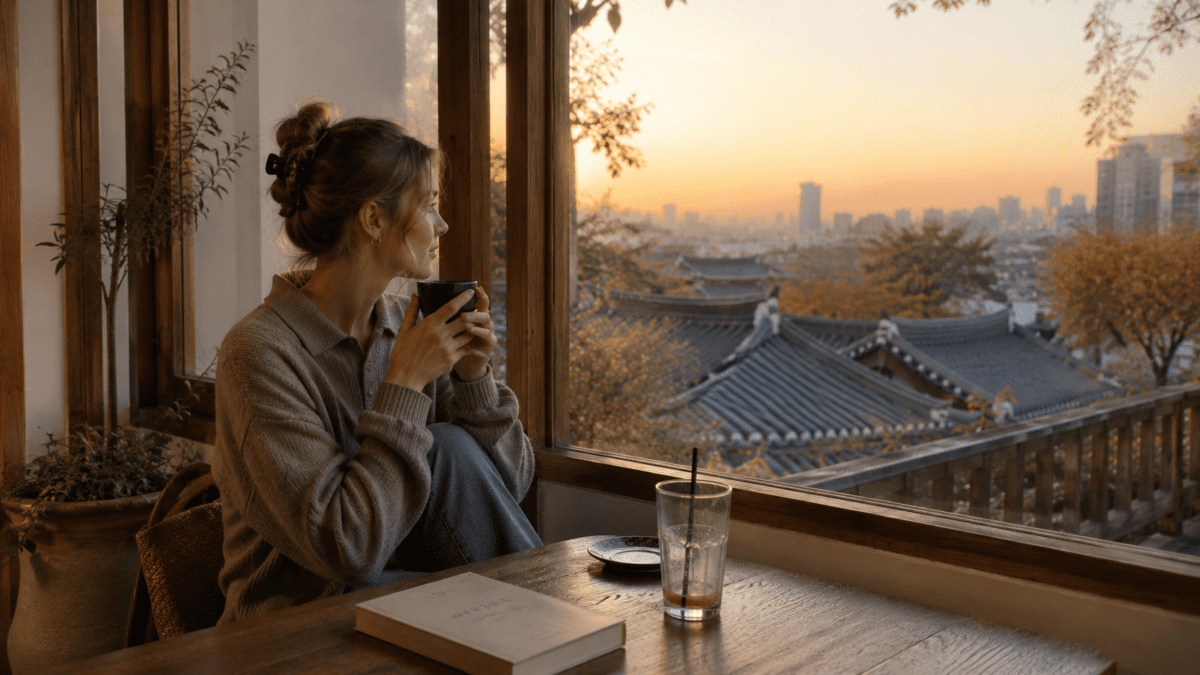
This is the thing visitors find hardest to internalize.
In many countries, lingering in a café past the point of finishing your drink carries a low-grade social cost. You sense it in the way the staff glances over. The way tables around you turn and yours doesn’t. The way a second menu appears, a suggestion disguised as a question: Can I get you anything else?
None of that happens here.
Finish your coffee and keep working. Open a second laptop. Fall asleep with your head on your arms — it happens, particularly near university campuses during exam season, students who haven’t slept in two days finding two hours of something resembling rest in a corner booth.
The staff does not come over. Nobody sighs audibly. The social contract is different: you paid for the space when you ordered. What you do in it afterward is not their business.
This isn’t indifference. It’s a deliberate structure. Korean café culture developed around the understanding that the space has value independent of continuous consumption. Operators price their drinks accordingly. The customer understands the arrangement. Nobody has to negotiate it out loud because it’s already been settled, somewhere upstream, by decades of use.
A visitor from certain Western cities will spend the first thirty minutes waiting for the signal to leave. It doesn’t come. Eventually — and this is the moment they’ll remember — they stop waiting. They settle. They stay.
That shift — from waiting to settling — is a small thing. But it marks the difference between experiencing a Korean café as a transaction and experiencing it as a space. Most visitors don’t notice when it happens. They just realize, at some point, that they’ve been there two hours and haven’t once felt watched. The drink on the table went cold an hour ago. Nobody minded. There’s something in the Korean relationship with time — what the afternoon holds — that a café makes visible without ever naming it.
The First Thing Visitors Notice About Korean Café Culture
It’s rarely the coffee.
It might be the design — the particular Korean café aesthetic that combines raw concrete with warm wood, pendant lighting hung low over two-person tables, a playlist that moves between lo-fi instrumental and early 2000s English pop without anyone seeming to notice the transition. The plant in the corner that is either very well maintained or a very good fake. The menu on the wall in a font chosen carefully enough to suggest someone with design training made this decision.
Or it might be the quiet. Not silence — Korean cafés are rarely silent — but a quality of noise that feels managed. Conversations happen, but they don’t escalate. Keyboards click. Ice shifts in plastic cups. The espresso machine fires in short bursts. It’s a sound environment designed for presence without performance.
But mostly, what visitors notice first is the density.
On a Saturday afternoon in Hongdae or Yeonnam-dong, every seat seems occupied. Yet nobody looks rushed. Not full in the anxious, hovering way of a restaurant with a wait list — full in the settled way of a library, where everyone has claimed their territory and intends to hold it. People are not in transit. They are not preparing to leave. They arrived, found a seat, and became part of the atmosphere.
The staff moves between tables without urgency. Orders are taken, drinks are delivered, and then the staff retreats back behind the counter, back into their own world. There’s a choreography to it — enough presence to function, enough absence to leave the room to the people sitting in it. A visitor used to cafés where staff check in every fifteen minutes will notice, eventually, that no one has come to the table in an hour. This is not neglect. It’s the arrangement.
From the outside, looking through the glass, it looks like a painting. Everyone slightly still, slightly absorbed, organized around small tables like a scene arranged by someone who understood that human beings look best when they have something to focus on.
A visitor orders a coffee and sits down. Two hours later, the cup is empty, the table is still theirs, and nobody has asked a single question. That’s usually when they realize the coffee was never the main product.
Content in this post was created with AI assistance.