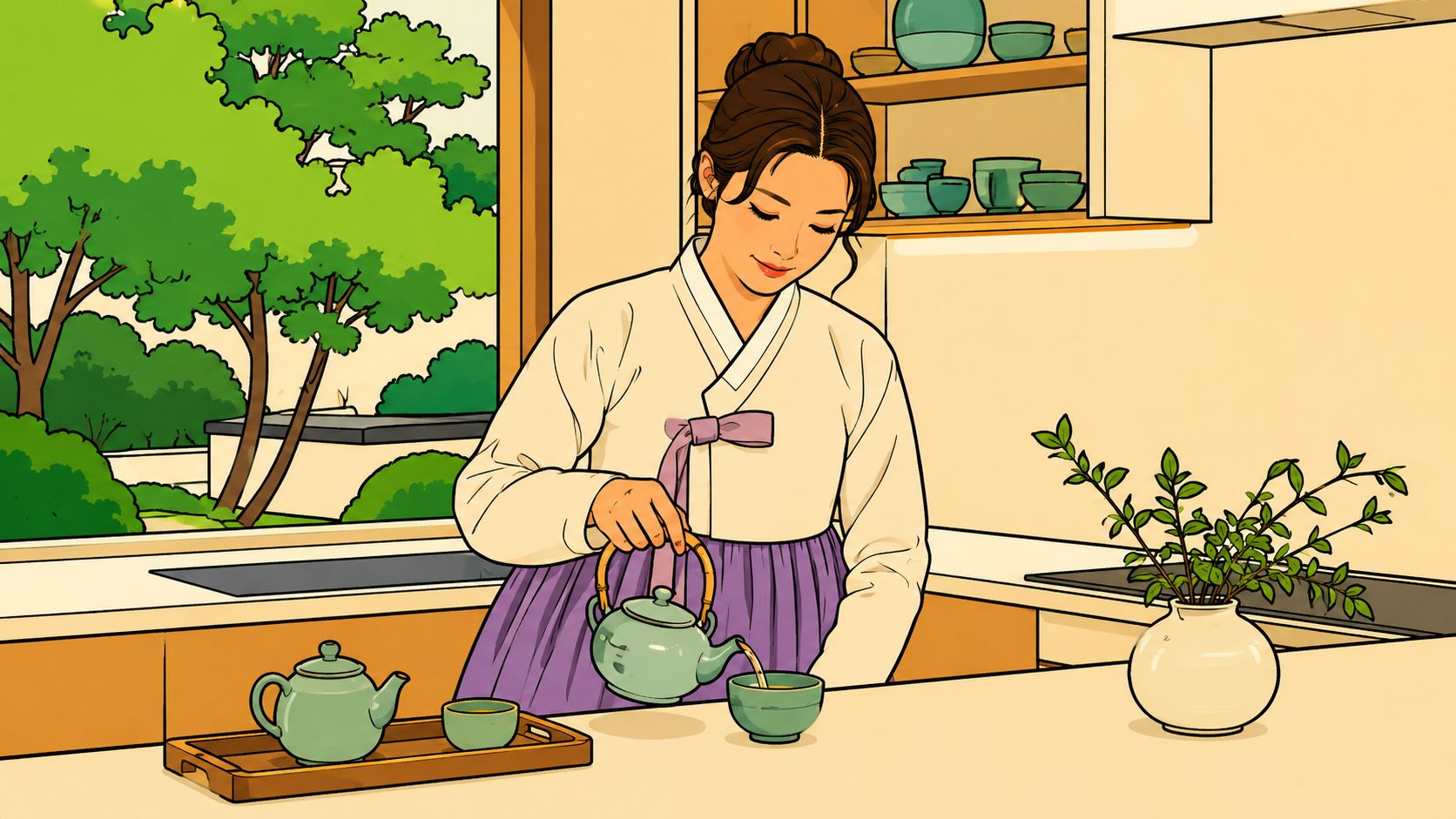

Most people who try Korean green tea for the first time make the same mistake.
They treat it like coffee. Boiling water, straight onto the leaves, done in two minutes. The tea that comes out is bitter and flat — nothing like what they were expecting. They assume they don’t like green tea, or that this particular variety isn’t for them, and they move on.
What they experienced wasn’t Korean green tea. It was Korean green tea brewed incorrectly, which produces a different drink entirely.
The temperature of the water and the length of the wait aren’t instructions to follow. They’re the actual ingredients.
It Starts With the Water, Not the Leaf
The leaf gets most of the attention. Origin, variety, harvest season, elevation — these are the details that tea enthusiasts discuss, and they matter. But for the person sitting down with that pot for the first time, none of that determines what ends up in the cup as much as what happens to the water before it touches the leaf.
Korean green tea is typically brewed between 60 and 75 degrees Celsius. Boiling water — the default for most people making any hot drink — sits at 100 degrees. That gap of 25 to 40 degrees is not a minor calibration. It’s the difference between a cup that opens slowly, releasing layers of sweetness and grass and something faintly oceanic, and a cup that tastes like regret.
The reason is chemical. Research on brewing conditions and green tea chemistry shows that higher temperatures extract bitter compounds from the leaf faster and more completely than lower temperatures do. The same leaf, the same steeping time, at different water temperatures, produces what are effectively two different drinks. One is harsh and one-dimensional. The other is quiet and complex, the kind of taste that arrives in stages rather than all at once.
This means the first step in making Korean green tea is waiting — not for the tea to steep, but for the water to cool enough to be useful. You boil the kettle and then you set it down and you do nothing for three to five minutes. In a world of optimized processes, this pause has no productivity value. It produces nothing. It is simply necessary.
The water teaches patience before the tea does.
For many people learning how to brew Korean green tea, the hardest step is not measuring the leaf. It is waiting for the water to cool.
Waiting Is Not Wasted Time

There’s a particular discomfort that comes with purposeless waiting — the kind where you’re not allowed to optimize the interval, where checking your phone would technically be possible but would somehow miss the point.
Making Korean green tea produces this discomfort reliably. The water is cooling. The leaves are steeping. Neither process benefits from your attention, but both require your presence in the sense that you need to be there when they’re ready. You’re not free to leave. You’re not occupied enough to be distracted. You’re in the interval.
Most people fill intervals. The two minutes between sending an email and receiving a reply. The four minutes a pot of coffee takes to brew. The thirty seconds of a loading screen. These gaps are automatically populated — a phone appears, a tab opens, a thought train begins. The interval disappears before it has a chance to be experienced as an interval.
Korean green tea resists this. The cooling water and the steeping leaves create a sequence of small, unchosen pauses that are long enough to be noticed but short enough that filling them feels slightly wrong. You could pick up your phone. But the cup is there, and the water is almost ready, and something about the sequence makes the phone feel beside the point.
This is where the waiting starts to do something to the person making the tea, separate from what it does to the drink. The intervals accumulate. The pace of the preparation becomes, briefly, the pace of the person. Not through effort or intention — just through the structural fact of being in a process that moves at its own speed.
You don’t slow down to make the tea. The tea’s requirements slow you down while you’re making it.
In this sense, the waiting is doing exactly what it does to the leaf — drawing out something that wouldn’t emerge under pressure.
Taste That Arrives in Layers
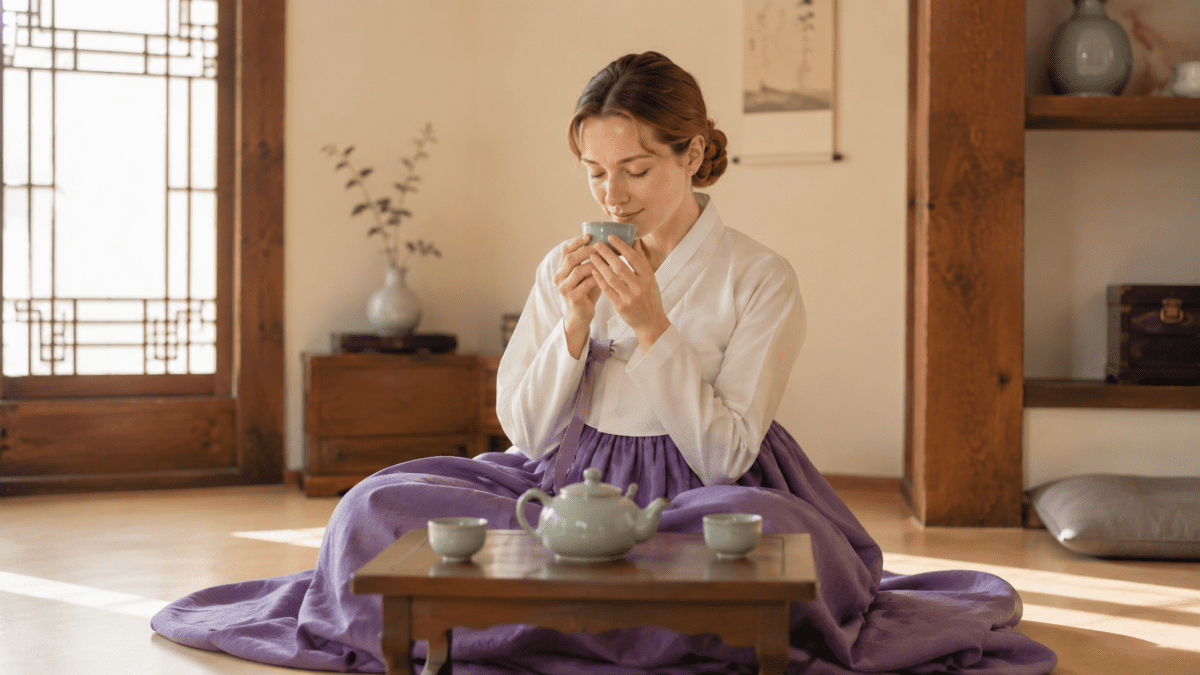
The first sip of properly brewed Korean green tea is never the best one.
This surprises people who are used to drinks that front-load their impact. Coffee announces itself immediately — the bitterness, the acidity, the caffeine. The first sip is the defining sip. Everything after is maintenance.
Korean green tea moves differently. The first sip is light, almost tentative — a suggestion of what’s coming. The sweetness that the lower temperature preserves takes a moment to register. The grassy quality that signals freshness arrives mid-sip. The faint mineral note that distinguishes it from its Japanese and Chinese counterparts lingers after you’ve swallowed.
By the third sip you’re tasting something different from the first. Not because the tea has changed, but because the attention has adjusted. The palate has slowed down to match the pace of what it’s receiving.
This layering is one of the defining characteristics of Korean green tea and one of the hardest things to describe to someone who hasn’t experienced it. It’s not complexity in the way wine is complex — not an intellectual exercise in identifying components. It’s more like the difference between reading a sentence quickly and reading it slowly. The words are the same. The experience isn’t.
The five phases framework in Korean timing philosophy notices a similar pattern. Information changes depending on the speed at which we move through an experience. Korean green tea simply makes that principle visible in a cup.
This is also why the second steep is often better than the first. The leaf has already opened. The person has already slowed down. Both are now moving at the same pace, and the cup that comes out of that alignment tastes different from the one that came before it — quieter, more settled, the bitterness gone and something rounder left in its place.
Why Speed Produces a Different Drink Entirely
There’s a version of this that sounds like a preference — some people like slow tea, some people like fast coffee, both are valid. But this case is more specific than that. Speed doesn’t produce a faster version of the same drink. It produces a worse one.
Boiling water on green tea leaves doesn’t just speed up the extraction. It selectively extracts the compounds that taste bitter while destroying the amino acids responsible for the sweetness and umami that define the character of a good Korean green tea. The heat is destructive in ways that can’t be compensated for by adjusting steeping time or leaf quantity. You simply end up with different chemistry in the cup.
This makes Korean green tea unusual among drinks. Most drinks are forgiving of impatience. A coffee brewed thirty seconds faster than optimal is still recognizably coffee. One brewed at the wrong temperature is not a faster version of itself — it’s a failure state.
The implication is that speed isn’t just discouraged here. It’s structurally incompatible with the result. The drink enforces its own pace, and the pace isn’t arbitrary. It’s the condition under which the thing you’re trying to taste actually exists.
Some things only appear when you wait for them. Korean green tea makes this literal.
The cup cools slightly while you sit there. The leaves settle at the bottom of the pot. Nothing important has happened. Yet the room feels different from five minutes ago. That’s the only evidence you need that something did.
This post was planned and edited by a human, with AI assistance.