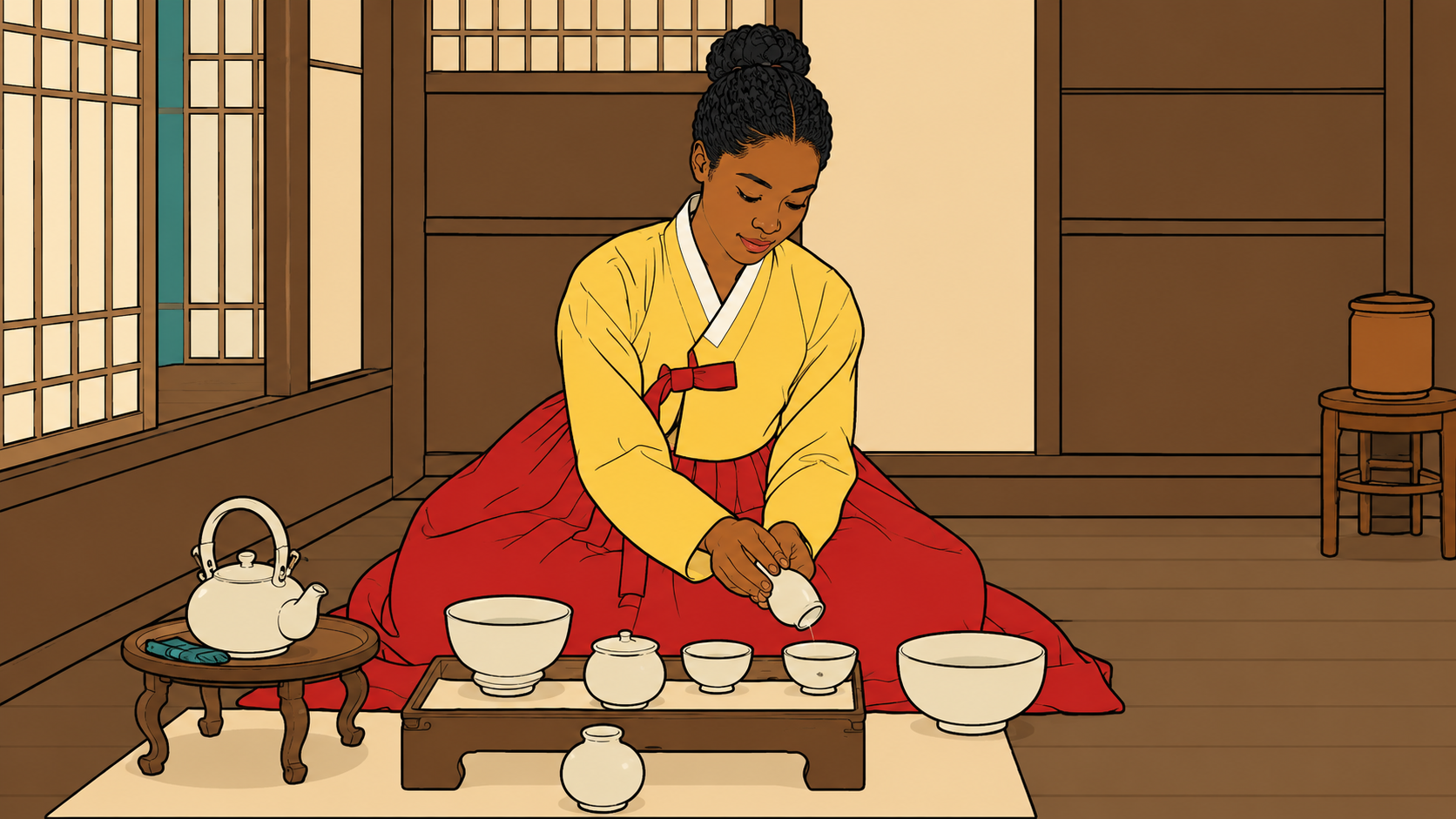
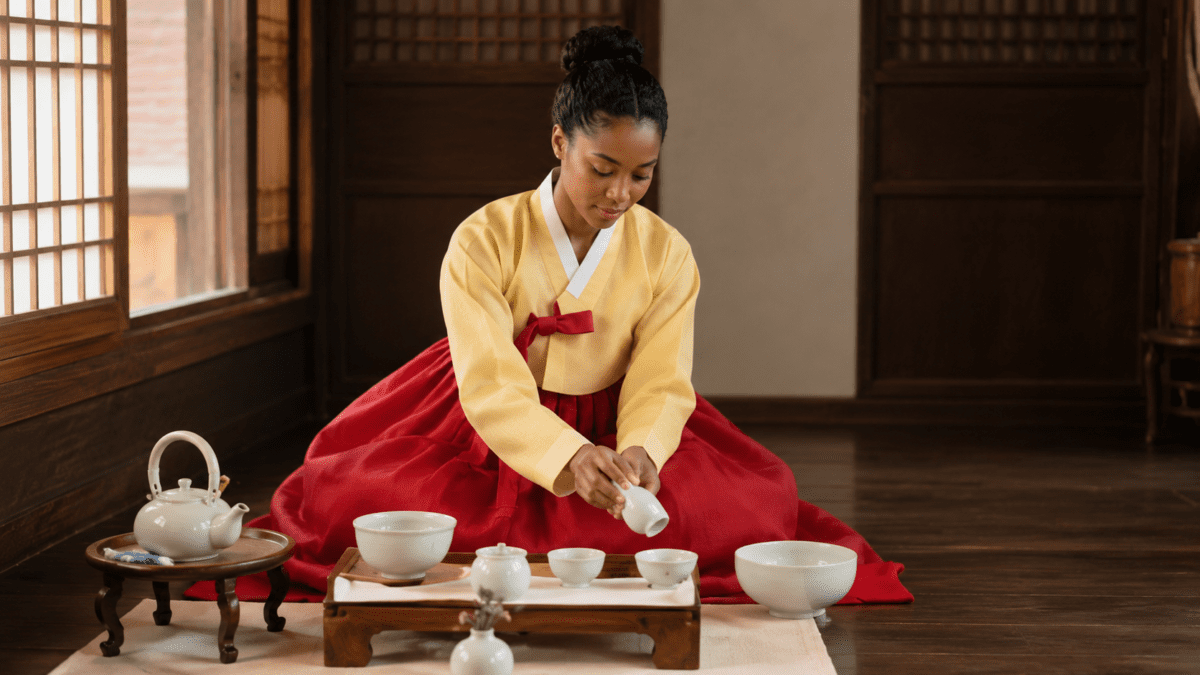
Most people walk into a Korean tea house by accident the first time.
They were looking for somewhere to sit, or following a recommendation they’d half-forgotten, or ducking out of the rain on a street they didn’t know well. They push open a low door, step down or across a threshold, and something shifts before they’ve had time to decide how they feel about it.
It’s not dramatic. There’s no obvious marker that says: you are now in a different kind of space. The shift is subtler — a drop in ambient noise, a change in the light, the specific quality of a room that isn’t trying to sell you anything at speed.
Korean tea houses don’t announce what they’re doing. They just do it.
By the time most visitors realize the pace has changed, they’ve already sat down, taken off their shoes, and ordered something they’re going to have to wait for. The transition happened while they weren’t paying attention to it.
The Moment the Rhythm Changes at the Door
There’s a threshold effect in Korean tea houses that’s easy to miss because it doesn’t announce itself.
In most commercial spaces — cafés, restaurants, shops — the environment is calibrated to keep you moving at a certain pace. Music at a tempo that discourages lingering. Furniture arranged to maximize turnover. Lighting bright enough that you stay alert and transactional. You walk in already knowing the rhythm, because the rhythm is the same everywhere.
Korean tea houses interrupt this without confrontation. The door is often low or narrow — not dramatically so, but enough that you have to pay brief attention to enter. The floor level sometimes changes. Shoes come off. Each of these is a small physical interruption, a micro-pause that breaks the momentum you brought in from the street.
You don’t decide to slow down. The architecture decides for you.
The effect is structural, not atmospheric. It doesn’t depend on mood or intention. A person who walks in stressed, checking their phone, running through a mental list — they encounter the same sequence of small interruptions as everyone else. The door, the shoes, the low table, the wait. By the third interruption the list has receded slightly. Not gone, but quieter. The space didn’t ask for the list to disappear. It simply created enough small pauses that the list lost its grip. That’s a different mechanism from relaxation — and a more reliable one.
This kind of shift rarely happens by decision. It happens when the surroundings change enough to remove the pressure that was keeping a person moving outward. The conditions that allow a different direction to begin aren’t activated by will — they respond to environment. The tea house creates those conditions at the door.
Low Tables and the Pace They Enforce

Sit at a standard café table and your body stays in its default posture — upright, ready, positioned for efficiency. You can open a laptop, take a call, work through a to-do list without changing anything about how you’re sitting. The chair and the table height are neutral. They don’t ask anything of you.
A low table asks something different.
To sit at a low table you either kneel or sit cross-legged or find some variation of floor-level posture that your body hasn’t used since childhood. None of these positions are comfortable for sustained productivity. You can’t type for long. You can’t hold a phone at the right angle for scrolling. The body, slightly awkward, slightly more present than usual, occupies a different relationship to the space.
This is not accidental. The low table is one of the oldest pieces of furniture in Korean domestic life, and its persistence in tea houses isn’t nostalgia — it’s function. The posture it produces is incompatible with the physical habits of output-mode.
A man who visited a tea house in Insadong during a work trip described sitting down at the low table and realizing, after about five minutes, that he had no idea what to do with his hands. His phone was in his pocket. His bag was by the wall. The cup was too small to hold with one hand and too hot to drink yet. He sat with both hands around the cup and waited, which was, he said later, the first time he’d waited for anything that week without simultaneously doing something else.
The low table enforced a kind of presence that upright furniture doesn’t require. Not mindfulness as a practice — just the physical fact of having nowhere else to direct the hands.
Why Silence Feels Natural, Not Awkward

Silence in most social settings is a problem to be solved. Someone speaks to fill it. A phone appears. Music exists in nearly every commercial space precisely because silence, in those contexts, creates discomfort — it implies something has gone wrong, that the interaction has stalled, that someone should be doing something.
Korean tea houses carry a different relationship to silence. It doesn’t feel like absence. It feels like the default condition of the space, and conversation, when it happens, feels like something layered on top of it rather than something filling a void.
Part of this is acoustic. Low ceilings, soft materials, small rooms — the sound environment of a traditional tea house absorbs rather than reflects. Voices don’t carry the way they do in high-ceilinged cafés. The space isn’t designed for projection.
But the deeper reason is that the silence has company. The sound of water being poured. The small ceramic sound of a lid being replaced. The specific quiet of a room where everyone is doing the same unhurried thing. It’s not empty silence — it’s occupied silence, and the difference is felt immediately.
Visitors who describe feeling unexpectedly comfortable with the quiet usually attribute it to the tea house’s atmosphere, as if it were a personality trait of the space. What they’re actually responding to is the structural fact that the silence has been made habitable — furnished with small sounds and a shared pace that removes the social pressure to fill it.
What Visitors Remember After They Leave
Ask someone what they remember about a Korean tea house visit and they rarely lead with the tea.
They describe the light — the particular quality of afternoon sun through hanji paper windows, diffused and directionless. They describe the floor, the specific feeling of sitting lower than usual. Some come back to specific places, like Insa-dong Chatjip, where the hanok setting makes the experience tangible rather than abstract.
What they’re describing is the experience of having been, briefly, in an environment that wasn’t asking anything of them.
This is rarer than it sounds. Most designed spaces — even spaces explicitly marketed as relaxing — are still oriented toward an outcome. The spa wants you to feel renewed. The park wants you to feel refreshed. The experience is framed as productive, a recovery investment, something you’re doing in order to perform better afterward.
The Korean tea house doesn’t make this argument. It doesn’t promise outcomes. You sit, you pour, you drink something that takes patience to appreciate. Whether you leave calmer or more focused or simply the same as you arrived — none of this is the point.
The point is the interval itself. The pause that doesn’t justify itself by what comes after.
That’s what visitors remember. Not the tea, exactly. The specific quality of an hour that belonged entirely to itself.
And that quality is transferable. People who visit once tend to look for it again — not necessarily in a tea house, but in any environment that replicates the conditions. A quiet corner. A cup that requires two hands. A few minutes with nowhere to be and nothing to produce. The tea house introduced them to a pace they hadn’t known they were missing. Once you’ve felt the difference, you start to notice its absence everywhere else.
This post was planned and edited by a human, with AI assistance.