

There’s a moment that happens in most coffee drinkers’ lives — usually somewhere in their thirties, sometimes earlier — when the coffee stops working the way it used to.
Not the caffeine. The caffeine still works fine. What stops working is the feeling around it. The ritual of it. The way a double shot used to feel like a starting gun and now just feels like maintenance. They’re still drinking it, still needing it, but somewhere along the way it stopped giving them anything except the absence of a headache.
Some of them switch to tea. Not because tea is healthier, not because someone told them to, but because they’re looking for something the coffee stopped providing — and they can’t quite name what that thing is.
Korean tea culture has been holding that unnamed thing for centuries. Most people just don’t know where to look.
A Drink That Doesn’t Rush You
The first thing people notice about Korean tea isn’t the taste. It’s the pace.
Coffee is designed around speed. The espresso shot is finished in thirty seconds. The drip coffee is ready in four minutes. Even the ritual of making it — the tamper, the grind, the pour — is oriented toward efficiency. You’re producing output. You’re getting somewhere.
Tea moves differently. The water has to cool before it touches the leaves. Green tea brewed at the wrong temperature tastes wrong — bitter, flat, nothing like what it should be. You wait. Not for long, but long enough that waiting becomes part of the activity rather than an obstacle to it.
This is the first structural difference between tea and coffee, and it’s the one that matters most for the people who end up staying. The pause isn’t a flaw in the process. The pause is the process.
A woman who started drinking Korean green tea during a period of back-to-back deadlines described it this way: she hadn’t changed anything else about her day, hadn’t meditated, hadn’t slowed down in any meaningful sense. But the ten minutes she spent waiting for the water to cool and the tea to steep had become, without her planning it, the only ten minutes in her day that didn’t have a task assigned to them.
She wasn’t doing nothing. She was making tea. But the making required a kind of attention that wasn’t useful for anything else — which meant, for those ten minutes, her other problems had nowhere to attach.
You don’t slow down to drink the tea. The tea slows you down while you’re making it.
What Coffee Cannot Give
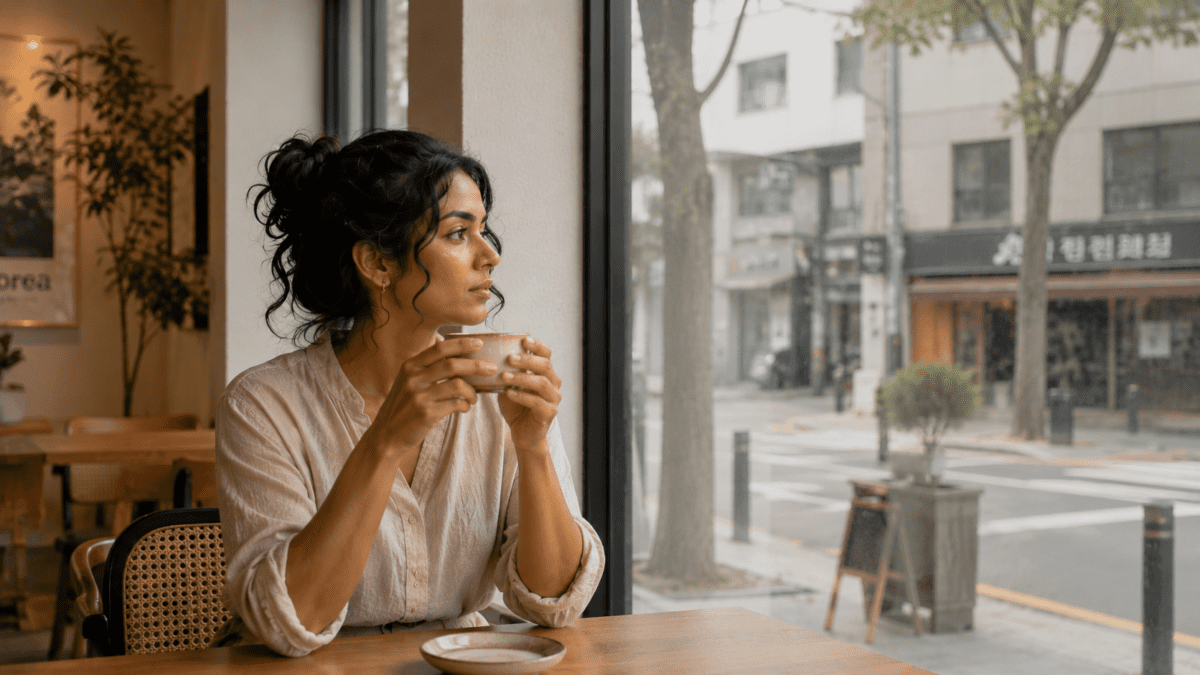
Coffee is optimized for one direction: forward. It raises alertness, compresses time, sharpens the edge between where you are and where you need to be. This is not a criticism. For most of the situations that modern life produces, this is exactly what’s needed.
But forward-only momentum has a structural problem. It accumulates. Day after day of pushing outward, producing, outputting — the nervous system doesn’t distinguish between kinds of effort. It registers volume. And after enough volume, the coffee that used to feel like a door opening starts to feel like a door that’s already been propped open for so long the mechanism has worn out.
What coffee cannot give is the opposite direction.
In Korean timing philosophy, the outward-moving, productive, visible phase is only half of the cycle. The other half is inward: accumulation, integration, the quiet building of what the next outward phase will eventually require. Neither phase is superior. But most people in high-output environments spend years, sometimes entire decade cycles, running the outward direction without ever creating conditions for the inward one.
Korean tea culture, without naming any of this, creates those conditions.
The smaller cup means you finish quickly and pour again — a gentle repetition that keeps the hands occupied without demanding mental presence. The lower temperature of the water slows the whole sequence down. The taste itself is subtle enough that you have to pay attention to catch it, which means your attention is occupied with something genuinely quiet rather than something urgently productive.
This is what coffee cannot give: a direction that moves inward rather than forward.
When Attention Slows Down With the Cup
There’s a particular quality to the attention that tea drinking produces — not focused, not effortful, not pointed at any outcome. It’s closer to what happens when you watch rain, or follow the movement of something at the edge of your vision. You’re present without being purposeful.
Most people have forgotten this mode exists.
The environments that dominate most lives — office spaces, screens, notification systems, conversations that require constant response — are all built around directed attention. You focus on this, then this, then this. The attention moves like a cursor, jumping from task to task, never allowed to simply drift.
Tea interrupts this without making a point of interrupting it. You’re not being asked to relax. You’re not following a guided meditation or sitting in a designated wellness space. You’re making a drink. But the drink requires you to slow the cursor down — to track something that moves at the pace of steeping leaves rather than the pace of incoming messages.
The shift happens somewhere in the first few minutes, and most people don’t notice it until it’s already happened. They look up from the cup and realize they’ve been thinking about nothing in particular. Not spacing out — present, just not pointed anywhere.
This is the attention that Korean tea culture has been cultivating for centuries: not emptiness, but undirected presence. A mode of awareness that doesn’t produce anything and doesn’t need to.
Why Korean Tea Culture Is Being Reconsidered Now

Korean tea culture isn’t new. The practice of preparing and drinking tea in Korea traces back more than a thousand years, woven through Buddhist monastery life, Joseon court ritual, and the quieter corners of daily existence that rarely appear in history books. What’s new is the audience finding it.
The timing makes sense. The last decade has produced a particular kind of exhaustion — not the exhaustion of physical labor but the exhaustion of sustained, always-on cognitive output. Remote work dissolved the edges between working hours and non-working hours. Screens followed people into the rooms that used to be screen-free. The nervous system that once got a break when you left the office now has nowhere to go.
Into this, Korean tea culture arrived — partly through tourism, partly through the global spread of Korean food and aesthetics, partly through the specific kind of person who finds themselves standing in a Korean tea house in Seoul and thinking: this is what I’ve been missing and I didn’t know what to call it.
What they were missing wasn’t the tea. They were missing a designed environment that didn’t ask anything of them — that was, in fact, structurally oriented toward giving the scanning, monitoring, output-producing part of the mind somewhere quiet to be.
The reconsidering happening now isn’t nostalgia. It’s not an aesthetic preference for clay pots over paper cups. It’s a functional response to a specific deficit — the absence, in most contemporary environments, of any designed space for the inward direction.
Korean tea culture offers that space without making it a project. You don’t have to commit to a practice, adopt a philosophy, or learn a vocabulary. You sit. You wait for the water to cool. You pour.
What’s interesting is how little resistance this meets. People who would never describe themselves as interested in tea culture, who would roll their eyes at the word “ritual,” find themselves returning. Not because they’ve converted to anything, but because the experience solved a problem they hadn’t formally identified — the problem of having nowhere to put their attention that didn’t immediately demand something back.
The rest happens on its own.
This post was planned and edited by a human, with AI assistance.