The wellness industry has a timing problem.
It sells recovery in weekend increments — two days, a nice hotel, a curated itinerary of rest. You arrive depleted. You leave slightly less depleted. Monday arrives on schedule.
A silent retreat doesn’t work like that. It doesn’t sell recovery. It removes the conditions that made recovery necessary.
That’s a different offer. It took the rest of the world a while to notice.
What the Wellness Industry Got Wrong
The modern wellness retreat was built around addition. Add a massage. Add breathwork. Add a sound bath, a forest walk, a chef-prepared menu of things that are good for you. The underlying assumption: you are depleted, and the right inputs will refill you.
Temple stay operates on subtraction.
No phone after nine. No choice about when to wake up, when to eat, what to wear. The robes are not an aesthetic decision — they are the removal of one. Every morning you put on the same thing as everyone else and the day begins without that particular negotiation.
What’s left, once the additions are gone, is harder to package. But it’s also harder to lose on the bus home.
We didn’t talk about this on the first evening. We were too busy counting the bell strikes — thirty-three, the evening count at Jingwansa, marking the line between what the day had been and what the night was about to become. But somewhere between the chanting and the tea that cooled slowly in our cups, something had already begun to lift. Not dramatically. More the way a room changes when someone stops talking. Nobody announced it. Nobody needed to. The subtraction had already started.
The global wellness market is worth over five trillion dollars. Burnout rates have not declined proportionally. What earth depletion actually looks like is not dramatic — it’s the quiet accumulation of processing everyone else’s load until nothing is left to give.
At some point the question stops being what should we add and starts being what would happen if we stopped. This is what happens when hard work stops working — not because the effort was wrong, but because the framework was.
A silent retreat has been answering that question for centuries. The rest of the world is only now asking it.
Nothing about it feels optimized. That’s precisely why it works. The schedule wasn’t designed to improve productivity or reduce stress. It was designed for practice, and the rest follows naturally.
The Temple That Kept Something
Jingwansa was founded in 1011. A bikhuni (비구니: bi-ku-ni, Buddhist nun) temple — run by and for Buddhist nuns — pressed against the base of Bukhansan in what is now one of Seoul’s most densely populated districts.
The Korean War left most of the complex in ash. Three halls survived: Nahanjeon (나한전: na-han-jeon, Hall of the Arhats), Chilseonggak (칠성각: chil-seong-gak, Seven Stars Shrine), Dokseongjon (독성전: dok-seong-jeon, Hall of the Lonely Saint) — the three that happened to be standing when the operation ended. Everything else was rebuilt across the following decades.
In 2009, workers renovating Chilseonggak found something pressed between the altar and a support column. A cloth bundle. Inside: a Taegeukgi (태극기: tae-geuk-gi, Korean national flag) from the March 1st Independence Movement of 1919. Wrapped around it, twenty items — independence newspapers, documents. The flag had been made by painting over a Japanese imperial flag. One corner was burned from what historians believe was use at a protest site.
The temple had been keeping something for eighty years without being asked to.
We stood in front of the reproduction mounted on the wall. The nun who described it didn’t dramatize. Just the facts: the burn mark, the trigrams positioned differently from the modern flag, the eighty years between hiding and discovery.
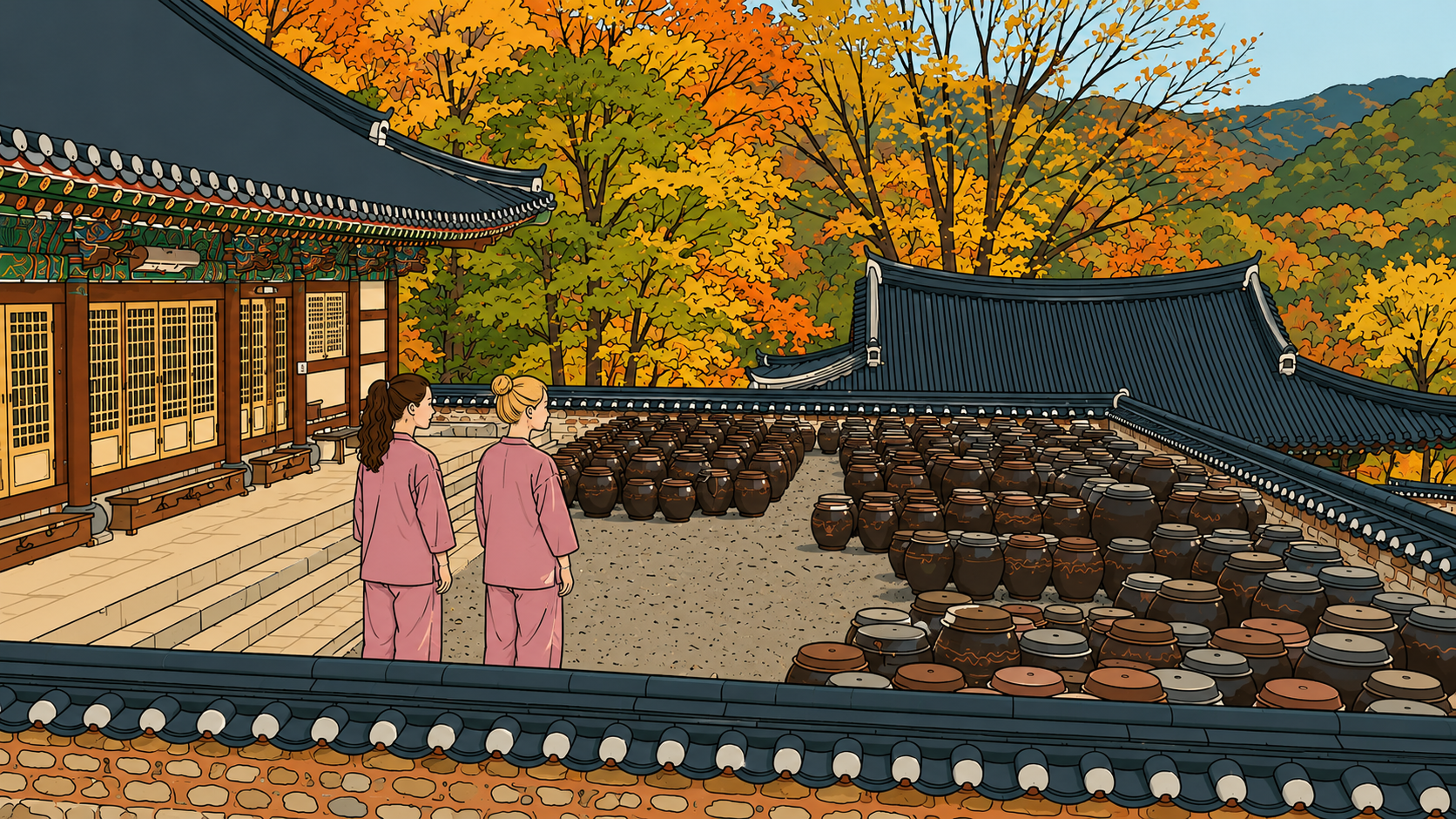
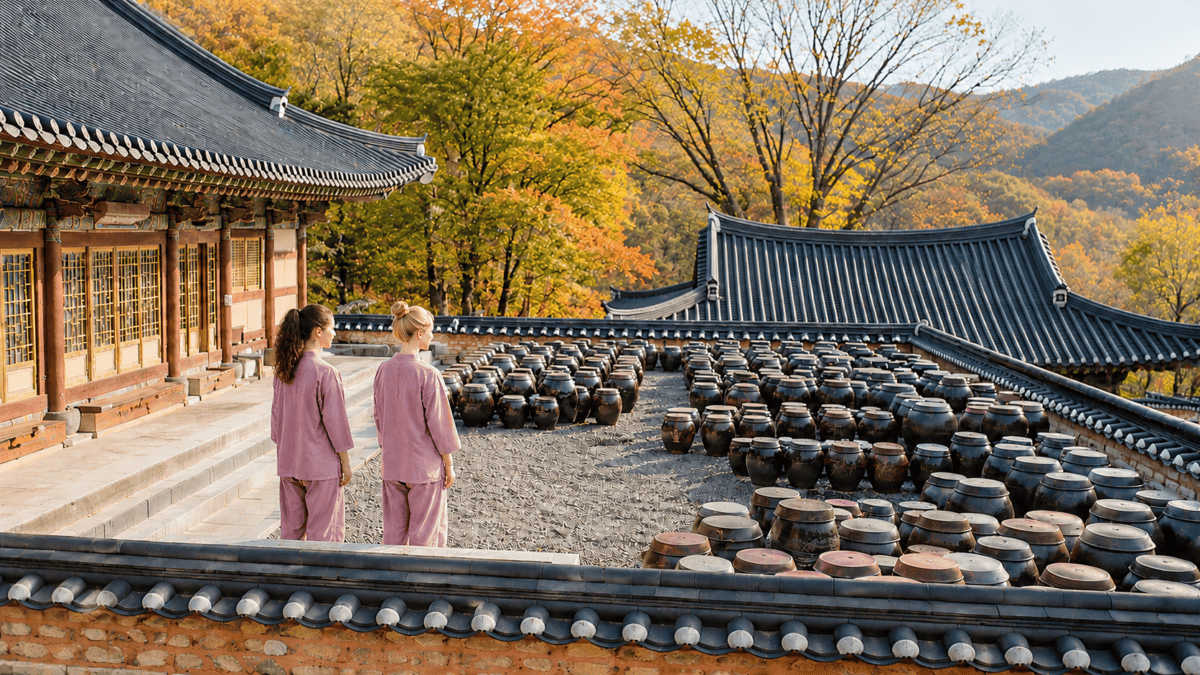
What stays with you is not the history. It’s the understanding that a place can hold things time doesn’t diminish. The rows of earthenware jars arranged outside the main hall — some holding doenjang (된장: doen-jang, fermented soybean paste) that has been fermenting for years, some empty, all of them waiting — are the same logic. Each jar was placed with the understanding that whatever goes inside will not be ready for a long time, and that this is not a problem to solve. Patience is not a virtue here. It’s a method. The temple knew this before the wellness industry invented a word for it.
The Schedule Is the Practice
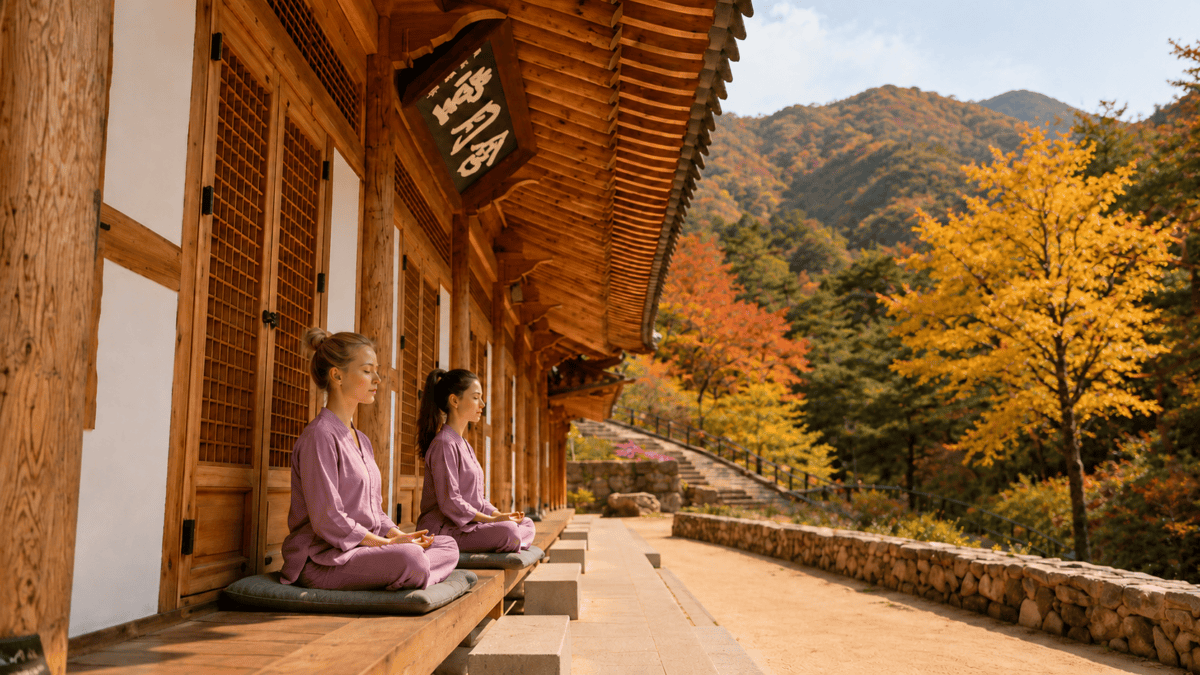
Korea’s Templestay program has been running since 2002. It started as infrastructure — a way to accommodate international visitors during the FIFA World Cup. What the organizers built for logistics became, over the following two decades, one of the most quietly influential wellness programs operating anywhere in the world.
The Cultural Corps of Korean Buddhism now oversees programs at more than 130 temples nationwide — mountain complexes accessible only on foot, city-adjacent temples thirty minutes from Seoul by subway, coastal temples where the morning bell competes with the sound of the sea. Annual participation has crossed 200,000. International guests account for a share that has grown every year since the program reopened after the pandemic.
The timing of the program’s global rise is not accidental. Burnout peaked during and after the pandemic in ways that self-care content could not address. Digital saturation reached a point where disconnection itself became the scarce resource — something people would pay for, travel for, wake up at 4 AM for.
Every element of the temple stay wellness schedule supports the next. You stop noticing the schedule itself and start noticing what it leaves behind. The structure disappears. The experience remains.
This is what most wellness programming misses. A yoga class on Tuesday doesn’t connect to anything on Wednesday. A meditation app sits beside a social media app on the same screen. The practices are real, but they often exist in isolation, disconnected from the rest of the day.
The day made sense from the inside. One hour led naturally to the next. You weren’t practicing anything. You were simply living inside the structure.
What Transfers and What Doesn’t
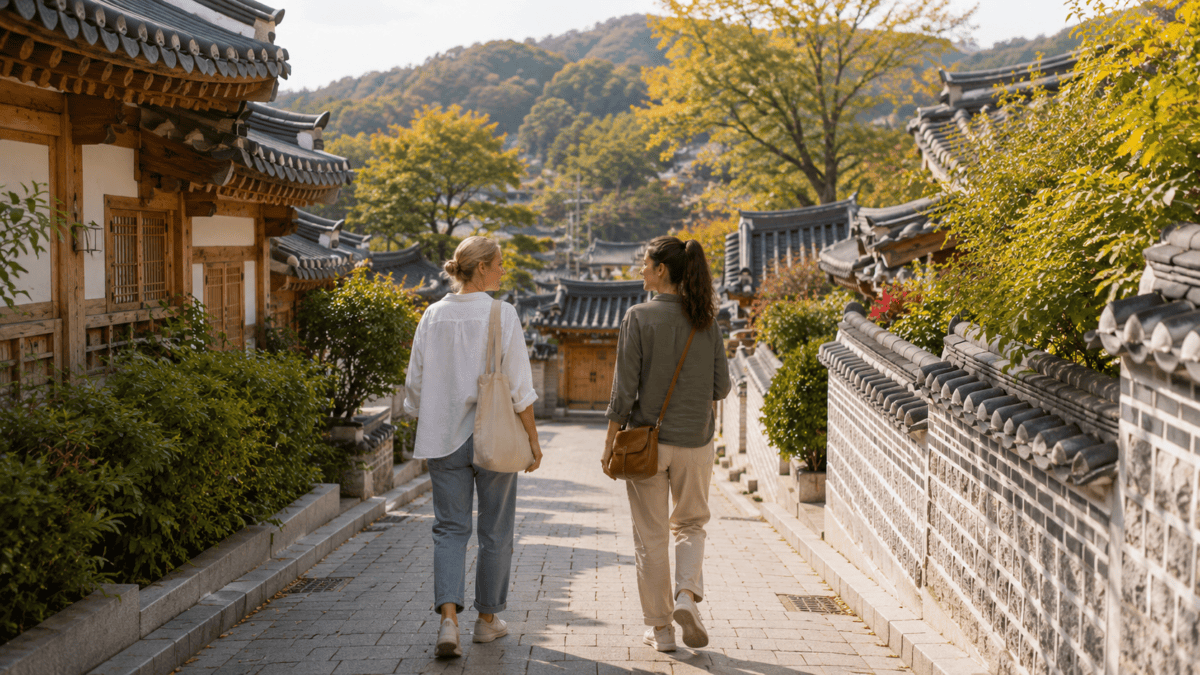
The common thing people say after a temple stay is some version of: I want to live like this.
They don’t mean the 4 AM bell. They mean the quality of a day that knows what it’s doing — where each hour earns the next, where nothing floats loose from everything else. That quality is real. It’s also not portable, not directly. The robes stay at the temple. The schedule dissolves before the bus reaches the highway.
What transfers is smaller. More durable.
We noticed it first on the bus back. The city assembled itself outside the window, district by district, and watching it felt different from usual. More deliberate. More like a choice.
Three weeks later, standing in a kitchen on a Wednesday morning, the kettle had finished boiling. The phone was face-down on the counter — placed there without deciding to. The steam was doing something in the window light — catching, releasing, catching again. Fifteen seconds passed before anything moved. The city was visible through the window. It hadn’t gone anywhere.
That gap. Not calm, exactly. Just enough space for a different choice. A space that hadn’t closed automatically. A half-second of actual quiet that existed before the habit moved in to fill it.
That gap had been there before the temple stay. We just hadn’t been able to see it.
A silent retreat doesn’t teach you to be calm. It teaches you to notice the moment before you reach — before the phone, before the scroll, before the next thing colonizes the space the last thing just vacated. That noticing doesn’t require robes or a mountain or a bell struck twenty-eight times before dawn. It requires only that you’ve felt, once, what a day looks like when the gaps are left open.
The return rate is high for a reason. First-time guests come for the experience. Second-time guests come for the structure. Third-time guests have stopped explaining why they come.
The schedule will still be correct when they arrive.
Nothing at the temple will have changed. The people will. That’s why they come back.
This post was planned and edited by a human, with AI assistance.