
The bell doesn’t negotiate.
Twenty-eight strikes at 4 AM — that’s what the temple schedule starts with, every morning, without exception. By the time either of us registered what the sound was, our bodies were already sitting up. Not from discipline. From something more automatic than that.
We’d gone to bed at nine. The rooms were dark, the mountain outside the window darker. Neither of us had set an alarm. The bell didn’t need us to.
The Bell That Doesn’t Wait
The courtyard was cold in a way that arrives before dawn has committed to anything. Breath visible. Ginkgo leaves underfoot. The kind of quiet that has weight.
We weren’t the only ones there.
Six other guests stood in loose formation. No one spoke. The nun leading the session didn’t explain what was about to happen. She simply began, and we followed.
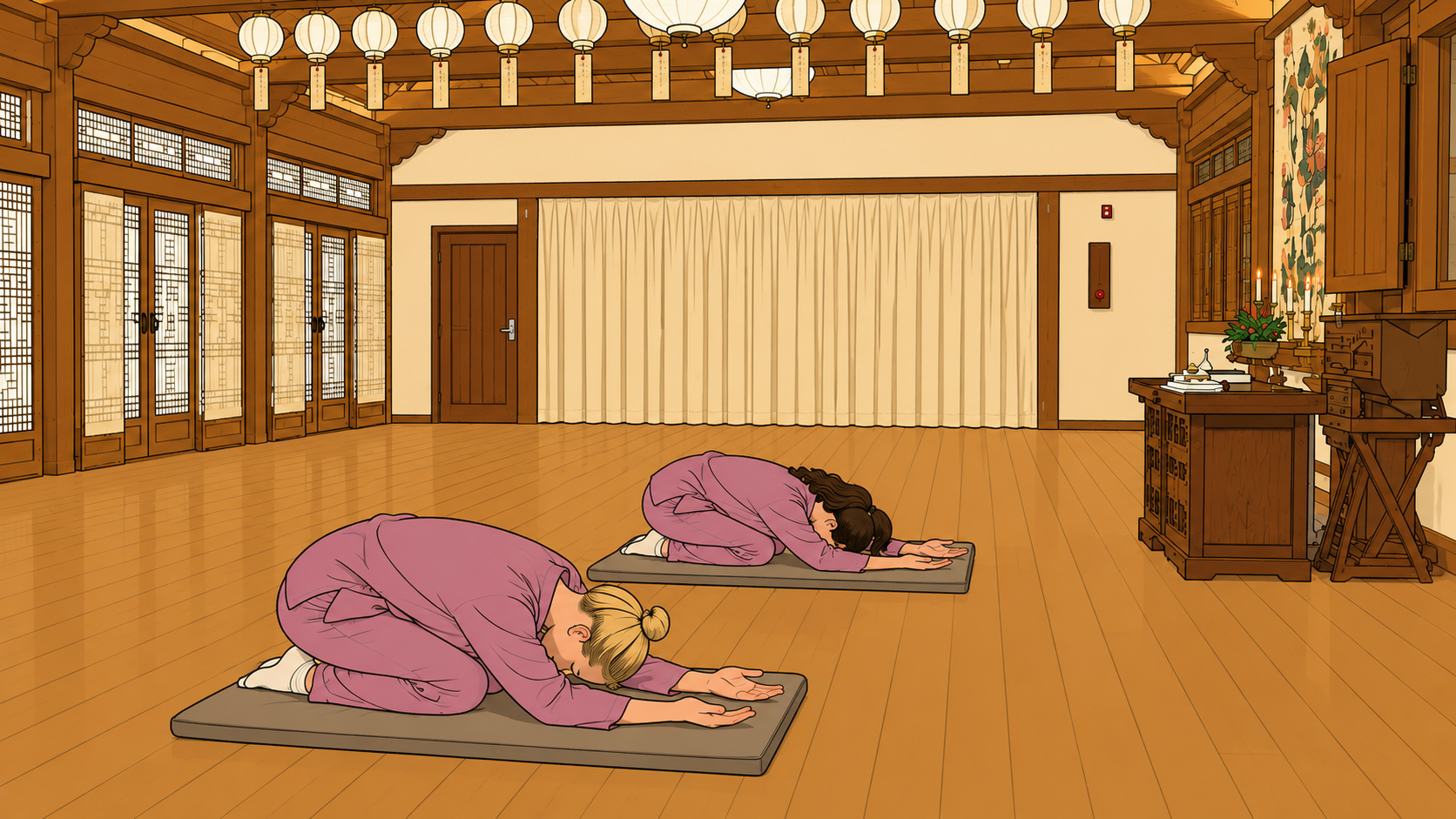
108 bows — baekpalbae (백팔배: baek-pal-bae, 108 prostrations). Each one full: knees to the floor, forehead down, palms open beside the face. Each one complete before the next begins. In Korean Buddhist practice, the number corresponds to 108 kinds of affliction — things the mind carries that it doesn’t need to. One bow, one thing set down.
Neither of us knew this yet. We counted instead.
By bow thirty, the thighs were burning. By bow sixty, counting had stopped. The body had learned the sequence before the mind had. Knees. Forehead. Hands. Then up. Then again.
By bow one hundred and eight, neither of us was thinking about much at all. Nobody needed to explain why.
That turned out to be the point.
After the bows, morning yeobul (예불: ye-bul, Buddhist morning chanting) in the main hall. The chanting was different from the evening before — faster, more urgent, as if morning required something that night didn’t. Outside the hall windows, the sky was still dark. By the time the chanting finished, the edges of Bukhansan had turned grey.
What Korean Temple Morning Does to Light
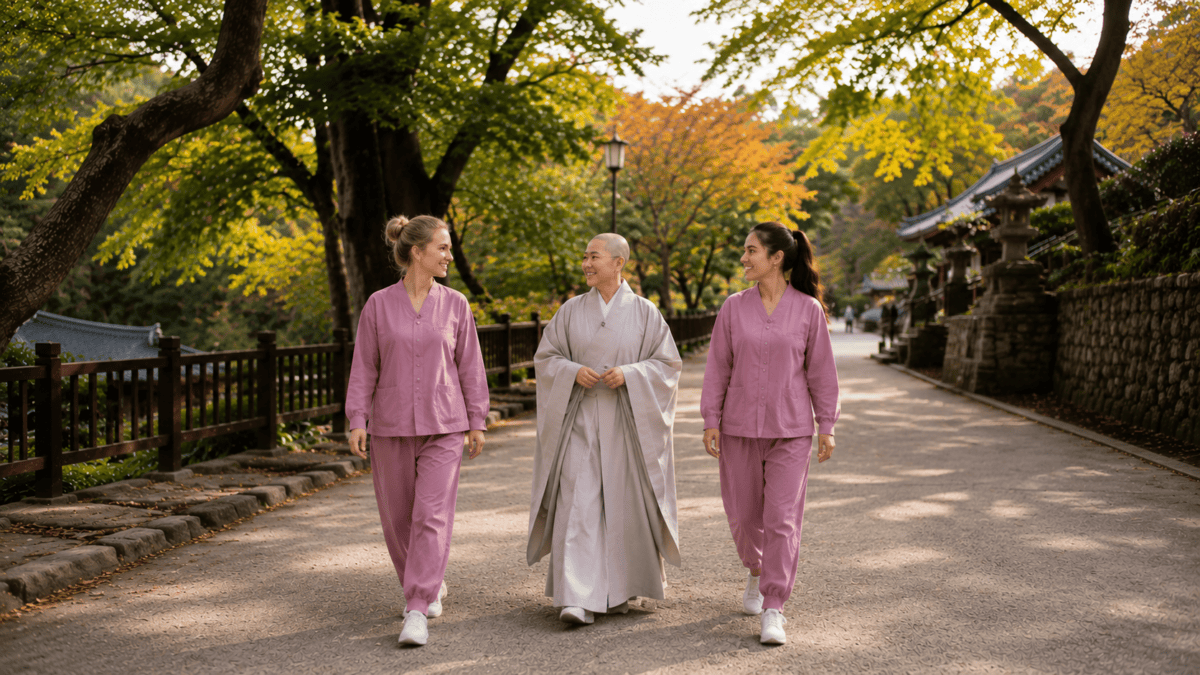
We stood in the courtyard afterward and watched.
Not the dramatic sunrise of travel photographs — no orange flooding the horizon, no golden light breaking through. Just a slow, incremental shift from dark to visible. The pine trees first. Then the stone lanterns. Then the rooftiles of the main hall, their curve catching the first flat light of morning as if they’d been positioned for exactly this.
It took about twenty minutes. We watched all of it.
In the city, morning happens while you’re doing something else. Checking a phone, making coffee, assembling yourself for whatever comes next. A temple schedule doesn’t work that way.
It moves in one direction, at one speed, and takes you with it whether you’re ready or not. By the time the courtyard was fully lit, it felt like half a day had already passed.
The mountain behind the main hall was doing what it does in early autumn — holding color at the ridgeline, releasing it slowly down the slope. Ginkgo yellow at the edges. Deeper green toward the ridge where the pines don’t turn. From the courtyard, Bukhansan was already close enough to change the quality of the light — the way a large body of water changes the air around it, without announcement.
Ten minutes up the trail behind the complex, the mountain gets deep fast. We didn’t go that morning. We didn’t need to. The mountain was already inside the frame.
One of us started to say something about the light, then stopped. Morning was already doing the talking.
Baru Gongyang — The Bowl Knows
Breakfast at six. Baru gongyang (발우공양: ba-ru gong-yang, ritual bowl meal) — four lacquered bowls, a specific order, a ritual unchanged for centuries.
The instruction: take only what you will finish.
This sounds simple. It isn’t.
We stood in front of the food and tried to calculate — not approximately, but exactly. How hungry, right now, for each thing. Rice first. Then soup. Then the side dishes, each portioned with a care that felt disproportionate until it didn’t. Seasoned spinach. A small piece of braised tofu. Kimchi.
The meal was eaten in silence. No phones, no conversation, no background noise. Just the food, the bowl, the person across the table doing the same thing. Outside the hall windows, Bukhansan was fully visible now — the morning light working its way down the slope the way it had been doing since before either of us was born. Nobody looked up. The bowls held our attention until the meal was over.
After eating, each bowl was cleaned with a piece of radish — wiped until nothing remained — then rinsed with warm water, which was drunk. Nothing wasted. Nothing left behind.
One of us had taken exactly the right amount. The bowl came clean on the first wipe.
The other had to drink the rinsing water twice.
Neither of us said anything. We didn’t need to.
Ulyeok — The Courtyard With No Finish Line
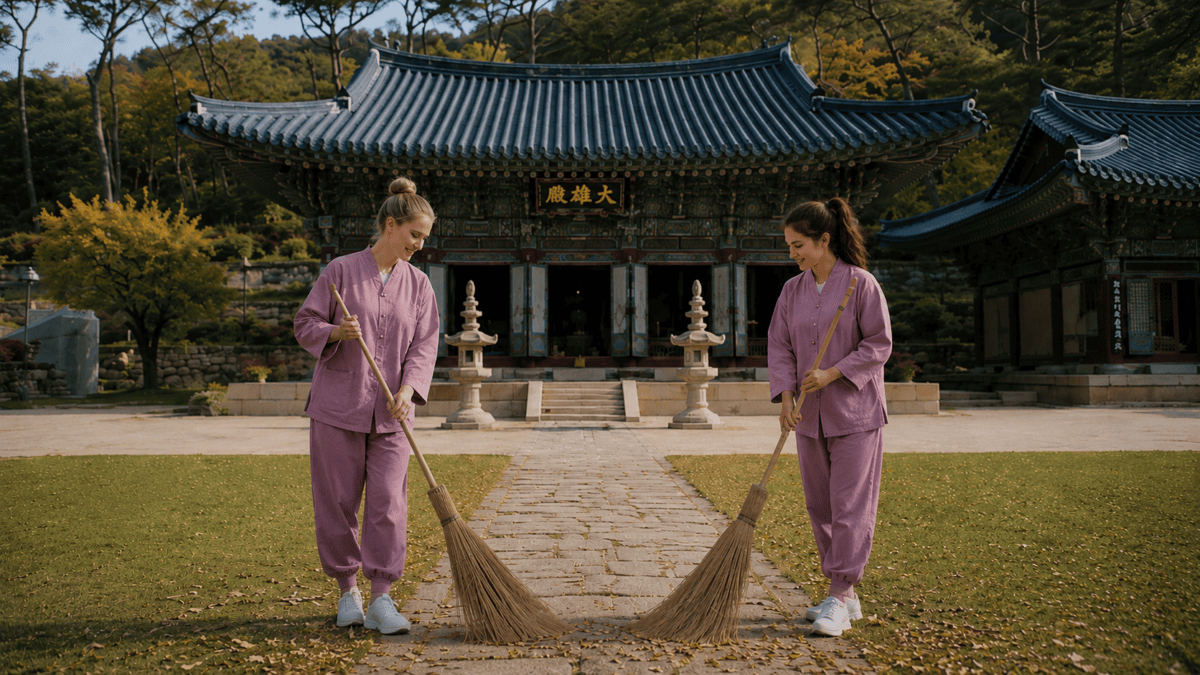
After gongyang, ulyeok (울력: ul-lyeok, communal labor) — the work period that is part of every temple day. Not optional. Not framed as anything other than what it is.
We were assigned the courtyard. Brooms made of bound twigs. A ginkgo tree at the far end that had no intention of stopping.
The first ten minutes went the way most things go — efficiently, toward an imagined version of done. The leaves moved. More came down. The tree was not participating in anyone’s timeline.
By the twentieth minute, something had shifted.
The sweeping had stopped being about the leaves.
The sound of twigs on stone. The weight of the broom in both hands. The specific texture of ginkgo leaves underfoot — slightly waxy, slightly resistant, different from every other kind of fallen leaf. Neither of us was winning. Neither of us needed to.
By the fortieth minute, the courtyard was not clean. It was cleaner. The ginkgo tree had no opinion about this.
We looked at each other at some point — not to check in, not to say anything. Just the way you look at someone when you’ve both stopped performing effort and started doing the thing itself. Behind the main hall, Bukhansan stayed exactly where it had always been. We were the only things still changing.
The Korean temple morning had given us four hours that connected end to end without a single gap. That turned out to be rarer than either of us had realized.
That turned out to be enough.
The Day That Made Sense
The bus back to the city runs from the temple gate. Ten minutes to Bulgwang, Yeonsinnae — the ordinary infrastructure of a Seoul morning, waiting exactly where it always is. From a courtyard where the Korean temple morning had just moved through four hours of unbroken logic, the bus stop felt like a different calculation entirely.
Every part of the temple schedule had connected to the next. The 4 AM bell led to the bows. The bows gave breakfast its silence. Breakfast carried naturally into the courtyard. Each part was the unit of transition into the next — nothing skipped, nothing wasted. Nothing floated loose from anything else.
What most mornings lack isn’t peace. Peace is too large a word. They lack sequence. One hour earning the next. A day built from the inside out instead of compressed by whatever is waiting ahead. The kind of morning that doesn’t ask whether you’re ready. It simply begins, and expects you to follow. By the time you’ve stood in a cold courtyard counting bows, watched the light reach the rooftiles, and cleaned a bowl until nothing remained, following no longer feels like a decision.
We got on the bus. The city assembled itself around us, district by district, the way it always does.
But the morning had already happened. Nobody was taking that back.
This post was planned and edited by a human, with AI assistance.