
Neither of us had done this before.
We’d talked about it for months — the kind of conversation that keeps circling back without landing anywhere. Then one Tuesday night, one of us actually booked it. Two spots, one weekend, no further discussion required.
By Thursday afternoon we were standing at a bus stop in Eunpyeong, bags at our feet, looking at each other with the particular expression of people who have committed to something before fully understanding what it was.
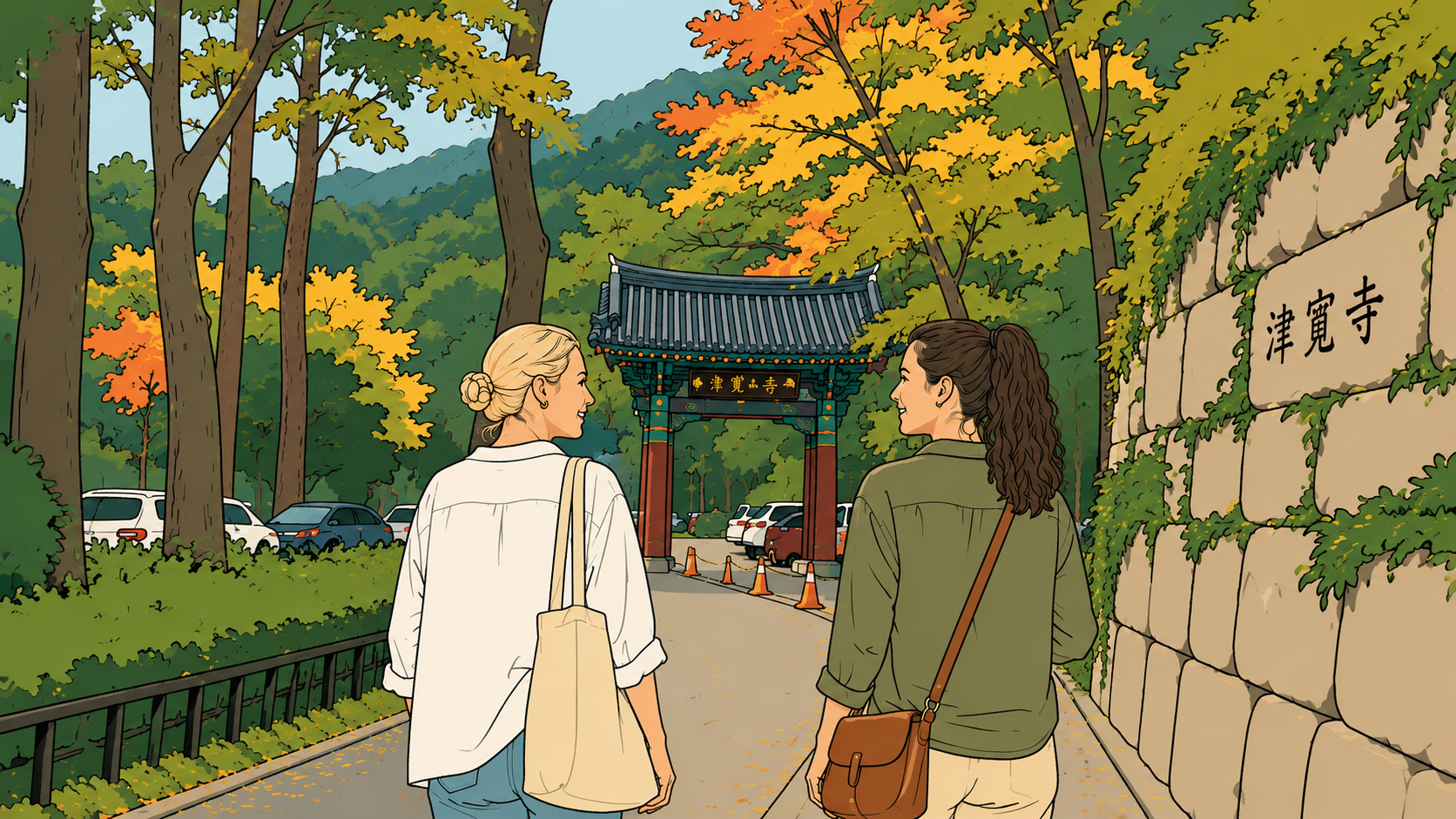
The view behind us was not what either of us had expected from a temple stay Korea itinerary. Nineteen-story apartment blocks. A Hana High School with its gates just closing. Convenience stores on both corners. The ordinary, compressed landscape of a district where roughly 100,000 people live in the kind of density that makes Seoul Seoul. Somewhere behind the buildings, the ridge of Bukhansan was just visible — and below it, the curved rooftiles of Eunpyeong Hanok Village catching the afternoon light.
The temple was fifteen minutes on foot. In the direction of the mountain.
The Gate That Ends the City
The path into the temple stay Korea experience ran alongside a stone wall. Old pine trees on one side, the last of the parking lot on the other. The city didn’t fade gradually. It ended at the Iljumun (일주문: il-ju-mun, the single-pillar gate) — the way a sentence ends at a period. One step through, and the apartment blocks were gone. Not hidden behind trees or distance. Gone. Bukhansan filled the space they’d been occupying, close enough that the ridgeline looked like something you could touch.
We stood there for a moment without saying anything. There was nothing useful to say. The gate had already made its point.
A nun at the front desk handed us each a set of robes. Purple — a soft, muted violet, the same cut for everyone. We changed in our rooms and met back in the corridor, both slightly uncertain about what to do with our hands. The robes had no shape that belonged specifically to either of us.
The rooms were small: wooden floors, a low table, a folded blanket, a window that looked directly into the mountain. We each put our own clothes in a corner. The jeans. The jacket. The particular version of ourselves we’d assembled before leaving the city that morning.
My room was called Inyong (인용: in-yong, endurance and acceptance). I looked it up later: endurance, patience, the practice of bearing what is difficult without resistance. I wasn’t sure if that was a warning or a welcome.
Outside the window, Bukhansan wasn’t doing anything in particular.
It wasn’t asking to be admired. It wasn’t performing calm. That turned out to be the first instruction.
The Afternoon: Lotus and Silence
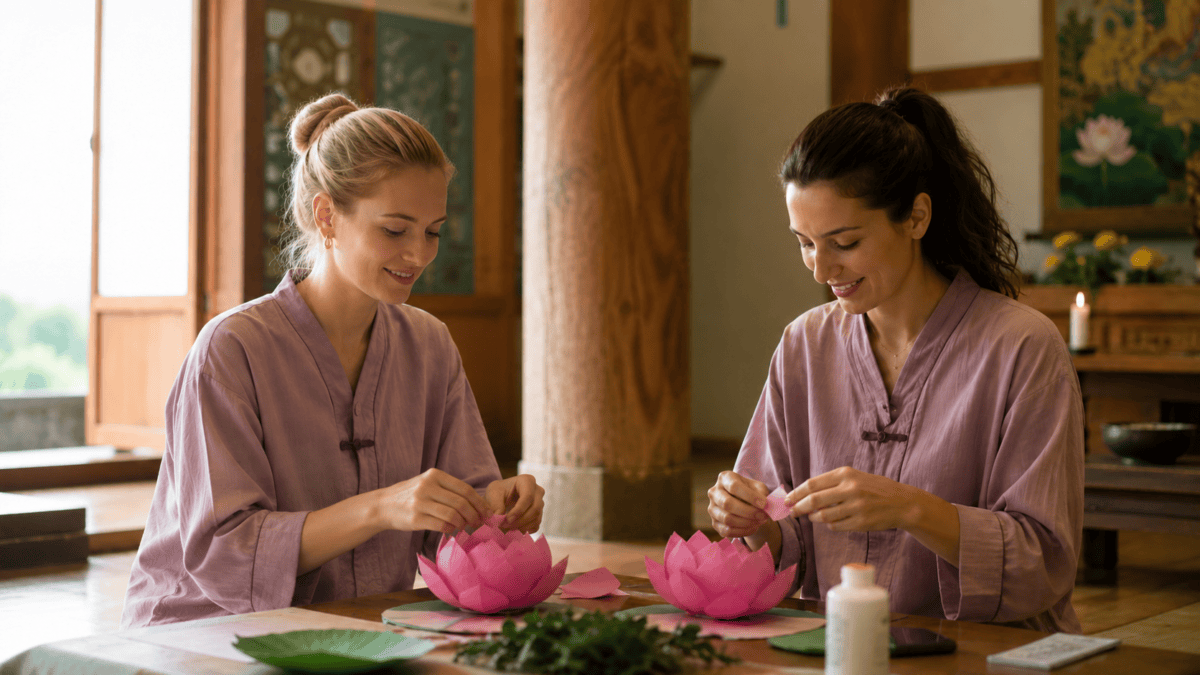
Free time after check-in. A nun set out sheets of colored hanji paper, small scissors, and glue at a low wooden table. The task: make a lotus flower. No further explanation.
We’d assumed it would take thirty minutes. Maybe forty.
Two and a half hours later, a nun came to tell us dinner was ready.
My hands ached. The lotus sitting in front of me had more than forty petals, each one folded and shaped individually, each one placed in sequence from the outside in. I couldn’t have described the process five minutes after finishing it.
What I remembered was the quality of attention it required. Not the kind that comes with a deadline — that attention is already thinking about what comes next, leaning forward before the current thing is done. This was different. Each petal asked only for itself. The one before it was finished. The one after it didn’t exist yet.
She glanced over at the other lotus on the table. Slightly more compact. More deliberate in the petal angles. Each outer petal curved at exactly the same angle. The inner ones tightened in a clean spiral.
“Yours looks like it was made by someone who kept second-guessing themselves.”
“Yours looks like it was made by a machine.”
Neither of us moved to correct this.
What surprised us wasn’t how long it took. It was that neither of us had once wondered what time it was. The lotus stayed where we left it between us. Imperfect. Deliberate. Finished. That seemed to be enough. Something shifts before you can name it — and the lotus was the first place it shifted.
Dinner: The Food That Didn’t Need to Prove Anything
Dinner was at five. We followed the sound of movement down to the dining hall, collected trays, and stood in front of the food.
The spread was simpler than either of us expected: rice, doenjang soup, seasoned bean sprouts, braised tofu, kimchi, hobakjeon — pumpkin pancake, pan-fried until the edges crisped. Jingwansa is known for its temple cuisine. The head nun, Gyeho Sunim, is considered one of the foremost practitioners of Korean Buddhist cooking in the country. None of this was mentioned at dinner. The food simply appeared.
It was the best meal either of us had eaten since arriving in Korea — and not what either of us had expected from a temple stay Korea weekend. Not because it was complicated. Because it wasn’t. Every ingredient tasted like itself — the bean sprouts clean and slightly nutty, the soup deep without being heavy, the pumpkin pancake sweet in a way that didn’t announce itself. We’d been eating around flavors for weeks, dishes designed to impress. This food had nothing to prove.
We went back for more bean sprouts. Then sat at the long wooden table longer than necessary, neither of us ready to leave.
After dinner, a nun led us slowly through the temple grounds. The city was gone in the way things go when you stop looking for them. Bukhansan rose behind every roofline, unhurried. At one point the path opened onto a terrace and Seoul appeared below — not the version we’d come from, the dense residential grid of Eunpyeong — but a wider version, the lit outline of a city still running, visible from inside a thousand-year-old silence.
We stood there for a while without taking photographs.
Evening: Thirty-Three
The evening bell at Jingwansa strikes 33 times. The number comes from Buddhist tradition. Nobody explained it that evening. We simply counted. Thirty-three, marking a line between what the day was and what the night would become.
We stood in the courtyard and counted without meaning to. The sound moved through the pine trees along the gate path. Bukhansan held the last amber of the afternoon at its ridgeline. Somewhere below the stone wall, the city continued. From the courtyard, it was inaudible.
The city was fifteen minutes away by foot. It felt like an accurate distance.
The evening ritual followed — the main hall, the chanting that rose and fell in patterns we couldn’t follow but didn’t need to. The sound of the large bell when it rang didn’t stop at the walls. It moved through them, the way sound moves through something that has stopped trying to contain things.
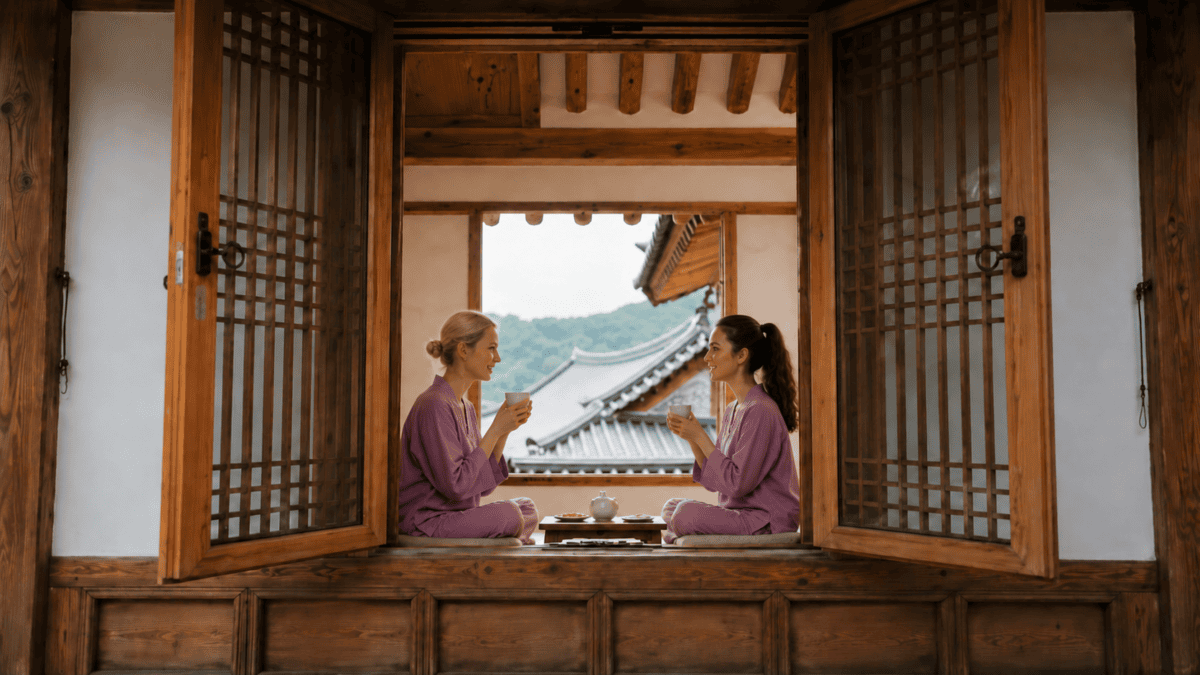
After the ritual: tea. A small room near the main hall, acorn tea and chrysanthemum set out without announcement. We each poured a cup and sat with it for a while. Nobody was talking. Nobody was checking anything. The tea cooled slowly. We let it.
At nine, the lights went out — the last thing a temple stay Korea takes before it gives you the dark and the mountain and nothing else.
In our rooms, we lay on the floor mats and looked at our respective ceilings. No screen, no scroll. Bukhansan outside the window was completely dark. The city was still there — we could feel it the way you feel a presence in a room before you’ve seen it. But it had stopped being the main fact.
Something had already started. Neither of us had a name for it yet.
Content in this post was created with AI assistance.