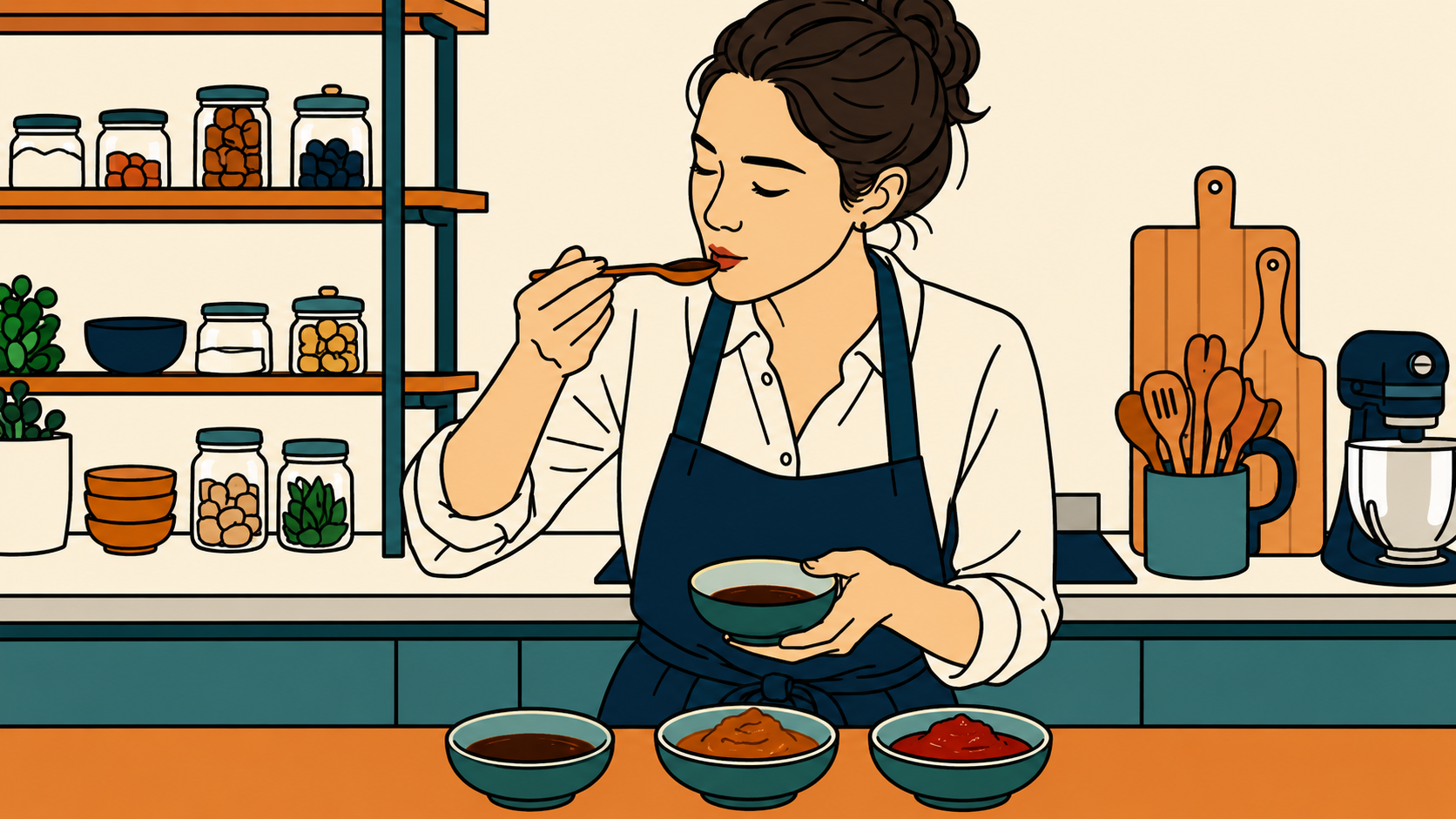
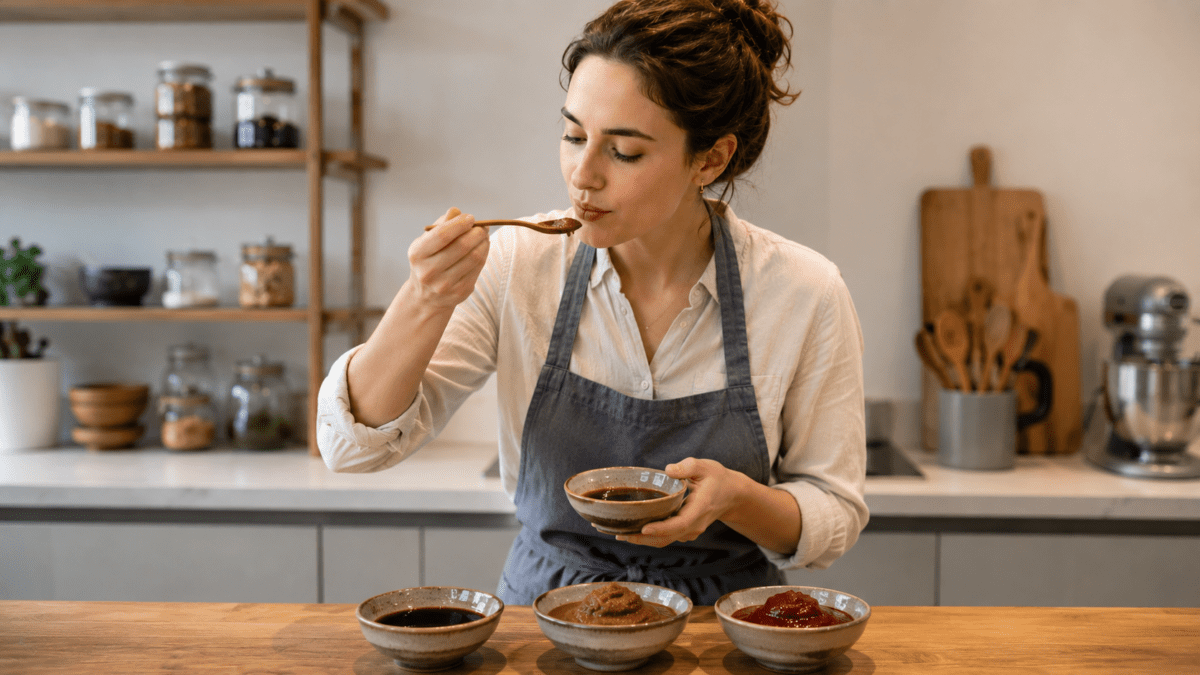
One block of meju. Three completely different sauces — all from the same Korean jang fermentation process.
If you told someone that ganjang, doenjang, and gochujang all come from the same source — the same soybeans, the same fermentation — most people wouldn’t believe you.
Ganjang is quiet and thin. Doenjang is thick and heavy. Gochujang is loud and red. They don’t look related. They don’t taste related. Put them in a lineup and you’d never guess they were family.
But they are. And how they became so different is one of the more interesting things about Korean jang fermentation.
From One Block, Three Lives
When meju blocks finish drying — weeks of mold, air, and slow transformation — they go into large earthenware jars with salt water. The lid goes on. The waiting begins.
During those months, something happens inside the jar that no one can see. The brine pulls flavor from the soybean block. Proteins break down further. The liquid deepens, darkens, becomes something it wasn’t when it went in.
When the time comes to open the jar, the contents are separated. The liquid drawn off becomes ganjang (간장: gan-jang, Korean soy sauce). The solid left behind becomes doenjang (된장: doen-jang, fermented soybean paste). Same jar. Same origin. Two completely different things.
Gochujang (고추장: go-chu-jang) takes a separate path — meju powder combined with red pepper, glutinous rice, and fermented malt, then aged in its own jar under the sun. It shares the meju foundation but develops its own character through different conditions, different ingredients, different time.
Three personalities. One source. What separates them is not the beginning — it’s everything that happens after.
Ganjang, Doenjang, Gochujang — Three Personalities
Let’s start with the one nobody talks about.
Ganjang is the liquid that rises when meju sits in brine. After months, the brine pulls flavor from the soybean block, turns dark, and becomes something that didn’t exist before.
It’s not Japanese soy sauce. Different process, different depth, different attitude. Japanese soy sauce is brewed with roasted wheat and tends toward a rounder, sweeter profile. Korean ganjang is rawer. Sharper. More direct. It tastes like fermentation didn’t try to hide itself.
But here’s the thing about ganjang: you almost never taste it alone. This is one of the quieter truths of Korean jang fermentation — the most essential layer is often the one nobody points to.
It goes into soups. Into marinades. Into namul (나물: na-mul, seasoned vegetable side dishes) — those small dishes that quietly line the table before the main course arrives. Ganjang doesn’t sit in a dipping bowl waiting for attention. It’s already inside the food by the time you pick up your chopsticks.
Think of it as the bassist in a band. Nobody comes to the show for the bass player. But take the bass out and the whole song sounds thin. That’s ganjang. Every Korean meal has it. Nobody points to it.
The oldest ganjang in some Korean families is decades old. Not thrown away — added to. Year after year, new batches blended into the old, the way a sourdough starter accumulates years of a kitchen’s particular character. The flavor compounds over generations. Once the continuity breaks, it’s gone. You can make new ganjang. You cannot make old ganjang.
After the liquid is drawn off, what’s left behind is a thick, dark, earthy paste. That’s doenjang.
If ganjang is the one you don’t notice, doenjang is the one you can’t forget. It hits the nose before it hits the tongue. Earthy, funky, almost confrontational — and then, dissolved into a pot of stew, somehow the most grounding thing you’ve tasted all week.
There’s a contradiction in doenjang that takes some getting used to. The smell is strong. Uncompromising. The first encounter, for someone who didn’t grow up with it, can stop them in the doorway. But the dishes it makes move in the opposite direction. Warm. Heavy with something that feels less like flavor and more like arrival.
Doenjang-jjigae (된장찌개: doen-jang-jji-gae) — the soybean paste stew that appears on nearly every Korean table — is probably the most eaten dish in Korea that nobody outside Korea knows by name. It’s not photogenic. It’s brown. It bubbles in a stone pot and looks like something a grandmother would make on a Tuesday, not something designed for a menu.
But ask any Korean living abroad what they miss, and this comes up before the fried chicken, before the barbecue, before anything with presentation. Kimchi too — but doenjang-jjigae is a different kind of missing. A bowl of doenjang-jjigae with rice, in a kitchen that smells right. That specific thing. Not the cuisine in general — that one bowl, in that one kind of kitchen.
Doenjang-jjigae is not exciting food. It’s necessary food. And there’s a difference.
The paste itself gets better with age. Fresh doenjang has an edge — sharp, slightly unfinished. A year later, it mellows. Two years, three years — the funk softens, the complexity deepens, and what remains tastes less like an ingredient and more like a decision that was made correctly, a long time ago, and left alone to become what it was going to become.
Then there’s the famous one.
Gochujang is the sauce the world met first — mostly because it’s red, it photographs well, and heat is a language everyone speaks immediately. It’s the reason Korean fried chicken has that sticky glaze. The reason tteokbokki (떡볶이: tteok-bok-ki) became a street food icon from Seoul to São Paulo. The reason “gochujang mayo” now exists in Brooklyn delis and London supermarkets without explanation.
But here’s what most people outside Korea don’t realize: gochujang isn’t just chili paste.
It’s fermented chili paste. Made with meju powder, glutinous rice, malt, and sun-dried chili flakes — then aged in earthenware under the sun, sometimes for a year or more. The heat is there, yes. But underneath the heat is sweetness from the rice, savory depth from the fermentation, and a pull that plain chili paste simply cannot produce.
Sriracha is one note, played loud. Gochujang is a chord that keeps opening.
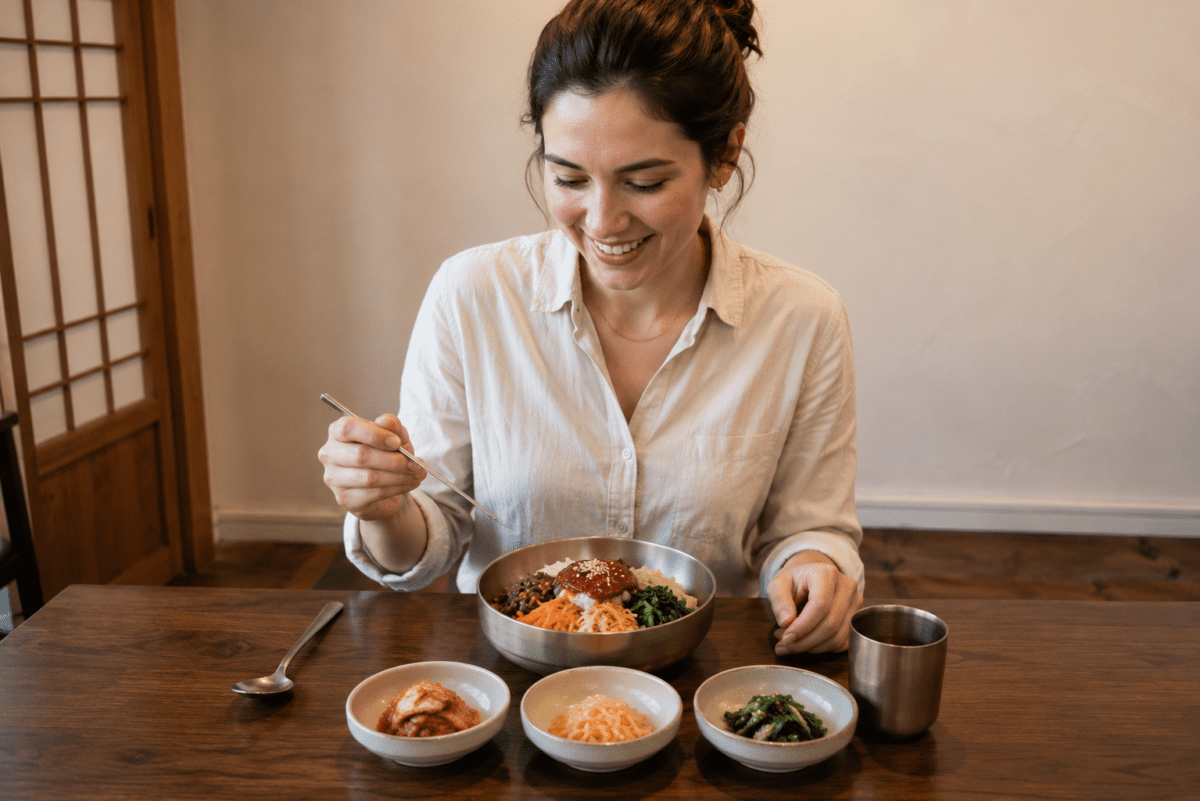
The heat arrives first. Then the sweetness. Then the fermented depth that sits at the back of the throat and doesn’t leave. Each layer arrives at a different speed, and by the time one fades, the next one is already there. This is why gochujang works across such different dishes — stews, marinades, bibimbap (비빔밥: bi-bim-bap), grilled meat. It has range. It has patience built into it — the same patience that built the meju it came from.
The world found gochujang through its heat. The heat was always the least interesting part.
What Makes Korean Flavor Different
Why does Korean food taste like nothing else?
Now you can see the answer.
It’s not one sauce. It’s three — each built from the same source but pulling in a completely different direction, the way Korean jang fermentation was always designed to branch rather than converge. Ganjang holds the structure. Doenjang carries the weight. Gochujang brings the energy. In most Korean meals, at least two of them are present. Often all three, working at different depths, in different dishes on the same table.
And the flavor they share — that deep, lingering, savory pull that stays after you swallow — is gamchil-mat (감칠맛: gam-chil-mat, layered savory depth).
Most people translate gamchil-mat as “umami.” It’s the easy comparison — both describe savory depth. But they’re not the same thing.
Umami was identified as a single taste receptor response, isolated from kombu seaweed in a Japanese lab in 1908. It’s a scientific category. Clean, specific, measurable. One signal, one response.
Gamchil-mat is not a lab result. It’s an accumulation.
It includes what Western science calls umami, but it also carries the funk of fermentation, the sweetness of slow protein breakdown, the particular complexity that only emerges from months or years of aging in clay. Umami is a note. Gamchil-mat is what the note becomes after it’s been played in the same room for a generation.
You can produce umami with MSG in seconds. Gamchil-mat requires time — the specific kind of time that happens when you stop trying to control the outcome.
Why Three, Not One
There’s one more thing worth noticing.
Korean food didn’t settle on one fermented sauce and call it done. It took the same starting point and pushed it in three directions — salty, earthy, hot. Structure, weight, energy. Each one irreplaceable. Each one incomplete without the others.
That unfamiliar pull — the one that stops people mid-bite and makes them ask what is that — is gamchil-mat. Not one of the three sauces alone. All three, working together in the same meal, building something none of them could produce on their own.
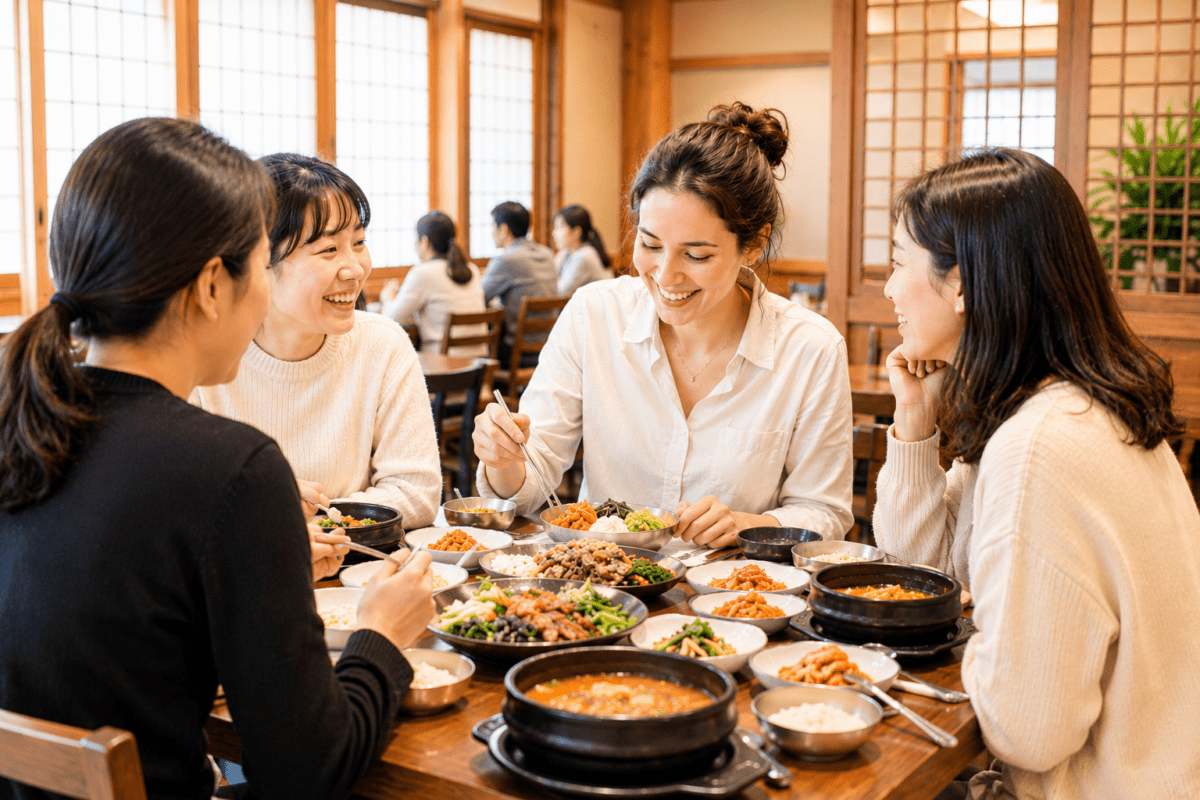
Walk into a Korean kitchen and the three jars are almost always there together. Not because the recipe calls for all of them at once, but because a Korean cook reaches for whichever one the dish needs in that moment — and knows, without thinking about it, which one that is. Ganjang when the broth needs depth but not color. Doenjang when the dish needs body. Gochujang when it needs to wake up.
That instinct — to seek balance through difference rather than through sameness, to hold opposing forces in the same meal without resolving the tension between them — shows up throughout Korean thinking. Not one answer. Three forces, each distinct, each necessary, held together not by blending but by placement.
A pot of doenjang-jjigae next to ganjang-seasoned namul with gochujang on the rice. Three sauces. Three speeds. Three different relationships with time. One table.
That’s not a recipe. That’s a way of eating that trusts opposing forces to create something none of them could make alone — the same logic that runs underneath Korean jang fermentation from the very first jar.
And it starts with one block of meju that had the patience to become three different things.
Some content in this post was created with AI assistance.