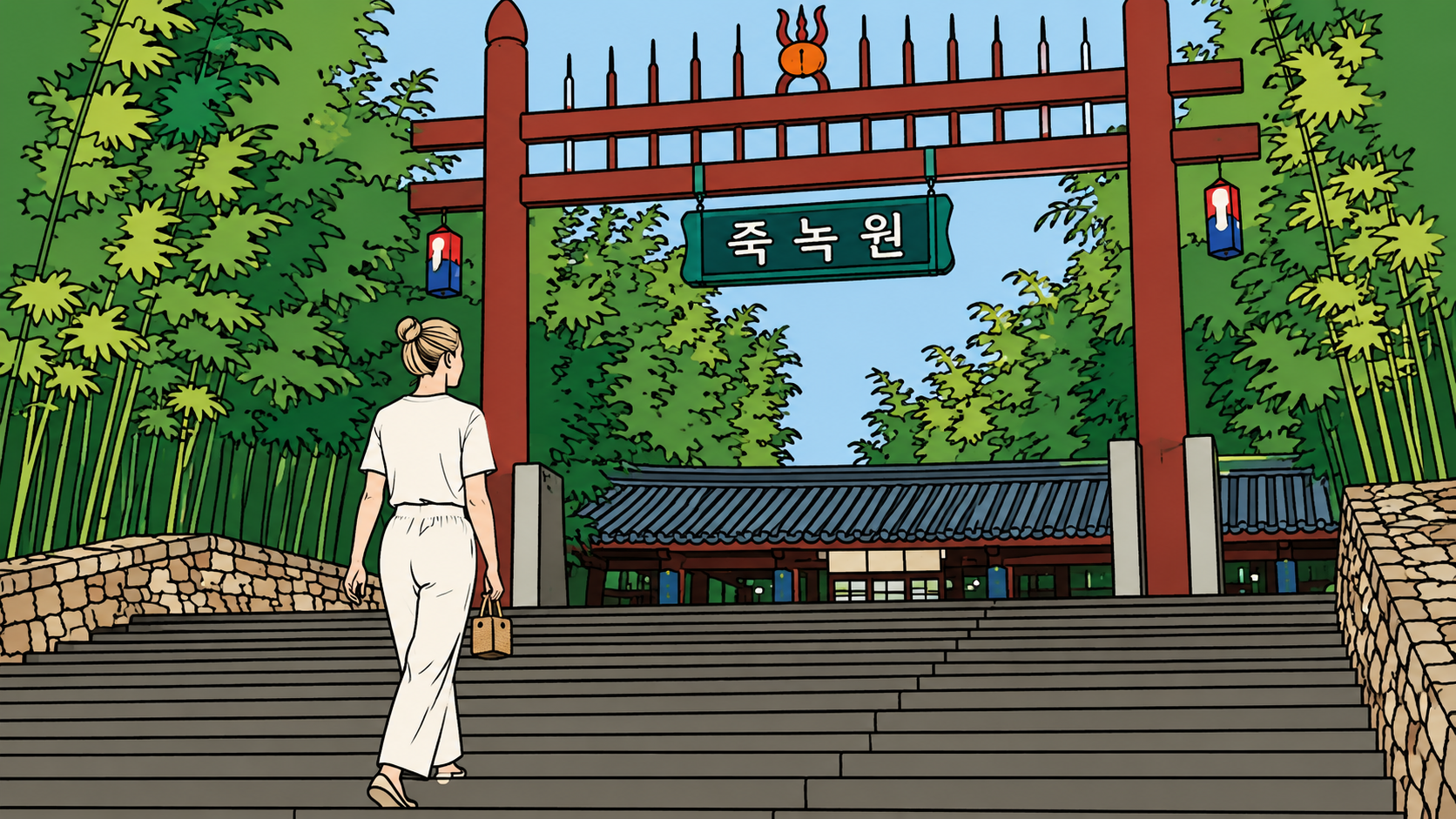
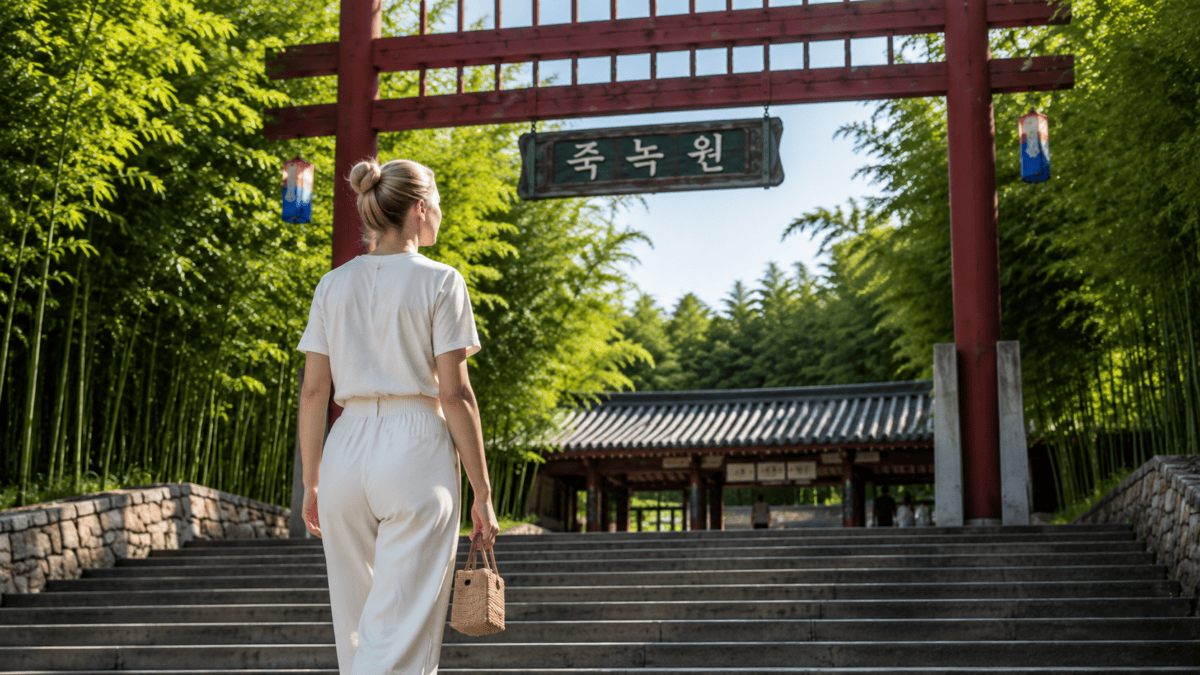
By eight in the morning the town of Damyang is already warm. The asphalt holds yesterday’s heat, the cicadas have started, and the light comes down flat and white off the low buildings near the entrance. You buy a ticket, walk toward a gap in a green wall, and step through it. And the summer you were standing in a moment ago is simply gone.
This is the first thing anyone remembers about the Juknokwon bamboo forest: not a view, but a change in the air, felt on the skin before the eyes catch up.
The Temperature Drops at the Gate
It happens within a few steps. Behind you the open sky and the heat off the pavement; ahead, a corridor of green that swallows both. The temperature falls — noticeably, several degrees, the way it does when you open a cellar door in August. The sweat on the back of your neck cools. The air turns from something you push through into something that moves around you, damp and green-smelling, faintly sweet.
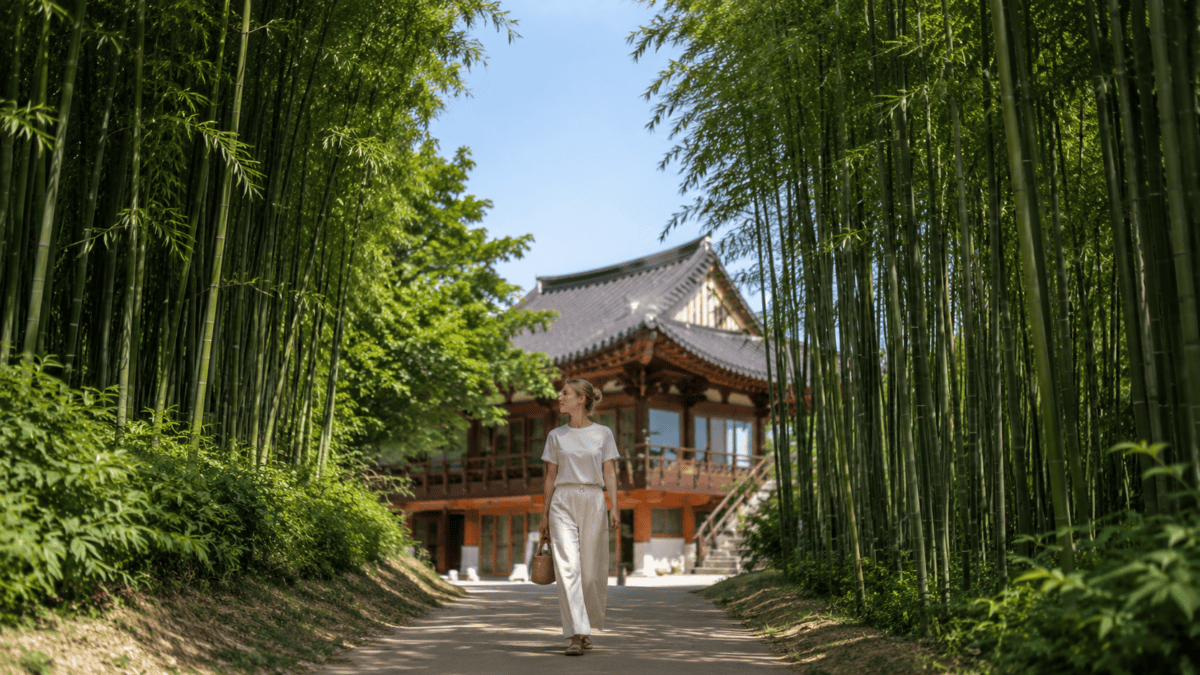
The stalks are close on either side, thick as a wrist, rising straight up past where you can comfortably look. They don’t taper for a long time. They just go up, pale green shading to a deeper green higher up, ringed at intervals where the segments meet. Between them the ground is dim and soft with fallen leaves, and the path — pale sand, packed hard — winds ahead and out of sight.
You slow down without deciding to. Partly it’s the cool. Partly it’s that the forest closes behind you as you go, so that after thirty steps the entrance is gone and the town with it, and there’s no reason left to hurry toward anything. The path forks and forks again, each branch the same corridor of green, and it stops mattering which one you take. A few people pass in the other direction, flushed from the heat they’re walking back into. You are walking the other way, into the cool, and the difference is written on both your faces.
Green Light, Filtered
Look up and the light is doing something you rarely see it do.
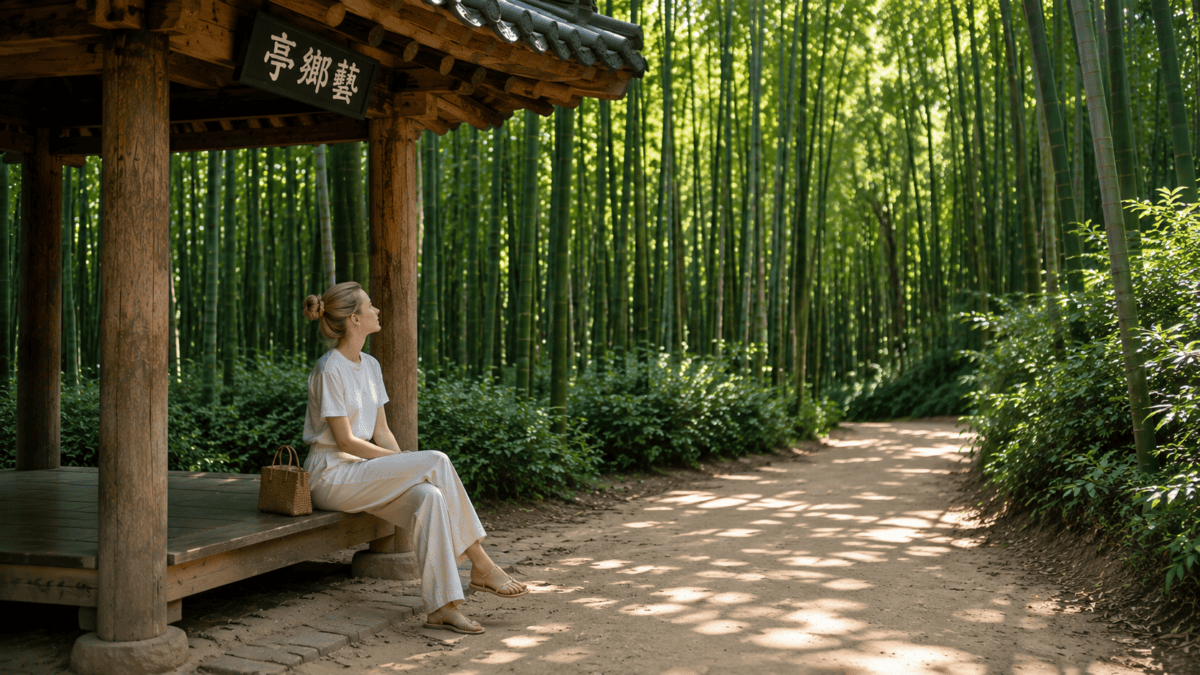
The canopy is high and dense, and the sun has to come through layers of leaves to reach you, so by the time it lands it isn’t white anymore. It’s green — a shifting, watery green that pools on the path and slides across your arms when you move. Your own skin takes the color. Hold up a hand and it’s faintly green too, the way everything is down here, as if the forest has dipped the whole scene in the same dye and left nothing out. Nothing is lit directly. Everything is lit through.
The stalks glow where the light passes behind them, while the shadows deepen into richer shades of green instead of grey, making the whole forest feel like a single color seen at different depths. When the wind stirs high in the canopy — often, though you never quite feel it below — the light breaks apart and gathers again. Bright patches drift across the path, shadows ripple over your hands, and for a moment the forest brightens before settling back into green. You could stand still and watch only this: the light breathing through the bamboo.
Down at eye level the green is closer, wetter, more solid. New shoots push up along the edges of the path, some already chest-high, their sheaths still wrapped tight and pale at the base. The young shoots seem almost impatient, pushing up through the soft earth as if yesterday’s forest had already become today’s — the same green push that drives everything upward, here made literal. Bamboo can grow a startling distance in a single summer day—fast enough that people claim they can hear it. You probably won’t. But standing beneath stalks that all seem caught mid-reach toward the light, you’ll understand why people believe the story.
The Sound the Juknokwon Bamboo Forest Makes
Stop walking and the forest starts to speak.
It isn’t birdsong, though there’s some of that, thin and far above. The main sound is the bamboo itself. When the wind moves through the canopy, the stalks knock together with a hollow, woody clack, irregular as wooden chimes struck at random. Beneath it runs the softer rush of thousands of leaves brushing against one another. The sound swells with each passing gust, then fades until only a few leaves drift quietly through the branches, ticking their way to the forest floor.
It’s a sound you register in the body before you name it. The clack of the stalks has a depth to it, a resonance, because each hollow segment is a little drum. Stand near a thick clump when the wind is up and you feel the sound as much as hear it — a soft pressure, a wooden murmur that seems to come from all around and slightly below. Then the gust dies and the whole thing quiets, and the silence that follows is not empty. It’s full of the small settling sounds of a green place: a leaf landing, water somewhere, the creak of a stalk leaning on its neighbor.
People come into this part of the forest and lower their voices without being asked. There’s nothing telling them to. The sound of the place simply makes a raised voice feel wrong, the way it would in a large empty room, and so the loudest thing, most of the time, is the bamboo, doing what it does whether or not anyone is there to hear it.
Where the Path Slows You Down
By the time the path bends toward the far side, something has happened to your sense of time.
You came in from a morning that was already ticking — the heat, the day’s plans, the phone warm in your pocket. Somewhere along the sand path that fell away. Not dramatically. The Juknokwon bamboo forest doesn’t ask you to slow down; it just removes, one by one, the reasons you had to speed up. No signs, no view to reach, no end of the trail worth rushing toward — only more green, more cool, more of the same woody sound, until hurry has nothing to attach to.
You just find, at some point, that you’ve been standing still for a while with no memory of deciding to stop, watching the green light move on the ground, listening to the stalks knock and hush, cool for the first time since you woke — the kind of pause that, somewhere else, would feel like a pause you’d feel you had to earn, and here just happens.
The path climbs a little and opens into a small clearing where the canopy thins and the heat reaches along the edges again, a reminder of the summer still waiting outside. A bench sits in the half-shade. From here you can see back down into the forest, the stalks dense and vertical and shifting, the light coming through them green. Someone is walking up slowly through it, unhurried, the way everyone here is unhurried, their outline dissolving and reforming between the poles of the bamboo.
You could turn back now, out through the gate, into the white heat and the cicadas, and the whole thing would close behind you like water. Or you could sit on the bench a while. The last of the sweat dries on your skin as the light shifts quietly across the path below. Somewhere above, a single leaf lets go and drifts through the green, taking its time. The bamboo isn’t going anywhere. The forest has stood here through every summer before this one, filtering the same light through the same canopy, and it will still be here after you’ve gone, doing exactly what it has always done. Which is, perhaps, the best reason to stay.
This post was planned and edited by a human, with AI assistance.