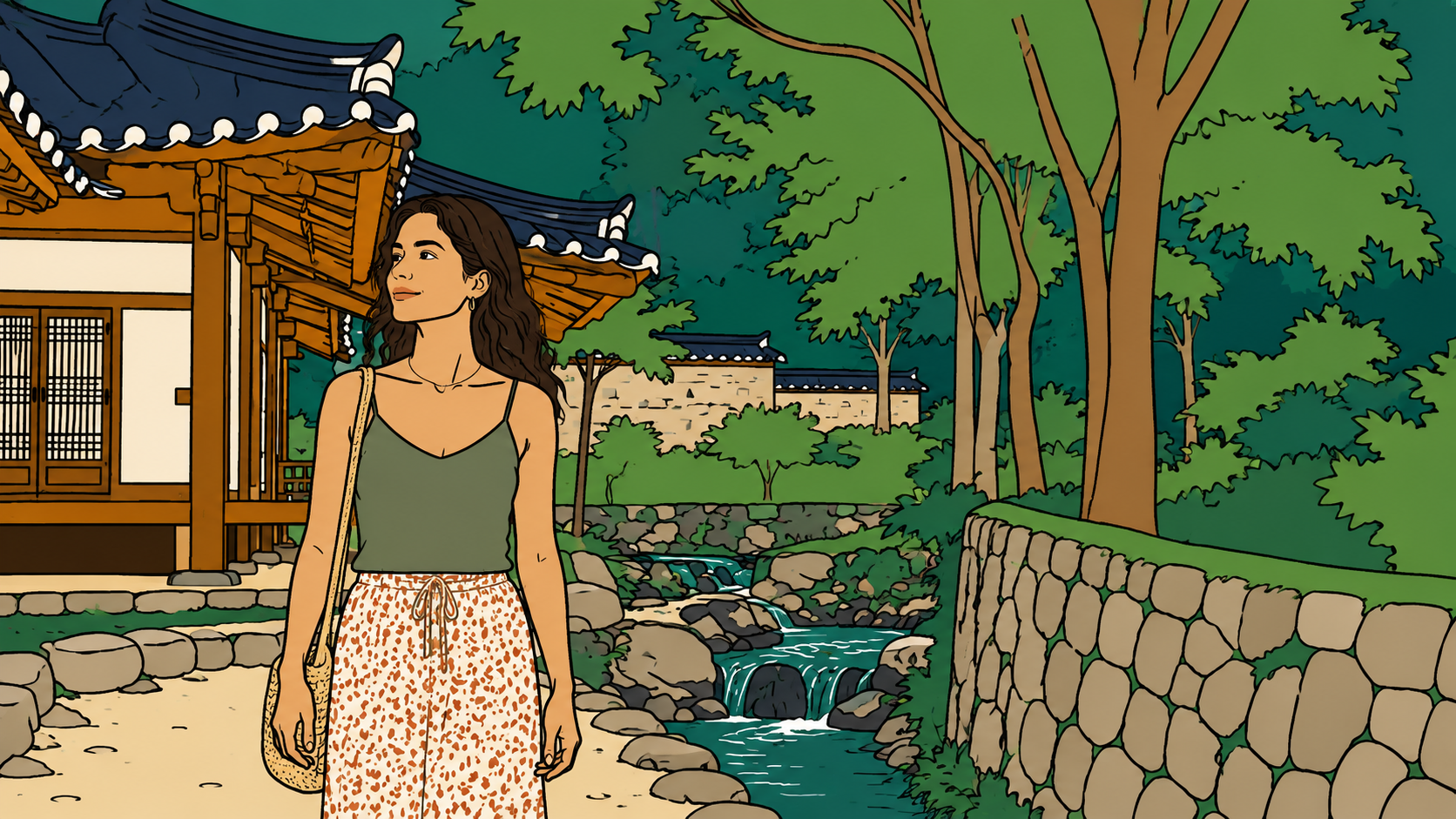
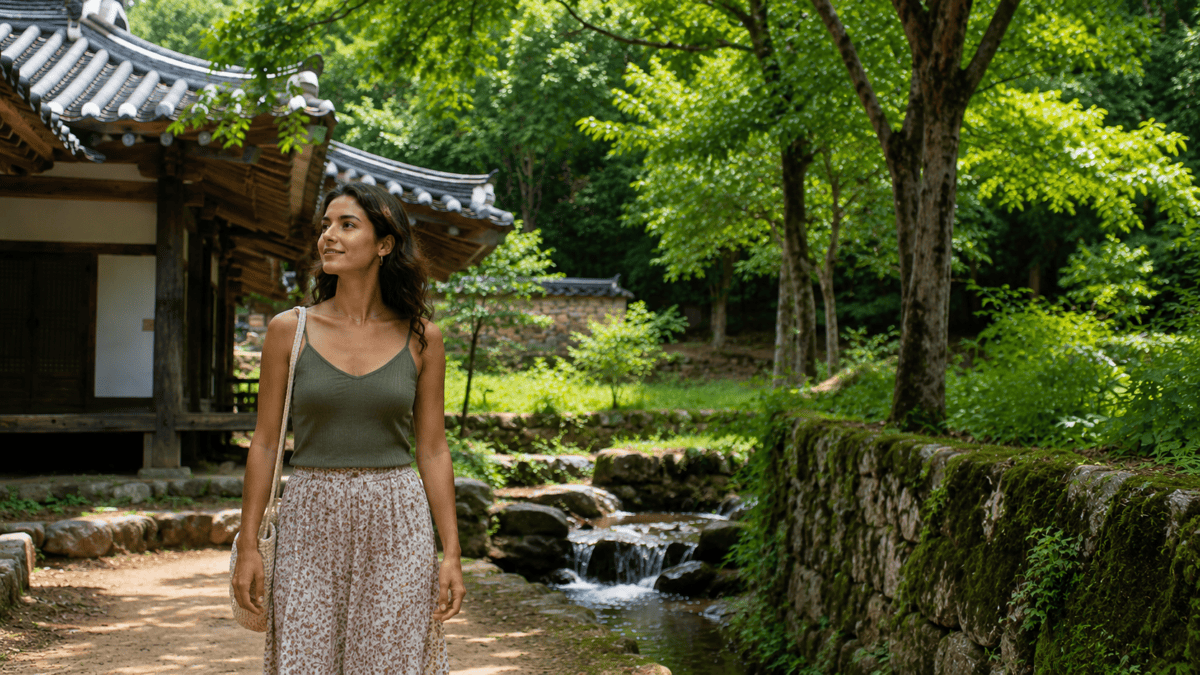
The last place is the quietest. You leave the road, cross a small bridge, and follow a path in under old trees to a garden a scholar laid out here four and a half centuries ago, built around a stream that was already running down the hillside before he came. He didn’t move the water. He built the garden to it — pavilions where you’d want to sit and listen, a channel to carry the sound where he wanted it heard.
This is the Soswaewon garden, and on a hot afternoon it does something the other places don’t. It arranges the summer into something you sit inside and listen to.
A Garden Built Around Water
It’s small, and that’s the first surprise. After the long tunnels of bamboo and tree, the wide shade of the old forest, the Soswaewon garden is almost modest — a hillside slope, a few wooden pavilions with tiled roofs, a low crumbling wall, and the stream running straight through the middle of all of it.
The water comes down from above, off the hill, and instead of being pushed aside it’s been let in. It runs under the wall through a small opening, drops over a little stone lip into a pool, slides across flat rocks, and goes on down through the garden and out the bottom. The pavilions sit right beside it, open on all sides, their wooden floors raised just above the ground. You take off your shoes and step up onto one and sit, and the stream is right there below you, a few feet away, doing what it has done continuously for four hundred years.
Nothing here shouts. The wood is dark and worn, the paint long gone, the roofs mossed. Plants have grown up wherever they liked — ferns in the wall, a crape myrtle in bloom, bamboo along the top edge. It reads less like a made thing than like a place that simply happened, which is the still center the whole garden is arranged around: a made place and a living one settled so long into each other that you can no longer find the seam.
You sit on the warm wood in the shade and the whole small world of it is laid out in front of you, and it asks nothing except that you stay a while. The wood is warm under your legs where the sun has reached it, cool where it hasn’t, and the boundary between the two moves slowly across the floor as the afternoon turns.
The Sound of Water, on Purpose
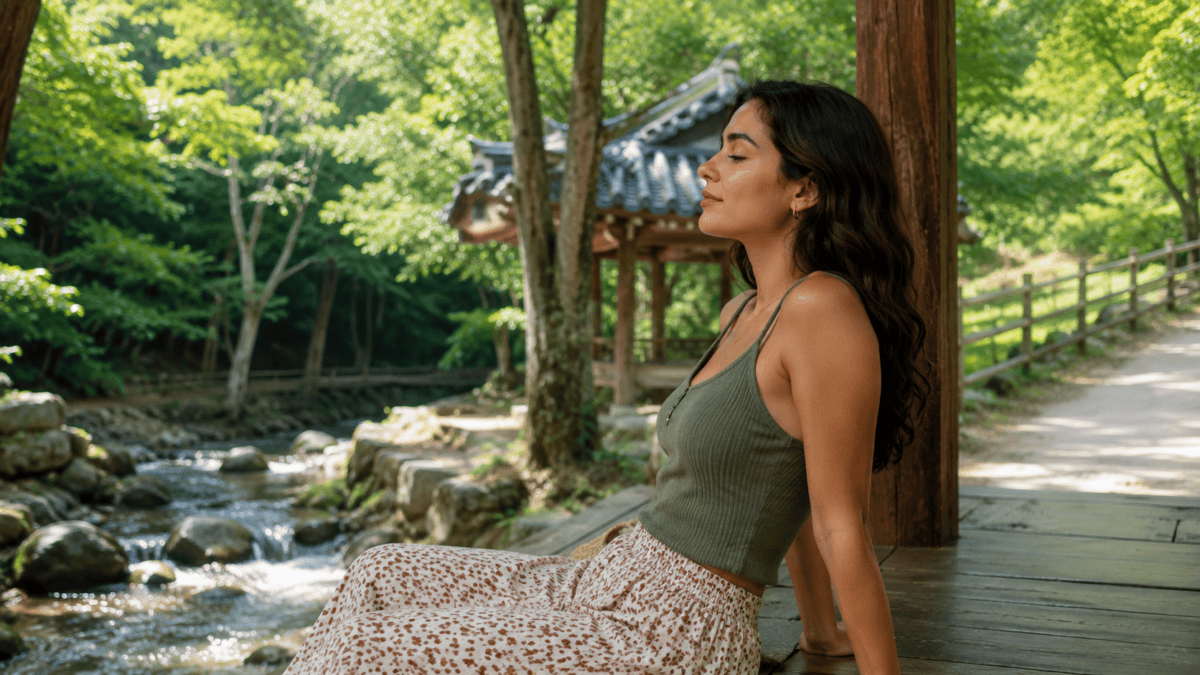
Sit still, and you understand what the garden was built for.
It was built to be heard. From the pavilion the stream is not a view so much as a sound — the drop over the stone lip makes a small steady pour, and below it the water breaks and chatters over the flat rocks, and the whole thing runs on without pause, a soft continuous falling-water sound that fills the space under the roof and settles you almost at once. The scholar placed the pavilion exactly here, beside exactly this drop, so that this is the sound you’d hear while you sat.
Four hundred years later it still works. You sit where he meant you to sit and hear what he meant you to hear.
And it isn’t only water. The bamboo along the top of the garden moves in the afternoon wind, and its dry rustle comes down over the water sound, the two of them layering — the low constant pour of the stream underneath, the higher shifting hush of the leaves above, rising and falling as the wind comes and goes. A bird. The knock of a wooden beam settling in the heat. Then just the water again, steady, going on.
You could close your eyes here and lose nothing that matters. The Soswaewon garden works as well on the ears as on the eyes, maybe better, and after a while you notice your breathing has slowed to match the water, and the heat of the afternoon, still pressing beyond the shade, has stopped being something you mind.
A Bowl of Rice Steamed in Bamboo
By the time you leave, you’re hungry, and Damyang has been waiting for this too.
The thing to eat here is daetongbap — rice steamed inside a cut section of bamboo. It comes to the table still in the tube, a pale green cylinder with the lid lifted, and the first thing is the smell: the warm nutty steam of the rice, and threaded all through it the faint clean grassy scent of the bamboo it cooked in, released by the heat. The rice inside is studded with beans, chestnut, jujube, a scatter of other grains, packed dense from the steaming, and it has taken the smell of the wood into itself.
You scrape it out into your bowl and it comes in a soft warm mass, sticky, still holding the round shape of the tube. It tastes the way it smells — mild, sweet, the chestnut and jujube soft in it, and under everything that faint green bamboo note, less a flavor than the memory of one, the same green you’ve been walking through all day now somehow inside the food. Around it come the small dishes, a dozen of them, pickled and salted and fresh, but the tube is the center of it, warm in your hands.
It’s a slow thing to eat, the way everything here has been slow — a meal you don’t hurry, scraped from its tube a spoonful at a time while the steam dies off it. The bamboo that shaded you in the morning is the bowl your lunch arrives in by afternoon. You eat the smell of it before the taste, and the taste is quieter than the smell, and both fade slowly the way the steam does. Nothing in Damyang lets you forget for long what the town is made of.
What the Summer Leaves Behind
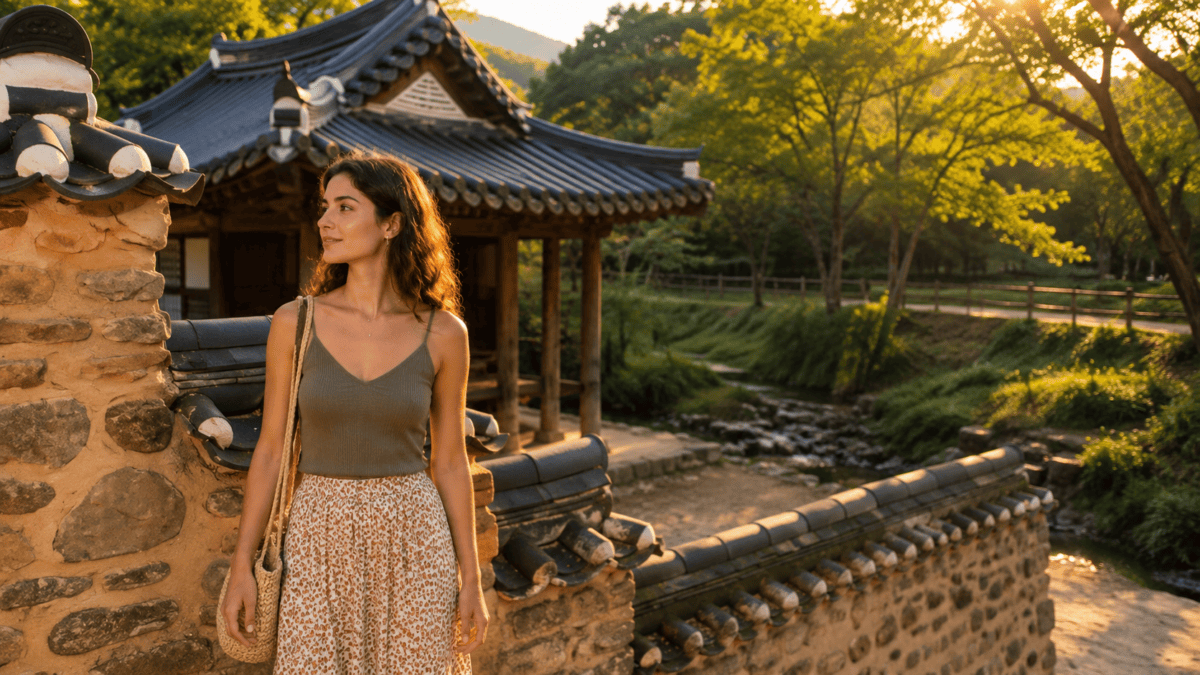
Outside, the afternoon has gone gold and long, and the heat has finally started to loosen.
You’ve spent a whole day inside the same green. The cool of the bamboo forest first thing, the light and shade of the tree tunnel, the old shade and cold water of the riverside forest, the water sound of the garden, and at the end the taste of the bamboo itself — one color and one place turned over and over, hour by hour, until the summer here has a shape you could almost hold in your hands.
It has been green the whole way through, and cool where everywhere else was hot, and slow in a way that took the entire day to work on you and will take a while to wear off.
The bamboo will keep growing tonight, fast in the dark, the way it does. The metasequoia road will run straight and empty under the moon, the warm asphalt giving back the day’s heat to no one. The old trees will shade the cold stream through the night, the water running colder as the air cools, and the garden water will pour over its stone lip to no one, the way it has for four hundred summers, the way it will next summer and the one after. None of it needs you there.
That’s the thing you carry back out to the road as the light goes — that all of this was here before you came and will be here long after, cool and green and unhurried, keeping its own slow time. You came for a single day of it. You leave with the green still on you, and the sound of water, and the taste of the tube that held your lunch, and the particular feeling, rare and hard to hold onto, of a summer day that was long in the good way.
This post was planned and edited by a human, with AI assistance.