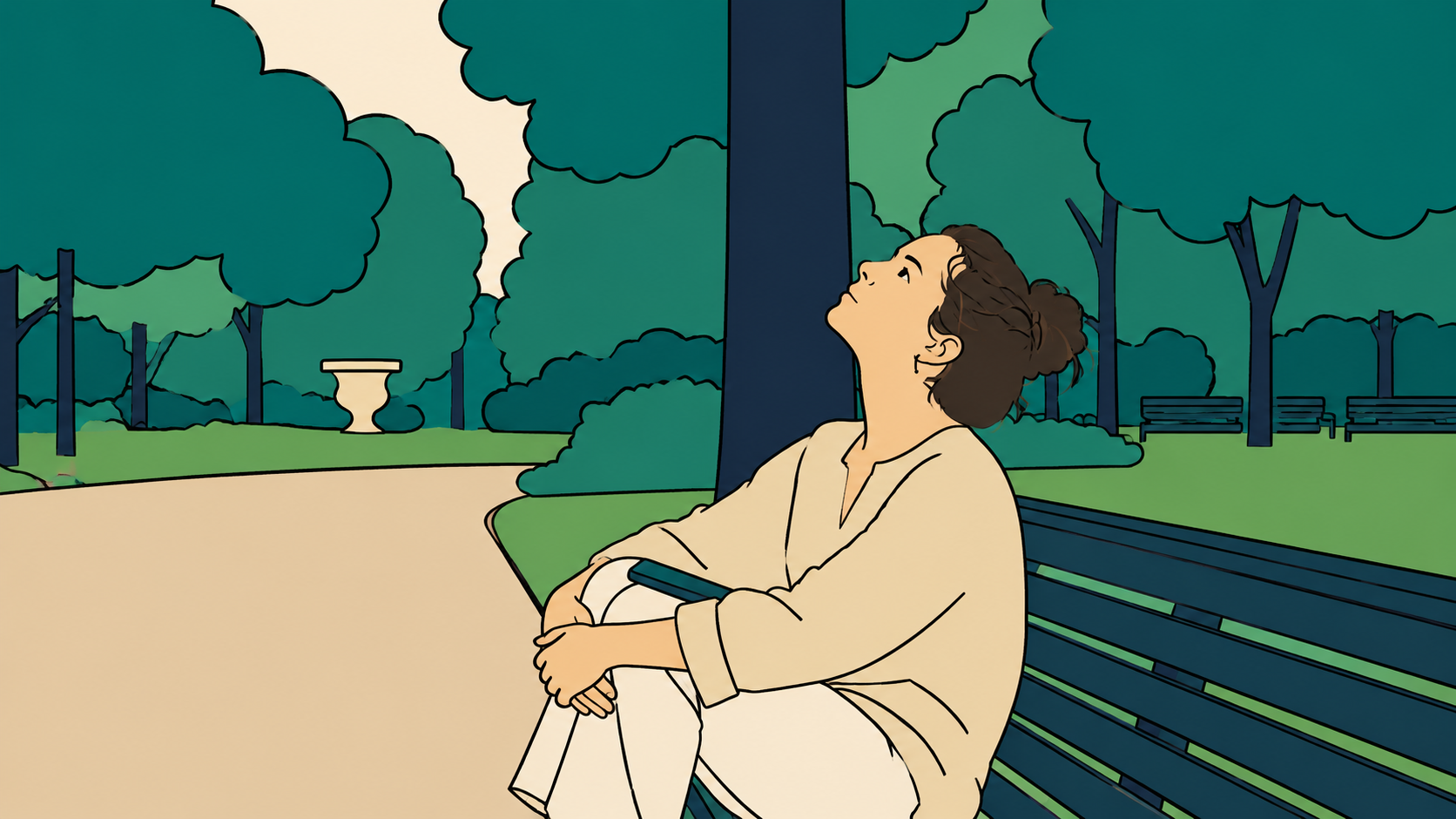

Your phone lights up. You see the name.
You don’t pick up right away.
Not because you’re busy. You know that. You set it face-down and stare at something else for a moment — the ceiling, your coffee, nothing in particular. Then you pick up anyway. You almost didn’t pick up the phone. But you did.
You always do.
Before You Almost Didn’t Pick Up the Phone
It lasts maybe two seconds. Three at most.
But something happens in those seconds. A small recalibration. You locate the version of yourself that knows how to answer these questions — the one who says fine and yes and working on some things — and you step into her before the call really begins.
She’s not fake. She’s just edited.
The unedited version is still there, somewhere behind the voice. She notices things. She tracks the temperature of the conversation before a single word has been exchanged. She’s the one who didn’t pick up right away, who needed that extra second before she could be the other version — the easier one, the one who makes the call go smoothly.
You’ve been doing this for so long you don’t even notice the switch anymore. It happens automatically, like adjusting your posture when someone walks into the room. You don’t decide to do it. Your body just knows.
What’s harder to locate is when it started. There wasn’t a moment. No single call where you decided to become slightly smaller, slightly more manageable, slightly easier to reassure. It happened the way most adaptations happen — gradually, then completely, until the edited version felt less like a performance and more like just what you do when you talk to them.
The question isn’t whether the editing is wrong. The question is what it costs, and whether you’ve ever actually counted.
The Question Arrives on Schedule

Every call has one.
Sometimes it comes early, in the first two minutes, before you’ve even settled in. Sometimes it waits — lets you talk about the weather, a cousin’s wedding, something your parents saw on the news — and then arrives anyway, patient and inevitable.
Are you seeing anyone?
Have you thought more about what’s next?
Are you saving? You need to be saving.
The specific question changes. What doesn’t change is the feeling underneath it. The assumption, quiet but consistent, that wherever you are right now is a waypoint. A draft. Something that will make more sense later, when the real version of your life clicks into place — the one with the recognizable shape, the one they can describe to people at dinner without having to pause and figure out how to explain it.
You answer. You’re good at answering.
You know how to give a response that sounds like information without actually being information. You’ve learned which details land well and which ones open doors you’d rather keep closed. You know that I’m figuring things out sounds worse than I’ve been really focused on work lately, even when they mean exactly the same thing.
What makes it complicated is that the question usually comes from a real place. It isn’t cruelty. It’s a particular kind of love that expresses itself through legibility — through wanting your life to have a shape they can hold, can point to, can feel settled about. The problem isn’t the caring. The problem is the gap between what caring looks like to them and what it feels like to receive it.
You know this. You’ve known it for years.
Knowing doesn’t make the shoulders come down.
There’s also the thing that happens after you answer — the follow-up, the practical suggestions, the names of people who did the thing they think you should be doing. You listen. You say mm-hmm in the right places. You’ve learned that engaging too directly just extends the section of the call you’re trying to move through. So you let it land, you say something neutral, and you wait for the conversation to shift.
It always shifts eventually. And when it does — when you’re back to easier things, lighter things — there’s a version of relief that feels almost like affection. Because underneath all of it, you actually like talking to them. That’s the part that makes it hard to explain to anyone who wasn’t on the call.
Afterward, you notice your shoulders were up near your ears the entire time.
What You Don’t Say Out Loud
There’s a version of the conversation you have in your head after you hang up.
The one where you explain — really explain — what this past year has actually looked like. Not the summary version, not the edited highlights, but the actual texture of it: the things you tried that didn’t work, the things you let go of, the slow and unspectacular process of figuring out what you actually want versus what you were told to want. The decision you made three months ago that felt enormous and that you still haven’t mentioned. The way some mornings feel different now, in a way that’s hard to put into words but feels important.
You never say it. Not because you’re afraid, exactly.
More because you already know the shape of what comes back. The silence that lasts half a beat too long. The pivot to something practical — have you looked into this, have you thought about that — that isn’t dismissal but functions like it. The way concern, when it arrives in a particular tone of voice, can sound almost indistinguishable from doubt.
So you keep the real version for yourself. You’ve built a whole interior life that the calls don’t touch.
The gap between what we share and what we actually experience tends to widen, not narrow, as we move further into independent adulthood. The distance isn’t dysfunction. It’s a structural feature of becoming a separate person. Most people assume it will close eventually. For most people, it doesn’t. It just becomes more familiar.
And still, something about that feels like a loss you haven’t quite named yet.
“that feeling has a cycle” — The Decade Cycle You Can’t See
The Feeling After You Hang Up

Not relief. Not exactly.
Something closer to a specific kind of tired. The kind that comes not from doing too much but from holding two versions of yourself in the same space for twenty minutes. Tracking the conversation on one level while managing something else on another. Being present and also slightly elsewhere, the whole time.
You loved hearing their voice. You were glad you picked up. You meant every nice thing you said. None of that is in question.
And still, you sit there for a minute after hanging up, not quite ready to go back to whatever you were doing before. The apartment feels a little louder than it did. Or maybe quieter. You’re not sure which.
You pick up your phone again — habit — and set it back down.
There’s no clean name for what just happened. It wasn’t a fight. Nothing went wrong. The call was fine, the way it’s usually fine, which is its own strange thing to sit with. Fine doesn’t mean easy. Fine doesn’t mean you weren’t working the entire time. Fine just means it’s over and you both said goodbye and you’ll do it again next week.
You almost didn’t pick up the phone. Now you’re sitting here wondering why you always do.
You don’t know exactly what you’re feeling. You know it isn’t simple, and you know it isn’t new, and you know that next week, when the phone lights up again, you’ll wait that same two or three seconds before you answer.
You’ll pick up. You always do.
The question is what you’re carrying when you do.
The phone is already dark again.
The name has scrolled up and out of view.
This post was planned and edited by a human, with AI assistance.