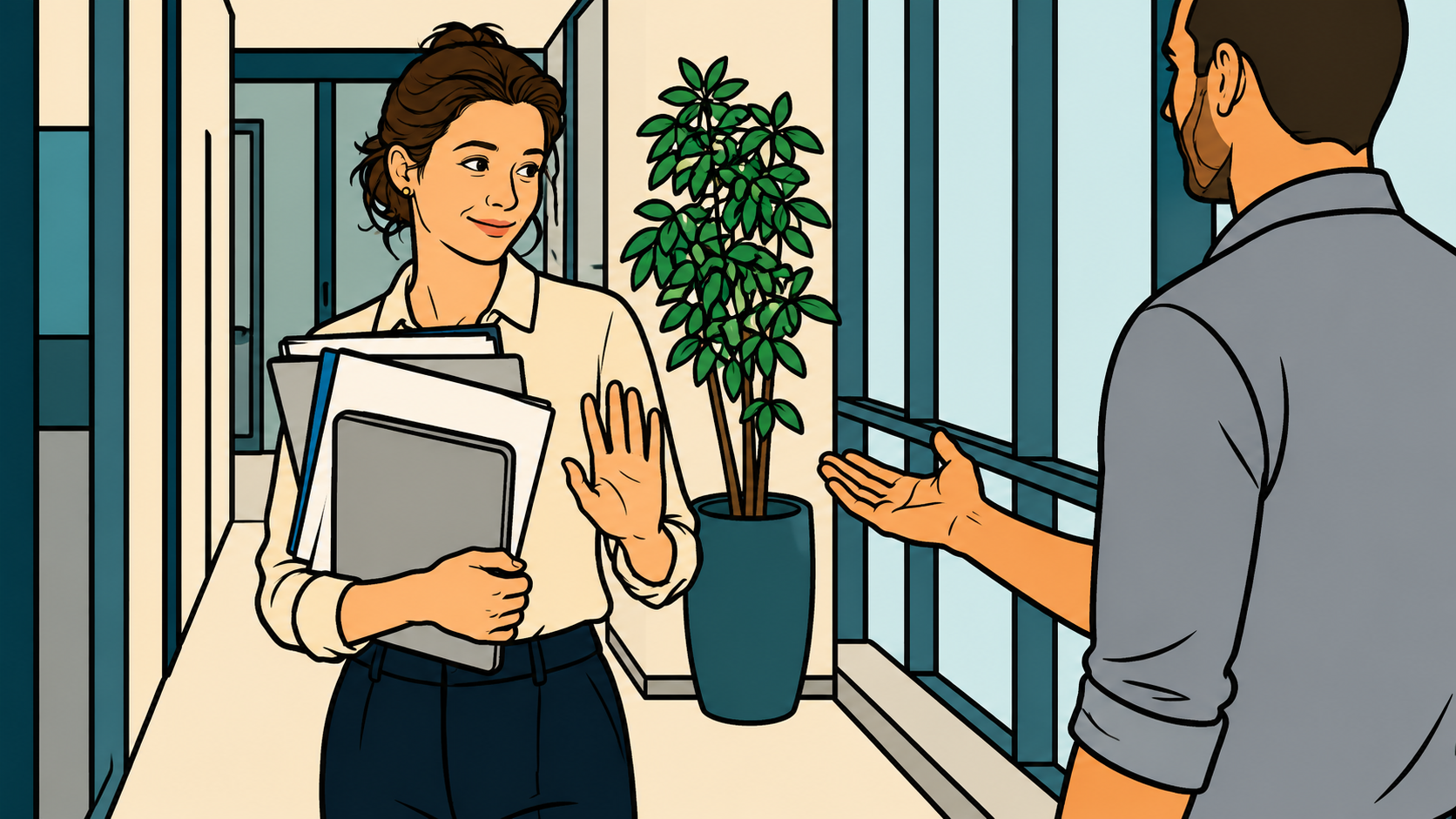

The offer was right there. “I could take a look at it for you, if you want.”
And you watched yourself do the thing you always do: the small smile, the half-step back, the answer that arrived before you’d considered the question. No, it’s fine — I’ve got it. The person nodded and moved on. The problem stayed exactly where it was, except now it was officially yours alone, sealed by your own signature.
Refusing help doesn’t feel like a decision when it happens. It feels like reflex, like politeness — like asking for help would cost more than just doing it alone. But run the tape back and notice: you weren’t fine, you didn’t have it, and the person offering could genuinely have helped. Something answered for you — and it wasn’t the part of you carrying the load.
This is one of the strangest entries in the self-sabotage ledger, because it wears the costume of strength. Nobody claps for the late-night snack or the abandoned project. But struggling alone gets admired. It photographs as independence. Which is exactly why it’s the version of the pattern that can run the longest without ever being questioned.
The Offer You Talk Yourself Out Of
Watch what happens in the two seconds after someone offers.
A colleague sees you buried and says she has a free hour. A friend offers to drive you to the appointment. Your sister asks, directly, if you need money this month — and she means it, and she has it. In each case there’s a flicker, maybe half a second, where some part of you leans toward yes. You can feel the relief of it, briefly, like warmth from a door opened on a cold landing.
Then the counter-arguments arrive, fully formed, suspiciously fast. She’s busy too. He’s just being polite. It would take longer to explain than to do it myself. Each one sounds like consideration for the other person. None of them were checked against reality. She wasn’t too busy — she offered. He wasn’t being polite — he brought it up twice. The explanation wouldn’t take longer; you’ve explained harder things to less willing audiences.
The arguments aren’t analysis. They’re a door being closed quickly, before the warmth gets in — and the speed is the tell. Real deliberation takes time. Refusing help takes half a second, because the answer was written long before this particular offer arrived.
Why Asking Feels More Dangerous Than Struggling

Here’s the math running underneath asking for help, and it’s worth seeing in full.
Struggling alone is expensive, but the cost is familiar. You know exactly what it feels like: the long nights, the slow grind, the quiet exhaustion that nobody witnesses. It’s heavy, but it’s yours — private, controlled, no moving parts that depend on anyone else’s mood or memory or opinion of you.
Asking introduces variables. The other person now knows you couldn’t do it alone. They might say yes and hold it somewhere, an invisible ledger you’ll feel every time they ask you for something. They might say yes and do it badly, leaving you to manage both the problem and their feelings about their effort. Or — the deep one — they might see, up close, exactly how behind you actually are. The mess before it’s cleaned up. The account before the deposit. The draft before the polish.
So the body picks the heavier load with the fewer witnesses. Struggling costs more, but asking exposes more, and somewhere along the line exposure got priced as the greater danger. It’s rarely a price that was set recently. For most people it goes back — to a household where needing things was met with sighs, where help came with commentary attached, where the safest position was the kid who handled it. The refusal isn’t assessing this offer, from this person, today. It’s running an old rule about what receiving costs, written in a room you left years ago.
Refusing help isn’t a measure of how strong you are. It’s a measure of how expensive receiving once was.
What Refusing Help Is Actually Avoiding
Because look at what the refusal reliably prevents — not the help itself, but everything the help would carry with it.
Being helped means being seen mid-struggle. Not the composed version that reports the struggle afterward, past tense, already resolved — the current version, still in it, hair not done, spreadsheet still broken. The story you tell later can be edited. The kitchen someone walks into cannot.
There’s a specific scene where this shows up in almost everyone’s life: someone visits while your place is a mess, and offers to help you sort it out, and you physically position yourself between them and the worst of it. It’s usually not like this. The words matter less than the body — already blocking, already managing the sightline. That’s the actual object of the refusal. Not the assistance. The angle of view.
And notice the strange arithmetic on the other side: you don’t think less of the people you help. If anything, being asked warms you toward them — being trusted with a request tends to build the bond, not spend it. The people in your life who ask you for things easily aren’t the ones you respect least. They might be the ones you feel closest to, precisely because they’ve let you in with the hair unwashed and the spreadsheet broken.
The rule only runs in one direction: everyone else may need things. Refusing help keeps you the exception — the one who gives but somehow never requests — and being the exception is the whole point. It’s the last room in the house that stays private.
The Cost of Staying Self-Sufficient

The bill for all this arrives slowly, and it’s larger than the individual struggles.
The obvious cost is efficiency — problems that take three weeks instead of three days, weight carried solo that was built for two. But that’s the small line item. The larger one is what self-sufficiency does to the people around you over time. They offered, and were refused. Offered again, refused again. Eventually they learn the lesson you’ve been teaching: this person doesn’t need anything. So they stop offering — not out of coldness, but out of respect for what you’ve insisted on.
And then the isolation you’ve been carefully constructing starts to feel like something that happened to you. You trained them to leave you alone, and then you were alone.
She saw the finished lesson on a Tuesday, from the wrong side. Her closest friend mentioned, in passing, a move she’d completed the weekend before — boxes, truck, the whole production, done. Three years ago that call would have come to her first. She heard herself say the expected thing, you should have told me, I would have helped, and her friend answered without any edge at all: “Oh — I didn’t want to bother you. You’ve always got so much going on.” There it was, her own sentence, returned in someone else’s voice. The friend hadn’t stopped caring. She’d simply learned the door. And she’d learned it from the person who built it.
There’s one more line, quieter than the rest. The people who love you don’t experience your self-sufficiency as strength. They experience it as distance — a door that stays closed specifically to them. Every refusal tells them the same thing: you don’t get to matter here. That’s not the message you mean to send. It’s the one that arrives.
So the direction, if you want one, isn’t a personality overhaul. It’s asking for help once — one accepted offer. Small, low-stakes, deliberately chosen — the ride, the extra pair of eyes, the hour someone freely gave. Say yes before the counter-arguments finish assembling, and then sit in the discomfort of being helped without immediately calculating the repayment. The discomfort is the old price tag being read one more time.
It’s out of date. The only way to find that out is to buy something.
This post was planned and edited by a human, with AI assistance.