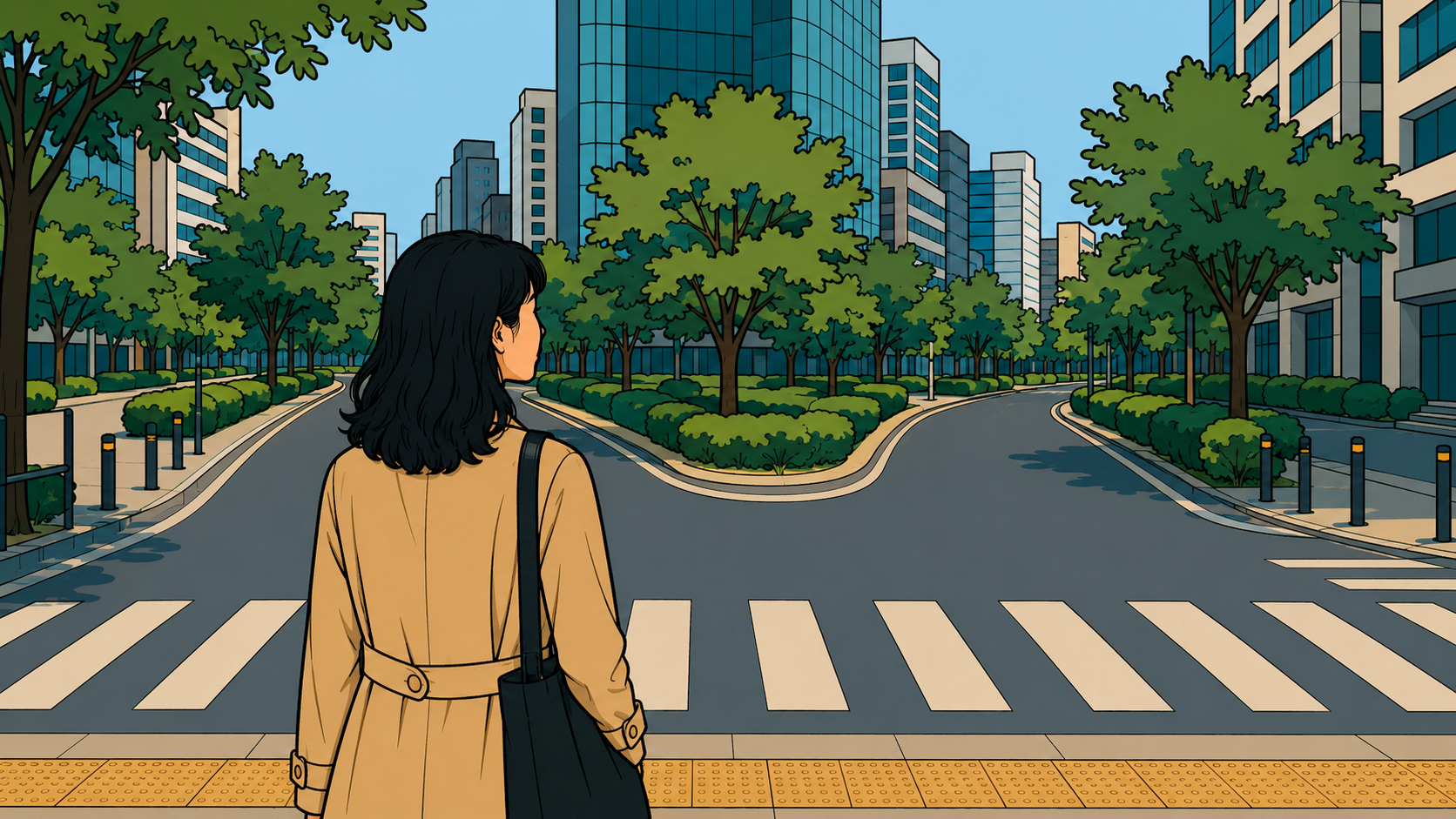

Look at a career change honestly and you’ll usually find three options: keep going, go harder, or go faster. Stay the course, push more, or accelerate. It feels like a range of options. It’s actually the same option wearing three outfits.
All three point the same direction — up, and more. The thing they share is exactly what makes them feel like a choice: you get to pick the intensity. What you don’t get to pick, and rarely even notice, is the direction. That was decided long before you started choosing.
You’ve probably run this loop without naming it. A stretch stops working, you diagnose it as not-enough, and you answer with more of what wasn’t working. It rarely occurs to you that the problem might be the direction itself, because the direction never presented itself as a choice in the first place.
This piece is about the option that’s never on the menu — and why you can’t see it from where you’re standing.
When More Becomes the Only Answer
Watch what happens when something isn’t working. The instinct is almost never “different.” It’s “more.” More hours, more optimization, more discipline, more of the exact thing that’s already not working.
That’s not a personal flaw. It’s what the structure trains. Every reward you’ve ever collected came from more — better grades, bigger titles, higher numbers. So more becomes the reflex, the first and often only answer, because it’s the only move that’s ever been reinforced. Nobody sits you down and teaches you that sometimes the answer is less, or elsewhere. You’d have to unlearn a lifetime of evidence to believe it.
Picture the manager who’s quietly unhappy but keeps taking on scope. Overwhelmed, so the fix is a productivity system. Still overwhelmed, so the fix is a coach, an earlier alarm, a tighter calendar. Every fix is a variation of more, and each one deepens the exact position making them miserable. The one move never on the table is stepping off the track entirely.
And each application of “more” quietly narrows what comes after it. The path you’re already on sets the range of what feels possible from here — economists call it path dependence, and it means your current options are shaped less by what’s actually available and more by what you’ve already committed to. Ten years of “more” doesn’t just build a career. It carves a groove so deep that “different” stops looking like a door and starts looking like a fall.
You can hear the groove most clearly when someone tries to describe leaving. The words come out apologetic and half-retracted before they finish — proof the track is doing the thinking. So more becomes the only answer, not because it’s right, but because it’s the only answer the groove still allows.
Why Lateral Moves Feel Like Failure

Suggest a sideways move to someone deep in the climb and watch their face. A lateral role. A step back to a smaller thing they’d actually enjoy. Same pay, less status, different direction. To almost everyone, it reads as failure — even when it’s obviously the healthier call.
Why? Because the script has only one axis: up. Anything that isn’t up gets filed as down. There’s no category for “sideways on purpose,” so the mind drops it into the nearest available bin, and the nearest bin is failure.
It shows up in the language people use. “I can’t just take a step back.” “That would be throwing it all away.” Throwing what away, exactly? Usually not the money — often just the story of unbroken ascent. The ascent became the identity, and protecting that identity now costs far more than the raise ever paid.
There’s a deeper reason under that one. By the time you’re years into a direction, the direction has quietly become you. Your sense of who you are and where you’re headed have fused, so a change of direction feels like a change of self — like erasing the person you spent a decade building. This is how losing yourself in the job actually happens: not in one dramatic moment, but in the slow merge of identity and trajectory until you can’t tell them apart.
So a lateral move never feels lateral. It feels like disappearing — which is exactly why the option that might save you is the first one you refuse to consider.
The Invisible Script Behind Your Career Choices
Here’s the uncomfortable part. Most of what you call a career change was decided by a script you didn’t write and can’t see.
The script is simple: success means climb, climb means more, more means up, and up is the only direction that counts. You absorbed it before you had words for it — from school, from parents, from every story about who’s “doing well.” By the time you started making adult decisions, the script was already running, and it framed every option before you got to weigh it.
A script does its best work invisibly. You don’t experience it as pressure; you experience it as your own preference. Of course you want the promotion. Of course you’d never take the smaller role. Those feel like your values. Some of them are just the script talking in your voice. You can test which is which with one question: would you still want it if no one could see it? Strip away the audience, the title in the signature, the number you can quote at a reunion, and notice how many of your “choices” go quiet when nobody’s watching.
And the script isn’t only external. Part of it is the shape you started with — the particular mix of drives and instincts that make certain directions feel like home and others feel like defeat. Two people run the same external script and follow it differently, because the internal shape underneath weights the options before either one “decides.” One can’t stop climbing; the other was never built to climb at all, and spends years feeling broken for it.
The point isn’t that you have no agency. It’s that a great deal of what feels like choice is really the script and the shape agreeing with each other, quietly, before you ever sat down to choose. That’s not cause for despair. Seeing the script doesn’t delete it, but it does the one thing the script can’t survive: it turns an invisible command into a visible option you can finally weigh.
The Direction Not on the Menu

So what is the option that never makes the menu?
It isn’t a specific job. It’s a question: what if up isn’t the only direction that counts? What if the right move, for this phase, is sideways, or slower, or a different game entirely — and the only reason you can’t see it is that the menu you were handed doesn’t list it?
The menu is not the territory. It’s a set of options someone else designed, filtered through a script you inherited and a shape you were born with. The directions not on it aren’t unavailable. They’re unlisted — and unlisted reads, from the inside, as impossible.
None of this means every climb is a trap, or that ambition is the enemy. Plenty of people are on exactly the right track and should keep going. The problem was never the direction up. It’s mistaking the only direction you can see for the only direction there is.
Here’s the reframe. When you feel stuck between keep going, go harder, and go faster, you aren’t choosing between three options. You’re confirming that you only ever had one, dressed three ways. The real freedom was never picking better among the three. It’s noticing that the menu was set before you arrived — and that you’re allowed to order off it.
Because the hardest thing to see about your own career change is this: mostly, you didn’t choose the options. The options were chosen for you, and you chose the intensity. The day you see the menu as a menu — made by someone, for some purpose, and not the whole of reality — is the day you get an actual choice for the first time.
This post was planned and edited by a human, with AI assistance.