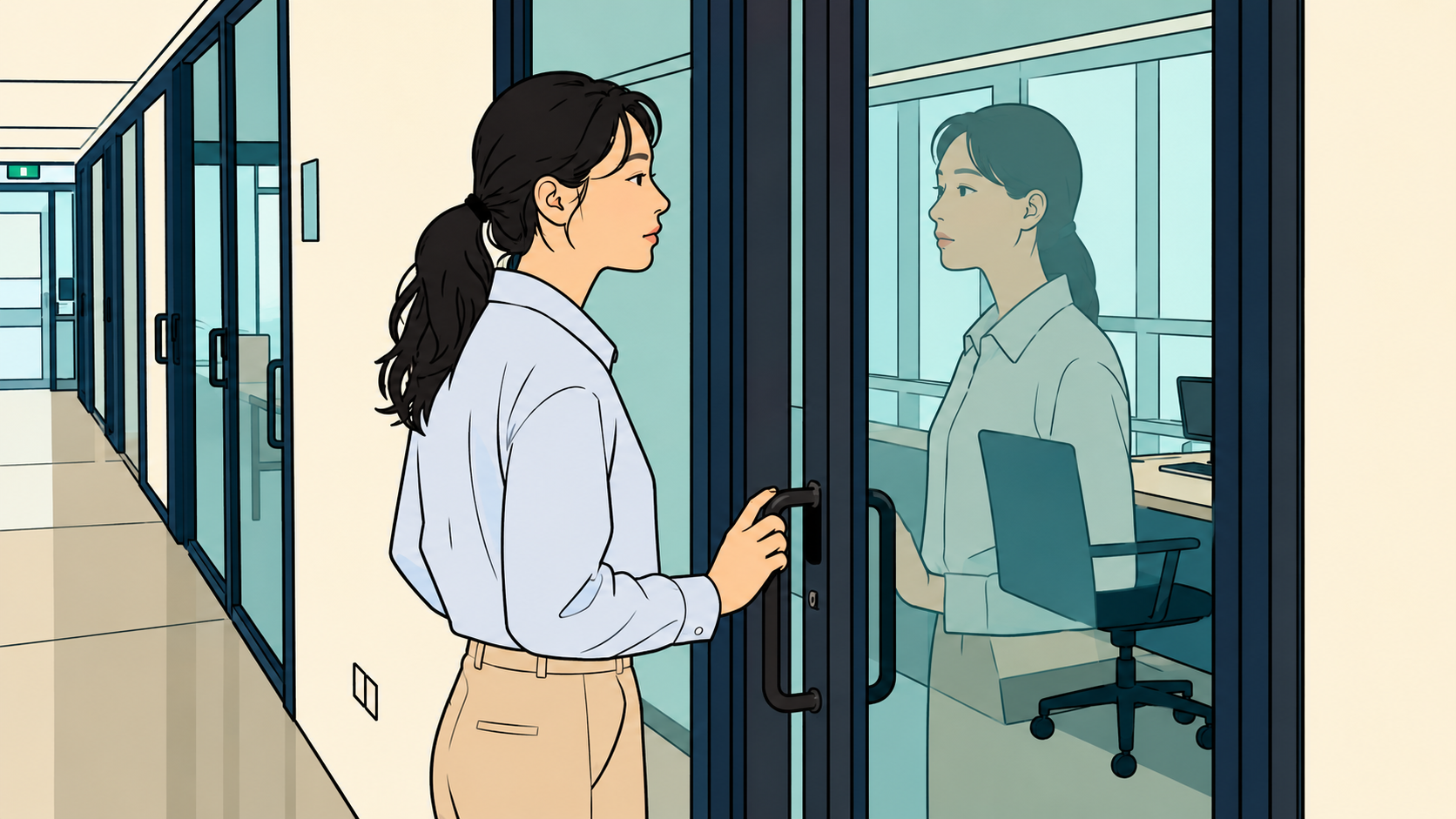

The fear of being rejected does its loudest work in the things that never happen. No scene, no conversation, no actual no. Just a quiet subtraction — the text you didn’t send, the room you didn’t walk into, the thing you wanted and talked yourself out of before anyone could turn you down.
Most of what this fear costs you doesn’t look like pain. It looks like nothing happening at all — a life quietly arranged around the one outcome you’re determined to never feel.
The Invitation You Declined Before It Came
There’s a particular move worth watching for. You want something — to go, to be included, to be chosen — and before anyone can say yes or no, you remove yourself from the running.
You see the group making plans and you get quiet, so nobody has to decide whether to include you. You want the promotion and you don’t apply, so you can’t be passed over. You’re interested in someone and you keep it so well hidden that the question of rejection never comes up. You didn’t get turned down. You made sure there was nothing to turn down.
Watch how you dress it up afterward. You don’t tell yourself you were scared. You tell yourself you weren’t that interested, that the timing was off, that it wasn’t the right fit anyway. The fear is smart enough to hand you a reasonable-sounding reason on the way out, so the retreat never registers as a retreat. It just feels like good judgment.
It feels like protection, and in the short term it is. You can’t be rejected from a room you never tried to enter. But look at what actually happened: you took the no and gave it to yourself, in advance, to save the other person the trouble. You called it realism. It was a pre-emptive rejection, delivered by you, to you.
That’s the quiet trap. The fear promises to protect you from a painful outcome, and its method is to hand you that exact outcome early — just with your own name on it instead of theirs. You don’t escape the no. You just become the one who says it.
How the Fear of Being Rejected Shrinks Your World
Do this enough times and it stops being a series of choices. It becomes the shape of your life.
The fear of being rejected works like a fence that keeps moving inward. First you avoid the big risks — the bold ask, the long shot. Then the medium ones. Then, without noticing, you’re routing around small things: not speaking up in a meeting, not texting first, not saying you didn’t understand. Each avoidance feels minor. Together they draw the borders of a much smaller life.
There’s a specific tax on the ones you love, too. You want closeness, but closeness is where rejection would hurt most, so you hold a little back — never fully landing, never quite letting someone all the way in. You stay warm but slightly out of reach, and call it independence. What it actually does is guarantee the distance you were afraid of, on your own terms, before anyone could impose it.
And the cruelest part is how safe it feels. Nothing bad is happening. No one’s rejecting you. But nothing much is happening at all, because you’ve quietly removed yourself from every situation where a no was possible — which turns out to be every situation that mattered.
You end up mistaking the absence of rejection for safety, when it’s really just the absence of living. The fence did its job. It kept the no out. It also kept you in.
The Safety of Never Asking

Look closely at not asking, because it’s where the fear hides best.
When you don’t ask — for help, for what you want, for clarity, for more — you get to keep a story intact: maybe they would have said yes. As long as you never ask, the yes stays possible in your head, and you never have to feel the actual no. Not asking preserves the fantasy. Asking risks it.
So you become fluent in going without. You tell yourself you don’t really need it, that it’s not a big deal, that you’re fine. You get good — genuinely skilled — at wanting less, or at least at looking like you want less. Low-maintenance. Easy. Undemanding. These sound like virtues, and sometimes they are. But underneath, they’re often just the fear wearing a nicer outfit.
The tell is the quiet resentment that builds anyway. When you never ask, your needs don’t disappear — they go underground and leak out sideways, as frustration at people who never gave you a thing you never actually requested. You wanted them to offer, so you wouldn’t have to risk the ask. They didn’t read your mind. And a small bitterness settles in, aimed at them, when the real setup was the silence you kept to stay safe.
There’s a second cost that’s easy to miss. Every time you go without instead of asking, you teach yourself the same lesson: my needs are too much to put on the table. The belief doesn’t stay put, either — it hardens with each repetition, until asking for even something small feels enormous, almost rude. The fear doesn’t just win the moment. It trains you for the next one.
Who Taught You to Expect the No

Nobody is born expecting rejection. The fear is learned, and usually early.
Somewhere back there, reaching out and getting nothing — or getting something worse than nothing — taught the system a rule. Maybe love came with conditions and could be withdrawn. Maybe needing things was treated as a burden. Maybe you asked for something once, plainly, and were made to feel foolish for wanting it. You don’t remember most of these moments. But the rule they wrote is still running: wanting is dangerous, and the safest move is to expect the no before it arrives.
This is worth knowing, not to assign blame, but because a learned rule is not a permanent truth. It was accurate once, in the environment that taught it. It stopped being accurate a long time ago, and nobody sent the update.
You can see the outdated rule most clearly in how you read neutral things now. A friend who’s busy this week, a reply that’s shorter than usual — the old rule fills them in as early evidence of the no it always expects. You’re not reacting to the person in front of you so much as to the one who taught you the rule, a long time ago, in a room you’ve half forgotten.
That’s where a different reading helps. In the way K-Saju treats a pattern like this — not as a fixed flaw in who you are but as a structure that formed for a reason and can be timed differently — the fear of being rejected stops being your character and becomes something more like weather you learned to always expect. Not who you are. A forecast you inherited.
You can’t argue yourself out of the fear in one move; it’s older than your reasons. But you can start noticing the pre-emptive nos as you hand them to yourself — the ask you’re about to skip, the room you’re about to avoid — and, once in a while, leave the question open instead of closing it for them. Not fearless. Just unwilling, this one time, to reject yourself on their behalf.
Because the real cost was never the rejections you survived. It was the choices you quietly deleted so you’d never have to. A life can grow smaller this way without ever looking broken, one unopened door at a time, quietly mistaken for safety. Nothing collapses all at once. The rooms simply get fewer, the asks get smaller, and eventually the life inside the fence feels normal.
This post was planned and edited by a human, with AI assistance.