

In late-1940s Seoul, Kim Ki-young studied dentistry while becoming increasingly drawn to cinema and visual composition. A camera sits on the desk beside him. His classmates learn human bodies. He learns light and shape. Same room. Different eyes.
The path toward a medical career was predetermined. The family was clear. Society was clear. But Kim Ki-young wasn’t the type who broke free at some point. He was never on the expected track to begin with. From the very start, he was looking at the world differently.
The Absent Dentist
Born in 1919. An educated household with expectations. These facts alone cannot explain Kim Ki-young. Because he abandoned all of it entirely.
By the time he entered medical school, he was already thinking of something else: film. What was cinema in colonial Korea? The world had already moved into the age of moving pictures. Hollywood was filled with James Cagney and Marlene Dietrich. The Soviet Union had Eisenstein’s montage theory documenting revolution. German expressionism was reshaping visual language entirely. In colonial Korea, cinema was still largely regarded as popular entertainment rather than a serious artistic medium. It was spectacle without vision. Escape without thought. This was what Korean audiences wanted. This was what the industry provided. Kim Ki-young wanted something else entirely.
After earning his dental degree in 1950, Kim Ki-young made his choice. It was through the United States Information Service that he discovered film. In Busan and Jinhae, he produced documentary and dramatic films—I Am a Truck and The Box of Death—works now rediscovered in America after decades. Although trained in medicine, he ultimately devoted himself entirely to cinema. His hands, already occupied by a camera, have no room for a surgeon’s blade. This isn’t a career choice. It’s inevitable. He can’t exist in both worlds. One heals the body. The other sees its decay.
This way of seeing—cold diagnosis without judgment—would later shape the language Korean cinema used to face the world.
What War Taught Him
(Wikimedia Commons, Public Domain / Edited)
What did Kim Ki-young see during Japanese occupation and liberation? What a director thinking about cinema learns in wartime is not theory. It is the architecture of hierarchy inside human beings.
After independence, the family began to collapse. Family members split by politics. One direction went north. Another stayed south. People sitting at the same table turned toward different nations. This enters Kim Ki-young’s lens. The destruction of relationships. The reversal of order. The displacement of class. These became the only subjects worth filming. He had seen it happen inside his own family. He understood that personal tragedy and historical rupture were inseparable. Cinema, for him, was a way to make this visible.
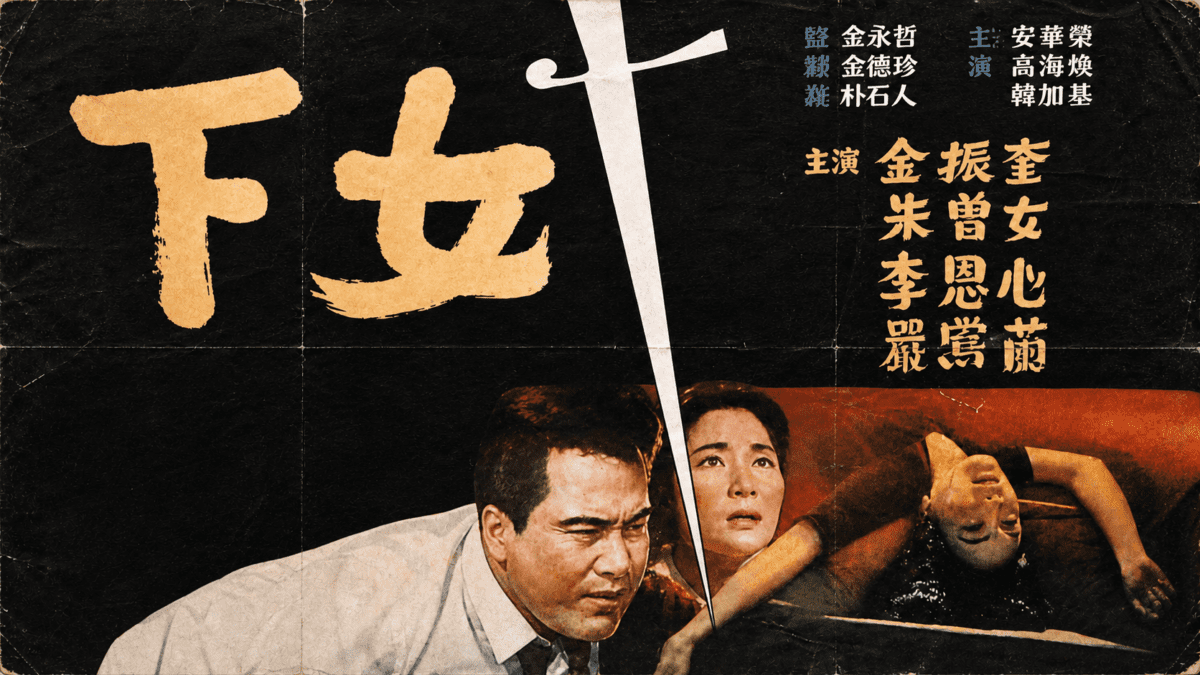
When The Housemaid was rediscovered decades later, critics were stunned. The film began to appear at major international film festivals.
A Director Who Made the Normal Look Abnormal
Korean cinema of the 1950s made films with messages. Liberation films. War films. National consciousness. Moral clarity. Film was a tool for teaching, for guiding society toward a vision of what it should become.
Kim Ki-young rejected this entirely. But not as a rebel raising a fist. As a dissectionist with a lens instead of a knife.
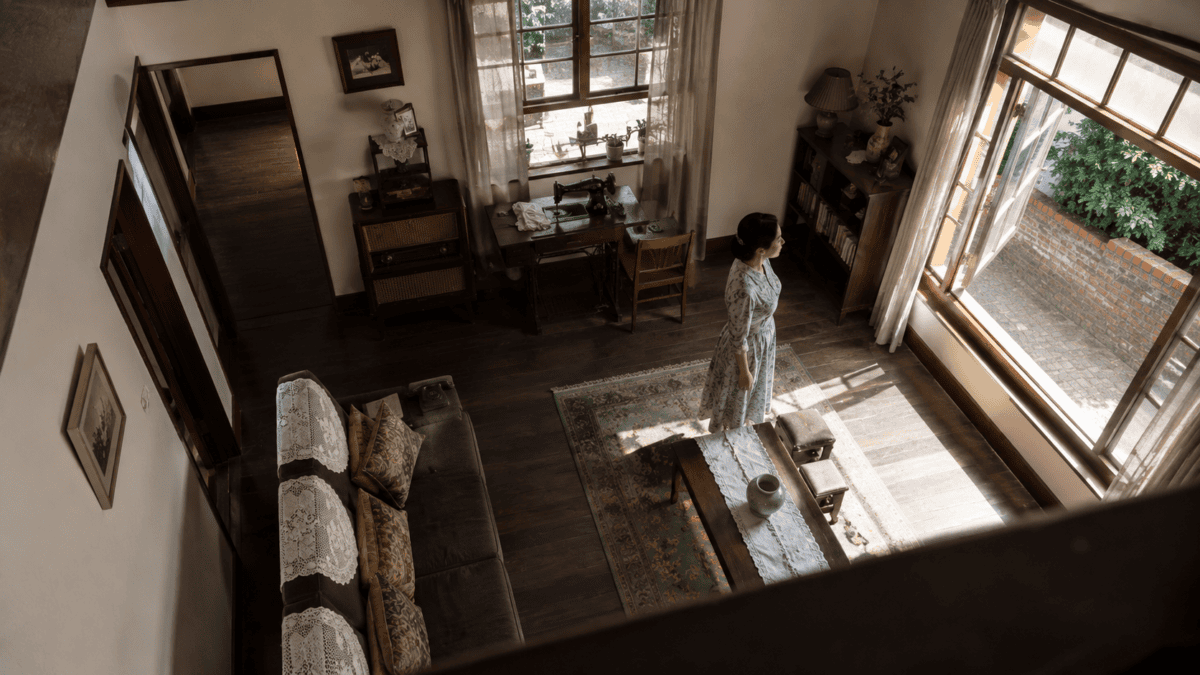
The home becomes dangerous. What he kept returning to was the safest space in Korean culture—the family home. But in his hands, it wasn’t safe. A man stops halfway up the staircase. He doesn’t go up. He doesn’t go down. The house has no direction—only pressure. This wasn’t fantasy. It was anatomy. He took the most familiar, most trusted space and made its logic visible and terrible.
In The Housemaid, he returns to the same house with different women. The pattern repeats. The violence returns. The decay accelerates. He wasn’t interested in variation or progress or narrative redemption. He was interested in inevitability. How the same space produces the same destruction, again and again, regardless of who enters it, under different circumstances. This is cinema about pressure, not people. The space itself becomes the protagonist—more real, more enduring than any person inside it.
Human beings become objects of study. In The Housemaid, the wife is dependent. The master is morally incomplete. The maid desires. The son is confused. Most Korean directors would apologize for this state of things. Show the path forward. Offer clarity. Kim Ki-young did something colder. He studied them. Like a dentist studies teeth—not to comfort, but to understand structure. He watched what people did when pretense was stripped away.
He didn’t hide desire. He displayed it. He didn’t soften class contradiction. He showed it as mechanism. The characters aren’t struggling against circumstance; they are circumstance. He filmed people the way a surgeon studies damaged tissue.
What separated Kim Ki-young from his peers was this: he understood that what people do isn’t decided by morality or will. It’s decided by what they carry inside meeting what surrounds them. The wife’s dependence wasn’t weakness—it was what her position required. The maid’s hunger wasn’t moral failing—it was the only form available to her. He rejected the idea that cinema should show people changing or improving. Instead, he showed what people truly are when circumstance strips away pretense—the mechanism beneath choice.
The camera remains cold. It sweeps the staircase without sentiment. A rat gnaws at the wall. Fire spreads. These repeated images communicate analysis, not emotion. Documentation, not judgment. Where others saw a moral universe, Kim Ki-young saw a system. Where others saw individual failing, he saw structural inevitability. The lens doesn’t judge. It observes. It records. It documents the mechanism as it unfolds, frame by frame.
Invisible Then, Essential Now
Here is the paradox: Although highly respected within certain film circles, Kim Ki-young never achieved broad mainstream recognition comparable to some of his contemporaries. Not in Korea. Not internationally.
Korean cinema in the 1960s and 70s had its stars. Shin Sang-ok. Lee Man-hee. Audiences filled theaters. But Kim Ki-young made films that were too singular, too cold, too strange. His work was often regarded as unconventional and difficult, even while he continued to receive critical recognition within the industry. The Housemaid circulated quietly through small festival circles. He made 30 films. Most were forgotten.
Then everything changed.
Starting in the 1990s, filmmakers and scholars began restoring his work. Showing it again. Writing about it. His films appeared at major festivals. Universities added him to curricula. Critics who had never heard of Korea discovered in him something essential: a way of seeing that had predicted everything cinema would become. Later critics and filmmakers found striking thematic and stylistic parallels between Kim Ki-young’s work and that of several internationally recognized directors. They saw in him a predecessor they didn’t know existed.
The restoration wasn’t an accident. It was necessity. As cinema matured, as audiences grew tired of easy narratives, Kim Ki-young’s cold vision became visible. What seemed strange in 1960 suddenly seemed necessary in 1995. The world had finally caught up to him.
Today, he isn’t “world-famous” like a household name. But among those who study cinema seriously—scholars, directors, critics—he is indispensable. A necessary voice. Someone who understood that you don’t change the world by making better messages. You change it by making people see that the normal world is already monstrous.
His films became weapons of perception. Young directors watched The Housemaid and understood that you didn’t need grand narratives or political slogans. You needed to look closely at what was already there. The cruelty in domestic spaces. The violence in ordinary transactions. The way what you carry inside meets what surrounds you, and that meeting becomes locked.
Kim Ki-young had discovered what few filmmakers understood: human behavior isn’t determined by morality or psychology. It’s determined by the collision between what’s inside a person and the conditions they face. The wife doesn’t change because she’s dependent; the maid doesn’t change because she hungers. They repeat because what’s inside keeps meeting what’s outside, and that meeting has no escape route. This wasn’t psychology. It wasn’t sociology. It was diagnosis—watching what happens when what’s inside meets what surrounds it.
Trained in dentistry, Kim Ki-young spent decades dissecting the same room through cinema. Over time, the filmmaker once overlooked became essential.
The question isn’t whether you prefer his work. The question is whether you can unsee what he showed you. Once you understand that homes aren’t safe, that desire doesn’t care about morality, that what happens to people is decided less by their will than by what they carry inside meeting what’s outside—you cannot watch cinema the same way again. You see the traps. You see the locked patterns. You see that escape is often impossible because the space itself is the prison.
This is his legacy. Not fame, but clarity. Not comfort, but truth.
This post was planned and edited by a human, with AI assistance.