
There is a particular kind of childhood invisibility that has nothing to do with being ignored. Your parents see you. They speak to you. They know where you are. And yet you have learned to make yourself as close to invisible as possible while remaining in the room.
You learned early that taking up space came with a cost—not the dramatic cost of punishment, but the slower cost of tension, of adding weight to a room already carrying too much. So you learned to stay small. You lowered your voice not because you were asked to, but because you noticed that quiet voices don’t disturb the air the way loud ones do. You made yourself easy, undemanding, the kind of presence that doesn’t add pressure.
Staying small became so effective that it became personality. You became someone who existed at minimum volume, who moved through the world taking up as little space as possible. Decades later, you still feel most at home in the margins. You still enter rooms carefully, reading the temperature before you fully arrive. And you do it with such automaticity that you don’t realize you’re doing it at all. This is what staying small does—it stops feeling like survival and becomes identity.
The Version of You That Took Up Less Space

There was a child who learned to speak softly. Not because anyone told her to, but because she noticed that when she spoke at full volume, something shifted in the room. A parent’s jaw tightened slightly. An adult’s attention sharpened in a way that felt like warning. Quiet was safer. Quiet allowed her to exist without creating waves.
So she began to calibrate everything about herself. Her laugh became smaller—not silent, but contained. Her excitement about things was expressed at a lower frequency. When she had something to say, she checked first, assessed whether the room could bear her voice, and often decided it couldn’t. She became fluent in edited speech, in thoughts filtered before they reached sound, in impulses interrupted before they became action.
This child learned to take up minimal physical space as well. She didn’t sprawl across the couch. She sat upright, careful, compact. She didn’t gesture widely when she talked. Her movements became economical. In a crowded family dinner, she occupied only the space she absolutely needed, leaving maximum room for others. She became someone who could fit into tight spaces, who could exist alongside difficult emotions without adding to them.
The genius of staying small is that it is invisible to the people who benefit from it. Your parents didn’t see your smaller voice as a loss. They experienced it as peacefulness. Your family didn’t notice your contracted body language as contraction—they simply noticed that you were easy to have around. You didn’t make messes. You didn’t demand attention. You didn’t create problems.
What no one saw—what you yourself didn’t see until much later—was that you had begun the process of disappearing. Not literally, but in the ways that matter. You had learned that your full presence was too much, that your excitement was contagious in the wrong way, that your natural volume was a liability. So you edited yourself. By adolescence, you didn’t remember the unedited version anymore. You didn’t speak at full volume because it felt foreign, dangerous. You didn’t take up physical space because your nervous system had learned that expansion equaled risk. The smaller version had become the only version.
The Difference Between Loud and Safe
In a house where staying small is survival, the distinction between loud and safe becomes one of the most important lessons a child learns. Not through instruction but through experience.
Loud is your full laugh echoing through the house. It is your voice raised in excitement about something you care about. It is running instead of walking quietly. It is disagreeing, resisting, wanting something enough to ask for it. Loud is the full version of you—your opinions, your enthusiasms, your frustrations, your joy expressed at normal human volume.
Safe is the alternative. Safe is quiet laughter. Safe is moderate enthusiasm. Safe is moving through the house in a way that doesn’t announce your presence. Safe is keeping your opinions to yourself. Safe is wanting things quietly, internally, without letting the wanting create any ripple. Safe is the smaller version, designed specifically not to add pressure.
Children in these houses learn which version produces tension and which produces calm. Loud creates vigilance in the room—everyone becomes alert, ready to manage whatever might come. Safe creates relaxation. Safe means the adults can lower their guard. So you choose safe. Again and again, you choose small.
With each choice, the neural pathway deepens. With each moment you don’t laugh at full volume, with each thought you keep to yourself, with each excitement you moderate, staying small becomes less a choice and more a reflex. And the problem is simple: staying small and being alive are not the same thing. Aliveness requires expansion. It requires taking up space, making noise, wanting things loudly enough to be heard, expressing joy and anger and uncertainty without first filtering it through the question: will this be too much for the room?
But you learned that aliveness was too much. So you learned to be safe instead. And now, whenever you consider speaking at full volume, whenever you think about expressing a strong opinion, whenever you imagine taking up more space—there is a sensation of danger. Your nervous system still remembers the lesson: loud is not safe. Small is.
What Happens When a Child Learns Not to Add Pressure

There is a specific weight that settles into the body of a child who learns that existing itself can be a burden. This child learns to make calculations about her own needs based not on whether they are legitimate, but on whether the family system can bear them right now.
Am I hungry? Yes. But is this the right time to ask for food? Is Dad already stressed? Is Mom depleted? Can the family absorb one more thing right now, or should I wait? The child becomes expert at deferring needs. She learns to ignore hunger cues in service of the family’s mood. She learns to sit with anxiety without mentioning it because saying it aloud would add one more problem to an already overflowing pile. She learns to need as little as possible. She becomes a child who has learned that her needs are a form of pressure—and pressure is something the family cannot afford.
What lingers from this is a profound difficulty with needs that extends into adulthood. Even in relationships where your needs would be welcomed and accommodated, you struggle to articulate them. Not from unawareness, but because your nervous system still registers need as a form of pressure you should not be adding.
Your partner asks what you want to eat, and you immediately minimize—anything is fine, whatever is easier. Your therapist asks what brought you in, and you find yourself shrinking your own struggles, making them seem smaller than they are. You have become so practiced at not adding pressure that you do it automatically, even when no pressure exists at all.
There is another piece that lingers more deeply: the sense that your needs are inherently selfish. That wanting something for yourself is a form of self-centeredness. That articulating what you need is a form of burden you should not place on others. This is not a belief you consciously hold. It is written into your nervous system at a level deeper than belief. The child who learned not to add pressure becomes an adult who experiences her own needs as a kind of embarrassment, apologizes for inconveniencing people with her existence, and feels guilty for opinions that differ from those around her.
Why Some Adults Still Enter Rooms Quietly
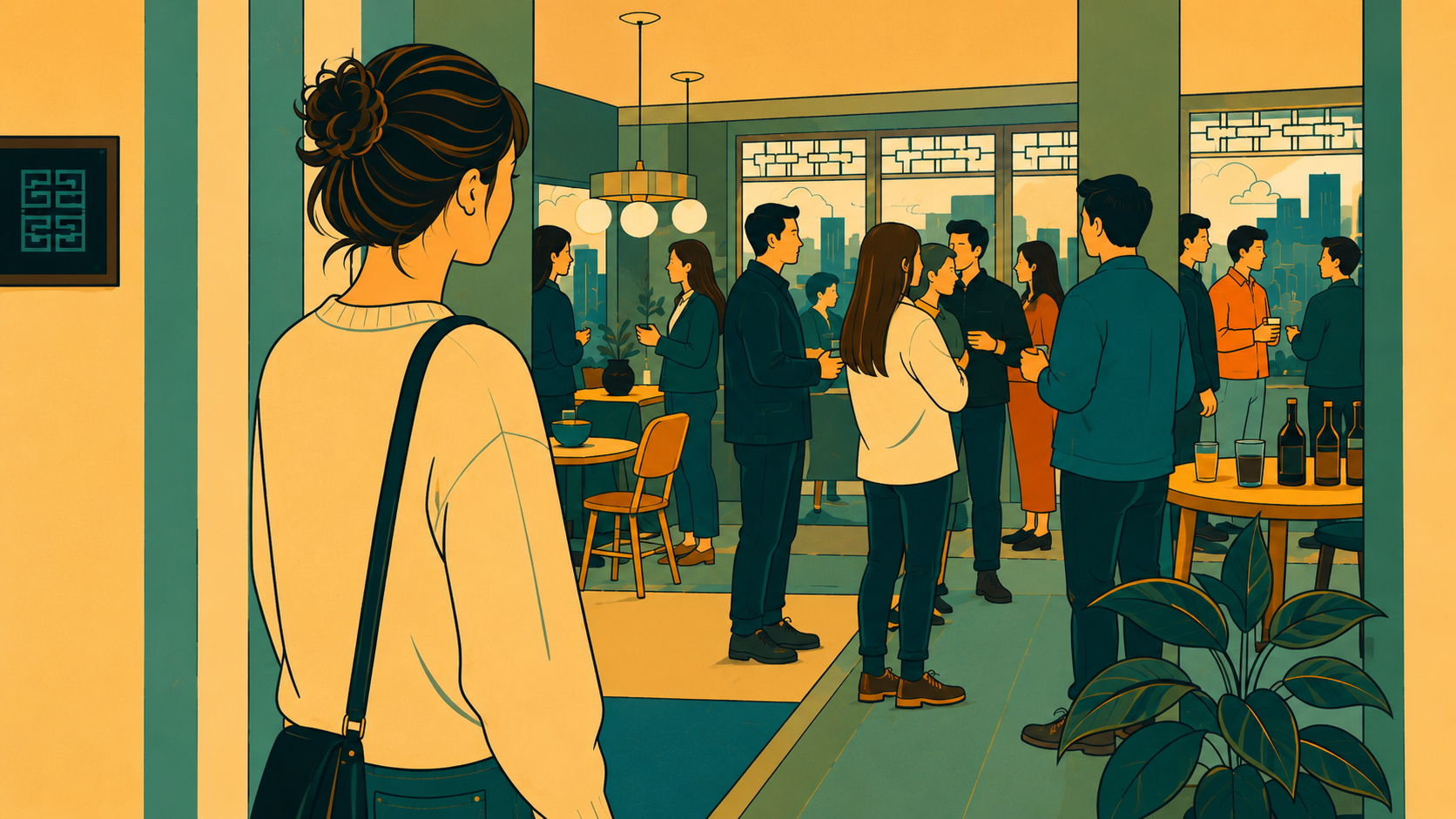
Watch her enter a room. She doesn’t stride in. She comes in carefully, quietly, reading the room before she fully arrives. Her eyes scan for the mood, the temperature, whether her arrival is a disruption or an addition. Only once she has assessed can she relax slightly, and even then it is partial.
This is what staying small looks like in adulthood. It is not that she is afraid of people or introverted or naturally reserved. It is that her nervous system has never learned that she has the right to simply arrive, to take up space, to exist without first asking permission. She sits down and makes herself compact—not because the chair is small but because she has learned to take up minimal space. She speaks, and her voice comes out quieter than it is. When she disagrees, she phrases it as a question. When she has a strong opinion, she softens it with hedging language. When she laughs, some part of her is listening to see if the laugh is too much, if the joy is too loud.
The person she is talking to often doesn’t notice any of this. They may simply perceive her as quiet, thoughtful, a good listener. They don’t see the effort it takes, the constant calculation, the perpetual shrinking. They don’t realize this apparent peacefulness is not peace at all, but a specific kind of vigilance.
The tragedy is that she has become so good at staying small that it is now invisible—even to herself. She no longer experiences it as a survival mechanism. She experiences it as personality. When someone tells her to speak up, to be more assertive, to take up more space, she feels it as criticism of who she is rather than recognition of what she has been forced to become.
Entering rooms quietly is what staying small looks like now. It is the way she moves through the world, always asking for permission, always checking whether her presence is welcome, always ready to make herself smaller if the room needs her to. The child who learned to be invisible in order to be safe has grown into an adult who still knows how to disappear, even in rooms full of people who love her.
This post was planned and edited by a human, with AI assistance.