

By 10 a.m., the morning rush is over.
The commuters are gone. The café has exhaled. The baristas have wiped down the counter and refilled the syrups and settled into the quieter rhythm of the mid-morning shift. And then, one by one, the students arrive.
Backpack first, then laptop, then the careful arrangement of everything else — highlighters sorted by color, a pencil case unzipped and placed within reach, a water bottle positioned exactly where it won’t get knocked over. The table that was empty twenty minutes ago now looks like a desk. Not metaphorically. Functionally. Studying in Korean cafés doesn’t look like killing time between classes. It looks like someone came here to work, set up a workspace, and intends to stay until the work is done.
This is what Korean cafés as study spaces actually produce — not just a place to sit with a book, but a specific condition for concentration that many students say they can’t replicate anywhere else.
Who Fills the Seats at 10 a.m.
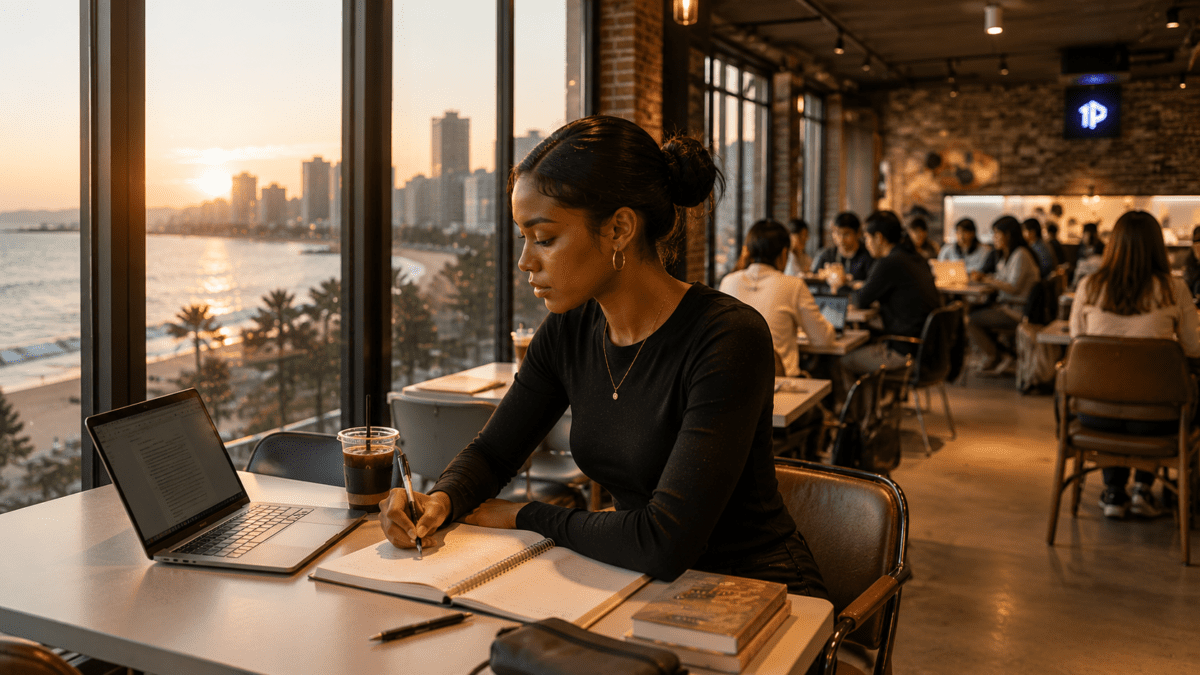
The 10 a.m. café is its own demographic.
University students, mostly, but not only. A woman in her late twenties with a government exam prep book, its spine cracked from repeated opening at the same chapter. A man in his thirties working through an online certification course, pausing the video every few minutes to write something down. Two high school students who have taken the day off — or perhaps haven’t — spreading practice tests across a four-person table with the confidence of people who have been doing this long enough to know exactly how much space they need.
What they share is not age or subject matter. It’s the specific intention that studying in Korean cafés requires: you came here to focus, you paid for the right to be here, and the unspoken agreement with everyone around you is that nobody is going to disturb that. The café understands this. The staff understands this. Even the other customers understand this, lowering their voices slightly when they sit near someone with a textbook open, the way you instinctively quiet yourself in a library even when no one has asked you to.
Walk past any of Seoul’s university neighborhoods — Sinchon, Hyehwa, Hongdae — on a weekday morning and the café windows tell the same story. Heads down. Screens open. Pens moving. The city outside continues at full speed, and inside, someone is trying to learn something. Some of them have been here since the café opened. Some will still be here when the lunch crowd arrives and leaves and the afternoon settles back into quiet. The seat doesn’t change. The work continues.
Hours Without Anyone Interrupting

The single most valuable thing a Korean café offers a student is not the coffee.
It’s the uninterrupted hours.
At home, there is always something else that could be done — the laundry, the dishes, the family member in the next room who needs something. The library is quiet but rigid, its silence carrying a social weight that some find oppressive rather than helpful. The school cafeteria is too loud, too social, too full of people who want to talk. The café sits in a different category: ambient enough to feel alive, structured enough to feel like a workspace, and — crucially — staffed by people who are not going to interrupt you.
Nobody comes to check if you need anything. Nobody asks how the studying is going. The drink was delivered when it arrived, and now you are simply here, in possession of your table, with as many hours as you need.
This is not accidental. Studying in Korean cafés became embedded in student culture precisely because the café offers what other environments don’t: the freedom to disappear into work without social obligation, in a space that is public enough to feel purposeful but private enough to feel undisturbed. The table has a power outlet. The wifi password is on the receipt. The playlist is calibrated to be present but ignorable. Everything about the environment has been optimized, consciously or not, for exactly this use.
A student who arrived at 10 a.m. looks up at 1 p.m. and is mildly surprised. Three hours passed. The coffee is long finished. The table is still theirs.
Why Ambient Noise Helps Concentration
The quiet of a library is not always an advantage.
Silence, it turns out, can be its own distraction — every small sound amplified, every thought louder than it needs to be, the absence of background noise creating a kind of acoustic pressure that some minds find harder to work inside than others. A moderate level of ambient noise — the kind produced naturally in a café — is often cited as helpful for creative thinking and focus on certain types of tasks.
One study found that students generated more ideas in the café than in the library — and that the effect was strongest in those with higher cognitive flexibility. This holds especially for tasks requiring sustained attention rather than precise memorization.
Korean students discovered this empirically, long before anyone named it. Studying in Korean cafés produces a specific sound environment: the hiss of the espresso machine, the low murmur of conversation, the occasional scrape of a chair, music at a volume that registers but doesn’t demand attention. It’s a texture of noise rather than noise itself — something to push against rather than something to fight through.
The effect is not universal. Some subjects require silence. Some students need absolute quiet. But for the kind of slow, sustained reading and writing that makes up most of undergraduate work — working through a dense text, drafting an essay, reviewing material for an exam that is still two weeks away — the ambient environment of a café provides just enough stimulation to keep the mind from turning in on itself.
There is also something about the presence of other people working that functions as a kind of social regulation. You are less likely to pick up your phone when the person across from you hasn’t looked up in forty minutes. Productivity becomes slightly contagious. Not through competition or comparison, but through a low-level ambient signal that says: this is a place where people focus.
The Café as a Semi-Public Workspace
There is a category of space that most cities don’t quite have a name for.
Not a library — too formal, too rule-bound, too quiet in a way that excludes certain kinds of work. Not a coworking space — too structured, too expensive, requiring registration and commitment. Not a park or a plaza — too exposed, too noisy, lacking the basic infrastructure of a table and an outlet and a roof. Korean cafés occupy the space between all of these: semi-public, semi-private, accessible to anyone who orders something, governed by informal norms rather than explicit rules.
Studying in Korean cafés works because the café has silently agreed to function as a workspace without ever calling itself one. The furniture is arranged for individual occupation. The lighting is calibrated for screens. The music doesn’t change key at the wrong moment. The staff manages the space without managing the people in it. All of this is a design decision, even when it doesn’t look like one.
What has emerged is a distributed network of workspaces embedded in the city’s commercial infrastructure — available at almost any hour, in almost any neighborhood, at the cost of a single drink. For students who don’t have a desk at home, or whose home is too small or too loud or too full of other people, this is not a convenience. It is a structural solution to a structural problem.
The table that becomes a desk is not a metaphor. It is a precise description of what happens when a person arrives at a café with a backpack and a plan and stays long enough to get something done. There’s a logic to finding the conditions that work and returning to them — the stem that always finds a way isn’t only a metaphor. It’s a description of how Korean students have been navigating their study lives for decades. The café provides the conditions. The student provides the rest.
Outside, Seoul moves at the speed Seoul moves at. Inside, someone is still on page forty-seven, highlighter in hand, not going anywhere yet.
Content in this post was created with AI assistance.